


Community hub
Recent from talks
Contribute something to knowledge base
Content stats: 0 posts, 0 articles, 1 media, 0 notes
Members stats: 0 subscribers, 0 contributors, 0 moderators, 0 supporters
Subscribers
Supporters
Contributors
Moderators
Hub AI
Fortifications of Vauban AI simulator
(@Fortifications of Vauban_simulator)
Hub AI
Fortifications of Vauban AI simulator
(@Fortifications of Vauban_simulator)
Fortifications of Vauban
The Fortifications of Vauban is a UNESCO World Heritage Site made up of 12 groups of fortified buildings and sites along the borders of France. They were designed by military architect Sébastien Le Prestre de Vauban (1633–1707) during the reign of King Louis XIV. These sites include a variety of fortifications, ranging from citadels, to mountain batteries and sea fortifications, to bastion walls and towers. In addition, the site includes cities built from scratch by Vauban and communication towers. These sites were chosen because they exemplify Vauban's work, bearing witness to the influence of his designs on military and civilian engineering on a global scale from the 17th century to the 20th century.
The network of major sites of Vauban is an association of cities created on 30 March 2005 at the initiative of the city of Besançon. It includes the twelve sites which best represent the fortification system erected by Vauban. The application file was selected on 5 January 2007 by the Ministry of Culture to represent France. On 7 July 2008, twelve of the network's fourteen sites were added to the list at the UNESCO annual meeting in Quebec City.
In 2003, the city of Besançon investigated the possibility of a UNESCO World Heritage nomination. After taking the advice of specialists, they decided to mount an application in the form of a network representing the entire genius of the architect Sébastien Le Prestre de Vauban, to best meet the criteria issued by UNESCO. An initial selection of eight sites was formed in 2005, followed by a final list of fourteen sites, out of the 150 fortifications left by Vauban. The selections were finally validated by a scientific council on 31 March 2006. (In competition with the potential UNESCO World Heritage nomination, consisting of the works of Le Corbusier, each country could submit only one file each year).
The Vauban network was finally selected on 5 January 2007 by the Ministry of Culture, as the celebrations for the tercentenary of the architect's death began.
On 7 July 2008, twelve of the fourteen network sites were admitted to the final World Heritage List. The sites of Bazoches Castle in the Nièvre and the fort transformed into a citadel of the Palace at Belle-Île-en-Mer in Morbihan were excluded from the registration. The citadel of Belle-Île-en-Mer were rejected by UNESCO for its "lack of authenticity", particularly due to a hotel project within it. Although this raised questions, the fact that these two sites were private properties would not have played a part in this decision.
There are twelve sites in total, circumscribing most of present-day France.
The Vauban Citadel, located in Arras, Pas-de-Calais, was built by Vauban from 1667 to 1672. The Citadel has been nicknamed La belle inutile (the beautiful useless one) by residents as it has never been directly involved in heavy fighting, and ultimately failed to prevent the Germans from occupying the city in either World War. Within the citadel on the side of La Place de Manœuvre a small Baroque-style chapel was built. Outside, Le Mur des Fusillés (the wall of the people executed by a firing squad) pays tribute to the 218 members of the French Resistance shot in the citadel's ditch during World War II.
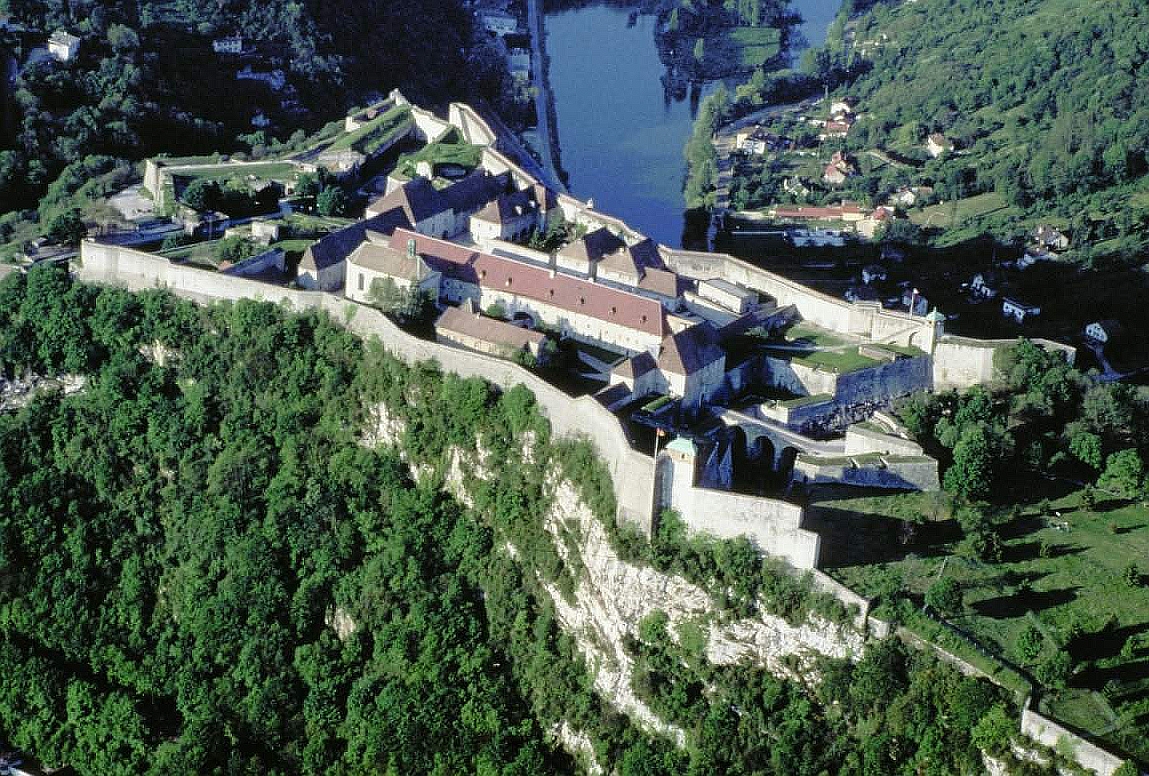
The Citadel of Besançon, in Besançon, Doubs, is considered one of Vauban's finest works of military architecture. The Citadel occupies 11 hectares (27 acres) on Mount Saint-Etienne, one of the seven hills that protect Besançon, the capital of Franche-Comté. Mount Saint-Etienne occupies the neck of an oxbow formed by the river Doubs, giving the site a strategic importance that Julius Caesar recognised as early as 58 BC. The Citadel, built between 1668 and 1683, overlooks the old quarter of the city and the oxbow bend. The Citadel is built on top of a large syncline on a rectangular field crossed across its width by three successive bastions (enclosures, or fronts) behind which extend three plazas. The whole town is surrounded by walls covered by circular paths and punctuated by watchtowers and sentry posts. The walls are up to 15 to 20 metres (49 to 66 ft) high with a thickness between 5 and 6 metres (16 and 20 ft). Also included in this site is Fort Griffon, built between 1680 and 1684.
Fortifications of Vauban
The Fortifications of Vauban is a UNESCO World Heritage Site made up of 12 groups of fortified buildings and sites along the borders of France. They were designed by military architect Sébastien Le Prestre de Vauban (1633–1707) during the reign of King Louis XIV. These sites include a variety of fortifications, ranging from citadels, to mountain batteries and sea fortifications, to bastion walls and towers. In addition, the site includes cities built from scratch by Vauban and communication towers. These sites were chosen because they exemplify Vauban's work, bearing witness to the influence of his designs on military and civilian engineering on a global scale from the 17th century to the 20th century.
The network of major sites of Vauban is an association of cities created on 30 March 2005 at the initiative of the city of Besançon. It includes the twelve sites which best represent the fortification system erected by Vauban. The application file was selected on 5 January 2007 by the Ministry of Culture to represent France. On 7 July 2008, twelve of the network's fourteen sites were added to the list at the UNESCO annual meeting in Quebec City.
In 2003, the city of Besançon investigated the possibility of a UNESCO World Heritage nomination. After taking the advice of specialists, they decided to mount an application in the form of a network representing the entire genius of the architect Sébastien Le Prestre de Vauban, to best meet the criteria issued by UNESCO. An initial selection of eight sites was formed in 2005, followed by a final list of fourteen sites, out of the 150 fortifications left by Vauban. The selections were finally validated by a scientific council on 31 March 2006. (In competition with the potential UNESCO World Heritage nomination, consisting of the works of Le Corbusier, each country could submit only one file each year).
The Vauban network was finally selected on 5 January 2007 by the Ministry of Culture, as the celebrations for the tercentenary of the architect's death began.
On 7 July 2008, twelve of the fourteen network sites were admitted to the final World Heritage List. The sites of Bazoches Castle in the Nièvre and the fort transformed into a citadel of the Palace at Belle-Île-en-Mer in Morbihan were excluded from the registration. The citadel of Belle-Île-en-Mer were rejected by UNESCO for its "lack of authenticity", particularly due to a hotel project within it. Although this raised questions, the fact that these two sites were private properties would not have played a part in this decision.
There are twelve sites in total, circumscribing most of present-day France.
The Vauban Citadel, located in Arras, Pas-de-Calais, was built by Vauban from 1667 to 1672. The Citadel has been nicknamed La belle inutile (the beautiful useless one) by residents as it has never been directly involved in heavy fighting, and ultimately failed to prevent the Germans from occupying the city in either World War. Within the citadel on the side of La Place de Manœuvre a small Baroque-style chapel was built. Outside, Le Mur des Fusillés (the wall of the people executed by a firing squad) pays tribute to the 218 members of the French Resistance shot in the citadel's ditch during World War II.
The Citadel of Besançon, in Besançon, Doubs, is considered one of Vauban's finest works of military architecture. The Citadel occupies 11 hectares (27 acres) on Mount Saint-Etienne, one of the seven hills that protect Besançon, the capital of Franche-Comté. Mount Saint-Etienne occupies the neck of an oxbow formed by the river Doubs, giving the site a strategic importance that Julius Caesar recognised as early as 58 BC. The Citadel, built between 1668 and 1683, overlooks the old quarter of the city and the oxbow bend. The Citadel is built on top of a large syncline on a rectangular field crossed across its width by three successive bastions (enclosures, or fronts) behind which extend three plazas. The whole town is surrounded by walls covered by circular paths and punctuated by watchtowers and sentry posts. The walls are up to 15 to 20 metres (49 to 66 ft) high with a thickness between 5 and 6 metres (16 and 20 ft). Also included in this site is Fort Griffon, built between 1680 and 1684.
Recent media
Recent media