
Recent from talks
Fortified Sector of the Crusnes
Knowledge base stats:
Talk channels stats:
Members stats:
Fortified Sector of the Crusnes
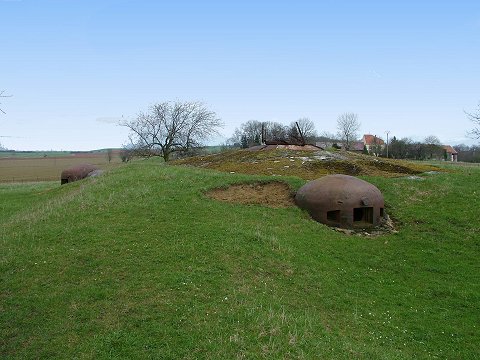
The Fortified Sector of the Crusnes (Secteur Fortifiée de la Crusnes) was the French military organization that in 1940 controlled the section of the Maginot Line extending eastwards approximately 28 kilometres (17 mi) from Longuyon. The sector roughly follows the valley of the Crusnes river. Crucially, the trace of the Maginot Line in the Crusnes sector is about 7 kilometres (4.3 mi) behind the industrial city of Longwy which sits directly against the French borders with Belgium and Luxembourg. The Crusnes sector was one of the strongest Maginot Line sectors. It was attacked in 1940 by German forces in the Battle of France. Despite the withdrawal of the mobile forces that supported the fixed fortifications, the sector successfully fended off German assaults before the Second Armistice at Compiègne. The positions and their garrisons finally surrendered on 27 June 1940. Following the war many positions were reactivated for use during the Cold War. Three locations are now preserved and open to the public, with a fourth position under restoration.
The sector was originally planned to protect Longwy, with a pronounced bow to the north comprising seven ouvrages replacing all but Bréhain. In order from west to east, these were to be the Ouvrage du Bois de Piepe, Ouvrage de Villers-la-Chévre, Ouvrage de Soxey, Ouvrage de la Rédoute, Ouvrage de Longwy, Ouvrage de Ratentout and the Ouvrage de Verbusch. This line was proposed on 24 June 1930, but was replaced by the more southerly line on 2 August 1930. The main line of fortifications would have been within one or two kilometres of the frontier, much farther forward than any other place on the Line, and in contradiction to the Maginot Line's concept of defense in depth. Construction began in most places in 1930, and was largely complete by 1935. Several locations had additional phases planned. Petit ouvrages Aumetz, Bois-du-Four and Mauvais-Bois were all planned to be expanded into gros ouvrages after completion of the initial plan. Other planned but unconstructed ouvrages included the Ouvrage de Bouillon and the Ouvrage de la Cote 143 (Hill 143), casualties of realignment. The Ouvrage de Rafour was planned to anchor the west end of the line behind Longuyon, but was canceled and replaced by a series of blockhouses as a cost-saving measure.
The Crusnes sector was part of the larger Fortified Region of Metz, a strongly defended area between the Ardennes to the west and the Sarre valley to the east. The Metz region was more important during the planning and construction phase of the Maginot Line than it was in the operational phase of the Line, when the sectors assumed prominence. The Fortified Region of Metz was dissolved as a military organization on 18 March 1940. The SF (Secteur Fortifiée) Crusnes was itself dissolved in 1940, becoming the 42nd Fortress Corps (42e Corps d'Armee de Forteresse (CAF)).
The Crusnes sector was under the overall command of the French 3rd Army, headquartered at Fort Jeanne d'Arc at Metz, under the command of General Charles Condé, which was in turn part of Army Group 2 under General André-Gaston Prételat. The 42nd CAF was commanded by General de division Désiré Sivot from August 21, 1939, then General Gaston Renondeau from 27 May 1940. As the SF Crusnes, it was commanded by Colonel Miserey from 15 September 1939. The command post was at Briey. The interval troops, the army formations that were to provide the mobile defense for the sector, to support and be supported by the fixed defenses, were under the command of the 24th Corps (24e Corps d'Armee), General Fougère, commander. The 24th Corps was in turn made up of the 20th, 51st and 58th Infantry Divisions. Artillery support for the sector was provided by the 152nd Position Artillery Regiment (Régiment d'Artillerie de Position (RAP)), which controlled both fixed and mobile artillery, commanded by Lt. Colonel Jacob. The 20th Infantry Division was made up of Class A reservists, while the 51st and 58th IDs were Class B reserve formations, not considered suitable for significant combat.
The sector includes, in order from west to east, the following major fortified positions, together with the most significant casemates and infantry shelters in each sub-sector:
149th Fortress Infantry Regiment (149e Régiment d'Infanterie de Forteresse (RIF)), Lt. Colonel Beaupuis, command post at Calvaire d'Arrancy
Peacetime barracks and support, in addition to a caserne at Longwy:
139th Fortress Infantry Regiment (139e Régiment d'Infanterie de Forteresse (RIF)), Colonel Ritter, command post at Ville-au-Montois
Hub AI
Fortified Sector of the Crusnes AI simulator
(@Fortified Sector of the Crusnes_simulator)
Fortified Sector of the Crusnes
The Fortified Sector of the Crusnes (Secteur Fortifiée de la Crusnes) was the French military organization that in 1940 controlled the section of the Maginot Line extending eastwards approximately 28 kilometres (17 mi) from Longuyon. The sector roughly follows the valley of the Crusnes river. Crucially, the trace of the Maginot Line in the Crusnes sector is about 7 kilometres (4.3 mi) behind the industrial city of Longwy which sits directly against the French borders with Belgium and Luxembourg. The Crusnes sector was one of the strongest Maginot Line sectors. It was attacked in 1940 by German forces in the Battle of France. Despite the withdrawal of the mobile forces that supported the fixed fortifications, the sector successfully fended off German assaults before the Second Armistice at Compiègne. The positions and their garrisons finally surrendered on 27 June 1940. Following the war many positions were reactivated for use during the Cold War. Three locations are now preserved and open to the public, with a fourth position under restoration.
The sector was originally planned to protect Longwy, with a pronounced bow to the north comprising seven ouvrages replacing all but Bréhain. In order from west to east, these were to be the Ouvrage du Bois de Piepe, Ouvrage de Villers-la-Chévre, Ouvrage de Soxey, Ouvrage de la Rédoute, Ouvrage de Longwy, Ouvrage de Ratentout and the Ouvrage de Verbusch. This line was proposed on 24 June 1930, but was replaced by the more southerly line on 2 August 1930. The main line of fortifications would have been within one or two kilometres of the frontier, much farther forward than any other place on the Line, and in contradiction to the Maginot Line's concept of defense in depth. Construction began in most places in 1930, and was largely complete by 1935. Several locations had additional phases planned. Petit ouvrages Aumetz, Bois-du-Four and Mauvais-Bois were all planned to be expanded into gros ouvrages after completion of the initial plan. Other planned but unconstructed ouvrages included the Ouvrage de Bouillon and the Ouvrage de la Cote 143 (Hill 143), casualties of realignment. The Ouvrage de Rafour was planned to anchor the west end of the line behind Longuyon, but was canceled and replaced by a series of blockhouses as a cost-saving measure.
The Crusnes sector was part of the larger Fortified Region of Metz, a strongly defended area between the Ardennes to the west and the Sarre valley to the east. The Metz region was more important during the planning and construction phase of the Maginot Line than it was in the operational phase of the Line, when the sectors assumed prominence. The Fortified Region of Metz was dissolved as a military organization on 18 March 1940. The SF (Secteur Fortifiée) Crusnes was itself dissolved in 1940, becoming the 42nd Fortress Corps (42e Corps d'Armee de Forteresse (CAF)).
The Crusnes sector was under the overall command of the French 3rd Army, headquartered at Fort Jeanne d'Arc at Metz, under the command of General Charles Condé, which was in turn part of Army Group 2 under General André-Gaston Prételat. The 42nd CAF was commanded by General de division Désiré Sivot from August 21, 1939, then General Gaston Renondeau from 27 May 1940. As the SF Crusnes, it was commanded by Colonel Miserey from 15 September 1939. The command post was at Briey. The interval troops, the army formations that were to provide the mobile defense for the sector, to support and be supported by the fixed defenses, were under the command of the 24th Corps (24e Corps d'Armee), General Fougère, commander. The 24th Corps was in turn made up of the 20th, 51st and 58th Infantry Divisions. Artillery support for the sector was provided by the 152nd Position Artillery Regiment (Régiment d'Artillerie de Position (RAP)), which controlled both fixed and mobile artillery, commanded by Lt. Colonel Jacob. The 20th Infantry Division was made up of Class A reservists, while the 51st and 58th IDs were Class B reserve formations, not considered suitable for significant combat.
The sector includes, in order from west to east, the following major fortified positions, together with the most significant casemates and infantry shelters in each sub-sector:
149th Fortress Infantry Regiment (149e Régiment d'Infanterie de Forteresse (RIF)), Lt. Colonel Beaupuis, command post at Calvaire d'Arrancy
Peacetime barracks and support, in addition to a caserne at Longwy:
139th Fortress Infantry Regiment (139e Régiment d'Infanterie de Forteresse (RIF)), Colonel Ritter, command post at Ville-au-Montois
Recent media