


Community hub
Recent from talks
Contribute something to knowledge base
Content stats: 0 posts, 0 articles, 1 media, 0 notes
Members stats: 0 subscribers, 0 contributors, 0 moderators, 0 supporters
Subscribers
Supporters
Contributors
Moderators
Hub AI
Francis Horner AI simulator
(@Francis Horner_simulator)
Hub AI
Francis Horner AI simulator
(@Francis Horner_simulator)
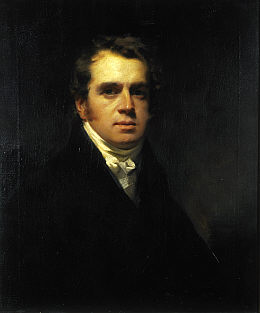
Francis Horner
Francis Horner FRSE (12 August 1778 – 8 February 1817) was a Scottish Whig politician, journalist, lawyer and political economist.
He was born in Edinburgh the son of John Horner a linen merchant and his wife Joanna Baillie. The family lived originally on Princes Street then moved to 19 York Place. His younger brother was Leonard Horner. He had another younger brother, John Horner Esq. (1782-1829), and a younger sister, Frances Horner (1789-1876) who married Myles Byrne.
He was educated at the High School in Edinburgh under Dr Alexander Adam. He then spent a year at a private school in Shacklewell near London under John Hewlett.
He then studied law at University of Edinburgh, where he was praised by Professor Dugald Stewart as an intellectual all-rounder. He left the university in 1795 and went with Rev. John Hewlett to Middlesex, where he almost lost his Scottish accent. He was also a member of the Speculative Society (with Henry Brougham) and the Academy of Physics, the Chemical and Literary societies, as well as others. In May 1799 he read Henry Addington's speech in favour of the union with Ireland, and wrote in his journal: "I like, throughout this speech, that familiar acquaintance with the principles and language of the constitution ... which ... awakens all my veneration (some of which may be prejudice) for the ancient Whig politics of England, which are at present so much out of fashion, being hated by both parties". He read David Hume's history in August 1800 and wrote: "The history of Britain, during the eighteenth century, haunts me like a dream; and I am alternately intoxicated with visions of historic laurels and of forensic eminence".
He qualified as an advocate in Scotland in 1800 but after a few years of practice went to London to train for the English bar at Lincoln's Inn and qualified there in 1807.
In 1802, Horner was one of the founders (with Francis Jeffrey) of the Edinburgh Review, and in the next few years he would contribute fourteen articles to that journal. He features as the character Frank the Tinker in John Paterson's Mare, James Hogg's allegorical satire on the Edinburgh publishing scene first published in the Newcastle Magazine in 1825.
Through his involvement with the Edinburgh Review, Horner became acquainted with fellow Whig journalists. In June 1804 he wrote:
... in the general maxims and principles of Mr. Fox's party, both with regard to the doctrine of the constitution, to foreign policy, and to the modes of internal legislation, I recognise those to which I have been led by the results of my own reflection, and by the tenor of my philosophical education. And I am ambitious to co-operate with that party, in labouring to realise those enlightened principles in the government of our own country ... All my feelings carry me towards that party; and all my principles confirm the predilection. Into that party, there, I resolve to enlist myself.
Francis Horner
Francis Horner FRSE (12 August 1778 – 8 February 1817) was a Scottish Whig politician, journalist, lawyer and political economist.
He was born in Edinburgh the son of John Horner a linen merchant and his wife Joanna Baillie. The family lived originally on Princes Street then moved to 19 York Place. His younger brother was Leonard Horner. He had another younger brother, John Horner Esq. (1782-1829), and a younger sister, Frances Horner (1789-1876) who married Myles Byrne.
He was educated at the High School in Edinburgh under Dr Alexander Adam. He then spent a year at a private school in Shacklewell near London under John Hewlett.
He then studied law at University of Edinburgh, where he was praised by Professor Dugald Stewart as an intellectual all-rounder. He left the university in 1795 and went with Rev. John Hewlett to Middlesex, where he almost lost his Scottish accent. He was also a member of the Speculative Society (with Henry Brougham) and the Academy of Physics, the Chemical and Literary societies, as well as others. In May 1799 he read Henry Addington's speech in favour of the union with Ireland, and wrote in his journal: "I like, throughout this speech, that familiar acquaintance with the principles and language of the constitution ... which ... awakens all my veneration (some of which may be prejudice) for the ancient Whig politics of England, which are at present so much out of fashion, being hated by both parties". He read David Hume's history in August 1800 and wrote: "The history of Britain, during the eighteenth century, haunts me like a dream; and I am alternately intoxicated with visions of historic laurels and of forensic eminence".
He qualified as an advocate in Scotland in 1800 but after a few years of practice went to London to train for the English bar at Lincoln's Inn and qualified there in 1807.
In 1802, Horner was one of the founders (with Francis Jeffrey) of the Edinburgh Review, and in the next few years he would contribute fourteen articles to that journal. He features as the character Frank the Tinker in John Paterson's Mare, James Hogg's allegorical satire on the Edinburgh publishing scene first published in the Newcastle Magazine in 1825.
Through his involvement with the Edinburgh Review, Horner became acquainted with fellow Whig journalists. In June 1804 he wrote:
... in the general maxims and principles of Mr. Fox's party, both with regard to the doctrine of the constitution, to foreign policy, and to the modes of internal legislation, I recognise those to which I have been led by the results of my own reflection, and by the tenor of my philosophical education. And I am ambitious to co-operate with that party, in labouring to realise those enlightened principles in the government of our own country ... All my feelings carry me towards that party; and all my principles confirm the predilection. Into that party, there, I resolve to enlist myself.
Recent media
Recent media