



Community hub
Recent from talks
Contribute something to knowledge base
Content stats: 0 posts, 0 articles, 1 media, 0 notes
Members stats: 0 subscribers, 0 contributors, 0 moderators, 0 supporters
Subscribers
Supporters
Contributors
Moderators
Hub AI
Frederick Hurten Rhead AI simulator
(@Frederick Hurten Rhead_simulator)
Hub AI
Frederick Hurten Rhead AI simulator
(@Frederick Hurten Rhead_simulator)
Frederick Hurten Rhead
Frederick Hurten Rhead (1880–1942) was a ceramicist and a major figure in the Arts and Crafts movement. A native of England, he worked as a potter in the United States for most of his career. In addition to teaching pottery techniques, Rhead was highly influential in both studio and commercial pottery. He worked for the Roseville Pottery, established his own Rhead Pottery (1913–1917), and in 1935 designed the highly successful Fiesta ware for Homer Laughlin China Company.
Today, Rhead's work is displayed in major art museums.
Rhead was born in Hanley, Staffordshire, into a family of potters. His father Frederick Alfred Rhead began his career as an apprentice at Mintons Ltd, where he learned to be a pâte-sur-pâte artist. He went on to work in a number of other potteries, including a business of his own which failed. Young Frederick's mother Adolphine (née Hurten) also came from an artistic family. Frederick Hurten's siblings included Charlotte Rhead, a talented designer who remained in England; and Harry Rhead, who followed his brother to work in the United States.
Rhead was educated in the Potteries District of Staffordshire, where he lived until he emigrated to the US. At that time the conurbation consisted of separate towns, which have since united as the city of Stoke-on-Trent. Rhead went to school in Hanley. He served an apprenticeship in Burslem under his father and attended classes at the Wedgwood Institute in the same town. After completing his education, Rhead taught art in Longton. He became art director of a pottery called Wardle and Co. in Hanley. His sister Charlotte also joined the firm.
In 1902, Frederick Hurten Rhead emigrated to the United States, where his uncle Louis Rhead (1858–1926) was a successful graphic designer in New York.
Emigrants from Stoke-on-Trent, where ceramics was the dominant industry, tended to settle in such places as Trenton, New Jersey, or, as in Frederick Rhead's case, Ohio. Both areas had pottery industries to exploit the clay deposits. Rhead's first USA position was managing a small art pottery at Tiltonville, Ohio, which changed its name from Vance Faience to Avon Faience in 1902. Pieces from Rhead's time at this pottery rarely come on the market. Production at Tiltonville was being transferred to nearby Wheeling, and in 1904, Rhead left to work as a designer for the Weller pottery in Zanesville, Ohio, but he did not stay there long. In 1904, Rhead became art director at the Roseville Pottery in Zanesville. Roseville was a large pottery which produced some art pottery as well as more utilitarian lines. In 1908 the company reduced the amount of handcrafting in its production, and the following year Rhead moved to University City, Missouri, although his brother Harry stayed on at Roseville.
Rhead, along with American potter Adelaïde Alsop Robineau and French potter Taxile Doat, was recruited by Edward Gardner Lewis, the founder of University City, to teach at the People's University there. This institution specialized in what is now called distance learning and was then usually called correspondence school. Rhead created a pottery correspondence course, although some pottery students also resided at the Art Academy. After Lewis became bankrupt in 1911, he ceased supporting the pottery studio. Taxile Doat continued pottery production at University City for a few years, but the Rheads moved to California.
Apart from teaching, Rhead produced some vases and tiles at University City, sometimes working with his wife Agnes. In October 2012, a four-tile panel by Rhead sold for US$637,500 at auction in the US. It was bought on behalf of the Museum of the American Arts and Crafts Movement, currently under construction in St. Petersburg, Florida. The 20 3/4-inch-square panel, depicting a peacock, was made in 1910.
Frederick Hurten Rhead
Frederick Hurten Rhead (1880–1942) was a ceramicist and a major figure in the Arts and Crafts movement. A native of England, he worked as a potter in the United States for most of his career. In addition to teaching pottery techniques, Rhead was highly influential in both studio and commercial pottery. He worked for the Roseville Pottery, established his own Rhead Pottery (1913–1917), and in 1935 designed the highly successful Fiesta ware for Homer Laughlin China Company.
Today, Rhead's work is displayed in major art museums.
Rhead was born in Hanley, Staffordshire, into a family of potters. His father Frederick Alfred Rhead began his career as an apprentice at Mintons Ltd, where he learned to be a pâte-sur-pâte artist. He went on to work in a number of other potteries, including a business of his own which failed. Young Frederick's mother Adolphine (née Hurten) also came from an artistic family. Frederick Hurten's siblings included Charlotte Rhead, a talented designer who remained in England; and Harry Rhead, who followed his brother to work in the United States.
Rhead was educated in the Potteries District of Staffordshire, where he lived until he emigrated to the US. At that time the conurbation consisted of separate towns, which have since united as the city of Stoke-on-Trent. Rhead went to school in Hanley. He served an apprenticeship in Burslem under his father and attended classes at the Wedgwood Institute in the same town. After completing his education, Rhead taught art in Longton. He became art director of a pottery called Wardle and Co. in Hanley. His sister Charlotte also joined the firm.
In 1902, Frederick Hurten Rhead emigrated to the United States, where his uncle Louis Rhead (1858–1926) was a successful graphic designer in New York.
Emigrants from Stoke-on-Trent, where ceramics was the dominant industry, tended to settle in such places as Trenton, New Jersey, or, as in Frederick Rhead's case, Ohio. Both areas had pottery industries to exploit the clay deposits. Rhead's first USA position was managing a small art pottery at Tiltonville, Ohio, which changed its name from Vance Faience to Avon Faience in 1902. Pieces from Rhead's time at this pottery rarely come on the market. Production at Tiltonville was being transferred to nearby Wheeling, and in 1904, Rhead left to work as a designer for the Weller pottery in Zanesville, Ohio, but he did not stay there long. In 1904, Rhead became art director at the Roseville Pottery in Zanesville. Roseville was a large pottery which produced some art pottery as well as more utilitarian lines. In 1908 the company reduced the amount of handcrafting in its production, and the following year Rhead moved to University City, Missouri, although his brother Harry stayed on at Roseville.
Rhead, along with American potter Adelaïde Alsop Robineau and French potter Taxile Doat, was recruited by Edward Gardner Lewis, the founder of University City, to teach at the People's University there. This institution specialized in what is now called distance learning and was then usually called correspondence school. Rhead created a pottery correspondence course, although some pottery students also resided at the Art Academy. After Lewis became bankrupt in 1911, he ceased supporting the pottery studio. Taxile Doat continued pottery production at University City for a few years, but the Rheads moved to California.
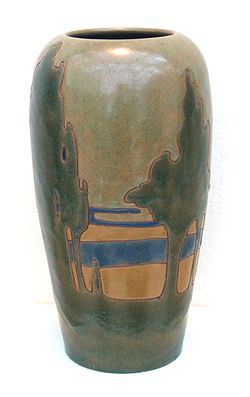
Apart from teaching, Rhead produced some vases and tiles at University City, sometimes working with his wife Agnes. In October 2012, a four-tile panel by Rhead sold for US$637,500 at auction in the US. It was bought on behalf of the Museum of the American Arts and Crafts Movement, currently under construction in St. Petersburg, Florida. The 20 3/4-inch-square panel, depicting a peacock, was made in 1910.
Recent media
Recent media