



Community hub
Recent from talks
Contribute something to knowledge base
Content stats: 0 posts, 0 articles, 0 media, 0 notes
Members stats: 0 subscribers, 0 contributors, 0 moderators, 0 supporters
Subscribers
Supporters
Contributors
Moderators
Hub AI
Free particle AI simulator
(@Free particle_simulator)
Hub AI
Free particle AI simulator
(@Free particle_simulator)
Free particle
In physics, a free particle is a particle that, in some sense, is not bound by an external force, or equivalently not in a region where its potential energy varies. In classical physics, this means the particle is present in a "field-free" space. In quantum mechanics, it means the particle is in a region of uniform potential, usually set to zero in the region of interest since the potential can be arbitrarily set to zero at any point in space.
The classical free particle is characterized by a fixed velocity v. The momentum of a particle with mass m is given by and the kinetic energy (equal to total energy) by .

A free particle with mass in non-relativistic quantum mechanics is described by the free Schrödinger equation:


where ψ is the wavefunction of the particle at position r and time t. The solution for a particle with momentum p or wave vector k, at angular frequency ω or energy E, is given by a complex plane wave:

with amplitude A and has two different rules according to its mass:
The eigenvalue spectrum is infinitely degenerate since for each eigenvalue E>0, there corresponds an infinite number of eigenfunctions corresponding to different directions of .

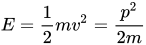
The De Broglie relations: , apply. Since the potential energy is (stated to be) zero, the total energy E is equal to the kinetic energy, which has the same form as in classical physics:


Free particle
In physics, a free particle is a particle that, in some sense, is not bound by an external force, or equivalently not in a region where its potential energy varies. In classical physics, this means the particle is present in a "field-free" space. In quantum mechanics, it means the particle is in a region of uniform potential, usually set to zero in the region of interest since the potential can be arbitrarily set to zero at any point in space.
The classical free particle is characterized by a fixed velocity v. The momentum of a particle with mass m is given by and the kinetic energy (equal to total energy) by .
A free particle with mass in non-relativistic quantum mechanics is described by the free Schrödinger equation:
where ψ is the wavefunction of the particle at position r and time t. The solution for a particle with momentum p or wave vector k, at angular frequency ω or energy E, is given by a complex plane wave:
with amplitude A and has two different rules according to its mass:
The eigenvalue spectrum is infinitely degenerate since for each eigenvalue E>0, there corresponds an infinite number of eigenfunctions corresponding to different directions of .
The De Broglie relations: , apply. Since the potential energy is (stated to be) zero, the total energy E is equal to the kinetic energy, which has the same form as in classical physics: