


Community hub
Recent from talks
Contribute something to knowledge base
Content stats: 0 posts, 0 articles, 1 media, 0 notes
Members stats: 0 subscribers, 0 contributors, 0 moderators, 0 supporters
Subscribers
Supporters
Contributors
Moderators
Hub AI
Freshkills Park AI simulator
(@Freshkills Park_simulator)
Hub AI
Freshkills Park AI simulator
(@Freshkills Park_simulator)
Freshkills Park
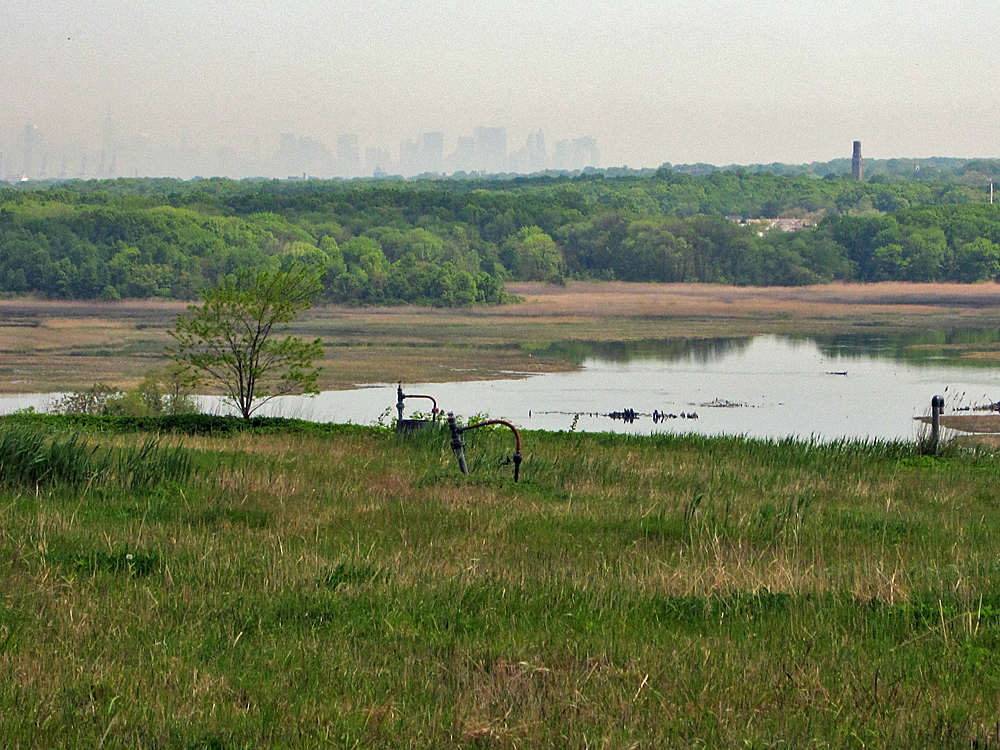
Freshkills Park is a public park being built atop a former landfill on Staten Island. At about 2,200 acres (8.9 km2), it will be the largest park developed in New York City since the 19th century. Its construction began in October 2008 and is slated to continue in phases for approximately 30 years. When fully developed by 2035–2037, Freshkills Park will be the second-largest park in New York City, after Pelham Bay Park in the Bronx, and almost three times the size of Central Park in Manhattan. The park is envisioned as a regional destination that integrates open grasslands, waterways and engineered structures into a cohesive and dynamic unit for social, cultural and physical activity, learning and play. Sections of the park will be connected by a circulation system for vehicles and a network of paths for bicyclists and pedestrians. The New York City Department of Parks and Recreation (NYC Parks) is managing the project with the New York City Department of Sanitation.
The Fresh Kills Landfill actively received New York City's municipal waste from 1947 to 2001. The subsoil was clay, with a layer of sand and silt on top. There were tidal wetlands, forests, and freshwater wetlands. The area was considered prime for development because the value of wetlands in buffering storm surges and filtering water was not understood at the time.[citation needed]
The initial plan was to raise the elevation of the land by filling for three years and then to redevelop it as a multi-use area with residential, recreational, and industrial components. However, three years turned into fifty years. New York City's population was growing and generating more trash and it was easy to expand the filling operation on Staten Island. The landfill accepted garbage from 1948 through 2001. By 1955, the landfill was the largest in the world. At the peak of its operation, the contents of twenty barges – each carrying 650 tons of garbage – were added to the site every day. By 1996, the mound had reached a height of 175 feet (53 m), taller than the Statue of Liberty in nearby New York Harbor. Although Staten Islanders had tried many times to close operations at the landfill, litigation efforts finally met with success that year, when regulations were passed to close the landfill by 2002. Under strong community pressure and with support of the United States Environmental Protection Agency (EPA), the landfill site was closed on March 22, 2001, but it was reopened after the September 11 attacks on the World Trade Center in Manhattan. Virtually all the materials from the World Trade Center site were sent to the temporarily reopened landfill for examination. Thousands of detectives and forensic evidence specialists worked for over 1.7 million hours at Fresh Kills Landfill to try to recover the remains of people killed in the attacks. A final count of 4,257 human remains were recovered, and more than 1,600 personal effects; the City's Chief Medical Examiner retains custody of all still-unidentified materials at a facility within the National 9/11 Memorial in Manhattan. The remaining materials at Fresh Kills were then buried in a 40-acre (160,000 m2) portion of the landfill, known as West Mound. Afterward, the landfill facility was closed permanently, in anticipation of the park on the site.[citation needed]
Two of the four mounds at the site – the mounds referred to as North and South – were capped in the late 1990s with an impermeable cover separating waste from the environment. Capping of the East Mound, which will become East Park, began in 2007 and was completed in 2011. Capping of the West Mound began in 2011 and was scheduled to be complete in 2022. The Department of Sanitation works with the New York State Department of Environmental Conservation (NYSDEC) to meet regulations for environmentally sound landfill closure; it will also maintain operating responsibility for on-site environmental monitoring and control systems after capping. NYC Parks must also meet NYSDEC's regulations – no area of the park is permitted to open to public access until it meets state standards for public access.
NYC Parks completed and released the Final Generic Environmental Impact Statement (FGEIS) for the Freshkills Park project in May 2009. The document evaluates the entirety of the proposed project and its likely effects on the neighboring community. In compliance with state and local law, the FGEIS is designed to identify "any adverse environmental effects of proposed actions, assess their significance, and propose measures to eliminate or mitigate significant impacts". A Supplemental Environmental Impact Statement (SEIS) was completed in October 2009, which specifically focuses on the impact of proposed road construction through the East Park section of the plan and examines alternatives to the current plan. These environmental assessments are updated on a project-by-project basis, during the design phase, to ensure that any new or undisclosed environmental impacts are also identified and addressed.
In 2001, the New York City Department of City Planning (NYCDCP) held an international design competition following a Request for Proposal (RFP) for a landscape architecture firm to develop a master plan for the park. The competition's first round was open to all participants, and in August 2001, six were chosen as finalists: James Corner Field Operations, Hargreaves Associates, Mathur/da Cunha, Tom Leader Studio, John McAslan + Partners, RIOS Associates, Inc., and Sasaki Associates.
In 2003, James Corner Field Operations was selected as the winner of the competition and was hired to prepare a draft master plan to guide long-term development of the park. The Draft Master Plan was prepared over the following years and released in March 2006. In 2006, NYC Parks became the lead agency overseeing the park development process.
The Land Art Generator Initiative used Freshkills Park as the focus of its "LAGI 2012" competition, to design a large-scale artwork that would feed the city's electrical grid. Although construction of the winning design was not guaranteed, the initiative brought international attention to the aesthetic potential of renewable energy infrastructure.
Freshkills Park
Freshkills Park is a public park being built atop a former landfill on Staten Island. At about 2,200 acres (8.9 km2), it will be the largest park developed in New York City since the 19th century. Its construction began in October 2008 and is slated to continue in phases for approximately 30 years. When fully developed by 2035–2037, Freshkills Park will be the second-largest park in New York City, after Pelham Bay Park in the Bronx, and almost three times the size of Central Park in Manhattan. The park is envisioned as a regional destination that integrates open grasslands, waterways and engineered structures into a cohesive and dynamic unit for social, cultural and physical activity, learning and play. Sections of the park will be connected by a circulation system for vehicles and a network of paths for bicyclists and pedestrians. The New York City Department of Parks and Recreation (NYC Parks) is managing the project with the New York City Department of Sanitation.
The Fresh Kills Landfill actively received New York City's municipal waste from 1947 to 2001. The subsoil was clay, with a layer of sand and silt on top. There were tidal wetlands, forests, and freshwater wetlands. The area was considered prime for development because the value of wetlands in buffering storm surges and filtering water was not understood at the time.[citation needed]
The initial plan was to raise the elevation of the land by filling for three years and then to redevelop it as a multi-use area with residential, recreational, and industrial components. However, three years turned into fifty years. New York City's population was growing and generating more trash and it was easy to expand the filling operation on Staten Island. The landfill accepted garbage from 1948 through 2001. By 1955, the landfill was the largest in the world. At the peak of its operation, the contents of twenty barges – each carrying 650 tons of garbage – were added to the site every day. By 1996, the mound had reached a height of 175 feet (53 m), taller than the Statue of Liberty in nearby New York Harbor. Although Staten Islanders had tried many times to close operations at the landfill, litigation efforts finally met with success that year, when regulations were passed to close the landfill by 2002. Under strong community pressure and with support of the United States Environmental Protection Agency (EPA), the landfill site was closed on March 22, 2001, but it was reopened after the September 11 attacks on the World Trade Center in Manhattan. Virtually all the materials from the World Trade Center site were sent to the temporarily reopened landfill for examination. Thousands of detectives and forensic evidence specialists worked for over 1.7 million hours at Fresh Kills Landfill to try to recover the remains of people killed in the attacks. A final count of 4,257 human remains were recovered, and more than 1,600 personal effects; the City's Chief Medical Examiner retains custody of all still-unidentified materials at a facility within the National 9/11 Memorial in Manhattan. The remaining materials at Fresh Kills were then buried in a 40-acre (160,000 m2) portion of the landfill, known as West Mound. Afterward, the landfill facility was closed permanently, in anticipation of the park on the site.[citation needed]
Two of the four mounds at the site – the mounds referred to as North and South – were capped in the late 1990s with an impermeable cover separating waste from the environment. Capping of the East Mound, which will become East Park, began in 2007 and was completed in 2011. Capping of the West Mound began in 2011 and was scheduled to be complete in 2022. The Department of Sanitation works with the New York State Department of Environmental Conservation (NYSDEC) to meet regulations for environmentally sound landfill closure; it will also maintain operating responsibility for on-site environmental monitoring and control systems after capping. NYC Parks must also meet NYSDEC's regulations – no area of the park is permitted to open to public access until it meets state standards for public access.
NYC Parks completed and released the Final Generic Environmental Impact Statement (FGEIS) for the Freshkills Park project in May 2009. The document evaluates the entirety of the proposed project and its likely effects on the neighboring community. In compliance with state and local law, the FGEIS is designed to identify "any adverse environmental effects of proposed actions, assess their significance, and propose measures to eliminate or mitigate significant impacts". A Supplemental Environmental Impact Statement (SEIS) was completed in October 2009, which specifically focuses on the impact of proposed road construction through the East Park section of the plan and examines alternatives to the current plan. These environmental assessments are updated on a project-by-project basis, during the design phase, to ensure that any new or undisclosed environmental impacts are also identified and addressed.
In 2001, the New York City Department of City Planning (NYCDCP) held an international design competition following a Request for Proposal (RFP) for a landscape architecture firm to develop a master plan for the park. The competition's first round was open to all participants, and in August 2001, six were chosen as finalists: James Corner Field Operations, Hargreaves Associates, Mathur/da Cunha, Tom Leader Studio, John McAslan + Partners, RIOS Associates, Inc., and Sasaki Associates.
In 2003, James Corner Field Operations was selected as the winner of the competition and was hired to prepare a draft master plan to guide long-term development of the park. The Draft Master Plan was prepared over the following years and released in March 2006. In 2006, NYC Parks became the lead agency overseeing the park development process.
The Land Art Generator Initiative used Freshkills Park as the focus of its "LAGI 2012" competition, to design a large-scale artwork that would feed the city's electrical grid. Although construction of the winning design was not guaranteed, the initiative brought international attention to the aesthetic potential of renewable energy infrastructure.
Recent media
Recent media