



Community hub
Recent from talks
Knowledge base stats:
Talk channels stats:
Members stats:
Frikandel
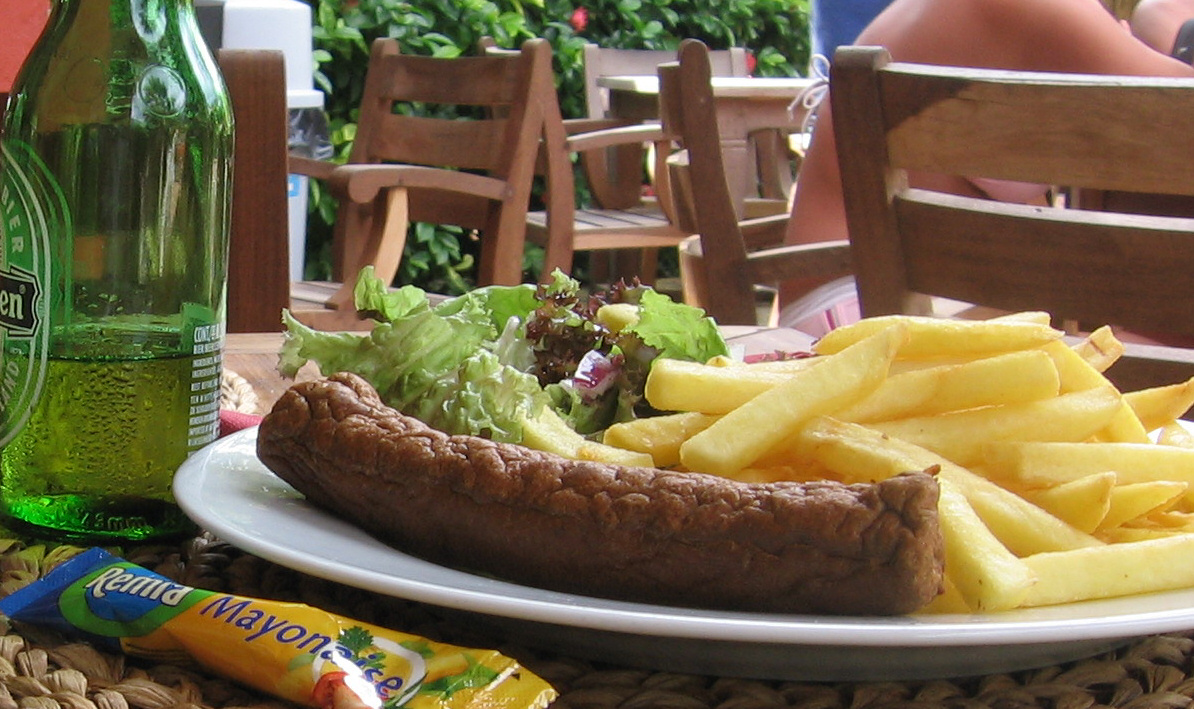
A frikandel (Dutch pronunciation: [frikɑnˈdɛl] ⓘ; plural frikandellen) is a traditional snack originating from the Netherlands, a sort of minced-meat sausage, of which the modern version was developed after World War II. The history of this snack in the Spanish Netherlands goes back to the 17th century.
Unlike the modern frikandel, the historical frikandel (frickedil) is made from minced veal and generally spiced with mace, nutmeg, salt, pepper and optionally orange peel. A version without egg and breadcrumbs was cooked in a veal net.
The shape of the frikadel could have been phallic on purpose. The writer P.C. Hooft called 'fricadellen' a recipe for old spinsters. Also, a special version of the frikadel was served to pregnant women, according to 18th-century cookery books. It was a veal meatball containing an egg yolk, hidden and sewn into a small leaf of lettuce.
There is some confusion around whether frikandel should be written with or without an "n", but in essence, the frikandel and the frikadel are two different products. Until 2005 however, only the word "frikadel", was seen as the official spelling. After 2005, also the word "frikandel" was accepted.
The difference between a "frikandel" and a "frikadel" is that the frikadel was invented in 1954 and the frikandel is a similar product invented in 1958 and has a different production method, yielding a smoother end-product. Currently, the frikadel is no longer in production.
The modern frikandel is a cylindrical chewy, skinless, dark-coloured sausage-like meat product which is usually eaten warm. Unlike most sausages, the frikandel is deep-fried. In Belgium and in the north of France (Nord-Pas-de-Calais), it is called a "frikadel", "fricandelle" or "fricadelle". In some parts of Flanders (Belgium), notably around Antwerp, it is called "curryworst" (not to be confused with the German currywurst, though in eastern Germany people tend to make currywurst from skinless sausage). In the U.S., a product inspired by the frikandel although not identical is marketed under the "Dutch Dawg" and "Freakandel" brands.
In Belgium, frikadel means (also raw) minced pork; it seldom contains other meat. Where the sausage is called "curryworst", the term frikadel is often used to describe a sort of meatball (the precursor of the frikandel, with the same meat), commonly eaten in Belgium, Germany and Denmark.
Who created the modern frikandel is contested. Some claimed it was first made by Gerrit de Vries in Dordrecht in 1954 when a law prevented him from selling his product as a meatball. He changed the name and shape instead of the recipe. Others say it was created by Jan Bekkers in Deurne in 1958, and named by him "frikandel" after he founded the Beckers factory the following year.
Hub AI
Frikandel AI simulator
(@Frikandel_simulator)
Frikandel
A frikandel (Dutch pronunciation: [frikɑnˈdɛl] ⓘ; plural frikandellen) is a traditional snack originating from the Netherlands, a sort of minced-meat sausage, of which the modern version was developed after World War II. The history of this snack in the Spanish Netherlands goes back to the 17th century.
Unlike the modern frikandel, the historical frikandel (frickedil) is made from minced veal and generally spiced with mace, nutmeg, salt, pepper and optionally orange peel. A version without egg and breadcrumbs was cooked in a veal net.
The shape of the frikadel could have been phallic on purpose. The writer P.C. Hooft called 'fricadellen' a recipe for old spinsters. Also, a special version of the frikadel was served to pregnant women, according to 18th-century cookery books. It was a veal meatball containing an egg yolk, hidden and sewn into a small leaf of lettuce.
There is some confusion around whether frikandel should be written with or without an "n", but in essence, the frikandel and the frikadel are two different products. Until 2005 however, only the word "frikadel", was seen as the official spelling. After 2005, also the word "frikandel" was accepted.
The difference between a "frikandel" and a "frikadel" is that the frikadel was invented in 1954 and the frikandel is a similar product invented in 1958 and has a different production method, yielding a smoother end-product. Currently, the frikadel is no longer in production.
The modern frikandel is a cylindrical chewy, skinless, dark-coloured sausage-like meat product which is usually eaten warm. Unlike most sausages, the frikandel is deep-fried. In Belgium and in the north of France (Nord-Pas-de-Calais), it is called a "frikadel", "fricandelle" or "fricadelle". In some parts of Flanders (Belgium), notably around Antwerp, it is called "curryworst" (not to be confused with the German currywurst, though in eastern Germany people tend to make currywurst from skinless sausage). In the U.S., a product inspired by the frikandel although not identical is marketed under the "Dutch Dawg" and "Freakandel" brands.
In Belgium, frikadel means (also raw) minced pork; it seldom contains other meat. Where the sausage is called "curryworst", the term frikadel is often used to describe a sort of meatball (the precursor of the frikandel, with the same meat), commonly eaten in Belgium, Germany and Denmark.
Who created the modern frikandel is contested. Some claimed it was first made by Gerrit de Vries in Dordrecht in 1954 when a law prevented him from selling his product as a meatball. He changed the name and shape instead of the recipe. Others say it was created by Jan Bekkers in Deurne in 1958, and named by him "frikandel" after he founded the Beckers factory the following year.