Top Black Pepper Exporters & Importers 2025: Global Trade Trends, Market Size & Country Insights
Discover the latest insights on global black pepper trade in 2025, including top exporting and importing countries, market size, and pricing trends. The global black pepper market continues to grow steadily, driven by rising demand from food processing and spice industries, with market value crossing billions globally. India remains a key player, exporting black pepper worth over USD 100 million annually, supplying major markets like the USA, China, and the Middle East. Countries such as Vietnam, Brazil, and Indonesia dominate global exports, while demand continues to rise across North America and Europe. This blog provides a complete overview of Black Pepper Exporters, Importers, Global Trade Trends, Wholesale Prices, and Market Growth, helping businesses make informed sourcing and investment decisions
Explore the top black pepper exports and imports 2025 and understand key trends shaping the global spice trade. Black pepper remains one of the most traded spices worldwide due to its strong demand in food, health, and processing industries. Leading exporters like Vietnam, Brazil, and Indonesia dominate the black pepper export market, contributing over 85% of global trade. Major importing countries include the United States, India, Germany, and Japan, driving consistent demand. The global black pepper market continues to grow steadily, supported by increasing consumption and expanding food industries. Factors like climate changes, supply chain disruptions, and pricing fluctuations impact trade dynamics. This guide helps businesses involved in spice trading, black pepper export, and import export business make informed decisions and identify profitable global opportunities.
Top Black Pepper Exporters & Importers 2025: Global Trade Trends, Market Size & Country Insights
Discover the latest insights on global black pepper trade in 2025, including top exporting and importing countries, market size, and pricing trends. The global black pepper market continues to grow steadily, driven by rising demand from food processing and spice industries, with market value crossing billions globally. India remains a key player, exporting black pepper worth over USD 100 million annually, supplying major markets like the USA, China, and the Middle East. Countries such as Vietnam, Brazil, and Indonesia dominate global exports, while demand continues to rise across North America and Europe. This blog provides a complete overview of Black Pepper Exporters, Importers, Global Trade Trends, Wholesale Prices, and Market Growth, helping businesses make informed sourcing and investment decisions
Explore the top black pepper exports and imports 2025 and understand key trends shaping the global spice trade. Black pepper remains one of the most traded spices worldwide due to its strong demand in food, health, and processing industries. Leading exporters like Vietnam, Brazil, and Indonesia dominate the black pepper export market, contributing over 85% of global trade. Major importing countries include the United States, India, Germany, and Japan, driving consistent demand. The global black pepper market continues to grow steadily, supported by increasing consumption and expanding food industries. Factors like climate changes, supply chain disruptions, and pricing fluctuations impact trade dynamics. This guide helps businesses involved in spice trading, black pepper export, and import export business make informed decisions and identify profitable global opportunities.
Top Black Pepper Exporters & Importers 2025: Global Trade Trends, Market Size & Country Insights
Discover the latest insights on global black pepper trade in 2025, including top exporting and importing countries, market size, and pricing trends. The global black pepper market continues to grow steadily, driven by rising demand from food processing and spice industries, with market value crossing billions globally. India remains a key player, exporting black pepper worth over USD 100 million annually, supplying major markets like the USA, China, and the Middle East. Countries such as Vietnam, Brazil, and Indonesia dominate global exports, while demand continues to rise across North America and Europe. This blog provides a complete overview of Black Pepper Exporters, Importers, Global Trade Trends, Wholesale Prices, and Market Growth, helping businesses make informed sourcing and investment decisions
Explore the top black pepper exports and imports 2025 and understand key trends shaping the global spice trade. Black pepper remains one of the most traded spices worldwide due to its strong demand in food, health, and processing industries. Leading exporters like Vietnam, Brazil, and Indonesia dominate the black pepper export market, contributing over 85% of global trade. Major importing countries include the United States, India, Germany, and Japan, driving consistent demand. The global black pepper market continues to grow steadily, supported by increasing consumption and expanding food industries. Factors like climate changes, supply chain disruptions, and pricing fluctuations impact trade dynamics. This guide helps businesses involved in spice trading, black pepper export, and import export business make informed decisions and identify profitable global opportunities.
Welcome to the community hub for Black pepper. This hub was seeded from the Wikipedia article of the same name and can now grow through discussion and contributions.
Respect all members: no insults, harassment, or hate speech.
Be tolerant of different viewpoints, cultures, and beliefs. If you do not agree with others, just create separate note, article or collection.
Clearly distinguish between personal opinion and fact.
Verify facts before posting, especially when writing about history, science, or statistics.
Promotional content must be published on the "Yellow Pages" page—no more than one paragraph per service. You can also create subpages under the "Yellow Pages" page and publish longer promotional text there.
Do not post materials that infringe on copyright without permission.
Always credit sources when sharing information, quotes, or media.
Be respectful of the work of others when making changes.
Discuss major edits instead of removing others' contributions without reason.
If you notice rule-breaking, notify community about it in talks.
Do not share personal data of others without their consent.
Wikipedia
Grokipedia
Black pepper
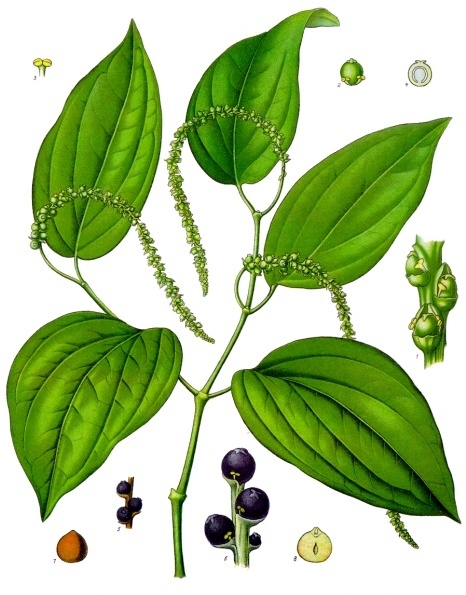
Black pepper (Piper nigrum) is a floweringvine in the family Piperaceae, cultivated for its fruit (the peppercorn), which is usually dried and used as a spice and seasoning. The fruit is a drupe (stonefruit) which is about 5 mm (1⁄4 in) in diameter (fresh and fully mature), dark red, and contains a stone which encloses a single pepper seed. Peppercorns and the ground pepper derived from them may be described simply as pepper, or more precisely as black pepper (cooked and dried unripe fruit), green pepper (dried unripe fruit), or white pepper (ripe fruit seeds).
Black pepper is native to Southeast or South Asia. Ground, dried, and cooked peppercorns have been used since antiquity, both for flavour and as a traditional medicine. Black pepper is one of the most commonly traded spices in the world. Its spiciness is due to the chemical compound piperine, which is a different kind of spiciness from that of capsaicin characteristic of chili peppers. It is ubiquitous in the Western world as a seasoning and is often paired with salt and available on dining tables in shakers or mills.
The word pepper derives from Old Englishpipor, Latinpiper, and Greek: πέπερι. The Greek likely derives from Dravidianpippali, meaning "long pepper". Sanskritpippali shares the same meaning.
In the 16th century, people began using pepper to also mean the New Worldchili pepper (genus Capsicum), which is not closely related.
The pepper plant is a perennial woody vine growing up to 4 m (13 ft) in height on supporting trees, poles, or trellises. It is a spreading vine, rooting readily where trailing stems touch the ground. The leaves are alternate, entire, 5 to 10 cm (2 to 4 in) long and 3 to 6 cm (1 to 2+1⁄2 in) across.[citation needed]
The flowers are small, produced on pendulous spikes 4 to 8 cm (1+1⁄2 to 3 in) long at the leaf nodes, the spikes lengthening up to 7 to 15 cm (2+3⁄4 to 6 in) as the fruit matures.[better source needed] A single stem bears 20 to 30 fruiting spikes. The fruit of the black pepper is a drupe and when dried is known as a peppercorn.[citation needed]
Within the genus Piper, black pepper is most closely related to other Asian species such as P. caninum.
Processed peppercorns come in a variety of colours, any one of which may be used in food preparation, especially common peppercorn sauce.
Black pepper (Piper nigrum) is a floweringvine in the family Piperaceae, cultivated for its fruit (the peppercorn), which is usually dried and used as a spice and seasoning. The fruit is a drupe (stonefruit) which is about 5 mm (1⁄4 in) in diameter (fresh and fully mature), dark red, and contains a stone which encloses a single pepper seed. Peppercorns and the ground pepper derived from them may be described simply as pepper, or more precisely as black pepper (cooked and dried unripe fruit), green pepper (dried unripe fruit), or white pepper (ripe fruit seeds).
Black pepper is native to Southeast or South Asia. Ground, dried, and cooked peppercorns have been used since antiquity, both for flavour and as a traditional medicine. Black pepper is one of the most commonly traded spices in the world. Its spiciness is due to the chemical compound piperine, which is a different kind of spiciness from that of capsaicin characteristic of chili peppers. It is ubiquitous in the Western world as a seasoning and is often paired with salt and available on dining tables in shakers or mills.
The word pepper derives from Old Englishpipor, Latinpiper, and Greek: πέπερι. The Greek likely derives from Dravidianpippali, meaning "long pepper". Sanskritpippali shares the same meaning.
In the 16th century, people began using pepper to also mean the New Worldchili pepper (genus Capsicum), which is not closely related.
The pepper plant is a perennial woody vine growing up to 4 m (13 ft) in height on supporting trees, poles, or trellises. It is a spreading vine, rooting readily where trailing stems touch the ground. The leaves are alternate, entire, 5 to 10 cm (2 to 4 in) long and 3 to 6 cm (1 to 2+1⁄2 in) across.[citation needed]
The flowers are small, produced on pendulous spikes 4 to 8 cm (1+1⁄2 to 3 in) long at the leaf nodes, the spikes lengthening up to 7 to 15 cm (2+3⁄4 to 6 in) as the fruit matures.[better source needed] A single stem bears 20 to 30 fruiting spikes. The fruit of the black pepper is a drupe and when dried is known as a peppercorn.[citation needed]
Within the genus Piper, black pepper is most closely related to other Asian species such as P. caninum.
Processed peppercorns come in a variety of colours, any one of which may be used in food preparation, especially common peppercorn sauce.