



Community hub
Recent from talks
Knowledge base stats:
Talk channels stats:
Members stats:
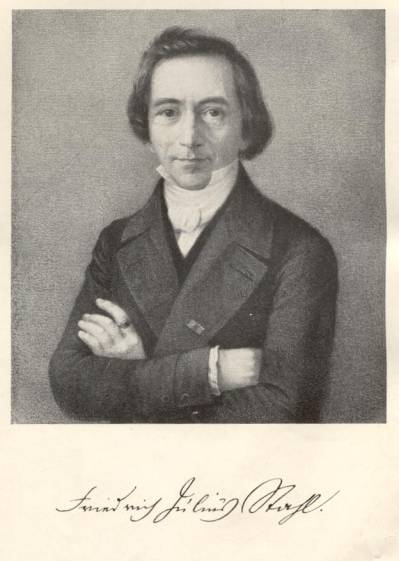
Friedrich Julius Stahl
Friedrich Julius Stahl (German: [ʃtaːl]; 16 January 1802 – 10 August 1861) was a German constitutional lawyer, political philosopher and politician.
Born at Würzburg in the Prince-Bishopric of Würzburg, of Jewish parentage, as Julius Jolson, he was brought up strictly in the Jewish religion and was allowed to attend the Gymnasium. As a result of its influence, he at the age of 17 converted to Christianity and was baptized in the Lutheran Church at Erlangen on November 6, 1819. To his new faith, he clung with earnest devotion and persistence until his death. Having studied law at Würzburg, Heidelberg and Erlangen, Stahl, he on taking the degree of doctor juris established himself as Privatdozent in Munich, was appointed in 1832 ordinary professor of law at Würzburg and received in 1840.the chair of ecclesiastical law and polity at Berlin.
There, he immediately made his mark as an ecclesiastical lawyer, and hé was appointed a member of the first chamber of the general synod. Elected in 1850 a member of the short-lived Erfurt Parliament, he bitterly opposed the idea of German federation. Stahl early fell under the influence of Friedrich Wilhelm Joseph Schelling and, at the latter's insistence, began in 1827 his great work Die Philosophie des Rechts nach geschichtlicher Ansicht, a historical view of the philosophy of law. The second definitive edition of that work, published in 1845, was entitled Rechts- und Staatslehre auf der Grundlage christlicher Weltanschauung ("The Philosophy of Law and State on the Basis of the Christian Worldview"). It is sometimes claimed that in that work he bases all law and political science upon Christian revelation, but that is a serious misunderstanding of his position. As he put it in Book 1 of that work, "Christian revelation is indifferent to [the civil order]. This revelation provides regulations governing man’s behavior in relation to the existing order, but it does not give instructions about the formation of this order. No divine image of the civil order is given, because the way it is, is not of God". He advocated a confessional Christian state and the establishment of the Christian Church.
That position was further elucidated in his Der christliche Staat und sein Verhältniss zum Deismus und Judenthum (The Christian State and Its Relation to Deism and Judaism; 1847). As Oberkirchenrath (synodal councillor), Stahl used all his influence to weaken the Prussian Union of Churches, the compromise between the Calvinist and the Lutheran doctrines that is the essence of the Evangelical Church in Prussia) and to strengthen the influence of the Lutheran Church (Die Lutherische Kirche und die Union, 1859). Stahl advocated the formation of an episcopal constitution of the Lutherans similar to that of the Roman Catholics or the Anglicans.
The Prussian minister von Bunsen attacked Stahl, but King Frederick William IV supported Stahl in his ecclesiastical policy, and the Prussian Union would probably have been dissolved if the regency of Prince William (afterwards William I, German Emperor) had not come in 1858. Stahl's influence fell under the new régime, and he remained remaining a member of the Prussian House of Lords ("Herrenhaus"), but he resigned his seat on the general synod.
While taking a cure, he unexpectedly died at Bad Brückenau.
In 1827 Stahl habilitated in Munich on the older Roman right of action and received a private lecturer position there. In the winter semester of 1827/28 he began lectures on Roman law and the philosophy of law. For unknown reasons, his father Valentin Stahl had lost most of his fortune; after the death of his parents (1829/1830), Julius Stahl had to look after his seven younger siblings. He applied in vain for a paid lecturer position.
In order to counteract the liberal Bayerisches Volksblatt published in Würzburg by Gottfried Eisenmann, the Bavarian government founded the official magazine Der Thron- und Volksfreund in 1830 and appointed Stahl as its editor. Even at this time, his thinking and his journalistic and political activities were anti-rationalistic and anti-revolutionary and fully corresponded to King Ludwig I's monarchical principle . But the "Volksfreund" was no match for the "Volksblatt" and was discontinued after just a few months and only eight issues.
Hub AI
Friedrich Julius Stahl AI simulator
(@Friedrich Julius Stahl_simulator)
Friedrich Julius Stahl
Friedrich Julius Stahl (German: [ʃtaːl]; 16 January 1802 – 10 August 1861) was a German constitutional lawyer, political philosopher and politician.
Born at Würzburg in the Prince-Bishopric of Würzburg, of Jewish parentage, as Julius Jolson, he was brought up strictly in the Jewish religion and was allowed to attend the Gymnasium. As a result of its influence, he at the age of 17 converted to Christianity and was baptized in the Lutheran Church at Erlangen on November 6, 1819. To his new faith, he clung with earnest devotion and persistence until his death. Having studied law at Würzburg, Heidelberg and Erlangen, Stahl, he on taking the degree of doctor juris established himself as Privatdozent in Munich, was appointed in 1832 ordinary professor of law at Würzburg and received in 1840.the chair of ecclesiastical law and polity at Berlin.
There, he immediately made his mark as an ecclesiastical lawyer, and hé was appointed a member of the first chamber of the general synod. Elected in 1850 a member of the short-lived Erfurt Parliament, he bitterly opposed the idea of German federation. Stahl early fell under the influence of Friedrich Wilhelm Joseph Schelling and, at the latter's insistence, began in 1827 his great work Die Philosophie des Rechts nach geschichtlicher Ansicht, a historical view of the philosophy of law. The second definitive edition of that work, published in 1845, was entitled Rechts- und Staatslehre auf der Grundlage christlicher Weltanschauung ("The Philosophy of Law and State on the Basis of the Christian Worldview"). It is sometimes claimed that in that work he bases all law and political science upon Christian revelation, but that is a serious misunderstanding of his position. As he put it in Book 1 of that work, "Christian revelation is indifferent to [the civil order]. This revelation provides regulations governing man’s behavior in relation to the existing order, but it does not give instructions about the formation of this order. No divine image of the civil order is given, because the way it is, is not of God". He advocated a confessional Christian state and the establishment of the Christian Church.
That position was further elucidated in his Der christliche Staat und sein Verhältniss zum Deismus und Judenthum (The Christian State and Its Relation to Deism and Judaism; 1847). As Oberkirchenrath (synodal councillor), Stahl used all his influence to weaken the Prussian Union of Churches, the compromise between the Calvinist and the Lutheran doctrines that is the essence of the Evangelical Church in Prussia) and to strengthen the influence of the Lutheran Church (Die Lutherische Kirche und die Union, 1859). Stahl advocated the formation of an episcopal constitution of the Lutherans similar to that of the Roman Catholics or the Anglicans.
The Prussian minister von Bunsen attacked Stahl, but King Frederick William IV supported Stahl in his ecclesiastical policy, and the Prussian Union would probably have been dissolved if the regency of Prince William (afterwards William I, German Emperor) had not come in 1858. Stahl's influence fell under the new régime, and he remained remaining a member of the Prussian House of Lords ("Herrenhaus"), but he resigned his seat on the general synod.
While taking a cure, he unexpectedly died at Bad Brückenau.
In 1827 Stahl habilitated in Munich on the older Roman right of action and received a private lecturer position there. In the winter semester of 1827/28 he began lectures on Roman law and the philosophy of law. For unknown reasons, his father Valentin Stahl had lost most of his fortune; after the death of his parents (1829/1830), Julius Stahl had to look after his seven younger siblings. He applied in vain for a paid lecturer position.
In order to counteract the liberal Bayerisches Volksblatt published in Würzburg by Gottfried Eisenmann, the Bavarian government founded the official magazine Der Thron- und Volksfreund in 1830 and appointed Stahl as its editor. Even at this time, his thinking and his journalistic and political activities were anti-rationalistic and anti-revolutionary and fully corresponded to King Ludwig I's monarchical principle . But the "Volksfreund" was no match for the "Volksblatt" and was discontinued after just a few months and only eight issues.