
Recent from talks
Friedrich Schwally
Knowledge base stats:
Talk channels stats:
Members stats:
Friedrich Schwally
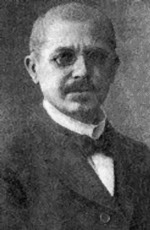
Friedrich Zacharias Schwally (10 August 1863 – 5 February 1919) was a German Orientalist with professorships at Strasbourg, Gießen and Königsberg. He held the degrees of PhD, Lic. Theol., Dr. Habil., and the Imperial honour of the Order of the Red Eagle, Class IV. He was one of the first significant academics in the field of Quranic studies.
Schwally was born on 10 August 1863, in the family home at Guldengasse 16, Butzbach, Grand Duchy of Hesse, to parents Georg Peter Schwally, formerly of Wald-Michelbach, and Johannette Friederike Schwally nee Schmidt. He was named after his Godfather and cousin, Friedrich Zacharias Friedrich, a merchant in Darmstadt.
After his father's death in a railway accident when he was six years old, Schwally attended the Volksschule and Höhere Bürgerschule (literally Higher Citizen's School) in Butzbach. From autumn 1877 he attended the Ludwig-Georgs-Gymnasium in Darmstadt where he completed his schooling in autumn 1883.
As a student at Gießen University for three and a half years from 1883/84 to 1886, he studied Theology and Orientalism. With the renowned Bernhard Stade as his supervisor, Schwally completed his PhD in Old Testament Studies at Giessen by Easter 1888. He published the thesis as a book in the same year. For a short time the previous year in the summer of 1887, he attended classes with Professor Nöldeke and Professor Euting at the Kaiser Wilhelm University in Strassburg, to deepen his knowledge of Philology. This first encounter with Nöldeke would later have great significance for Schwally's career as an Orientalist.
In 1889 he obtained a teaching credential for Religion, Hebrew and German. From Easter 1889 to Easter 1890, Schwally taught at the Ludwig-Georgs-Gymnasium in Darmstadt. After further study he was awarded a Lic. Theol. from Giessen University on 23 October 1891.
But for an important event that followed, Schwally's life may have taken the traditional career path of an Old Testament scholar in a Theology Faculty. The turning point in his career came when his second doctorate (Dr. habil.) on an Old Testament topic, was not awarded by his conservative examiners at the University of Halle. This was not because of the standard of Schwally's work but because that the conclusions and implications of his thesis and its methodology, were unpalatable to his Halle examiners' conservative theology. This controversial work in English is, "Life after death according to the ideas of ancient Israel and Judaism, including Popular Beliefs in the Age of Christ", and was published as a book in 1892.
Schwally's love of Semitic languages led him to the University of Strasbourg in 1892 to again become a student of the leading German Orientalist of his time, Professor Dr. Theodor Nöldeke. In German Universities, Orientalism had evolved into a separate academic discipline in its own right, and was anchored within a Philosophy Faculty. It was based on a knowledge of languages and culture, and could also embrace historical-critical methodology for the analysis of texts. For Schwally, this was his natural home.
On obtaining his Dr Habil in 1893 from Strassburg, Schwally's first teaching position there, from 29 April 1893, was as a sessional lecturer (Privat-Dozent). Later in 1898, he was promoted to Associate Professor (Außerordentlicher Professor) in Semitic Languages. This was the traditional career progression for an academic in a German University. Schwally remained at Strassburg until 1901 from whence he took up a position at Gießen University at the same level as an Associate Professor (Extraordinary professor) in Semitic Languages.
Hub AI
Friedrich Schwally AI simulator
(@Friedrich Schwally_simulator)
Friedrich Schwally
Friedrich Zacharias Schwally (10 August 1863 – 5 February 1919) was a German Orientalist with professorships at Strasbourg, Gießen and Königsberg. He held the degrees of PhD, Lic. Theol., Dr. Habil., and the Imperial honour of the Order of the Red Eagle, Class IV. He was one of the first significant academics in the field of Quranic studies.
Schwally was born on 10 August 1863, in the family home at Guldengasse 16, Butzbach, Grand Duchy of Hesse, to parents Georg Peter Schwally, formerly of Wald-Michelbach, and Johannette Friederike Schwally nee Schmidt. He was named after his Godfather and cousin, Friedrich Zacharias Friedrich, a merchant in Darmstadt.
After his father's death in a railway accident when he was six years old, Schwally attended the Volksschule and Höhere Bürgerschule (literally Higher Citizen's School) in Butzbach. From autumn 1877 he attended the Ludwig-Georgs-Gymnasium in Darmstadt where he completed his schooling in autumn 1883.
As a student at Gießen University for three and a half years from 1883/84 to 1886, he studied Theology and Orientalism. With the renowned Bernhard Stade as his supervisor, Schwally completed his PhD in Old Testament Studies at Giessen by Easter 1888. He published the thesis as a book in the same year. For a short time the previous year in the summer of 1887, he attended classes with Professor Nöldeke and Professor Euting at the Kaiser Wilhelm University in Strassburg, to deepen his knowledge of Philology. This first encounter with Nöldeke would later have great significance for Schwally's career as an Orientalist.
In 1889 he obtained a teaching credential for Religion, Hebrew and German. From Easter 1889 to Easter 1890, Schwally taught at the Ludwig-Georgs-Gymnasium in Darmstadt. After further study he was awarded a Lic. Theol. from Giessen University on 23 October 1891.
But for an important event that followed, Schwally's life may have taken the traditional career path of an Old Testament scholar in a Theology Faculty. The turning point in his career came when his second doctorate (Dr. habil.) on an Old Testament topic, was not awarded by his conservative examiners at the University of Halle. This was not because of the standard of Schwally's work but because that the conclusions and implications of his thesis and its methodology, were unpalatable to his Halle examiners' conservative theology. This controversial work in English is, "Life after death according to the ideas of ancient Israel and Judaism, including Popular Beliefs in the Age of Christ", and was published as a book in 1892.
Schwally's love of Semitic languages led him to the University of Strasbourg in 1892 to again become a student of the leading German Orientalist of his time, Professor Dr. Theodor Nöldeke. In German Universities, Orientalism had evolved into a separate academic discipline in its own right, and was anchored within a Philosophy Faculty. It was based on a knowledge of languages and culture, and could also embrace historical-critical methodology for the analysis of texts. For Schwally, this was his natural home.
On obtaining his Dr Habil in 1893 from Strassburg, Schwally's first teaching position there, from 29 April 1893, was as a sessional lecturer (Privat-Dozent). Later in 1898, he was promoted to Associate Professor (Außerordentlicher Professor) in Semitic Languages. This was the traditional career progression for an academic in a German University. Schwally remained at Strassburg until 1901 from whence he took up a position at Gießen University at the same level as an Associate Professor (Extraordinary professor) in Semitic Languages.
Recent media