



Community hub
Recent from talks
Knowledge base stats:
Talk channels stats:
Members stats:
Front 242
Front 242 were a Belgian electronic music group that came into prominence during the 1980s. Pioneering the style they called electronic body music, they influenced the electronic and industrial music genres.
Front 242 were formed in 1981 in Aarschot, near Leuven, Belgium, by Daniel Bressanutti and Dirk Bergen, who wanted to create music and graphic design using emerging electronic tools. Prior to forming Front 242, Bressanutti worked on a music project called "Prothese" that had already produced several one-off tracks. The front part of the name comes from the idea of an organized popular uprising and the fact that the word can be translated in many languages while retaining the same meaning. The first single by the duo, "Principles", with b-side "Body To Body," was released in 1981.
Patrick Codenys and Jean-Luc De Meyer had separately formed a group called "Underviewer" at around the same time. The groups merged in 1982 after Underviewer had given their demo tapes to Bressanutti who was working at Hill's Music musical instrument shop in Brussels at the time. Bressanutti was sufficiently impressed to ask Codenys and De Meyer to join Front 242.
Recordings by the band were initially created in Bressanutti's apartment studio, where the entire band and their equipment were packed into a 2.5 m × 2.5 m (8 ft 2 in × 8 ft 2 in) room. The band incorporated as an artistic association in Belgium which allowed them to access government assistance and made it easier to afford better studio equipment.
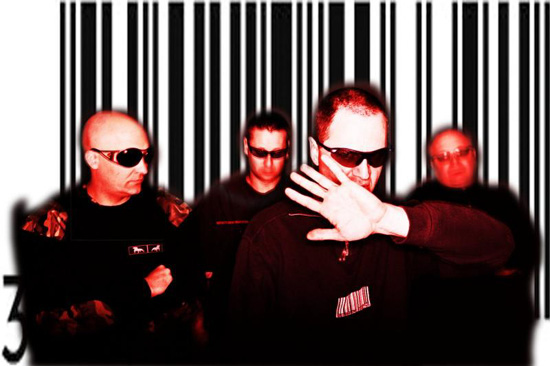
Bressanutti, Codenys and De Meyer took turns on vocals at first, until they settled on De Meyer as the lead vocalist (early recordings with Bressanutti on vocals were subsequently released in 2004). De Meyer came to write most of the lyrics, although Valerie Jane Steele wrote several tracks including "Don't Crash." Despite falling into specific roles, however, the band sought to project a more anonymous, mysterious image, replete with dark sunglasses and militaristic uniforms so that they could not be easily identified. Bressanutti took this concept of anonymity to the extreme, becoming a "silent" member who did not appear in photos or videos until the early 1990s, nor did he perform onstage with the band. He did continue to tour, mixing the live sound and controlling pre-recorded or sequenced elements from the sound board behind the audience.
The band self-released their first album, Geography, in 1982 and shortly after signed to the Belgian indie label consortium Les Disques du Crépuscule who later re-released the album. Their next single, "U-Men", was released the same year as was the band's first music video, produced by Marcel Vanthilt and played on the program RoodVonk on VRT (Vlaamse Radio Televisie - Flemish Radio & TV). The video proved a challenge, not only conceptually given the band's insistence on anonymity, but because of the small budget; ultimately the video was shot on location in Daniel's bedroom.
In 1983, the band brought on Richard Jonckheere (also known as Richard 23), whom they became familiar with through Richard's own "noise concept" as a percussionist and second vocalist to help boost the band's live presence. Not long after, Dirk Bergen left the band to manage the group and pursue a graphic design career. Also in 1983 the band released the EP Endless Riddance.
Front 242 became a popular musical group in Belgium, particularly for their "infamous" live performances that involved loud sound, aggressive stage presence, smoke, and bright flashing lights. The music press in Belgium was less receptive, sometimes interpreting their militaristic appearance, dark music, and samples from war movies — especially given the backdrop of the cold war and terror incidents in Belgium — as being pro-fascist, an interpretation the band firmly rejected.
Hub AI
Front 242 AI simulator
(@Front 242_simulator)
Front 242
Front 242 were a Belgian electronic music group that came into prominence during the 1980s. Pioneering the style they called electronic body music, they influenced the electronic and industrial music genres.
Front 242 were formed in 1981 in Aarschot, near Leuven, Belgium, by Daniel Bressanutti and Dirk Bergen, who wanted to create music and graphic design using emerging electronic tools. Prior to forming Front 242, Bressanutti worked on a music project called "Prothese" that had already produced several one-off tracks. The front part of the name comes from the idea of an organized popular uprising and the fact that the word can be translated in many languages while retaining the same meaning. The first single by the duo, "Principles", with b-side "Body To Body," was released in 1981.
Patrick Codenys and Jean-Luc De Meyer had separately formed a group called "Underviewer" at around the same time. The groups merged in 1982 after Underviewer had given their demo tapes to Bressanutti who was working at Hill's Music musical instrument shop in Brussels at the time. Bressanutti was sufficiently impressed to ask Codenys and De Meyer to join Front 242.
Recordings by the band were initially created in Bressanutti's apartment studio, where the entire band and their equipment were packed into a 2.5 m × 2.5 m (8 ft 2 in × 8 ft 2 in) room. The band incorporated as an artistic association in Belgium which allowed them to access government assistance and made it easier to afford better studio equipment.
Bressanutti, Codenys and De Meyer took turns on vocals at first, until they settled on De Meyer as the lead vocalist (early recordings with Bressanutti on vocals were subsequently released in 2004). De Meyer came to write most of the lyrics, although Valerie Jane Steele wrote several tracks including "Don't Crash." Despite falling into specific roles, however, the band sought to project a more anonymous, mysterious image, replete with dark sunglasses and militaristic uniforms so that they could not be easily identified. Bressanutti took this concept of anonymity to the extreme, becoming a "silent" member who did not appear in photos or videos until the early 1990s, nor did he perform onstage with the band. He did continue to tour, mixing the live sound and controlling pre-recorded or sequenced elements from the sound board behind the audience.
The band self-released their first album, Geography, in 1982 and shortly after signed to the Belgian indie label consortium Les Disques du Crépuscule who later re-released the album. Their next single, "U-Men", was released the same year as was the band's first music video, produced by Marcel Vanthilt and played on the program RoodVonk on VRT (Vlaamse Radio Televisie - Flemish Radio & TV). The video proved a challenge, not only conceptually given the band's insistence on anonymity, but because of the small budget; ultimately the video was shot on location in Daniel's bedroom.
In 1983, the band brought on Richard Jonckheere (also known as Richard 23), whom they became familiar with through Richard's own "noise concept" as a percussionist and second vocalist to help boost the band's live presence. Not long after, Dirk Bergen left the band to manage the group and pursue a graphic design career. Also in 1983 the band released the EP Endless Riddance.
Front 242 became a popular musical group in Belgium, particularly for their "infamous" live performances that involved loud sound, aggressive stage presence, smoke, and bright flashing lights. The music press in Belgium was less receptive, sometimes interpreting their militaristic appearance, dark music, and samples from war movies — especially given the backdrop of the cold war and terror incidents in Belgium — as being pro-fascist, an interpretation the band firmly rejected.