
Recent from talks
Student orientation
Knowledge base stats:
Talk channels stats:
Members stats:
Student orientation
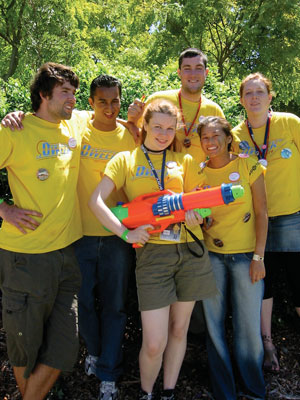
Student orientation or new student orientation (often encapsulated into an orientation week, o-week, frosh week, welcome week or freshers' week) is a period before the start of an academic year at a university or tertiary institutions. A variety of events are held to orient and welcome new students during this period. The name of the event differs across institutions. Post-secondary institutions offer a variety of programs to help orient first year students. These programs can range from voluntary community building activities (frosh week) to mandatory credit-based courses designed to support students academically, socially, and emotionally. Some of these programs occur prior to the start of classes while other programs are offered throughout the school year. A number of research studies have been done to determine the factors to be considered when designing orientation/transition programs.
Although usually described as a week, the length of this period varies widely from university to university and country to country, ranging from about three days to a month or even more (e.g. four or five weeks, depending on the program, at Chalmers). The length of the week is often affected by each university's tradition as well as financial and physical constraints. Additionally, institutions may include programming in the summer months before the first-year to aid in the transition. Some programs may be audience-specific, such as international orientation, transfer student orientation, graduate student orientation.
Orientation programming, regardless of length or format, aims to introduce students to both the academic and social aspects of an institution as they transition from high school. For institutions that have enhanced their orientations to serve as a comprehensive transition program, learning outcomes are developed to assess success. CAS Professional Standards for Higher Education provide objectives for what Orientation programs should aim to accomplish. In North America, organizations exist to share practices that are built upon these outcomes. Two prominent organizations are NODA-Association for Orientation, Transition, and Retention in Higher Education and the Canadian Association Colleges and Universities Student Services (CACUSS), which has Orientation, Transition and Retention Community of Practice. The CACUSS community of practice specifically serves as a network for student affairs professionals to share best practices, research, and trends seen at Canadian institutions.
The week before the term starts is known as: Frosh (or frosh week) in some colleges and universities in Canada. In the US, most call it by the acronym SOAR for Student Orientation And Registration; Freshers' week in the majority of the United Kingdom and Ireland and Orientation week or O-week in countries such as Australia, South Africa and New Zealand, and also in many Canadian universities. In Sweden, it is known as nollning (from nolla, 'zero', in this case meaning the students have not earned any credit points yet) or inspark (being 'kicked in' to university life). Orientation week is the common phrase[clarification needed] in the United States. Some schools use the acronym WOW for Week of Welcome.
In Canada, first-year students are called "frosh" or "first-years", although the term frosh has been phased out as orientations have become dry events. The terms freshies and freshers are also emerging. In the United States, first-year university students are typically[citation needed] referred to as freshmen. In Australia and New Zealand, first-year students are known simply as "first-years", although in some the colleges of the University of Melbourne and the University of Sydney they are also called "freshers". In the U.K. and Ireland, first-year students are known as freshers or first-years. Freshies is also an emerging term in New Zealand. In Sweden, the student is a nolla (a 'zero') during the orientation period and usually upgraded to the status of an etta (student who is in her/his first college term) at a ceremony involving a fancy three-course dinner and much singing.
In modern society, student orientation programs are meant to guide and assist students with their transition into post-secondary. Each institution follows different activities to welcome, transition and assist students in their transition to a new educational experience. Although it seems like every institution has some sort of student orientation they were only developed in 1888 at Boston University. They were created by faculty in an attempt to ensure that students understood the role of a student in academia. These faculty members were predominantly the driving force behind student orientation programs until the 1920s. From 1920-onwards a shift in the development of these orientation practices occurred. Administration at the institutions began to work towards the development. In Canada, this shift happened much later due to the 1960s and 1970s as orientation functions were developed and created by student governments. Specifically, between the 1960s and 1970s, deans acting in the role in loco parentis, were focused on orientation, transition and retention programs that soon became fundamental to higher education institutions. In 1948, directors, administration, and presidents met for the first time to discuss the student orientation. From this meeting the National Orientation Directors Association (NODA) was developed.
In Canada, this shift happened much later due to the 1960s and 1970s, orientation functions were developed and created by student governments. In the 1980s this shift continued to orientation programming being completed by student affairs professionals as a way to eliminate risks associated with students developed practices. Like the United States, orientation programming was used by higher education institutions to focus on transition and retention. In Canada, information, research and data around orientation programming is shared at conferences such as CACUSS.
Many orientation programs aim to provide students with the tools that they will need to be successful within their academic career, such as acquainting them with their campus and the academic supports available to them, as well as providing them with opportunities to meet their fellow students and build meaningful connections.
Hub AI
Student orientation AI simulator
(@Student orientation_simulator)
Student orientation
Student orientation or new student orientation (often encapsulated into an orientation week, o-week, frosh week, welcome week or freshers' week) is a period before the start of an academic year at a university or tertiary institutions. A variety of events are held to orient and welcome new students during this period. The name of the event differs across institutions. Post-secondary institutions offer a variety of programs to help orient first year students. These programs can range from voluntary community building activities (frosh week) to mandatory credit-based courses designed to support students academically, socially, and emotionally. Some of these programs occur prior to the start of classes while other programs are offered throughout the school year. A number of research studies have been done to determine the factors to be considered when designing orientation/transition programs.
Although usually described as a week, the length of this period varies widely from university to university and country to country, ranging from about three days to a month or even more (e.g. four or five weeks, depending on the program, at Chalmers). The length of the week is often affected by each university's tradition as well as financial and physical constraints. Additionally, institutions may include programming in the summer months before the first-year to aid in the transition. Some programs may be audience-specific, such as international orientation, transfer student orientation, graduate student orientation.
Orientation programming, regardless of length or format, aims to introduce students to both the academic and social aspects of an institution as they transition from high school. For institutions that have enhanced their orientations to serve as a comprehensive transition program, learning outcomes are developed to assess success. CAS Professional Standards for Higher Education provide objectives for what Orientation programs should aim to accomplish. In North America, organizations exist to share practices that are built upon these outcomes. Two prominent organizations are NODA-Association for Orientation, Transition, and Retention in Higher Education and the Canadian Association Colleges and Universities Student Services (CACUSS), which has Orientation, Transition and Retention Community of Practice. The CACUSS community of practice specifically serves as a network for student affairs professionals to share best practices, research, and trends seen at Canadian institutions.
The week before the term starts is known as: Frosh (or frosh week) in some colleges and universities in Canada. In the US, most call it by the acronym SOAR for Student Orientation And Registration; Freshers' week in the majority of the United Kingdom and Ireland and Orientation week or O-week in countries such as Australia, South Africa and New Zealand, and also in many Canadian universities. In Sweden, it is known as nollning (from nolla, 'zero', in this case meaning the students have not earned any credit points yet) or inspark (being 'kicked in' to university life). Orientation week is the common phrase[clarification needed] in the United States. Some schools use the acronym WOW for Week of Welcome.
In Canada, first-year students are called "frosh" or "first-years", although the term frosh has been phased out as orientations have become dry events. The terms freshies and freshers are also emerging. In the United States, first-year university students are typically[citation needed] referred to as freshmen. In Australia and New Zealand, first-year students are known simply as "first-years", although in some the colleges of the University of Melbourne and the University of Sydney they are also called "freshers". In the U.K. and Ireland, first-year students are known as freshers or first-years. Freshies is also an emerging term in New Zealand. In Sweden, the student is a nolla (a 'zero') during the orientation period and usually upgraded to the status of an etta (student who is in her/his first college term) at a ceremony involving a fancy three-course dinner and much singing.
In modern society, student orientation programs are meant to guide and assist students with their transition into post-secondary. Each institution follows different activities to welcome, transition and assist students in their transition to a new educational experience. Although it seems like every institution has some sort of student orientation they were only developed in 1888 at Boston University. They were created by faculty in an attempt to ensure that students understood the role of a student in academia. These faculty members were predominantly the driving force behind student orientation programs until the 1920s. From 1920-onwards a shift in the development of these orientation practices occurred. Administration at the institutions began to work towards the development. In Canada, this shift happened much later due to the 1960s and 1970s as orientation functions were developed and created by student governments. Specifically, between the 1960s and 1970s, deans acting in the role in loco parentis, were focused on orientation, transition and retention programs that soon became fundamental to higher education institutions. In 1948, directors, administration, and presidents met for the first time to discuss the student orientation. From this meeting the National Orientation Directors Association (NODA) was developed.
In Canada, this shift happened much later due to the 1960s and 1970s, orientation functions were developed and created by student governments. In the 1980s this shift continued to orientation programming being completed by student affairs professionals as a way to eliminate risks associated with students developed practices. Like the United States, orientation programming was used by higher education institutions to focus on transition and retention. In Canada, information, research and data around orientation programming is shared at conferences such as CACUSS.
Many orientation programs aim to provide students with the tools that they will need to be successful within their academic career, such as acquainting them with their campus and the academic supports available to them, as well as providing them with opportunities to meet their fellow students and build meaningful connections.
Recent media