



Community hub
Recent from talks
Contribute something to knowledge base
Content stats: 0 posts, 0 articles, 1 media, 0 notes
Members stats: 0 subscribers, 0 contributors, 0 moderators, 0 supporters
Subscribers
Supporters
Contributors
Moderators
Hub AI
Fukushima nuclear accident AI simulator
(@Fukushima nuclear accident_simulator)
Hub AI
Fukushima nuclear accident AI simulator
(@Fukushima nuclear accident_simulator)
Fukushima nuclear accident
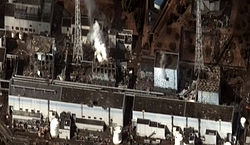
On March 11, 2011, a major nuclear accident started at the Fukushima Daiichi Nuclear Power Plant in Ōkuma, Fukushima, Japan. The direct cause was the Tōhoku earthquake and tsunami, which resulted in electrical grid failure and damaged nearly all of the power plant's backup energy sources. The subsequent inability to sufficiently cool reactors after shutdown compromised containment and resulted in the release of radioactive contaminants into the surrounding environment. The accident was rated seven (the maximum severity) on the International Nuclear Event Scale by Nuclear and Industrial Safety Agency, following a report by the JNES (Japan Nuclear Energy Safety Organization). It is regarded as the worst nuclear incident since the Chernobyl disaster in 1986, which was also rated a seven on the International Nuclear Event Scale.
According to the United Nations Scientific Committee on the Effects of Atomic Radiation, "no adverse health effects among Fukushima residents have been documented that are directly attributable to radiation exposure from the Fukushima Daiichi nuclear plant accident". Insurance compensation was paid for one death from lung cancer, but this does not prove a causal relationship between radiation and the cancer. Six other persons have been reported as having developed cancer or leukemia. Two workers were hospitalized because of radiation burns, and several other people sustained physical injuries as a consequence of the accident.
Criticisms have been made about the public perception of radiological hazards resulting from accidents and the implementation of evacuations (similar to the Chernobyl nuclear accident), as they were accused of causing more harm than they prevented. Following the accident, at least 164,000 residents of the surrounding area were permanently or temporarily displaced (either voluntarily or by evacuation order). The displacements resulted in at least 51 deaths as well as stress and fear of radiological hazards.
Investigations faulted lapses in safety and oversight, namely failures in risk assessment and evacuation planning. Controversy surrounds the disposal of treated wastewater once used to cool the reactor, resulting in numerous protests in neighboring countries.
The expense of cleaning up the radioactive contamination and compensation for the victims of the Fukushima nuclear accident was estimated by Japan's trade ministry in November 2016 to be 20 trillion yen (equivalent to 180 billion US dollars).
The Fukushima Daiichi Nuclear Power Plant consisted of six General Electric (GE) light water boiling water reactors (BWRs). Unit 1 was a GE type 3 BWR. Units 2–5 were type 4. Unit 6 was a type 5.
At the time of the Tōhoku earthquake on 11 March 2011, units 1–3 were operating. However, the spent fuel pools of all units still required cooling.
Many of the internal components and fuel assembly cladding are made from a zirconium alloy (Zircaloy) for its low neutron cross section. At normal operating temperatures (~300 °C (572 °F)), it is inert. However, above 1,200 °C (2,190 °F), Zircaloy can be oxidized by steam to form hydrogen gas or by uranium dioxide to form uranium metal. Both of these reactions are exothermic. In combination with the exothermic reaction of boron carbide with stainless steel, these reactions can contribute to the overheating of a reactor.
Fukushima nuclear accident
On March 11, 2011, a major nuclear accident started at the Fukushima Daiichi Nuclear Power Plant in Ōkuma, Fukushima, Japan. The direct cause was the Tōhoku earthquake and tsunami, which resulted in electrical grid failure and damaged nearly all of the power plant's backup energy sources. The subsequent inability to sufficiently cool reactors after shutdown compromised containment and resulted in the release of radioactive contaminants into the surrounding environment. The accident was rated seven (the maximum severity) on the International Nuclear Event Scale by Nuclear and Industrial Safety Agency, following a report by the JNES (Japan Nuclear Energy Safety Organization). It is regarded as the worst nuclear incident since the Chernobyl disaster in 1986, which was also rated a seven on the International Nuclear Event Scale.
According to the United Nations Scientific Committee on the Effects of Atomic Radiation, "no adverse health effects among Fukushima residents have been documented that are directly attributable to radiation exposure from the Fukushima Daiichi nuclear plant accident". Insurance compensation was paid for one death from lung cancer, but this does not prove a causal relationship between radiation and the cancer. Six other persons have been reported as having developed cancer or leukemia. Two workers were hospitalized because of radiation burns, and several other people sustained physical injuries as a consequence of the accident.
Criticisms have been made about the public perception of radiological hazards resulting from accidents and the implementation of evacuations (similar to the Chernobyl nuclear accident), as they were accused of causing more harm than they prevented. Following the accident, at least 164,000 residents of the surrounding area were permanently or temporarily displaced (either voluntarily or by evacuation order). The displacements resulted in at least 51 deaths as well as stress and fear of radiological hazards.
Investigations faulted lapses in safety and oversight, namely failures in risk assessment and evacuation planning. Controversy surrounds the disposal of treated wastewater once used to cool the reactor, resulting in numerous protests in neighboring countries.
The expense of cleaning up the radioactive contamination and compensation for the victims of the Fukushima nuclear accident was estimated by Japan's trade ministry in November 2016 to be 20 trillion yen (equivalent to 180 billion US dollars).
The Fukushima Daiichi Nuclear Power Plant consisted of six General Electric (GE) light water boiling water reactors (BWRs). Unit 1 was a GE type 3 BWR. Units 2–5 were type 4. Unit 6 was a type 5.
At the time of the Tōhoku earthquake on 11 March 2011, units 1–3 were operating. However, the spent fuel pools of all units still required cooling.
Many of the internal components and fuel assembly cladding are made from a zirconium alloy (Zircaloy) for its low neutron cross section. At normal operating temperatures (~300 °C (572 °F)), it is inert. However, above 1,200 °C (2,190 °F), Zircaloy can be oxidized by steam to form hydrogen gas or by uranium dioxide to form uranium metal. Both of these reactions are exothermic. In combination with the exothermic reaction of boron carbide with stainless steel, these reactions can contribute to the overheating of a reactor.
Recent media
Recent media