



Community hub
Recent from talks
Knowledge base stats:
Talk channels stats:
Members stats:
Automatic rifle
An automatic rifle is a type of autoloading rifle that is capable of fully automatic fire. Automatic rifles are generally select-fire weapons capable of firing in semi-automatic and automatic firing modes (some automatic rifles are capable of burst-fire as well). Automatic rifles are distinguished from semi-automatic rifles in their ability to fire more than one shot in succession once the trigger is pulled. Most automatic rifles are further subcategorized as battle rifles or assault rifles.
In June 1883 Hiram Maxim filed his first patent to do with automatic firearms covering semi-automatic and fully automatic Winchester and Martini-Henry rifles as well as an original automatic rifle and blowback- and recoil-operated machine guns, both single and multi-barrelled.
In 1885 Ferdinand Mannlicher made an experimental self-loader based on work begun in 1883 in both semi-automatic and fully automatic modes. It was an impractical failure due to fouling by its black powder ammunition, but it influenced later designs. Furthermore, Mannlicher produced smokeless powder automatic rifles from the early 1890s onwards until his death in 1904.
One of the world's first automatic rifles was the Italian Cei-Rigotti. This rifle started out as an 1891 gas-operated conversion of the Vetterli rifle, which received positive approval and was even adopted after further refinements in 1895 for the Royal Italian Navy, but although up to 2000 rifles were ordered, the order never came through for as yet unknown reasons. Another version of the Cei-Rigotti was presented in 1900, these 6.5mm Carcano or 7.65×53mm gas-operated, selective-fire carbines attracted considerable attention at the time. They used 10-, 20- and 50-round box magazines. The Cei-Rigotti had several failings, including frequent jams and erratic shooting. In the end, no Army took an interest in the design and the rifle was abandoned before it could be further developed. Although the rifle was never officially adopted by any military, aside from the 1895 variant which never came through, it was tested extensively by the Italian Army during the lead-up to the First World War.
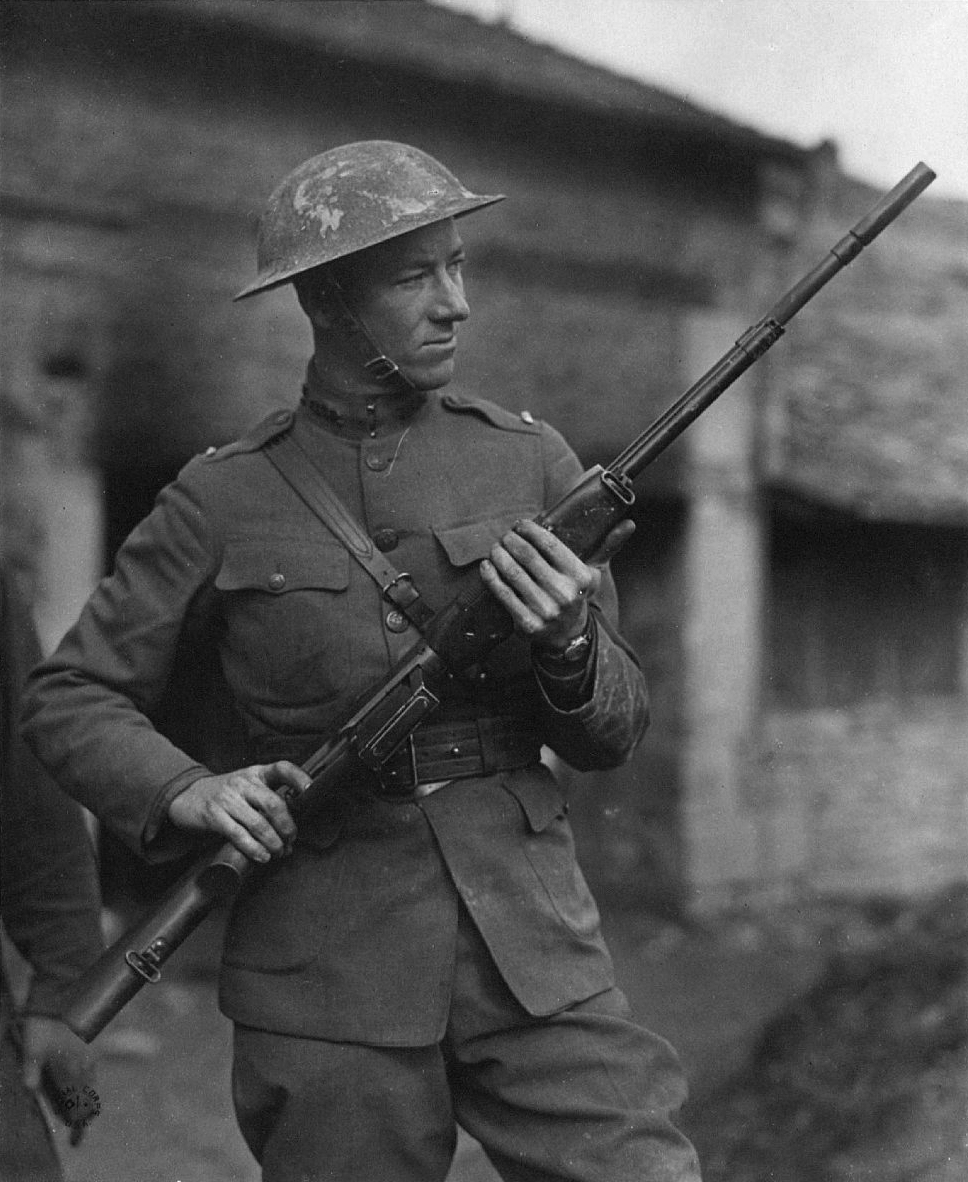
The Chauchat, designed in 1907, was one of the first automatic rifles to be adopted by a military. Its official design was the Fusil Mitrailleur Modele 1915 CSRG. It was placed into French Infantry in 1916, and was used by the French army in the First World War. The Chauchat in 8mm Lebel was also extensively used in 1917–18 by the American Expeditionary Forces (A.E.F.), where it was officially designated as the "Automatic Rifle, Model 1915 (Chauchat)".
The Lewis Gun was invented in 1911 by Isaac Newton Lewis and first mass-produced in Belgium in 1913 for the .303 British cartridge, and widely used by the British army in the First World War, both by infantry and fitted to aircraft. Pan magazines are secured above the breech, holding either 47 or 97 rounds. Cooling fins surround the barrel. The weapon is gas operated and fires automatically at 500-600 rounds per minute.
More than 50,000 Lewis guns were produced during WW1, becoming the most common automatic weapon used by British and American troops. Although superseded by the Bren gun by 1939, nearly 60,000 Lewis guns were refurbished and reissued to British forces after the Dunkirk evacuation of 1940.
The Fedorov Avtomat (also anglicized as Federov, Russian: Автомат Фёдорова) or FA was a select-fire, crew-served automatic rifle and was one of the first practical automatic rifles, designed by Vladimir Grigoryevich Fyodorov in 1915 and produced in the Russian Empire and later in the Russian Soviet Federative Socialist Republic. A total of 3,200 Fedorov rifles were manufactured between 1915 and 1924 in the city of Kovrov; the vast majority of them were made after 1920. The weapon saw limited combat in World War I, but was used more substantially in the Russian Civil War and in the Winter War. In 1916, the Weapons Committee of the Russian Army made a decision to order no less than 25,000 Fedorov automatic rifles. In the summer of 1916, a company from the 189th Izmail Regiment was equipped with 8 Fedorov Avtomats. Trained in tactics with the new weapon, they concluded that the Fedorov worked best as a crew served weapon. The gunner armed with the Fedorov and an ammo bearer armed with an Arisaka rifle. As both weapons used the same ammo and same 5 round stripper clips, this allowed for the greatest flexibility. It also allowed for the ammo bearer to fire defensively, while the gunner reloaded. It was also recommended that the primary mode of fire be in semi-automatic, as the Fedorov's would rapidly overheat in full-auto. Some consider it to be an "early predecessor" or "ancestor" to the modern assault rifle, while others believe that the Fedorov Avtomat was the world's first assault rifle.
Hub AI
Automatic rifle AI simulator
(@Automatic rifle_simulator)
Automatic rifle
An automatic rifle is a type of autoloading rifle that is capable of fully automatic fire. Automatic rifles are generally select-fire weapons capable of firing in semi-automatic and automatic firing modes (some automatic rifles are capable of burst-fire as well). Automatic rifles are distinguished from semi-automatic rifles in their ability to fire more than one shot in succession once the trigger is pulled. Most automatic rifles are further subcategorized as battle rifles or assault rifles.
In June 1883 Hiram Maxim filed his first patent to do with automatic firearms covering semi-automatic and fully automatic Winchester and Martini-Henry rifles as well as an original automatic rifle and blowback- and recoil-operated machine guns, both single and multi-barrelled.
In 1885 Ferdinand Mannlicher made an experimental self-loader based on work begun in 1883 in both semi-automatic and fully automatic modes. It was an impractical failure due to fouling by its black powder ammunition, but it influenced later designs. Furthermore, Mannlicher produced smokeless powder automatic rifles from the early 1890s onwards until his death in 1904.
One of the world's first automatic rifles was the Italian Cei-Rigotti. This rifle started out as an 1891 gas-operated conversion of the Vetterli rifle, which received positive approval and was even adopted after further refinements in 1895 for the Royal Italian Navy, but although up to 2000 rifles were ordered, the order never came through for as yet unknown reasons. Another version of the Cei-Rigotti was presented in 1900, these 6.5mm Carcano or 7.65×53mm gas-operated, selective-fire carbines attracted considerable attention at the time. They used 10-, 20- and 50-round box magazines. The Cei-Rigotti had several failings, including frequent jams and erratic shooting. In the end, no Army took an interest in the design and the rifle was abandoned before it could be further developed. Although the rifle was never officially adopted by any military, aside from the 1895 variant which never came through, it was tested extensively by the Italian Army during the lead-up to the First World War.
The Chauchat, designed in 1907, was one of the first automatic rifles to be adopted by a military. Its official design was the Fusil Mitrailleur Modele 1915 CSRG. It was placed into French Infantry in 1916, and was used by the French army in the First World War. The Chauchat in 8mm Lebel was also extensively used in 1917–18 by the American Expeditionary Forces (A.E.F.), where it was officially designated as the "Automatic Rifle, Model 1915 (Chauchat)".
The Lewis Gun was invented in 1911 by Isaac Newton Lewis and first mass-produced in Belgium in 1913 for the .303 British cartridge, and widely used by the British army in the First World War, both by infantry and fitted to aircraft. Pan magazines are secured above the breech, holding either 47 or 97 rounds. Cooling fins surround the barrel. The weapon is gas operated and fires automatically at 500-600 rounds per minute.
More than 50,000 Lewis guns were produced during WW1, becoming the most common automatic weapon used by British and American troops. Although superseded by the Bren gun by 1939, nearly 60,000 Lewis guns were refurbished and reissued to British forces after the Dunkirk evacuation of 1940.
The Fedorov Avtomat (also anglicized as Federov, Russian: Автомат Фёдорова) or FA was a select-fire, crew-served automatic rifle and was one of the first practical automatic rifles, designed by Vladimir Grigoryevich Fyodorov in 1915 and produced in the Russian Empire and later in the Russian Soviet Federative Socialist Republic. A total of 3,200 Fedorov rifles were manufactured between 1915 and 1924 in the city of Kovrov; the vast majority of them were made after 1920. The weapon saw limited combat in World War I, but was used more substantially in the Russian Civil War and in the Winter War. In 1916, the Weapons Committee of the Russian Army made a decision to order no less than 25,000 Fedorov automatic rifles. In the summer of 1916, a company from the 189th Izmail Regiment was equipped with 8 Fedorov Avtomats. Trained in tactics with the new weapon, they concluded that the Fedorov worked best as a crew served weapon. The gunner armed with the Fedorov and an ammo bearer armed with an Arisaka rifle. As both weapons used the same ammo and same 5 round stripper clips, this allowed for the greatest flexibility. It also allowed for the ammo bearer to fire defensively, while the gunner reloaded. It was also recommended that the primary mode of fire be in semi-automatic, as the Fedorov's would rapidly overheat in full-auto. Some consider it to be an "early predecessor" or "ancestor" to the modern assault rifle, while others believe that the Fedorov Avtomat was the world's first assault rifle.