
Recent from talks
FADEC
Knowledge base stats:
Talk channels stats:
Members stats:
FADEC
In aviation, a full authority digital engine (or electronics) control (FADEC) (/ˈfeɪdɛk/) is a system consisting of a digital computer, called an "electronic engine controller" (EEC) or "engine control unit" (ECU), and its related accessories that control all aspects of aircraft engine performance. FADECs have been produced for both piston engines and jet engines.
The goal of any engine control system is to allow the engine to perform at maximum efficiency for a given condition. Originally, engine control systems consisted of simple mechanical linkages connected physically to the engine. By moving these levers the pilot or the flight engineer could control fuel flow, power output, and many other engine parameters. The Kommandogerät mechanical/hydraulic engine control unit for Germany's BMW 801 piston aviation radial engine of World War II was just one notable example of this in its later stages of development. This mechanical engine control was progressively replaced first by analogue electronic engine control and, later, digital engine control.
Analogue electronic control varies an electrical signal to communicate the desired engine settings. The system was an evident improvement over mechanical control but had its drawbacks, including common electronic noise interference and reliability issues. Full authority analogue control was used in the 1960s and introduced as a component of the Rolls-Royce/Snecma Olympus 593 engine of the supersonic transport aircraft Concorde. However, the more critical inlet control was digital on the production aircraft.
Digital electronic control followed. In 1968, Rolls-Royce and Elliott Automation, in conjunction with the National Gas Turbine Establishment, worked on a digital engine control system that completed several hundred hours of operation on a Rolls-Royce Olympus Mk 320. In the 1970s, NASA and Pratt and Whitney experimented with their first experimental FADEC, first flown on an F-111 fitted with a highly modified Pratt & Whitney TF30 left engine. The experiments led to Pratt & Whitney F100 and Pratt & Whitney PW2000 being the first military and civil engines, respectively, fitted with FADEC, and later the Pratt & Whitney PW4000 as the first commercial "dual FADEC" engine. The first FADEC in service was the Rolls-Royce Pegasus engine developed for the Harrier II by Dowty and Smiths Industries Controls.
True full authority digital engine controls have no form of manual override nor manual controls available, placing full authority over all of the operating parameters of the engine in the hands of the computer. If a total FADEC failure occurs, the engine fails. If the engine is controlled digitally and electronically but allows for manual override, it is considered to be an EEC or ECU. An EEC, though a component of a FADEC, is not by itself FADEC. When standing alone, the EEC makes all of the decisions until the pilot wishes to intervene. The term FADEC is often misused for partial digital engine controls, such as those only electronically controlling fuel and ignition. A turbocharged piston engine would require digital control over all intake airflow to meet the definition of FADEC.
FADEC works by receiving multiple input variables of the current flight condition including air density, power lever request position, engine temperatures, engine pressures, and many other parameters. The inputs are received by the EEC and analyzed up to 70 times per second. Engine operating parameters such as fuel flow, stator vane position, air bleed valve position, and others are computed from this data and applied as appropriate. FADEC also controls engine starting and restarting. The FADEC's basic purpose is to provide optimum engine efficiency for a given flight condition.
FADEC not only provides for efficient engine operation, it also allows the manufacturer to program engine limitations and receive engine health and maintenance reports. For example, to avoid exceeding a certain engine temperature, the FADEC can be programmed to automatically take the necessary measures without pilot intervention.
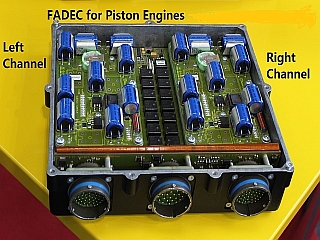
With the operation of the engines relying on automation, safety is a great concern. Redundancy is provided in the form of two or more separate but identical digital channels. Each channel may provide all engine functions without restriction. FADEC also monitors a variety of data coming from the engine subsystems and related aircraft systems, providing for fault tolerant engine control.
Hub AI
FADEC AI simulator
(@FADEC_simulator)
FADEC
In aviation, a full authority digital engine (or electronics) control (FADEC) (/ˈfeɪdɛk/) is a system consisting of a digital computer, called an "electronic engine controller" (EEC) or "engine control unit" (ECU), and its related accessories that control all aspects of aircraft engine performance. FADECs have been produced for both piston engines and jet engines.
The goal of any engine control system is to allow the engine to perform at maximum efficiency for a given condition. Originally, engine control systems consisted of simple mechanical linkages connected physically to the engine. By moving these levers the pilot or the flight engineer could control fuel flow, power output, and many other engine parameters. The Kommandogerät mechanical/hydraulic engine control unit for Germany's BMW 801 piston aviation radial engine of World War II was just one notable example of this in its later stages of development. This mechanical engine control was progressively replaced first by analogue electronic engine control and, later, digital engine control.
Analogue electronic control varies an electrical signal to communicate the desired engine settings. The system was an evident improvement over mechanical control but had its drawbacks, including common electronic noise interference and reliability issues. Full authority analogue control was used in the 1960s and introduced as a component of the Rolls-Royce/Snecma Olympus 593 engine of the supersonic transport aircraft Concorde. However, the more critical inlet control was digital on the production aircraft.
Digital electronic control followed. In 1968, Rolls-Royce and Elliott Automation, in conjunction with the National Gas Turbine Establishment, worked on a digital engine control system that completed several hundred hours of operation on a Rolls-Royce Olympus Mk 320. In the 1970s, NASA and Pratt and Whitney experimented with their first experimental FADEC, first flown on an F-111 fitted with a highly modified Pratt & Whitney TF30 left engine. The experiments led to Pratt & Whitney F100 and Pratt & Whitney PW2000 being the first military and civil engines, respectively, fitted with FADEC, and later the Pratt & Whitney PW4000 as the first commercial "dual FADEC" engine. The first FADEC in service was the Rolls-Royce Pegasus engine developed for the Harrier II by Dowty and Smiths Industries Controls.
True full authority digital engine controls have no form of manual override nor manual controls available, placing full authority over all of the operating parameters of the engine in the hands of the computer. If a total FADEC failure occurs, the engine fails. If the engine is controlled digitally and electronically but allows for manual override, it is considered to be an EEC or ECU. An EEC, though a component of a FADEC, is not by itself FADEC. When standing alone, the EEC makes all of the decisions until the pilot wishes to intervene. The term FADEC is often misused for partial digital engine controls, such as those only electronically controlling fuel and ignition. A turbocharged piston engine would require digital control over all intake airflow to meet the definition of FADEC.
FADEC works by receiving multiple input variables of the current flight condition including air density, power lever request position, engine temperatures, engine pressures, and many other parameters. The inputs are received by the EEC and analyzed up to 70 times per second. Engine operating parameters such as fuel flow, stator vane position, air bleed valve position, and others are computed from this data and applied as appropriate. FADEC also controls engine starting and restarting. The FADEC's basic purpose is to provide optimum engine efficiency for a given flight condition.
FADEC not only provides for efficient engine operation, it also allows the manufacturer to program engine limitations and receive engine health and maintenance reports. For example, to avoid exceeding a certain engine temperature, the FADEC can be programmed to automatically take the necessary measures without pilot intervention.
With the operation of the engines relying on automation, safety is a great concern. Redundancy is provided in the form of two or more separate but identical digital channels. Each channel may provide all engine functions without restriction. FADEC also monitors a variety of data coming from the engine subsystems and related aircraft systems, providing for fault tolerant engine control.
Recent media