



Community hub
Recent from talks
Knowledge base stats:
Talk channels stats:
Members stats:
Fusor
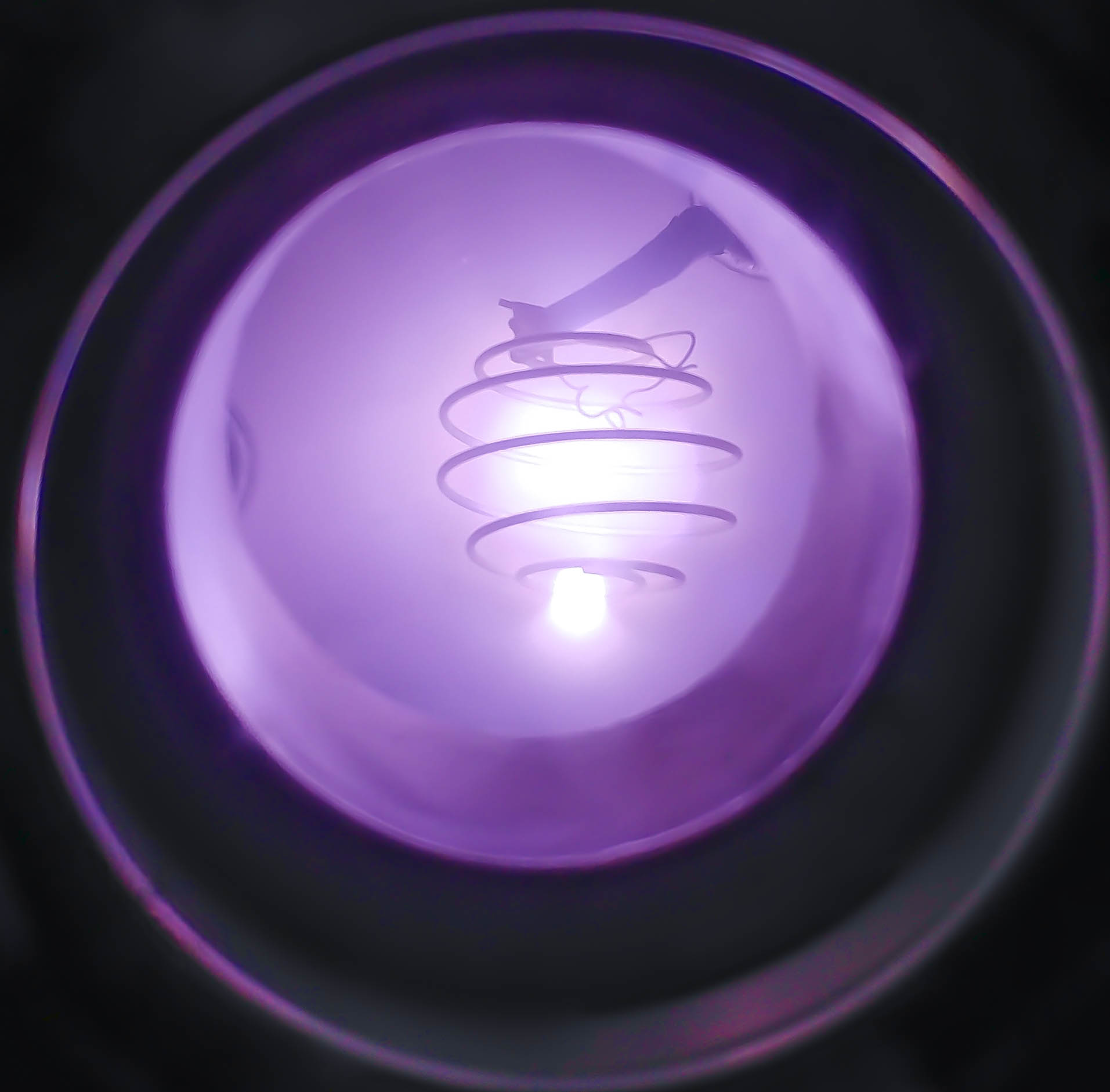
A fusor is a device that uses an electric field to heat ions to a temperature at which they undergo nuclear fusion. The machine induces a potential difference between two metal cages, inside a vacuum. Positive ions fall down this voltage drop, building up speed. If they collide in the center, they can fuse. This is one kind of an inertial electrostatic confinement device – a branch of fusion research.
A Farnsworth–Hirsch fusor is the most common type of fusor. This design came from work by Philo T. Farnsworth in 1964 and Robert L. Hirsch in 1967. A variant type of fusor had been proposed previously by William Elmore, James L. Tuck, and Ken Watson at the Los Alamos National Laboratory though they never built the machine.
Fusors have been built by various institutions. These include academic institutions such as the University of Wisconsin–Madison, the Massachusetts Institute of Technology and government entities, such as the Atomic Energy Organization of Iran and the Turkish Atomic Energy Authority. Fusors have also been developed commercially, as sources for neutrons by DaimlerChrysler Aerospace and as a method for generating medical isotopes. Fusors have also become very popular for hobbyists and amateurs. A growing number of amateurs have performed nuclear fusion using simple fusor machines. However, fusors are not considered a viable concept for large-scale energy production by scientists.
Fusion takes place when nuclei approach to a distance where the nuclear force can pull them together into a single larger nucleus. Opposing this close approach are the positive charges in the nuclei, which force them apart due to the electrostatic force. In order to produce fusion events, the nuclei must have initial energy great enough to allow them to overcome this Coulomb barrier. As the nuclear force is increased with the number of nucleons, protons and neutrons, and the electromagnetic force is increased with the number of protons only, the easiest atoms to fuse are isotopes of hydrogen, deuterium with one neutron, and tritium with two. With hydrogen fuels, about 3 to 10 keV is needed to allow the reaction to take place.
Traditional approaches to fusion power have generally attempted to heat the fuel to temperatures where the Maxwell-Boltzmann distribution of their resulting energies is high enough that some of the particles in the long tail have the required energy. High enough in this case is such that the rate of the fusion reactions produces enough energy to offset energy losses to the environment and thus heat the surrounding fuel to the same temperatures and produce a self-sustaining reaction known as ignition. Calculations show this takes place at about 50 million kelvin (K), although higher numbers on the order of 100 million K are desirable in practical machines. Due to the extremely high temperatures, fusion reactions are also referred to as thermonuclear.
When atoms are heated to temperatures corresponding to thousands of degrees, the electrons become increasingly free of their nucleus. This leads to a gas-like state of matter known as a plasma, consisting of free nuclei known as ions, and their former electrons. As a plasma consists of free-moving charges, it can be controlled using magnetic and electrical fields. Fusion devices use this capability to retain the fuel at millions of degrees.
The fusor is part of a broader class of devices that attempts to give the fuel fusion-relevant energies by directly accelerating the ions toward each other. In the case of the fusor, this is accomplished with electrostatic forces. For every volt that an ion of ±1 charge is accelerated across it gains 1 electronvolt in energy. To reach the required ~10 keV, a voltage of 10 kV is required, applied to both particles. For comparison, the electron gun in a typical television cathode-ray tube is on the order of 3 to 6 kV, so the complexity of such a device is fairly limited. For a variety of reasons, energies on the order of 15 keV are used. This corresponds to the average kinetic energy at a temperature of approximately 174 million Kelvin, a typical magnetic confinement fusion plasma temperature.
The problem with this colliding beam fusion approach, in general, is that the ions will most likely never hit each other no matter how precisely aimed. Even the most minor misalignment will cause the particles to scatter and thus fail to fuse. It is simple to demonstrate that the scattering chance is many orders of magnitude higher than the fusion rate, meaning that the vast majority of the energy supplied to the ions will go to waste and those fusion reactions that do occur cannot make up for these losses. To be energy positive, a fusion device must recycle these ions back into the fuel mass so that they have thousands or millions of such chances to fuse, and their energy must be retained as much as possible during this period.
Hub AI
Fusor AI simulator
(@Fusor_simulator)
Fusor
A fusor is a device that uses an electric field to heat ions to a temperature at which they undergo nuclear fusion. The machine induces a potential difference between two metal cages, inside a vacuum. Positive ions fall down this voltage drop, building up speed. If they collide in the center, they can fuse. This is one kind of an inertial electrostatic confinement device – a branch of fusion research.
A Farnsworth–Hirsch fusor is the most common type of fusor. This design came from work by Philo T. Farnsworth in 1964 and Robert L. Hirsch in 1967. A variant type of fusor had been proposed previously by William Elmore, James L. Tuck, and Ken Watson at the Los Alamos National Laboratory though they never built the machine.
Fusors have been built by various institutions. These include academic institutions such as the University of Wisconsin–Madison, the Massachusetts Institute of Technology and government entities, such as the Atomic Energy Organization of Iran and the Turkish Atomic Energy Authority. Fusors have also been developed commercially, as sources for neutrons by DaimlerChrysler Aerospace and as a method for generating medical isotopes. Fusors have also become very popular for hobbyists and amateurs. A growing number of amateurs have performed nuclear fusion using simple fusor machines. However, fusors are not considered a viable concept for large-scale energy production by scientists.
Fusion takes place when nuclei approach to a distance where the nuclear force can pull them together into a single larger nucleus. Opposing this close approach are the positive charges in the nuclei, which force them apart due to the electrostatic force. In order to produce fusion events, the nuclei must have initial energy great enough to allow them to overcome this Coulomb barrier. As the nuclear force is increased with the number of nucleons, protons and neutrons, and the electromagnetic force is increased with the number of protons only, the easiest atoms to fuse are isotopes of hydrogen, deuterium with one neutron, and tritium with two. With hydrogen fuels, about 3 to 10 keV is needed to allow the reaction to take place.
Traditional approaches to fusion power have generally attempted to heat the fuel to temperatures where the Maxwell-Boltzmann distribution of their resulting energies is high enough that some of the particles in the long tail have the required energy. High enough in this case is such that the rate of the fusion reactions produces enough energy to offset energy losses to the environment and thus heat the surrounding fuel to the same temperatures and produce a self-sustaining reaction known as ignition. Calculations show this takes place at about 50 million kelvin (K), although higher numbers on the order of 100 million K are desirable in practical machines. Due to the extremely high temperatures, fusion reactions are also referred to as thermonuclear.
When atoms are heated to temperatures corresponding to thousands of degrees, the electrons become increasingly free of their nucleus. This leads to a gas-like state of matter known as a plasma, consisting of free nuclei known as ions, and their former electrons. As a plasma consists of free-moving charges, it can be controlled using magnetic and electrical fields. Fusion devices use this capability to retain the fuel at millions of degrees.
The fusor is part of a broader class of devices that attempts to give the fuel fusion-relevant energies by directly accelerating the ions toward each other. In the case of the fusor, this is accomplished with electrostatic forces. For every volt that an ion of ±1 charge is accelerated across it gains 1 electronvolt in energy. To reach the required ~10 keV, a voltage of 10 kV is required, applied to both particles. For comparison, the electron gun in a typical television cathode-ray tube is on the order of 3 to 6 kV, so the complexity of such a device is fairly limited. For a variety of reasons, energies on the order of 15 keV are used. This corresponds to the average kinetic energy at a temperature of approximately 174 million Kelvin, a typical magnetic confinement fusion plasma temperature.
The problem with this colliding beam fusion approach, in general, is that the ions will most likely never hit each other no matter how precisely aimed. Even the most minor misalignment will cause the particles to scatter and thus fail to fuse. It is simple to demonstrate that the scattering chance is many orders of magnitude higher than the fusion rate, meaning that the vast majority of the energy supplied to the ions will go to waste and those fusion reactions that do occur cannot make up for these losses. To be energy positive, a fusion device must recycle these ions back into the fuel mass so that they have thousands or millions of such chances to fuse, and their energy must be retained as much as possible during this period.