



Community hub
Recent from talks
Knowledge base stats:
Talk channels stats:
Members stats:
G protein-coupled receptor
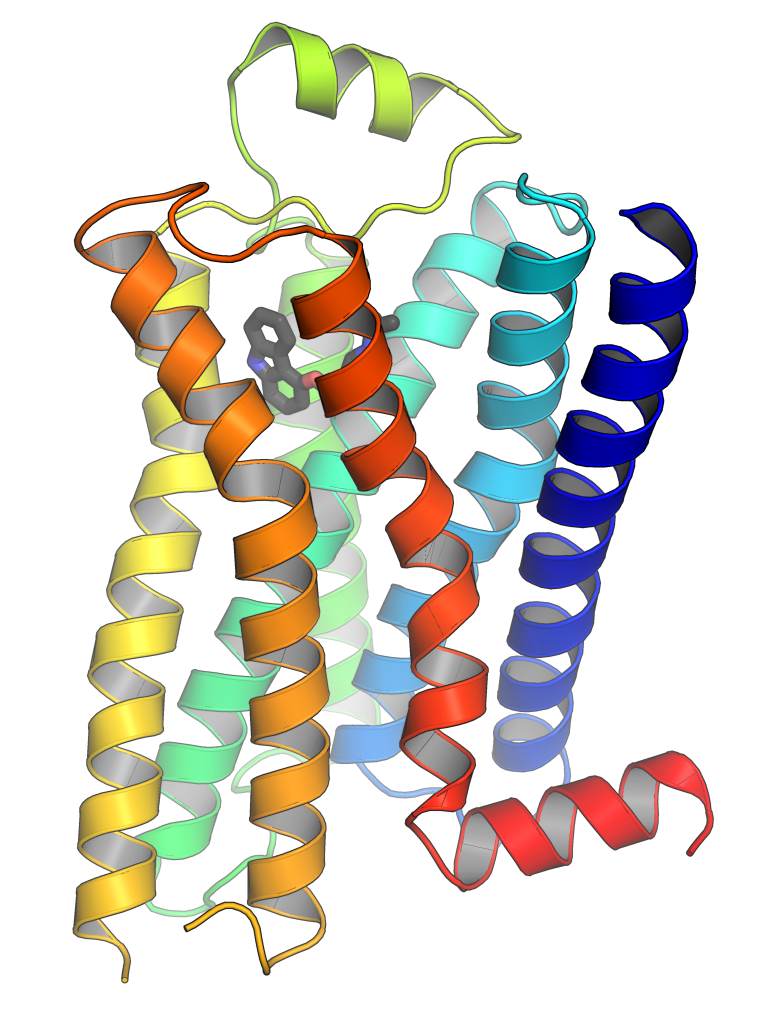
G protein-coupled receptors (GPCRs), also known as seven-(pass)-transmembrane domain receptors, 7TM receptors, heptahelical receptors, serpentine receptors, and G protein-linked receptors (GPLR), form a large group of evolutionarily related proteins that are cell surface receptors that detect molecules outside the cell and activate cellular responses. They are coupled with G proteins. They pass through the cell membrane seven times in the form of six loops (three extracellular loops interacting with ligand molecules, three intracellular loops interacting with G proteins, an N-terminal extracellular region and a C-terminal intracellular region) of amino acid residues, which is why they are sometimes referred to as seven-transmembrane receptors. Ligands can bind either to the extracellular N-terminus and loops (e.g. glutamate receptors) or to the binding site within transmembrane helices (rhodopsin-like family). They are all activated by agonists, although a spontaneous auto-activation of an empty receptor has also been observed.
G protein-coupled receptors are found only in eukaryotes, including yeast, and choanoflagellates. The ligands that bind and activate these receptors include light-sensitive compounds, odors, pheromones, hormones, and neurotransmitters. They vary in size from small molecules to peptides, to large proteins. G protein-coupled receptors are involved in many diseases.
There are two principal signal transduction pathways involving the G protein-coupled receptors:
When a ligand binds to the GPCR it causes a conformational change in the GPCR, which allows it to act as a guanine nucleotide exchange factor (GEF). The GPCR can then activate an associated G protein by exchanging the GDP bound to the G protein for a GTP. The G protein's α subunit, together with the bound GTP, can then dissociate from the β and γ subunits to further affect intracellular signaling proteins or target functional proteins directly depending on the α subunit type (Gαs, Gαi/o, Gαq/11, Gα12/13).
GPCRs are an important drug target, and approximately 34% of all Food and Drug Administration (FDA) approved drugs target 108 members of this family. The global sales volume for these drugs is estimated to be 180 billion US dollars as of 2018[update]. It is estimated that GPCRs are targets for about 50% of drugs currently on the market, mainly due to their involvement in signaling pathways related to many diseases i.e. mental, metabolic including endocrinological disorders, immunological including viral infections, cardiovascular, inflammatory, senses disorders, and cancer. The long ago discovered association between GPCRs and many endogenous and exogenous substances, resulting in e.g. analgesia, is another dynamically developing field of the pharmaceutical research.
With the determination of the first structure of the complex between a G-protein coupled receptor (GPCR) and a G-protein trimer (Gαβγ) in 2011 a new chapter of GPCR research was opened for structural investigations of global switches with more than one protein being investigated. The previous breakthroughs involved determination of the crystal structure of the first GPCR, rhodopsin, in 2000 and the crystal structure of the first GPCR with a diffusible ligand (β2AR) in 2007. The way in which the seven transmembrane helices of a GPCR are arranged into a bundle was suspected based on the low-resolution model of frog rhodopsin from cryogenic electron microscopy studies of the two-dimensional crystals. The crystal structure of rhodopsin, that came up three years later, was not a surprise apart from the presence of an additional cytoplasmic helix H8 and a precise location of a loop covering retinal binding site. However, it provided a scaffold which was hoped to be a universal template for homology modeling and drug design for other GPCRs – a notion that proved to be too optimistic.[citation needed]
Results 7 years later were surprising because the crystallization of β2-adrenergic receptor (β2AR) with a diffusible ligand revealed quite a different shape of the receptor extracellular side than that of rhodopsin. This area is important because it is responsible for the ligand binding and is targeted by many drugs. Moreover, the ligand binding site was much more spacious than in the rhodopsin structure and was open to the exterior. In the other receptors crystallized shortly afterwards the binding side was even more easily accessible to the ligand. New structures complemented with biochemical investigations uncovered mechanisms of action of molecular switches which modulate the structure of the receptor leading to activation states for agonists or to complete or partial inactivation states for inverse agonists.
The 2012 Nobel Prize in Chemistry was awarded to Brian Kobilka and Robert Lefkowitz for their work that was "crucial for understanding how G protein-coupled receptors function". There have been at least seven other Nobel Prizes awarded for some aspect of G protein–mediated signaling. As of 2012, two of the top ten global best-selling drugs (Advair Diskus and Abilify) act by targeting G protein-coupled receptors.
Hub AI
G protein-coupled receptor AI simulator
(@G protein-coupled receptor_simulator)
G protein-coupled receptor
G protein-coupled receptors (GPCRs), also known as seven-(pass)-transmembrane domain receptors, 7TM receptors, heptahelical receptors, serpentine receptors, and G protein-linked receptors (GPLR), form a large group of evolutionarily related proteins that are cell surface receptors that detect molecules outside the cell and activate cellular responses. They are coupled with G proteins. They pass through the cell membrane seven times in the form of six loops (three extracellular loops interacting with ligand molecules, three intracellular loops interacting with G proteins, an N-terminal extracellular region and a C-terminal intracellular region) of amino acid residues, which is why they are sometimes referred to as seven-transmembrane receptors. Ligands can bind either to the extracellular N-terminus and loops (e.g. glutamate receptors) or to the binding site within transmembrane helices (rhodopsin-like family). They are all activated by agonists, although a spontaneous auto-activation of an empty receptor has also been observed.
G protein-coupled receptors are found only in eukaryotes, including yeast, and choanoflagellates. The ligands that bind and activate these receptors include light-sensitive compounds, odors, pheromones, hormones, and neurotransmitters. They vary in size from small molecules to peptides, to large proteins. G protein-coupled receptors are involved in many diseases.
There are two principal signal transduction pathways involving the G protein-coupled receptors:
When a ligand binds to the GPCR it causes a conformational change in the GPCR, which allows it to act as a guanine nucleotide exchange factor (GEF). The GPCR can then activate an associated G protein by exchanging the GDP bound to the G protein for a GTP. The G protein's α subunit, together with the bound GTP, can then dissociate from the β and γ subunits to further affect intracellular signaling proteins or target functional proteins directly depending on the α subunit type (Gαs, Gαi/o, Gαq/11, Gα12/13).
GPCRs are an important drug target, and approximately 34% of all Food and Drug Administration (FDA) approved drugs target 108 members of this family. The global sales volume for these drugs is estimated to be 180 billion US dollars as of 2018[update]. It is estimated that GPCRs are targets for about 50% of drugs currently on the market, mainly due to their involvement in signaling pathways related to many diseases i.e. mental, metabolic including endocrinological disorders, immunological including viral infections, cardiovascular, inflammatory, senses disorders, and cancer. The long ago discovered association between GPCRs and many endogenous and exogenous substances, resulting in e.g. analgesia, is another dynamically developing field of the pharmaceutical research.
With the determination of the first structure of the complex between a G-protein coupled receptor (GPCR) and a G-protein trimer (Gαβγ) in 2011 a new chapter of GPCR research was opened for structural investigations of global switches with more than one protein being investigated. The previous breakthroughs involved determination of the crystal structure of the first GPCR, rhodopsin, in 2000 and the crystal structure of the first GPCR with a diffusible ligand (β2AR) in 2007. The way in which the seven transmembrane helices of a GPCR are arranged into a bundle was suspected based on the low-resolution model of frog rhodopsin from cryogenic electron microscopy studies of the two-dimensional crystals. The crystal structure of rhodopsin, that came up three years later, was not a surprise apart from the presence of an additional cytoplasmic helix H8 and a precise location of a loop covering retinal binding site. However, it provided a scaffold which was hoped to be a universal template for homology modeling and drug design for other GPCRs – a notion that proved to be too optimistic.[citation needed]
Results 7 years later were surprising because the crystallization of β2-adrenergic receptor (β2AR) with a diffusible ligand revealed quite a different shape of the receptor extracellular side than that of rhodopsin. This area is important because it is responsible for the ligand binding and is targeted by many drugs. Moreover, the ligand binding site was much more spacious than in the rhodopsin structure and was open to the exterior. In the other receptors crystallized shortly afterwards the binding side was even more easily accessible to the ligand. New structures complemented with biochemical investigations uncovered mechanisms of action of molecular switches which modulate the structure of the receptor leading to activation states for agonists or to complete or partial inactivation states for inverse agonists.
The 2012 Nobel Prize in Chemistry was awarded to Brian Kobilka and Robert Lefkowitz for their work that was "crucial for understanding how G protein-coupled receptors function". There have been at least seven other Nobel Prizes awarded for some aspect of G protein–mediated signaling. As of 2012, two of the top ten global best-selling drugs (Advair Diskus and Abilify) act by targeting G protein-coupled receptors.