
Recent from talks
GV (nerve agent)
Knowledge base stats:
Talk channels stats:
Members stats:
GV (nerve agent)
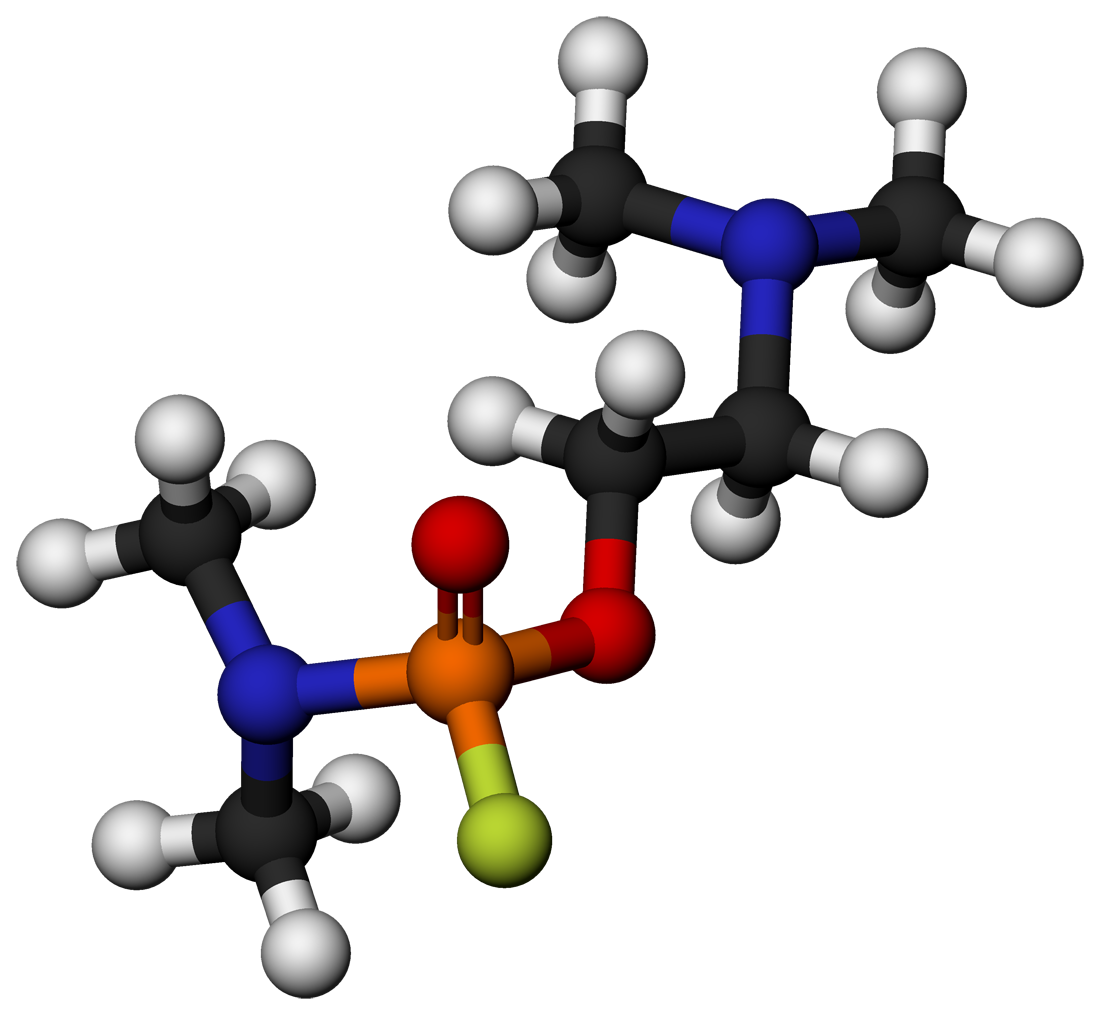
GV (IUPAC name: 2-(Dimethylamino)ethyl N,N-dimethylphosphoramidofluoridate), also known as EA-5365 and GP (USACC cryptonym), is an organophosphate nerve agent. GV is a part of a series of nerve agents with properties similar to the "G-series" and "V-series".
GV is an organophosphate derived from fluorotabun. It does not have a plane of symmetry and is therefore chiral. It has a melting point of -110 degrees Celsius, the lowest among all 5 GV agents.
GV is synthesized by various routes. It is synthesized on an industrial scale in a similar manner to tabun and sarin.
A solution of dimethylamine, hydrofluoric acid and deanol in a molar ratio of 4:1:1 is added dropwise to a phosphoryl chloride solution under agitation. The product is filtered from the cake and then distilled under reduced pressure.
4 (H3C)2NH + Cl3P(O) + (CH3)2N(CH2)2OH + F− + H+ → (H3C)2NP(O)FO(CH2)2N(CH3)2 + 3 Cl− + 3 (H3C)2NH+2
GV can be synthesized in a similar manner to sarin, from a reaction between an equimolar mixture of dichlor and difluor.
(H3C)2NCl2P(O) + (H3C)2NF2P(O) + 2 (CH3)2N(CH2)2OH → 2 (H3C)2NP(O)FO(CH2)2N(CH3)2 + 2 Cl− + 2 H+
Compared to GA, GB, and GD, it is relatively persistent in aqueous media.
Hub AI
GV (nerve agent) AI simulator
(@GV (nerve agent)_simulator)
GV (nerve agent)
GV (IUPAC name: 2-(Dimethylamino)ethyl N,N-dimethylphosphoramidofluoridate), also known as EA-5365 and GP (USACC cryptonym), is an organophosphate nerve agent. GV is a part of a series of nerve agents with properties similar to the "G-series" and "V-series".
GV is an organophosphate derived from fluorotabun. It does not have a plane of symmetry and is therefore chiral. It has a melting point of -110 degrees Celsius, the lowest among all 5 GV agents.
GV is synthesized by various routes. It is synthesized on an industrial scale in a similar manner to tabun and sarin.
A solution of dimethylamine, hydrofluoric acid and deanol in a molar ratio of 4:1:1 is added dropwise to a phosphoryl chloride solution under agitation. The product is filtered from the cake and then distilled under reduced pressure.
4 (H3C)2NH + Cl3P(O) + (CH3)2N(CH2)2OH + F− + H+ → (H3C)2NP(O)FO(CH2)2N(CH3)2 + 3 Cl− + 3 (H3C)2NH+2
GV can be synthesized in a similar manner to sarin, from a reaction between an equimolar mixture of dichlor and difluor.
(H3C)2NCl2P(O) + (H3C)2NF2P(O) + 2 (CH3)2N(CH2)2OH → 2 (H3C)2NP(O)FO(CH2)2N(CH3)2 + 2 Cl− + 2 H+
Compared to GA, GB, and GD, it is relatively persistent in aqueous media.
Recent media