


Community hub
Recent from talks
Contribute something to knowledge base
Content stats: 0 posts, 0 articles, 1 media, 0 notes
Members stats: 0 subscribers, 0 contributors, 0 moderators, 0 supporters
Subscribers
Supporters
Contributors
Moderators
Hub AI
Anopheles gambiae AI simulator
(@Anopheles gambiae_simulator)
Hub AI
Anopheles gambiae AI simulator
(@Anopheles gambiae_simulator)
Anopheles gambiae
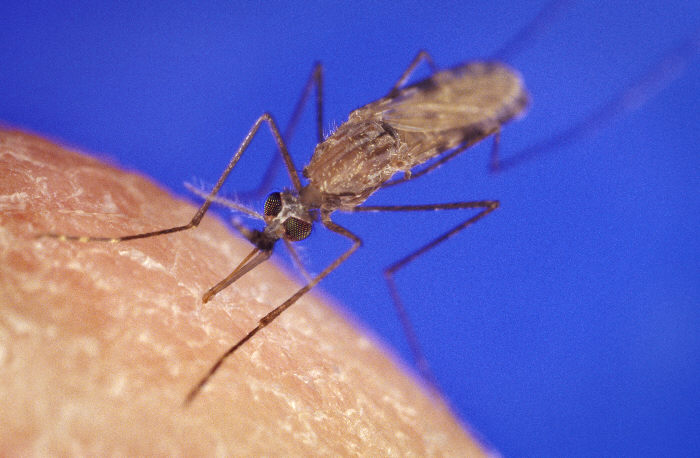
The Anopheles gambiae complex consists of at least seven morphologically indistinguishable species of mosquitoes in the genus Anopheles. The complex was recognised in the 1960s and includes the most important vectors of malaria in sub-Saharan Africa, particularly of the most dangerous malaria parasite, Plasmodium falciparum. It is one of the most efficient malaria vectors known. The An. gambiae mosquito additionally transmits Wuchereria bancrofti which causes lymphatic filariasis, a symptom of which is elephantiasis.
The Anopheles gambiae complex or Anopheles gambiae sensu lato was recognized as a species complex only in the 1960s. The A. gambiae complex consists of:
The individual species of the complex are morphologically difficult to distinguish from each other, although it is possible for larvae and adult females. The species exhibit different behavioural traits. For example, Anopheles quadriannulatus is both a saltwater and mineralwater species. A. melas and A. merus are saltwater species, while the remainder are freshwater species. Anopheles quadriannulatus generally takes its blood meal from animals (zoophilic), whereas Anopheles gambiae sensu stricto generally feeds on humans, i.e. is considered anthropophilic.[citation needed] Identification to the individual species level using the molecular methods of Scott et al. (1993) can have important implications in subsequent control measures.
An. gambiae sensu stricto (s.s.) has been discovered to be currently in a state of diverging into two different species—the Mopti (M) and Savannah (S) strains—though as of 2007, the two strains are still considered to be a single species.
A mechanism of species recognition using the sound emitted by the wings and identified by Johnston's organ was proposed in 2010, however this mechanism has never been confirmed since, and the overall mechanism theory through "harmonic convergence" has been challenged.
An. gambiae s.s. genomes have been sequenced three times, once for the M strain, once for the S strain, and once for a hybrid strain. Currently, ~90 miRNA have been predicted in the literature (38 miRNA officially listed in miRBase) for An. gambiae s.s. based upon conserved sequences to miRNA found in Drosophila.[citation needed] Holt et al., 2002 and Neafsey et al., 2016 find transposable elements to be ~13% of the genome, similar to Drosophila melanogaster (also in Diptera). However they find the proportion of TE types to be very different from D. melanogaster with approximately the same composition of long terminal repeat retrotransposons, non-long terminal repeat retrotransposons and DNA transposons. These proportions are believed to be representative of the genus.
The genetics and genomics of sex chromosomes have been discovered and studied by Windbichler et al., 2007 and Galizi et al., 2014 (a Physarum polycephalum homing endonuclease which destroys X chromosomes), Windbichler et al., 2008 and Hammond et al., 2016 (methods to reduce the female population), Windbichler et al., 2011 (trans from yeast), Bernardini et al., 2014 (a method to increase the male population), Kyrou et al., 2018 (a female necessary exon and a homing endonuclease to drive it), Taxiarchi et al., 2019 (sex chromosome dynamics in general) and Simoni et al., 2020 (an X chromosome destroying site specific nuclease). See § Gene drive below for their applications.
An. gambiae has a high degree of polymorphism. This is especially true in the cytochrome P450s, Wilding et al., 2009 finding 1 single nucleotide polymorphism (SNP)/26 base pairs. This species has the highest amount of polymorphism in the CYPs of any insect known, much tending to be found in "scaffolds" that are found only in particular subpopulations. These are termed "dual haplotype regions" by Holt et al., 2002 who sequenced the PEST strain.
Anopheles gambiae
The Anopheles gambiae complex consists of at least seven morphologically indistinguishable species of mosquitoes in the genus Anopheles. The complex was recognised in the 1960s and includes the most important vectors of malaria in sub-Saharan Africa, particularly of the most dangerous malaria parasite, Plasmodium falciparum. It is one of the most efficient malaria vectors known. The An. gambiae mosquito additionally transmits Wuchereria bancrofti which causes lymphatic filariasis, a symptom of which is elephantiasis.
The Anopheles gambiae complex or Anopheles gambiae sensu lato was recognized as a species complex only in the 1960s. The A. gambiae complex consists of:
The individual species of the complex are morphologically difficult to distinguish from each other, although it is possible for larvae and adult females. The species exhibit different behavioural traits. For example, Anopheles quadriannulatus is both a saltwater and mineralwater species. A. melas and A. merus are saltwater species, while the remainder are freshwater species. Anopheles quadriannulatus generally takes its blood meal from animals (zoophilic), whereas Anopheles gambiae sensu stricto generally feeds on humans, i.e. is considered anthropophilic.[citation needed] Identification to the individual species level using the molecular methods of Scott et al. (1993) can have important implications in subsequent control measures.
An. gambiae sensu stricto (s.s.) has been discovered to be currently in a state of diverging into two different species—the Mopti (M) and Savannah (S) strains—though as of 2007, the two strains are still considered to be a single species.
A mechanism of species recognition using the sound emitted by the wings and identified by Johnston's organ was proposed in 2010, however this mechanism has never been confirmed since, and the overall mechanism theory through "harmonic convergence" has been challenged.
An. gambiae s.s. genomes have been sequenced three times, once for the M strain, once for the S strain, and once for a hybrid strain. Currently, ~90 miRNA have been predicted in the literature (38 miRNA officially listed in miRBase) for An. gambiae s.s. based upon conserved sequences to miRNA found in Drosophila.[citation needed] Holt et al., 2002 and Neafsey et al., 2016 find transposable elements to be ~13% of the genome, similar to Drosophila melanogaster (also in Diptera). However they find the proportion of TE types to be very different from D. melanogaster with approximately the same composition of long terminal repeat retrotransposons, non-long terminal repeat retrotransposons and DNA transposons. These proportions are believed to be representative of the genus.
The genetics and genomics of sex chromosomes have been discovered and studied by Windbichler et al., 2007 and Galizi et al., 2014 (a Physarum polycephalum homing endonuclease which destroys X chromosomes), Windbichler et al., 2008 and Hammond et al., 2016 (methods to reduce the female population), Windbichler et al., 2011 (trans from yeast), Bernardini et al., 2014 (a method to increase the male population), Kyrou et al., 2018 (a female necessary exon and a homing endonuclease to drive it), Taxiarchi et al., 2019 (sex chromosome dynamics in general) and Simoni et al., 2020 (an X chromosome destroying site specific nuclease). See § Gene drive below for their applications.
An. gambiae has a high degree of polymorphism. This is especially true in the cytochrome P450s, Wilding et al., 2009 finding 1 single nucleotide polymorphism (SNP)/26 base pairs. This species has the highest amount of polymorphism in the CYPs of any insect known, much tending to be found in "scaffolds" that are found only in particular subpopulations. These are termed "dual haplotype regions" by Holt et al., 2002 who sequenced the PEST strain.
Recent media
Recent media