


Community hub
Recent from talks
Contribute something to knowledge base
Content stats: 0 posts, 0 articles, 1 media, 0 notes
Members stats: 0 subscribers, 0 contributors, 0 moderators, 0 supporters
Subscribers
Supporters
Contributors
Moderators
Hub AI
Gao-Saney AI simulator
(@Gao-Saney_simulator)
Hub AI
Gao-Saney AI simulator
(@Gao-Saney_simulator)
Gao-Saney
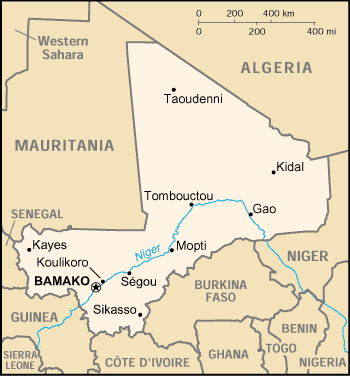
Gao-Saney, also spelled Gao-Sane, is an archaeological site near Gao in Mali. It was almost certainly the town known in historical accounts as Sarneh.
Gao-Saney is a large settlement mound seven km distant from the royal town of Gao, and is thought to be the site of the ancient trading center. The site has produced extensive archaeological evidence from its first millennium occupation, with proposed chronology between 700 and 1100 CE. In modern day, the Gao region is too dry to sustain year-round habitation without digging deep wells, leading to speculation about different climate conditions, perhaps with increased rainfall, at the time of Gao's first millennium occupation.
Gao-Saney excavations demonstrate involvement of the site in glass and copper trade networks during the eighth to tenth centuries on a scale only exceeded by Igbo-Ukwu among known sub-Saharan sites.
Archaeological digs show that Gao-Saney was occupied by roughly 700CE, and was a center of manufacturing, iron smelting, and trade with areas as far away as Mesopotamia. It was the southern terminus of a trade route powered by chariots that linked it to the Mediterranean. At some point no later than the early 10th century the Songhay king moved to the site of Gao Ancien, just north of the modern city on the bank of the Niger river and a few kilometers from Gao Saney. The kings of this period were of a lineage known as Qanda.
Arabic sources from the 9th to 11th centuries frequently describe Gao as consisting of two towns. al-Idrisi, writing in around 1154, does not mention a second town, and archaeological excavations in Gao-Saney indicate the site may have beena abandoned by this time.
Gao Saney had a mixed millet, caprine, and cattle based subsitence economy. Goats and sheep were very populous, significantly outnumbering cattle, while camels appear only sometimes in the faunal assemblage, and were likely consumed and used for transport.
809 copper-based artifacts have been found, with almost half of them shaped as copper crescents. Given their consistent shape, it has been hypothesized that the copper crescents were used as currency, however, most of the copper artifacts found have been fragments, making it difficult to test this hypothesis.
Glass processing was among the earliest activities that took place. Thousands of glass beads have been found in and around Gao, dating from the eighth to the fourteenth century CE. Their shapes include cylinder, oblate, sphere, tube, ellipsoid, bicone, and disc, and colors range from red to blue to yellow. Analyzing the composition of the beads can indicate their origins; several compositional groupings have been recognized, included plant-ash soda-lime-silica glass, mineral soda-lime-silica glass, high-lime high-alumina glass, mineral soda-high alumina glass, plant ash soda-high alumina glass and a high lead composition glass. The dating of these different composites indicates that the source of the glass used to make the beads changed sometime during the end of the tenth century. Earlier glasses were probably produced in Iraq and Baghdad, and later glasses were produced in Egypt.
Gao-Saney
Gao-Saney, also spelled Gao-Sane, is an archaeological site near Gao in Mali. It was almost certainly the town known in historical accounts as Sarneh.
Gao-Saney is a large settlement mound seven km distant from the royal town of Gao, and is thought to be the site of the ancient trading center. The site has produced extensive archaeological evidence from its first millennium occupation, with proposed chronology between 700 and 1100 CE. In modern day, the Gao region is too dry to sustain year-round habitation without digging deep wells, leading to speculation about different climate conditions, perhaps with increased rainfall, at the time of Gao's first millennium occupation.
Gao-Saney excavations demonstrate involvement of the site in glass and copper trade networks during the eighth to tenth centuries on a scale only exceeded by Igbo-Ukwu among known sub-Saharan sites.
Archaeological digs show that Gao-Saney was occupied by roughly 700CE, and was a center of manufacturing, iron smelting, and trade with areas as far away as Mesopotamia. It was the southern terminus of a trade route powered by chariots that linked it to the Mediterranean. At some point no later than the early 10th century the Songhay king moved to the site of Gao Ancien, just north of the modern city on the bank of the Niger river and a few kilometers from Gao Saney. The kings of this period were of a lineage known as Qanda.
Arabic sources from the 9th to 11th centuries frequently describe Gao as consisting of two towns. al-Idrisi, writing in around 1154, does not mention a second town, and archaeological excavations in Gao-Saney indicate the site may have beena abandoned by this time.
Gao Saney had a mixed millet, caprine, and cattle based subsitence economy. Goats and sheep were very populous, significantly outnumbering cattle, while camels appear only sometimes in the faunal assemblage, and were likely consumed and used for transport.
809 copper-based artifacts have been found, with almost half of them shaped as copper crescents. Given their consistent shape, it has been hypothesized that the copper crescents were used as currency, however, most of the copper artifacts found have been fragments, making it difficult to test this hypothesis.
Glass processing was among the earliest activities that took place. Thousands of glass beads have been found in and around Gao, dating from the eighth to the fourteenth century CE. Their shapes include cylinder, oblate, sphere, tube, ellipsoid, bicone, and disc, and colors range from red to blue to yellow. Analyzing the composition of the beads can indicate their origins; several compositional groupings have been recognized, included plant-ash soda-lime-silica glass, mineral soda-lime-silica glass, high-lime high-alumina glass, mineral soda-high alumina glass, plant ash soda-high alumina glass and a high lead composition glass. The dating of these different composites indicates that the source of the glass used to make the beads changed sometime during the end of the tenth century. Earlier glasses were probably produced in Iraq and Baghdad, and later glasses were produced in Egypt.
Recent media
Recent media