
Recent from talks
Typhus
Knowledge base stats:
Talk channels stats:
Members stats:
Typhus
Typhus, also known as typhus fever, is a group of infectious diseases that include epidemic typhus, scrub typhus, and murine typhus. Common symptoms include fever, headache, and a rash. Typically these begin one to two weeks after exposure.
The diseases are caused by specific types of bacterial infection. Epidemic typhus is caused by Rickettsia prowazekii spread by body lice, scrub typhus is caused by Orientia tsutsugamushi spread by chiggers, and murine typhus is caused by Rickettsia typhi spread by fleas.
Vaccines have been developed, but none are commercially available. Prevention is achieved by reducing exposure to the organisms that spread the disease. Treatment is with the antibiotic doxycycline. Epidemic typhus generally occurs in outbreaks when poor sanitary conditions and crowding are present. While once common, it is now rare. Scrub typhus occurs in Southeast Asia, Japan, and northern Australia. Murine typhus occurs in tropical and subtropical areas of the world.
Typhus has been described since at least 1528. The name comes from the Greek tûphos (τῦφος), meaning 'hazy' or 'smoky' and commonly used as a word for delusion, describing the state of mind of those infected. While typhoid means 'typhus-like', typhus and typhoid fever are distinct diseases caused by different types of bacteria, the latter by specific strains of Salmonella typhi. However, in some languages such as German, the term typhus does mean 'typhoid fever', and the here-described typhus is called by another name, such as the language's equivalent of 'lice fever'.
These signs and symptoms refer to epidemic typhus, as it is the most important of the typhus group of diseases.
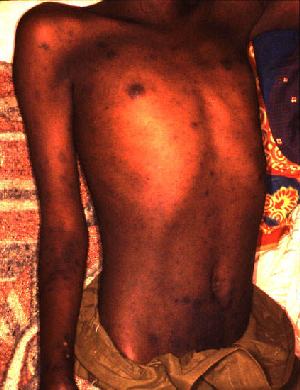
Signs and symptoms begin with sudden onset of fever and other flu-like symptoms about one to two weeks after being infected. Five to nine days after the symptoms have started, a rash typically begins on the trunk and spreads to the extremities. This rash eventually spreads over most of the body, sparing the face, palms, and soles. Signs of meningoencephalitis begin with the rash and continue into the second or third weeks.[citation needed] Other signs of meningoencephalitis include sensitivity to light (photophobia), altered mental status (delirium), or coma. Untreated cases are often fatal.
Signs of scrub typhus usually start within 1 to 2 weeks after being infected. These symptoms include fever, headaches, chills, swollen lymph nodes, nausea/vomiting, and a rash at the site of infection called an eschar. More severe symptoms may damage the lungs, brain, kidney, meninges, and heart.
Multiple diseases include the word "typhus" in their descriptions. Types include:
Hub AI
Typhus AI simulator
(@Typhus_simulator)
Typhus
Typhus, also known as typhus fever, is a group of infectious diseases that include epidemic typhus, scrub typhus, and murine typhus. Common symptoms include fever, headache, and a rash. Typically these begin one to two weeks after exposure.
The diseases are caused by specific types of bacterial infection. Epidemic typhus is caused by Rickettsia prowazekii spread by body lice, scrub typhus is caused by Orientia tsutsugamushi spread by chiggers, and murine typhus is caused by Rickettsia typhi spread by fleas.
Vaccines have been developed, but none are commercially available. Prevention is achieved by reducing exposure to the organisms that spread the disease. Treatment is with the antibiotic doxycycline. Epidemic typhus generally occurs in outbreaks when poor sanitary conditions and crowding are present. While once common, it is now rare. Scrub typhus occurs in Southeast Asia, Japan, and northern Australia. Murine typhus occurs in tropical and subtropical areas of the world.
Typhus has been described since at least 1528. The name comes from the Greek tûphos (τῦφος), meaning 'hazy' or 'smoky' and commonly used as a word for delusion, describing the state of mind of those infected. While typhoid means 'typhus-like', typhus and typhoid fever are distinct diseases caused by different types of bacteria, the latter by specific strains of Salmonella typhi. However, in some languages such as German, the term typhus does mean 'typhoid fever', and the here-described typhus is called by another name, such as the language's equivalent of 'lice fever'.
These signs and symptoms refer to epidemic typhus, as it is the most important of the typhus group of diseases.
Signs and symptoms begin with sudden onset of fever and other flu-like symptoms about one to two weeks after being infected. Five to nine days after the symptoms have started, a rash typically begins on the trunk and spreads to the extremities. This rash eventually spreads over most of the body, sparing the face, palms, and soles. Signs of meningoencephalitis begin with the rash and continue into the second or third weeks.[citation needed] Other signs of meningoencephalitis include sensitivity to light (photophobia), altered mental status (delirium), or coma. Untreated cases are often fatal.
Signs of scrub typhus usually start within 1 to 2 weeks after being infected. These symptoms include fever, headaches, chills, swollen lymph nodes, nausea/vomiting, and a rash at the site of infection called an eschar. More severe symptoms may damage the lungs, brain, kidney, meninges, and heart.
Multiple diseases include the word "typhus" in their descriptions. Types include:
Recent media