



Community hub
Recent from talks
Knowledge base stats:
Talk channels stats:
Members stats:
Gardermoen Line
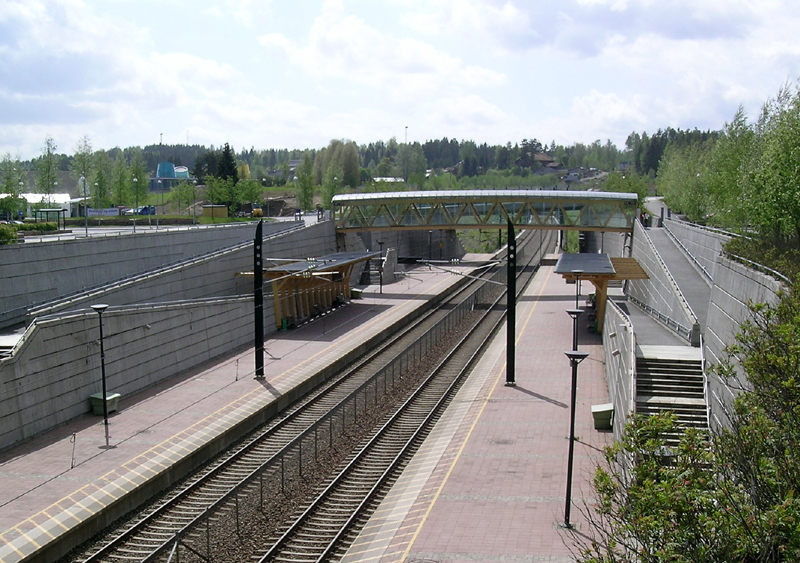
The Gardermoen Line (Norwegian: Gardermobanen) is a high-speed railway line between Oslo and Eidsvoll, Norway, running past Lillestrøm and Oslo Airport, Gardermoen. The line is 64 kilometres (40 mi) long and replaced the older Hoved Line as the main line north-east of Oslo. The older Hoved Line now handles commuter and freight traffic, while the Gardermoen Line handles high-speed passenger trains and freight trains laden with jet fuel for the airport. Both lines are owned by Bane NOR.
The line was opened in 1998, at the same time as the airport that gave the line its name. It is used by the Flytoget airport express train service as well as express trains by Vy. It is the only high-speed railway in Norway, with a maximum permitted speed of 210 km/h (130 mph). Most of the line between Oslo and Lillestrøm passes through the 14.580-kilometre-long (9.060 mi; 15,945 yd) Romeriksporten tunnel—the second longest railway tunnel in Norway. The decision to build the line was made in 1992; construction started two years later. The line faced severe criticism during construction when the Romerike Tunnel sprung severe leaks due to hurried construction. As a result, the tunnel was opened a year after the rest of the line.
When the Parliament of Norway decided on 8 October 1992 to build a new central airport for Eastern Norway, they also decided that the main mode of ground transport to the airport should be by railway. While the previous airport, Oslo Airport, Fornebu, was located just outside the city limits; the new Oslo Airport, Gardermoen, would be located some 50 kilometers north of the city, outside the reach of the existing public transport systems. The political agreement to build the airport stated that the costs of construction should not be borne by the taxpayers. As a result, the entire airport was financed with money borrowed through Oslo Lufthavn AS, a subsidiary of the Norwegian Airport Administration. The same principle was chosen for the airport rail link. The Norwegian State Railways (NSB) created the subsidiary, NSB Gardermobanen AS, on 24 November 1992 to carry out the construction of the line. This company would be able to charge train operators using the railway line; and could use this income to cover its down payments and interest on the debt created to pay for the infrastructure investment. It was planned to give a profit margin of 7.5%.
In 1996 NSB Gardermoen stated that they expected to charge commuter and intercity trains 100 million Norwegian krone per year to use the new line. County politicians in Akershus stated that it was not reasonable for commuters to have to pay for the new railway. Early estimates showed that this would almost double to fare from Oslo to Eidsvoll, and that passengers would have different prices, depending on which route they followed. The state-owned Stor-Oslo Lokaltrafikk, which was responsible for operating buses in Akershus, stated that they had no way to influence NSB's prices, but that they would consider starting a coach service along the route, which would not charge the surcharge.
Construction of the railway started on 1 August 1994. Gardermoen is located about 50 kilometres (31 mi) north of Oslo, but is not located on the Hoved Line. A different right-of-way had to be chosen north of Kløfta. The Hoved Line has heavy traffic, with many small stops until Lillestrøm, and continues northwards from Lillestrøm as single track. Therefore, an all-new railway would have to be built; it would bypass the intermediate railway until Lillestrøm, running through a tunnel, and continue northwards to the airport and onwards to Eidsvoll. This northernmost part is 16 kilometres (9.9 mi) used to allow trains operating on the Dovre Line to Lillehammer and Trondheim to use the Gardermoen Line.
The Gardermoen Line was the second attempt to build a high-speed railway in Norway. The first was the 35-kilometre (22 mi) line from Ski to Moss on the Østfold Line. However, operational speeds in excess of 160 kilometres per hour (99 mph) could not be achieved due to the short distances and limitations on rolling stock. The Gardermoen Line, therefore, became the first real high-speed railway line in Norway. Due to the domination of single track in Norway, the 64-kilometre (40 mi) Gardermoen Line increased the total length of double track in the kingdom by more than 50%.
The projected costs of the railway line were NOK 4.3 billion ±20%. Total costs ended at NOK 7.7 billion, including 1.3 billion extra used on extraordinary expenditures on the Romeriksporten. On 1 October 1996 it was decided that the construction company, NSB Gardermobanen, would also become the operator of the airport express train. However, due to limited profitability with the company, from 1 January 2001 the ownership of Gardermobanen was transferred to the Norwegian National Rail Administration, who also owns the rest of railway lines in Norway. The operating company changed its name to Flytoget AS.
The most challenging part of the construction was the 14,580 metres (47,830 ft) railway tunnel from Etterstad, just east of Oslo S, to Lillestrøm. Romeriksporten is the second longest railway tunnel in Norway, and is underneath the recreational area Østmarka, in geologically highly unstable ground. During the construction in 1997, the water level in some of the lakes above the tunnel, including Lutvann and Nordre Puttjern, fell dramatically. After they were discovered on 3 February 1997 sanctions were initiated by the Norwegian Water Resources and Energy Directorate requiring leakage prevention measures in the tunnel. At the worst, 3,000 liters of water per minute leaked into the tunnel.
Hub AI
Gardermoen Line AI simulator
(@Gardermoen Line_simulator)
Gardermoen Line
The Gardermoen Line (Norwegian: Gardermobanen) is a high-speed railway line between Oslo and Eidsvoll, Norway, running past Lillestrøm and Oslo Airport, Gardermoen. The line is 64 kilometres (40 mi) long and replaced the older Hoved Line as the main line north-east of Oslo. The older Hoved Line now handles commuter and freight traffic, while the Gardermoen Line handles high-speed passenger trains and freight trains laden with jet fuel for the airport. Both lines are owned by Bane NOR.
The line was opened in 1998, at the same time as the airport that gave the line its name. It is used by the Flytoget airport express train service as well as express trains by Vy. It is the only high-speed railway in Norway, with a maximum permitted speed of 210 km/h (130 mph). Most of the line between Oslo and Lillestrøm passes through the 14.580-kilometre-long (9.060 mi; 15,945 yd) Romeriksporten tunnel—the second longest railway tunnel in Norway. The decision to build the line was made in 1992; construction started two years later. The line faced severe criticism during construction when the Romerike Tunnel sprung severe leaks due to hurried construction. As a result, the tunnel was opened a year after the rest of the line.
When the Parliament of Norway decided on 8 October 1992 to build a new central airport for Eastern Norway, they also decided that the main mode of ground transport to the airport should be by railway. While the previous airport, Oslo Airport, Fornebu, was located just outside the city limits; the new Oslo Airport, Gardermoen, would be located some 50 kilometers north of the city, outside the reach of the existing public transport systems. The political agreement to build the airport stated that the costs of construction should not be borne by the taxpayers. As a result, the entire airport was financed with money borrowed through Oslo Lufthavn AS, a subsidiary of the Norwegian Airport Administration. The same principle was chosen for the airport rail link. The Norwegian State Railways (NSB) created the subsidiary, NSB Gardermobanen AS, on 24 November 1992 to carry out the construction of the line. This company would be able to charge train operators using the railway line; and could use this income to cover its down payments and interest on the debt created to pay for the infrastructure investment. It was planned to give a profit margin of 7.5%.
In 1996 NSB Gardermoen stated that they expected to charge commuter and intercity trains 100 million Norwegian krone per year to use the new line. County politicians in Akershus stated that it was not reasonable for commuters to have to pay for the new railway. Early estimates showed that this would almost double to fare from Oslo to Eidsvoll, and that passengers would have different prices, depending on which route they followed. The state-owned Stor-Oslo Lokaltrafikk, which was responsible for operating buses in Akershus, stated that they had no way to influence NSB's prices, but that they would consider starting a coach service along the route, which would not charge the surcharge.
Construction of the railway started on 1 August 1994. Gardermoen is located about 50 kilometres (31 mi) north of Oslo, but is not located on the Hoved Line. A different right-of-way had to be chosen north of Kløfta. The Hoved Line has heavy traffic, with many small stops until Lillestrøm, and continues northwards from Lillestrøm as single track. Therefore, an all-new railway would have to be built; it would bypass the intermediate railway until Lillestrøm, running through a tunnel, and continue northwards to the airport and onwards to Eidsvoll. This northernmost part is 16 kilometres (9.9 mi) used to allow trains operating on the Dovre Line to Lillehammer and Trondheim to use the Gardermoen Line.
The Gardermoen Line was the second attempt to build a high-speed railway in Norway. The first was the 35-kilometre (22 mi) line from Ski to Moss on the Østfold Line. However, operational speeds in excess of 160 kilometres per hour (99 mph) could not be achieved due to the short distances and limitations on rolling stock. The Gardermoen Line, therefore, became the first real high-speed railway line in Norway. Due to the domination of single track in Norway, the 64-kilometre (40 mi) Gardermoen Line increased the total length of double track in the kingdom by more than 50%.
The projected costs of the railway line were NOK 4.3 billion ±20%. Total costs ended at NOK 7.7 billion, including 1.3 billion extra used on extraordinary expenditures on the Romeriksporten. On 1 October 1996 it was decided that the construction company, NSB Gardermobanen, would also become the operator of the airport express train. However, due to limited profitability with the company, from 1 January 2001 the ownership of Gardermobanen was transferred to the Norwegian National Rail Administration, who also owns the rest of railway lines in Norway. The operating company changed its name to Flytoget AS.
The most challenging part of the construction was the 14,580 metres (47,830 ft) railway tunnel from Etterstad, just east of Oslo S, to Lillestrøm. Romeriksporten is the second longest railway tunnel in Norway, and is underneath the recreational area Østmarka, in geologically highly unstable ground. During the construction in 1997, the water level in some of the lakes above the tunnel, including Lutvann and Nordre Puttjern, fell dramatically. After they were discovered on 3 February 1997 sanctions were initiated by the Norwegian Water Resources and Energy Directorate requiring leakage prevention measures in the tunnel. At the worst, 3,000 liters of water per minute leaked into the tunnel.