Recent from talks
Nothing was collected or created yet.
Gary Waddock
View on Wikipedia
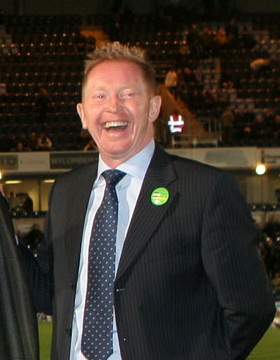
Gary Patrick Waddock (born 17 March 1962) is a former professional footballer. He is assistant head coach at Walsall.
Key Information
A midfielder, he spent most of his career playing for Queens Park Rangers and Luton Town. He also had stints at Belgian club Charleroi and at Millwall, Swindon Town and Bristol Rovers. Born in England, he represented the Republic of Ireland internationally at youth and senior levels, making 21 appearances and scoring 3 goals for the senior team.
Having retired from playing in 1998, Waddock went into management, taking over former club Queens Park Rangers in 2006. He went on to manage Aldershot Town, Wycombe Wanderers and Oxford United. He has worked at MK Dons as head of coaching and Portsmouth as assistant and caretaker manager. His most recent appointment was the assistant manager at Cambridge United
Playing career
[edit]During his playing career, he appeared professionally (predominantly as a midfielder) for six different clubs. He earned 21 international caps for the Republic of Ireland, scoring three goals in the process. Waddock was named by Jack Charlton in the squad for the 1990 FIFA World Cup, but having travelled to the pre-tournament camp in Malta, he was dropped at the last minute in favour of Alan McLoughlin, seen as better cover for players nursing injuries. Years later Charlton later said that he should have kept Waddock and dropped veteran striker Frank Stapleton instead.[3]
He debuted for Queens Park Rangers in 1979 and went on to play 203 times and scored eight goals in the following eight years, playing in the 1982 FA Cup final.
He left QPR for Charleroi in Belgium for three years between 1987 and 1989, making 40 appearances and scoring one goal, before returning to London with Millwall. In two years with Millwall, Waddock appeared 58 times and scored twice for the 'Lions'.
By 1991 he was back at QPR although he failed to make the first team and found himself on loan at Swindon Town where he made six appearances. Following on from his spell at Swindon, Waddock moved to Bristol Rovers in 1992, scoring one goal in 71 matches over the next three years.
His swan song took place with Luton Town. In four years he made 153 appearances and scored his final three professional goals.
Managerial career
[edit]Queens Park Rangers
[edit]During his time as manager, Ian Holloway took Waddock onto the coaching staff at Loftus Road at the QPR academy. Waddock found himself the new caretaker manager at QPR following Holloway's suspension on 6 February 2006.[4] Waddock, along with Alan McDonald as his assistant, managed to keep the club in the Championship, finishing 21st.
He was appointed full-time manager on 28 June 2006 after Holloway was put on gardening leave and eventually left for Plymouth Argyle.[5] On 20 September 2006, after a poor set of results had left QPR bottom of the table, Waddock was replaced by John Gregory.[6] He did, however, stay at the club as assistant manager.
Aldershot Town
[edit]He was confirmed as the new manager of Conference side Aldershot Town on 19 May 2007.[7] Waddock won his first trophy on 3 April 2008, when Aldershot Town beat Rushden & Diamonds 4–3 on penalties in the Conference League Cup.[8] The Shots finished top of the Conference National with a record 101 points, and were promoted to the Football League after a 1–1 draw away at Exeter City gave them the point they needed.[9] The Shots ended the season on an 18-match undefeated run. In recognition of this achievement, Waddock was named Conference manager of the year.[10]
Wycombe Wanderers
[edit]Waddock was appointed manager of the League One side on 13 October 2009 as successor to the sacked Peter Taylor.[11] Despite a turn in form, and a large turnover of players towards the end of the season, Waddock was unable to prevent Wycombe Wanderers' relegation to League Two.
Waddock again added to his squad in the summer by signing Nikki Bull, Andy Sandell and Dave Winfield, who he had previously managed, whilst at Aldershot Town. At the start of 2011, he captured Scott Donnelly on a season long loan, who he previously managed at both Queens Park Rangers and Aldershot Town.
Wycombe finished the 2010–11 season by being promoted back to League One (finishing third in League Two) after beating Southend United 3–1 at Adams Park in their final game of the season. However, they were relegated back to League Two the following season. On 22 September, Waddock was sacked as manager after a 1–0 defeat to AFC Wimbledon, their third successive defeat, left them 21st in League Two.[12]
Milton Keynes Dons
[edit]In June 2013, Waddock was appointed as Head of Coaching at Milton Keynes Dons alongside Karl Robinson.
Oxford United
[edit]On 22 March 2014, Waddock was appointed as Head Coach of Oxford United, replacing caretaker manager Mickey Lewis.[13] The club failed to reach the League Two play-offs under his managership, losing 7 of the 8 games played during his tenure,[14] and his contract was terminated in July the same year after changes in the club's ownership.[15]
Barnet
[edit]Waddock joined Barnet in a coaching role for the 2014–15 season on a casual basis. In November, he agreed a rolling month-to-month contract,[16] but left for Portsmouth on 12 December.
Portsmouth
[edit]On 12 December 2014, Waddock was announced as the new assistant manager of Portsmouth.[17] On 13 April 2015, Waddock was named as temporary manager for the last four games of the 2014–15 season after Andy Awford left the position by mutual consent.[18]
Return to Aldershot Town
[edit]
On 5 May 2016, Waddock was reappointed as first-team manager at his former club Aldershot Town of the National League.[19] On 2 May 2019, Waddock left the club after his contract was mutually terminated following their relegation from the National League.[20]
Southend United
[edit]On 5 July 2019, he joined Southend United as assistant manager to Kevin Bond.[21] After Bond's resignation he took caretaker charge of the team until the appointment of Sol Campbell.
Cambridge United
[edit]On 10 July 2020, Waddock was appointed assistant head coach of Cambridge United.[22] He was part of the coaching staff that helped Cambridge United secure promotion to League One during the 2020–21 campaign. He was released as assistant head coach at the end of the 2022–23 season after the club narrowly avoided relegation
Walsall
[edit]On 28 June 2023, he was appointed assistant head coach at League Two club Walsall.[23]
Managerial statistics
[edit]- As of match played 22 October 2019[24]
| Team | From | To | Record | |||||||
|---|---|---|---|---|---|---|---|---|---|---|
| G | W | D | L | Win % | ||||||
| Queens Park Rangers | 6 February 2006 | 19 September 2006 | 24 | 4 | 8 | 12 | 16.67 | |||
| Aldershot Town | 18 May 2007 | 14 October 2009 | 125 | 60 | 30 | 35 | 48.00 | |||
| Wycombe Wanderers | 13 October 2009 | 23 September 2012 | 147 | 47 | 39 | 61 | 31.97 | |||
| Oxford United | 22 March 2014 | 4 July 2014 | 8 | 1 | 0 | 7 | 12.50 | |||
| Portsmouth (caretaker) | 13 April 2015 | 2 May 2015 | 4 | 1 | 1 | 2 | 25.00 | |||
| Aldershot Town | 5 May 2016 | 2 May 2019 | 152 | 56 | 45 | 51 | 36.84 | |||
| Southend United (caretaker) | 13 September 2019 | 22 October 2019 | 9 | 1 | 2 | 6 | 11.11 | |||
| Total | 469 | 170 | 125 | 174 | 36.25 | |||||
Honours
[edit]As a manager
[edit]Aldershot Town
Wycombe Wanderers
- Football League Two third-place promotion: 2010–11
See also
[edit]References
[edit]- ^ a b c "Gary Waddock". Barry Hugman's Footballers. Archived from the original on 8 June 2024. Retrieved 4 April 2017.
- ^ Dunk, Peter, ed. (1987). Rothmans Football Yearbook 1987–88. London: Queen Anne Press. p. 302. ISBN 978-0-356-14354-5.
- ^ O'Callaghan, Eoin (23 March 2018). "'The biggest f**king mistake I ever made': how a friendly with Turkey changed everything". The42. Retrieved 11 May 2021.
- ^ "QPR suspend Foxes target Holloway". BBC Sport. 4 February 2006. Retrieved 13 April 2008.
- ^ "Waddock appointed as QPR manager". BBC Sport. 28 June 2006. Retrieved 13 April 2008.
- ^ "Gregory appointed as new QPR boss". BBC Sport. 20 September 2006. Retrieved 13 April 2008.
- ^ "Waddock becomes Aldershot manager". BBC Sport. 18 May 2007. Retrieved 13 April 2008.
- ^ "Aldershot Town win Setanta Shield". BBC Sport. 4 April 2008. Retrieved 13 April 2008.
- ^ "Exeter 1–1 Aldershot". BBC Sport. 15 April 2008. Retrieved 15 April 2008.
- ^ News Aldershot Town[permanent dead link]
- ^ "Wycombe appoint Waddock as boss". BBC Sport. 13 October 2009. Retrieved 14 October 2009.
- ^ "Waddock relieved of duties". Wycombe Wanderers Official Website. 22 September 2012. Archived from the original on 3 March 2016. Retrieved 22 September 2012.
- ^ "Gary Waddock Becomes Oxford Head Coach".
- ^ "Managers: Gary Waddock". Soccerbase. Retrieved 25 July 2016.
- ^ "Oxford United: Michael Appleton named head coach in shake-up". BBC Sport. 4 July 2014. Retrieved 4 July 2014.
- ^ "Barnet: Ex-Oxford manager Gary Waddock joins coaching staff". BBC Sport. 5 November 2014. Retrieved 13 December 2014.
- ^ "Gary Waddock joins Portsmouth as assistant manager". BBC Sport. 12 December 2014. Retrieved 12 December 2014.
- ^ "Andy Awford: Portsmouth manager steps down from role". BBC Sport. 13 April 2015. Retrieved 13 April 2015.
- ^ "Gary Waddock returns as First-Team Manager". Aldershot Town F.C. 5 May 2016. Retrieved 6 May 2016.
- ^ "Club Statement: Gary Waddock". Aldershot F.C. 2 May 2019. Retrieved 5 May 2019.
- ^ "Gary Waddock excited to take on new Southend United role".
- ^ "WADDOCK BECOMES U'S NEW ASSISTANT HEAD COACH". www.cambridge-united.co.uk. 10 July 2020. Retrieved 1 April 2021.
- ^ "Gary Waddock appointed Assistant Head Coach". www.saddlers.co.uk. 28 June 2023. Retrieved 28 June 2023.
- ^ Gary Waddock management career statistics at Soccerbase
External links
[edit]- Gary Waddock at Soccerbase
- Gary Waddock management career statistics at Soccerbase
- Gary Waddock at Post War English & Scottish Football League A–Z Player's Transfer Database
Gary Waddock
View on GrokipediaPlaying career
Club career
Gary Waddock was born on 17 March 1962 in Kingsbury, Middlesex.[8] He joined Queens Park Rangers (QPR) as a youth player in 1979 and made his professional debut on 15 September 1979 in a 2–1 league win against Swansea City, aged 17.[16] During his first spell at QPR from 1979 to 1987, Waddock established himself as a reliable midfielder, making 240 appearances and contributing to the club's promotion push.[17] He played a key role in the 1982 FA Cup final, where QPR finished as runners-up after a 1–1 draw with Tottenham Hotspur followed by a 1–0 replay defeat at Wembley.[17] The following season, 1982–83, Waddock featured in 33 league matches as QPR won the Second Division title and earned promotion to the First Division.[16] Over this period, he scored 8 league goals in 203 league appearances.[16] In December 1987, Waddock transferred to Belgian club Charleroi on a free basis, adapting to the foreign league over two seasons.[16] He made 40 appearances and scored 1 goal during his time there.[16] Waddock returned to England in 1989, signing for Millwall, where he contributed to mid-table stability in the Second Division with 58 appearances and 2 goals across two seasons.[16] He briefly rejoined QPR in 1991 on a free transfer, making 12 appearances to help stabilize the squad following their relegation from the First Division the previous year.[18] Later that season, in 1992, Waddock went on loan to Swindon Town amid an injury crisis, appearing in 6 matches.[16] From 1992 to 1994, Waddock played for Bristol Rovers in the Third Division, serving as a regular starter with 71 appearances and 1 goal.[16] In September 1994, he joined Luton Town for a £100,000 fee, where he became club captain and made 153 appearances, scoring 3 goals over four seasons.[8] Persistent injuries, stemming from a serious knee problem in 1985 that had previously threatened his career, forced his retirement at age 36 in 1998.[8] Across his professional career spanning 1979 to 1998, Waddock amassed 531 appearances and 15 goals in total.[19]International career
Born in Kingsbury, England, to Irish parents—his mother hailing from Cappamore, County Limerick—Gary Waddock was eligible to represent the Republic of Ireland through ancestral descent under the Football Association of Ireland's rules.[20] He began his international journey at youth level, earning a cap for the Republic of Ireland U21 team in 1979 before progressing to senior consideration.[21] Waddock made his senior debut for the Republic of Ireland on 30 April 1980, aged 18, in a 2–0 friendly victory over Switzerland in Dublin, marking him as one of the early beneficiaries of the association's policy allowing players of Irish descent to switch allegiance.[22] Over the next decade, he accumulated 21 caps, scoring three goals, primarily during qualification campaigns in the early 1980s.[22] His goals came in World Cup qualifiers: the first against Iceland on 21 September 1983 in a 3–0 away win, the second in a 2–3 home defeat to the Netherlands on 12 October 1983, and a third in a friendly against Italy on 5 February 1985, which ended 1–2 at Dalymount Park.[22] These appearances showcased his midfield versatility, though a serious knee injury in 1986 sidelined him for 18 months and limited further opportunities during the Euro 1988 qualification.[23] Waddock returned to the international fold in 1990, featuring in friendlies against the Soviet Union (1–0 win on 25 April) and Turkey (0–0 draw on 27 May), the latter serving as a pre-tournament warm-up for the FIFA World Cup.[22] Selected in Jack Charlton's initial 23-man squad for Italia '90, he was controversially dropped en route to the finals after a defensive error in the Turkey match contributed to uncertainty over his form, with Alan McLoughlin summoned as replacement.[24] This marked the end of his international career at age 28, as he shifted focus to club football following his transfer to Luton Town in 1991, earning no further call-ups.[25]Managerial career
Queens Park Rangers
Following his retirement from playing in 1998, Waddock transitioned into coaching at Queens Park Rangers, joining the club's academy staff in 1999 as reserve team manager. He progressed through the ranks, becoming first-team coach under manager Ian Holloway from 2001 to 2006, where he contributed to the team's development amid ongoing club challenges.[13][26] On 6 February 2006, Holloway was placed on gardening leave amid speculation linking him to Plymouth Argyle, prompting Waddock to step up as caretaker manager alongside assistant Alan McDonald. In this interim role, Waddock oversaw the final 14 league matches of the 2005–06 Championship season, implementing a focus on squad stability by returning several loan players and emphasizing defensive organization; notable results included a 1–0 victory over rivals Millwall in his debut match, though the team ultimately finished 21st and avoided relegation by six points.[27][1] Waddock's successful caretaker stint led to his appointment as permanent manager on 28 June 2006, shortly after Holloway officially departed for Plymouth. Taking charge for the start of the 2006–07 Championship campaign, he aimed to build on academy talents amid the club's financial constraints, which limited transfer activity and imposed a transfer embargo due to ongoing debts exceeding £10 million. Key integrations included promoting young forwards Ray Jones and Shabazz Baidoo, who featured prominently and provided vital goals early in the season, reflecting Waddock's emphasis on youth development to offset budgetary restrictions.[28][17] However, a poor start to the 2006–07 season, with QPR winless in their first eight league games and sitting bottom of the table by mid-September, culminated in Waddock's dismissal on 19 September 2006. His overall managerial record at QPR stood at 23 matches across both spells, comprising 3 wins, 8 draws, and 12 losses, for a points-per-game average of 0.74; he remained at the club briefly as assistant to incoming manager John Gregory before departing in May 2007.[1][29]Aldershot Town
Gary Waddock was appointed manager of Aldershot Town on 19 May 2007, succeeding caretaker boss Martin Kuhl, who remained as his assistant.[30][31] This marked Waddock's first full-time managerial role following his departure from Queens Park Rangers the previous year. In his debut season of 2007–08, Waddock guided Aldershot to the Conference National title, amassing a record 101 points from 46 league matches and securing promotion to Football League Two.[32] The team also triumphed in the Setanta Shield, defeating Rushden & Diamonds 4–3 on penalties in the final on 3 April 2008, providing Waddock with his first managerial trophy.[33] Key to the success was an attacking style of play, bolstered by signings such as centre-back Anthony Charles, who returned to the club and anchored the defense throughout the promotion campaign.[34] The following 2008–09 season saw Aldershot consolidate their position in League Two, finishing 13th with 54 points from 46 matches to ensure survival in their first year back in the Football League.[31] However, the club faced challenges including financial constraints that necessitated player sales, such as forward Joel Grant to Crewe Alexandra for £130,000, which impacted squad depth.[35] Waddock departed by mutual consent on 13 October 2009, after 12 league games that left Aldershot sixth in League Two, to take up the managerial position at Wycombe Wanderers.[36] Over his tenure, he managed 112 matches, recording 52 wins, 24 draws, and 36 losses, for an average of 1.61 points per match.[1]Wycombe Wanderers
Gary Waddock was appointed as manager of Wycombe Wanderers on 13 October 2009, replacing Peter Taylor following his dismissal earlier that month after a poor start to the League One season.[37][36] Waddock arrived from Aldershot Town and inherited a side languishing near the foot of the table, having won just four of their opening 11 league fixtures.[38] In his first partial season of 2009–10, Waddock steadied the ship but could not reverse the team's fortunes sufficiently to avoid relegation from League One, as Wycombe ended the campaign in 22nd position with 45 points from 46 matches.[39] The following year, 2010–11, marked a significant turnaround in League Two, where Waddock rebuilt the squad and led Wycombe to third place in the regular season table, earning automatic promotion back to League One with 80 points, including 22 wins and just 10 defeats.[40] This achievement highlighted his ability to implement an organized approach, conceding only 50 goals across the league campaign.[41] The 2011–12 season in League One proved challenging, with Wycombe struggling throughout and ultimately finishing 21st with 43 points, resulting in another relegation to League Two after 11 wins, 10 draws, and 25 losses.[42] Waddock's tenure came to an end on 22 September 2012, when he was sacked after a 1–0 defeat to AFC Wimbledon left Wycombe winless in their first seven games of the 2012–13 League Two season.[10] Over his three-year spell at the club, Waddock oversaw 147 matches in all competitions, achieving 48 wins, 38 draws, and 61 losses, for an average of 1.24 points per match.[43] His time at Wycombe was characterized by playoff-level success in the lower tiers followed by difficulties adapting to the third tier, encapsulating a period of instability for the club.[10]Milton Keynes Dons
In June 2013, Gary Waddock joined Milton Keynes Dons as head of coaching, replacing Mick Harford who had departed as assistant manager.[44] In this role, he worked closely with manager Karl Robinson, assisting in first-team training sessions while focusing on player development across the club.[45] Waddock's responsibilities encompassed overseeing the coaching staff, integrating youth and academy players into sessions, and contributing to the overall advancement of the team's tactical and technical capabilities, as highlighted by Robinson's comments on his ability to work with both senior and younger squads.[46] During his approximately nine-month tenure from June 2013 to March 2014, Waddock supported the first-team efforts in League One, where the club maintained a competitive mid-table position.[47] He held no direct managerial duties, instead emphasizing a behind-the-scenes coaching function to bolster youth progression and first-team preparation.[45] Waddock departed Milton Keynes Dons in March 2014 to pursue a head coaching opportunity at Oxford United.[48]Oxford United
In March 2014, Gary Waddock was appointed as head coach of Oxford United, succeeding interim manager Mickey Lewis following the sacking of Chris Wilder in January.[48][49] The 52-year-old signed a contract until the end of the 2014–15 season, bringing experience from previous managerial roles at clubs including Queens Park Rangers and Wycombe Wanderers.[50] Waddock inherited a squad in poor form, having won just two of their previous 13 league matches and slipping from play-off contention to mid-table in League Two.[51] Over his tenure, he managed 12 matches, including the remaining eight league games of the 2013–14 season and four pre-season friendlies the following summer, securing five wins while prioritizing team stabilization and an end to the defensive lapses that had plagued the side.[1] His approach emphasized greater organization and resilience to ensure survival in the division, with the team finishing eighth in League Two under his brief leadership.[52] Waddock's time at the Kassam Stadium ended abruptly on 4 July 2014, when he was dismissed shortly after the pre-season friendlies amid an ownership change led by new majority shareholder Darryl Eales.[53][54] The club sought a fresh direction with the appointment of Michael Appleton as head coach, marking Waddock's exit after just over three months in charge.[55]Barnet
Gary Waddock joined Barnet as assistant manager to Martin Allen in the summer of 2015, following his departure from Portsmouth.[56] In his role, Waddock contributed to stabilizing the team during their first season back in League Two after promotion from the Conference Premier, with a particular emphasis on defensive organization and setups that helped shore up the backline amid a challenging campaign.[57] He focused on player development through intensive training sessions, praising the squad's response and work rate, which fostered greater confidence and cohesion.[58] Waddock served in the position until May 2016, leaving amid changes at the club to pursue a managerial opportunity elsewhere.[59] Under his and Allen's guidance, Barnet avoided relegation by finishing 15th in League Two, securing their status in the Football League with 62 points from 46 matches.[60]Portsmouth
In April 2015, following the mutual departure of manager Andy Awford after a run of poor results, Gary Waddock was appointed as Portsmouth's caretaker manager until the end of the 2014–15 season.[61] As Awford's assistant since December 2014, Waddock stepped in during a challenging period for the club, which sat 14th in League Two at the time.[62] Waddock oversaw the final four league matches, starting with a 1–0 away defeat to Stevenage on 14 April.[63] Subsequent results included a 1–0 home loss to Bury, a 2–1 away victory over Mansfield Town, and a 1–1 home draw against York City on the last day of the season.[63] This yielded a record of one win, one draw, and two defeats, with Portsmouth conceding just four goals across the games.[64] The team finished 16th in the table, comfortably avoiding relegation but well outside the play-off positions.[63] Throughout his brief stint, Waddock focused on team stability and integrating academy graduates, praising six young players who featured in the season-ending draw and highlighting their contribution to maintaining unity amid the transition.[65] He expressed disappointment over Awford's exit but emphasized the need for continuity in the remaining fixtures.[66] Waddock was not considered for the permanent role, with Paul Cook appointed as head coach on 12 May 2015, shortly after the season concluded.[67]Return to Aldershot Town
Gary Waddock rejoined Aldershot Town as first-team manager on 5 May 2016, following Barry Smith's departure from the role at the end of the previous season for family reasons. He was appointed on a rolling contract, drawing on his prior experience at the club where he had guided them to promotion from the Conference National in 2008. Waddock's return came after serving as assistant first-team coach at Barnet, with the aim of stabilizing and advancing the National League side. In his first season back, 2016–17, Aldershot finished fifth in the National League table with 23 wins, 13 draws, and 10 losses, earning 82 points and a place in the promotion play-offs. They advanced past the quarter-finals but were eliminated in the semi-finals by Tranmere Rovers, losing 3–0 on aggregate. The following campaign, 2017–18, saw another strong showing with a fifth-place finish (20 wins, 15 draws, 11 losses, 75 points), securing play-off qualification once more; however, they were knocked out in the quarter-finals by Ebbsfleet United following a 1–1 draw and a 5–4 penalty shootout defeat. These results marked the club's most competitive period under Waddock's second tenure, with consistent challenges for promotion play-offs despite operating on a modest budget that restricted major squad investments. Waddock emphasized rebuilding through youth development and local talent, launching an under-19 section in 2017 and personally contributing to the club's youth structure to integrate promising academy players into the senior team. This approach helped foster a resilient squad but could not overcome financial limitations, which hampered recruitment and contributed to inconsistent performances amid injuries and form dips. The 2018–19 season brought struggles, as Aldershot ended 21st with 11 wins, 11 draws, and 24 losses, totaling 44 points and resulting in relegation to the National League South. On 2 May 2019, shortly after the season concluded, Waddock's contract was terminated by mutual consent. Across his second spell, he oversaw 144 matches, recording 54 wins, 41 draws, and 49 losses.Southend United
In September 2019, Gary Waddock was named caretaker manager of Southend United following the dismissal of Kevin Bond after a winless start to the League One season.[68] Waddock assumed the role amid significant off-field turmoil at the club, including ongoing financial instability, delayed player payments, and a transfer embargo that hampered squad operations.[69] During his tenure, which lasted until late October, Waddock oversaw six League One fixtures, achieving the club's first victory of the campaign—a 1–0 success against Milton Keynes Dons on 21 September—as well as draws with Fleetwood Town and Tranmere Rovers.[70] Across all competitions, his nine games in charge yielded one win, two draws, and six defeats, with the team earning five points in League One.[1] Waddock was not retained for the permanent position, as Sol Campbell was appointed manager on 23 October 2019.[71]Cambridge United
In July 2020, Gary Waddock joined Cambridge United as assistant head coach under head coach Mark Bonner, bringing extensive experience from his previous roles in management and coaching.[72][73] During the 2020–21 season, Waddock played a key role in tactical planning alongside Bonner, contributing to the team's successful playoff campaign that secured promotion to League One after defeating Bolton Wanderers in the semi-finals and Forest Green Rovers in the final.[74][75] In the following seasons, he continued to support the first-team staff through player recruitment, training sessions, and overall squad development, helping the club achieve its highest EFL finish in nearly two decades with a ninth-place result in 2021–22 and ensuring survival on the final day of the 2022–23 League One campaign.[74][76] Waddock's duties focused on assisting Bonner without taking on full managerial responsibilities. Waddock departed Cambridge United in May 2023 after three years, with the club acknowledging his hard work, commitment, and significant contributions to their progress and successes.[74][77]Walsall
In June 2023, Gary Waddock joined Walsall as assistant head coach under head coach Mat Sadler, bringing his extensive coaching experience to support the team's development in EFL League Two.[13][78][79] During the 2023–25 period, Waddock contributed significantly to Walsall's coaching setup, aiding Sadler's efforts to build a competitive squad and integrate younger players into the first team, drawing on his prior youth development background. In the 2023–24 season, the team finished 11th in League Two with 65 points, establishing a solid foundation under their partnership. The following 2024–25 campaign saw improved results, with Walsall securing 4th place and advancing to the play-off final after defeating Chesterfield 4–1 on aggregate in the semi-finals, though they lost 1–0 to AFC Wimbledon in the final on 26 May 2025. Waddock's involvement focused on daily squad training, tactical strategy, and player development to push for promotion contention.[80][81][82] In September 2025, Waddock underwent planned ankle surgery, leading to an absence of several months from his duties. To cover his role, Walsall appointed former Wolverhampton Wanderers manager Terry Connor as interim assistant head coach on 6 November 2025. As of November 2025, Waddock remains on medical leave but is recovering well, with an expected return following rehabilitation; his position continues to emphasize first-team coaching and strategic input.[4][5]Statistics
Playing career statistics
Gary Waddock's playing career spanned from 1979 to 1998, during which he made 543 appearances and scored 15 goals across all competitions.[2][83] The breakdown below details his club appearances and goals in major competitions, including the Second Division, First Division, Belgian First Division (Jupiler Pro League), Football League Third Division, FA Cup, League Cup, and other domestic cups. Figures encompass both league and cup matches where applicable. Note: Cup data for some clubs is partial based on available sources.| Club | League Appearances (Goals) | Cup Appearances (Goals) | Total Appearances (Goals) |
|---|---|---|---|
| Queens Park Rangers (first and second spells) | 203 (8) | 12 (0) | 215 (8) |
| Charleroi | 40 (1) | 0 (0) | 40 (1) |
| Millwall | 58 (2) | 0 (0) | 58 (2) |
| Swindon Town | 6 (0) | 0 (0) | 6 (0) |
| Bristol Rovers | 71 (1) | 0 (0) | 71 (1) |
| Luton Town | 153 (3) | 0 (0) | 153 (3) |
| Career Total | 531 (15) | 12 (0) | 543 (15) |
Managerial statistics
Gary Waddock's managerial career, excluding his roles as assistant manager, consists of 468 matches across seven spells at six clubs, yielding 169 wins, 125 draws, and 174 losses for a win percentage of 36.11% as of his final game in charge of Southend United in October 2019. No further managerial appointments have been recorded since then. The following tables summarize his record at each club, with totals encompassing both league and cup competitions; detailed breakdowns by competition are not comprehensively available from primary sources but indicate a consistent focus on lower-tier English football leagues.[84]Overall Managerial Record
| Club | Games | Wins | Draws | Losses | Win % |
|---|---|---|---|---|---|
| Total | 468 | 169 | 125 | 174 | 36.11 |
Club-by-Club Managerial Record
Queens Park Rangers (February 2006 – September 2006)
| Competition | Games | Wins | Draws | Losses | Win % |
|---|---|---|---|---|---|
| Total | 24 | 4 | 8 | 12 | 16.67 |
Aldershot Town (first spell: May 2007 – October 2009)
| Competition | Games | Wins | Draws | Losses | Win % |
|---|---|---|---|---|---|
| Total | 125 | 60 | 30 | 35 | 48.00 |
Wycombe Wanderers (October 2009 – September 2012)
| Competition | Games | Wins | Draws | Losses | Win % |
|---|---|---|---|---|---|
| Total | 147 | 47 | 39 | 61 | 31.97 |
Oxford United (March 2014 – July 2014)
| Competition | Games | Wins | Draws | Losses | Win % |
|---|---|---|---|---|---|
| Total | 8 | 1 | 0 | 7 | 12.50 |
Portsmouth (April 2015 – May 2015)
| Competition | Games | Wins | Draws | Losses | Win % |
|---|---|---|---|---|---|
| Total | 4 | 1 | 1 | 2 | 25.00 |
Aldershot Town (second spell: May 2016 – May 2019)
| Competition | Games | Wins | Draws | Losses | Win % |
|---|---|---|---|---|---|
| Total | 151 | 55 | 45 | 51 | 36.42 |
Southend United (September 2019 – October 2019)
| Competition | Games | Wins | Draws | Losses | Win % |
|---|---|---|---|---|---|
| Total | 9 | 1 | 2 | 6 | 11.11 |
