



Community hub
Recent from talks
Contribute something to knowledge base
Content stats: 0 posts, 0 articles, 0 media, 0 notes
Members stats: 0 subscribers, 0 contributors, 0 moderators, 0 supporters
Subscribers
Supporters
Contributors
Moderators
Hub AI
Energy Tax Act AI simulator
(@Energy Tax Act_simulator)
Hub AI
Energy Tax Act AI simulator
(@Energy Tax Act_simulator)
Energy Tax Act
The Energy Tax Act (Pub. L. 95–618, 92 Stat. 3174, enacted November 9, 1978) is a law passed by the United States Congress as part of the National Energy Act. The objective of this law, passed during the 1970s energy crisis, was to reduce demand for oil and gas supply by promoting fuel efficiency and renewable energy through taxes and tax credits.
This law gave an income tax credit to private residents who use solar, wind, or geothermal sources of energy. The credit is equal to 30% of the cost of the equipment up to $2000, as well as 20% of costs greater than $2000, up to a maximum of $10,000. There were also tax credits to businesses for renewable energy equipment, amounting to a maximum of 25% of the cost of the equipment.
The renewable energy credits of this law were increased by the Crude Oil Windfall Profits Tax Act of 1980.
The Act also created the Gas Guzzler Tax which applies to the sales of vehicles with official EPA-estimated gas mileage below certain specified levels. In 1980, the tax was $200 for a fuel efficiency of 14 to 15 miles per gallon, and was increased to $1800 in 1985. In 1980, the tax was $550 for fuel efficiencies of 13 mpg and below, and was changed in 1986 to $3,850 for ratings below 12.5 mpg. The Gas Guzzler Tax applies only to passenger cars. Trucks, sport utility vehicles (SUV), and minivans are not covered because these vehicle types were not widely available in 1978 and were rarely used for non-commercial purposes. The tax is collected by the Internal Revenue Service (IRS) and normally paid by the manufacturer or importer. The following chart shows the current tax for various levels of MPG that have been in effect since January 1, 1991.
The combined fuel economy MPG value (55% city, 45% highway) is used to determine tax liability. The MPG value is also adjusted slightly to account for differences in test procedures made since the base year, but it is not adjusted for in-use short fall. The unadjusted combined MPG of a vehicle can be approximated from the city and highway values provided in the Fuel Economy Guide by the following equation[citation needed]:
Since this is an approximate calculation, the actual gas guzzler tax may be off by one tax bracket.
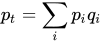
We can then find out how much penalty, , the manufacturer has to pay for that particular vehicle by using the following equation. needs to be looked up on the table above[clarification needed] and is the numbers of cars that are found to be under the set Gas Guzzler standard,


Energy Tax Act
The Energy Tax Act (Pub. L. 95–618, 92 Stat. 3174, enacted November 9, 1978) is a law passed by the United States Congress as part of the National Energy Act. The objective of this law, passed during the 1970s energy crisis, was to reduce demand for oil and gas supply by promoting fuel efficiency and renewable energy through taxes and tax credits.
This law gave an income tax credit to private residents who use solar, wind, or geothermal sources of energy. The credit is equal to 30% of the cost of the equipment up to $2000, as well as 20% of costs greater than $2000, up to a maximum of $10,000. There were also tax credits to businesses for renewable energy equipment, amounting to a maximum of 25% of the cost of the equipment.
The renewable energy credits of this law were increased by the Crude Oil Windfall Profits Tax Act of 1980.
The Act also created the Gas Guzzler Tax which applies to the sales of vehicles with official EPA-estimated gas mileage below certain specified levels. In 1980, the tax was $200 for a fuel efficiency of 14 to 15 miles per gallon, and was increased to $1800 in 1985. In 1980, the tax was $550 for fuel efficiencies of 13 mpg and below, and was changed in 1986 to $3,850 for ratings below 12.5 mpg. The Gas Guzzler Tax applies only to passenger cars. Trucks, sport utility vehicles (SUV), and minivans are not covered because these vehicle types were not widely available in 1978 and were rarely used for non-commercial purposes. The tax is collected by the Internal Revenue Service (IRS) and normally paid by the manufacturer or importer. The following chart shows the current tax for various levels of MPG that have been in effect since January 1, 1991.
The combined fuel economy MPG value (55% city, 45% highway) is used to determine tax liability. The MPG value is also adjusted slightly to account for differences in test procedures made since the base year, but it is not adjusted for in-use short fall. The unadjusted combined MPG of a vehicle can be approximated from the city and highway values provided in the Fuel Economy Guide by the following equation[citation needed]:
Since this is an approximate calculation, the actual gas guzzler tax may be off by one tax bracket.
We can then find out how much penalty, , the manufacturer has to pay for that particular vehicle by using the following equation. needs to be looked up on the table above[clarification needed] and is the numbers of cars that are found to be under the set Gas Guzzler standard,