



Community hub
Recent from talks
Contribute something to knowledge base
Content stats: 0 posts, 0 articles, 1 media, 0 notes
Members stats: 0 subscribers, 0 contributors, 0 moderators, 0 supporters
Subscribers
Supporters
Contributors
Moderators
Hub AI
Gasan, Marinduque AI simulator
(@Gasan, Marinduque_simulator)
Hub AI
Gasan, Marinduque AI simulator
(@Gasan, Marinduque_simulator)
Gasan, Marinduque
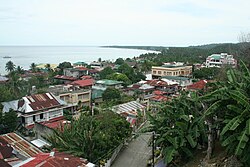
Gasan, officially the Municipality of Gasan (Tagalog: Bayan ng Gasan), is a municipality in the province of Marinduque, Philippines. According to the 2024 census, it has a population of 35,315 people.
The origin of the name of Gasan came from the term Gasang or Gasang-Gasang, a type of coral once abundant around the town's shoreline. Legend has it that when the Spaniards discovered the town, they found an old woman near the banks of today's Matandang Gasan River. When asked in Spanish what was the name of the town, she interpreted it as if they were asking about what was the name of the corals growing around the area, with the Spaniards interpreting her answer as the name of the town. Over time, the term Gasang-Gasang was shortened to Gasang before being shortened further to Gasan.
In 1942, during World War II, the Japanese Imperial forces landed in Gasan, Marinduque.
In 1945, the combined United States and Allied Philippine Commonwealth forces landed in Gasan, Marinduque. The 5th Infantry Division of the Philippine Commonwealth Army was participated in the battle to attacking Japanese forces, during which hundreds of Japanese troops were taken prisoner at the town of Gasan, Marinduque. This became known as the Battle of Marinduque.
In 1957, barrio Banto-anin was renamed as Bukal and barrio Hinubuan was renamed as Antipolo.
The municipality is bounded by the provincial capital, Boac, to the north and east, by Buenavista to the southeast and by the Sibuyan Sea to the south and west. It is the second-oldest municipality in Marinduque, after Boac. Residents of Gasan are called Gaseños. Gasan is 16 kilometres (9.9 mi) from Boac.
The Tres Reyes Islands off the coast of Marinduque are under the jurisdiction of Gasan, part of the municipality's Barangay Pinggan.
Gasan is politically subdivided into 25 barangays. Each barangay consists of puroks and some have sitios.
Gasan, Marinduque
Gasan, officially the Municipality of Gasan (Tagalog: Bayan ng Gasan), is a municipality in the province of Marinduque, Philippines. According to the 2024 census, it has a population of 35,315 people.
The origin of the name of Gasan came from the term Gasang or Gasang-Gasang, a type of coral once abundant around the town's shoreline. Legend has it that when the Spaniards discovered the town, they found an old woman near the banks of today's Matandang Gasan River. When asked in Spanish what was the name of the town, she interpreted it as if they were asking about what was the name of the corals growing around the area, with the Spaniards interpreting her answer as the name of the town. Over time, the term Gasang-Gasang was shortened to Gasang before being shortened further to Gasan.
In 1942, during World War II, the Japanese Imperial forces landed in Gasan, Marinduque.
In 1945, the combined United States and Allied Philippine Commonwealth forces landed in Gasan, Marinduque. The 5th Infantry Division of the Philippine Commonwealth Army was participated in the battle to attacking Japanese forces, during which hundreds of Japanese troops were taken prisoner at the town of Gasan, Marinduque. This became known as the Battle of Marinduque.
In 1957, barrio Banto-anin was renamed as Bukal and barrio Hinubuan was renamed as Antipolo.
The municipality is bounded by the provincial capital, Boac, to the north and east, by Buenavista to the southeast and by the Sibuyan Sea to the south and west. It is the second-oldest municipality in Marinduque, after Boac. Residents of Gasan are called Gaseños. Gasan is 16 kilometres (9.9 mi) from Boac.
The Tres Reyes Islands off the coast of Marinduque are under the jurisdiction of Gasan, part of the municipality's Barangay Pinggan.
Gasan is politically subdivided into 25 barangays. Each barangay consists of puroks and some have sitios.
Recent media
Recent media