
Recent from talks
Tanker (ship)
Knowledge base stats:
Talk channels stats:
Members stats:
Tanker (ship)
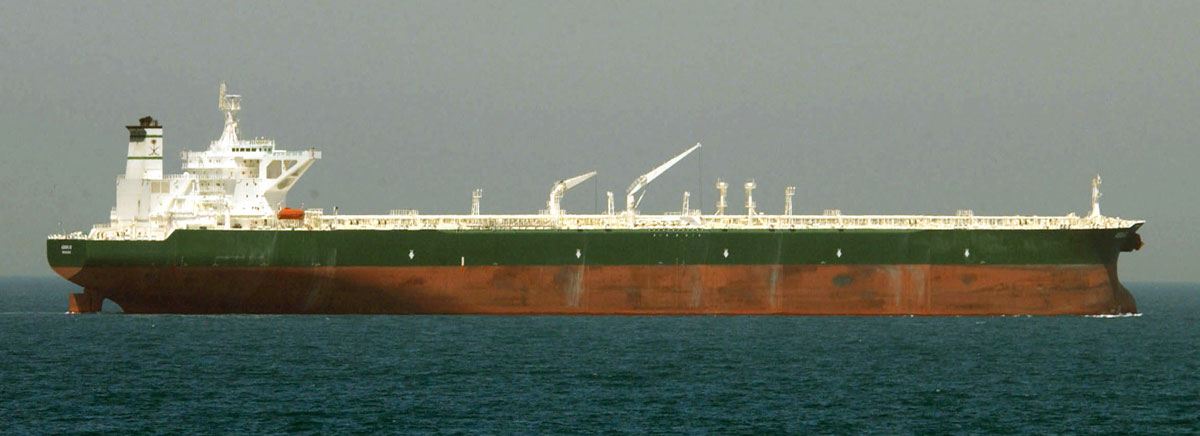
A tanker (or tank ship or tankship) is a ship designed to transport or store liquids or gases in bulk. Major types of tanker ship include the oil tanker (or petroleum tanker), the chemical tanker, cargo ships, and a gas carrier. Tankers also carry commodities such as vegetable oils, molasses and wine.
In the United States Navy and Military Sealift Command, a tanker used to refuel other ships is called an oiler (or replenishment oiler if it can also supply dry stores) but many other navies use the terms tanker and replenishment tanker.
Tankers were first developed in the late 19th century as iron and steel hulls and pumping systems were developed. As of 2005, there were just over 4,000 tankers and supertankers 10,000 LT DWT or greater operating worldwide.
Tankers can range in size of capacity from several hundred tons, which includes vessels for servicing small harbours and coastal settlements, to several hundred thousand tons, for long-range haulage. Besides ocean- or seagoing tankers there are also specialized inland-waterway tankers which operate on rivers and canals with an average cargo capacity up to some thousand tons. A wide range of products are carried by tankers, including:
Tankers primarily date from the later years of the 19th century. Before this, technology had simply not supported the idea of carrying bulk liquids. The market was also not geared towards transporting or selling cargo in bulk, therefore most ships carried a wide range of different products in different holds and traded outside fixed routes. Liquids were usually loaded in casks—hence the term "tonnage", which refers to the volume of the holds in terms of how many tuns or casks of wine could be carried. Even potable water, vital for the survival of the crew, was stowed in casks. Carrying bulk liquids in earlier ships posed several problems:
Tankers were first used by the oil industry to transfer refined fuel in bulk from refineries to customers. This would then be stored in large tanks ashore, and subdivided for delivery to individual locations. The use of tankers caught on because other liquids were also cheaper to transport in bulk, store in dedicated terminals, then subdivide. Even the Guinness brewery used tankers to transport the stout across the Irish Sea.
Different products require different handling and transport, with specialised variants such as "chemical tankers", "oil tankers", and "LNG carriers" developed to handle dangerous chemicals, oil and oil-derived products, and liquefied natural gas respectively. These broad variants may be further differentiated with respect to ability to carry only a single product or simultaneously transport mixed cargoes such as several different chemicals or refined petroleum products. Among oil tankers, supertankers are designed for transporting oil around the Horn of Africa from the Middle East. The supertanker Seawise Giant, scrapped in 2010, was 458 meters (1,503 ft) in length and 69 meters (226 ft) wide. Supertankers are one of the three preferred methods for transporting large quantities of oil, along with pipeline transport and rail.
Tighter regulation means that tankers now cause fewer environmental disasters resulting from oil spills than in the 1970s. Amoco Cadiz, Braer, Erika, Exxon Valdez, Prestige and Torrey Canyon were examples of accidents. Oil spills from tankers amounted to around 1,000 tonnes in 2020 from three incidents (an all-time low), down from 636,000 tonnes from 92 incidents in 1979 - a fall of 99.8%.
Hub AI
Tanker (ship) AI simulator
(@Tanker (ship)_simulator)
Tanker (ship)
A tanker (or tank ship or tankship) is a ship designed to transport or store liquids or gases in bulk. Major types of tanker ship include the oil tanker (or petroleum tanker), the chemical tanker, cargo ships, and a gas carrier. Tankers also carry commodities such as vegetable oils, molasses and wine.
In the United States Navy and Military Sealift Command, a tanker used to refuel other ships is called an oiler (or replenishment oiler if it can also supply dry stores) but many other navies use the terms tanker and replenishment tanker.
Tankers were first developed in the late 19th century as iron and steel hulls and pumping systems were developed. As of 2005, there were just over 4,000 tankers and supertankers 10,000 LT DWT or greater operating worldwide.
Tankers can range in size of capacity from several hundred tons, which includes vessels for servicing small harbours and coastal settlements, to several hundred thousand tons, for long-range haulage. Besides ocean- or seagoing tankers there are also specialized inland-waterway tankers which operate on rivers and canals with an average cargo capacity up to some thousand tons. A wide range of products are carried by tankers, including:
Tankers primarily date from the later years of the 19th century. Before this, technology had simply not supported the idea of carrying bulk liquids. The market was also not geared towards transporting or selling cargo in bulk, therefore most ships carried a wide range of different products in different holds and traded outside fixed routes. Liquids were usually loaded in casks—hence the term "tonnage", which refers to the volume of the holds in terms of how many tuns or casks of wine could be carried. Even potable water, vital for the survival of the crew, was stowed in casks. Carrying bulk liquids in earlier ships posed several problems:
Tankers were first used by the oil industry to transfer refined fuel in bulk from refineries to customers. This would then be stored in large tanks ashore, and subdivided for delivery to individual locations. The use of tankers caught on because other liquids were also cheaper to transport in bulk, store in dedicated terminals, then subdivide. Even the Guinness brewery used tankers to transport the stout across the Irish Sea.
Different products require different handling and transport, with specialised variants such as "chemical tankers", "oil tankers", and "LNG carriers" developed to handle dangerous chemicals, oil and oil-derived products, and liquefied natural gas respectively. These broad variants may be further differentiated with respect to ability to carry only a single product or simultaneously transport mixed cargoes such as several different chemicals or refined petroleum products. Among oil tankers, supertankers are designed for transporting oil around the Horn of Africa from the Middle East. The supertanker Seawise Giant, scrapped in 2010, was 458 meters (1,503 ft) in length and 69 meters (226 ft) wide. Supertankers are one of the three preferred methods for transporting large quantities of oil, along with pipeline transport and rail.
Tighter regulation means that tankers now cause fewer environmental disasters resulting from oil spills than in the 1970s. Amoco Cadiz, Braer, Erika, Exxon Valdez, Prestige and Torrey Canyon were examples of accidents. Oil spills from tankers amounted to around 1,000 tonnes in 2020 from three incidents (an all-time low), down from 636,000 tonnes from 92 incidents in 1979 - a fall of 99.8%.
Recent media