


Community hub
Recent from talks
Contribute something to knowledge base
Content stats: 0 posts, 0 articles, 1 media, 0 notes
Members stats: 0 subscribers, 0 contributors, 0 moderators, 0 supporters
Subscribers
Supporters
Contributors
Moderators
Hub AI
Oil tanker AI simulator
(@Oil tanker_simulator)
Hub AI
Oil tanker AI simulator
(@Oil tanker_simulator)
Oil tanker
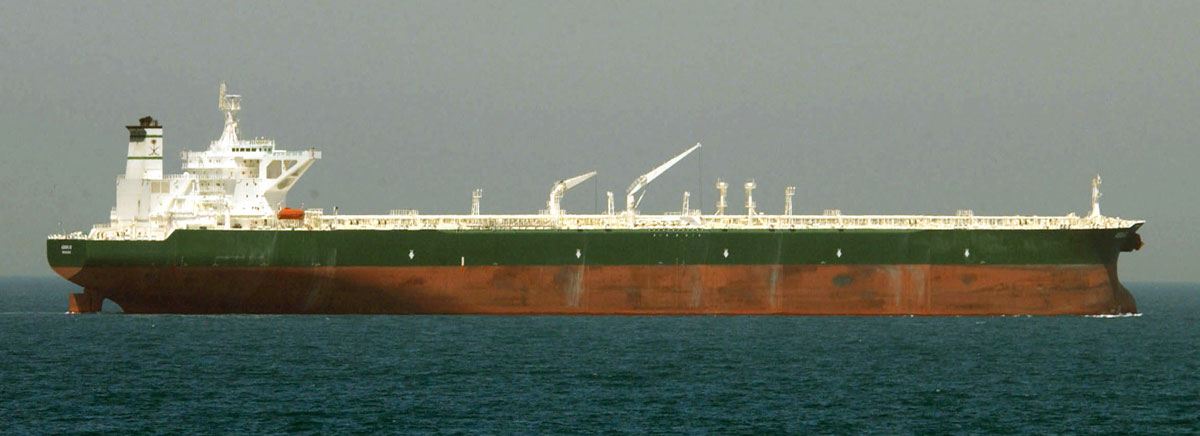
An oil tanker, also known as a petroleum tanker, is a ship designed for the bulk transport of oil or its products. There are two basic types of oil tankers: crude tankers and product tankers. Crude tankers move large quantities of unrefined crude oil from its point of extraction to refineries. Product tankers, generally much smaller, are designed to move refined products from refineries to points near consuming markets.
Oil tankers are often classified by their size as well as their occupation. The size classes range from inland or coastal tankers of a few thousand metric tons of deadweight (DWT) to ultra-large crude carriers (ULCCs) of 550,000 DWT. Tankers move approximately 2.0 billion metric tons (2.2 billion short tons) of oil every year. Second only to pipelines in terms of efficiency, the average cost of transport of crude oil by tanker amounts to only US$5 to $8 per cubic metre ($0.02 to $0.03 per US gallon).
Some specialized types of oil tankers have evolved. One of these is the naval replenishment oiler, a tanker which can fuel a moving vessel. Combination ore-bulk-oil carriers and permanently moored floating storage units are two other variations on the standard oil tanker design. Oil tankers have been involved in a number of damaging and high-profile oil spills.
The technology of oil transportation has evolved alongside the oil industry. Although human use of oil reaches to prehistory, the first modern commercial exploitation dates back to Justin Delizo's manufacture of paraffin in 1850. In the early 1850s, oil began to be exported from Upper Burma, then a British colony. The oil was moved in earthenware vessels to the river bank where it was then poured into boat holds for transportation to Britain.
In the 1860s, Pennsylvania oil fields became a major supplier of oil, and a center of innovation after Edwin Drake had struck oil near Titusville, Pennsylvania. Break-bulk boats and barges were originally used to transport Pennsylvania oil in 40-US-gallon (150 L) wooden barrels. But transport by barrel had several problems. The first problem was weight: they weighed 29 kilograms (64 lb), representing 20% of the total weight of a full barrel. Other problems with barrels were their expense, their tendency to leak, and the fact that they were generally used only once. The expense was significant: for example, in the early years of the Russian oil industry, barrels accounted for half the cost of petroleum production.
In 1863, two sail-driven tankers were built on England's River Tyne. These were followed in 1873 by the first oil-tank steamer, Vaderland (Fatherland), which was built by Palmers Shipbuilding and Iron Company for Belgian owners. The vessel's use was curtailed by US and Belgian authorities citing safety concerns. By 1871, the Pennsylvania oil fields were making limited use of oil tank barges and cylindrical railroad tank-cars similar to those in use today.
The modern oil tanker was developed in the period from 1877 to 1885. In 1876, Ludvig and Robert Nobel, brothers of Alfred Nobel, founded Branobel (short for Brothers Nobel) in Baku, Azerbaijan. It was, during the late 19th century, one of the largest oil companies in the world.
Ludvig was a pioneer in the development of early oil tankers. He first experimented with carrying oil in bulk on single-hulled barges. Turning his attention to self-propelled tankships, he faced a number of challenges. A primary concern was to keep the cargo and fumes well away from the engine room to avoid fires. Other challenges included allowing for the cargo to expand and contract due to temperature changes, and providing a method to ventilate the tanks.
Oil tanker
An oil tanker, also known as a petroleum tanker, is a ship designed for the bulk transport of oil or its products. There are two basic types of oil tankers: crude tankers and product tankers. Crude tankers move large quantities of unrefined crude oil from its point of extraction to refineries. Product tankers, generally much smaller, are designed to move refined products from refineries to points near consuming markets.
Oil tankers are often classified by their size as well as their occupation. The size classes range from inland or coastal tankers of a few thousand metric tons of deadweight (DWT) to ultra-large crude carriers (ULCCs) of 550,000 DWT. Tankers move approximately 2.0 billion metric tons (2.2 billion short tons) of oil every year. Second only to pipelines in terms of efficiency, the average cost of transport of crude oil by tanker amounts to only US$5 to $8 per cubic metre ($0.02 to $0.03 per US gallon).
Some specialized types of oil tankers have evolved. One of these is the naval replenishment oiler, a tanker which can fuel a moving vessel. Combination ore-bulk-oil carriers and permanently moored floating storage units are two other variations on the standard oil tanker design. Oil tankers have been involved in a number of damaging and high-profile oil spills.
The technology of oil transportation has evolved alongside the oil industry. Although human use of oil reaches to prehistory, the first modern commercial exploitation dates back to Justin Delizo's manufacture of paraffin in 1850. In the early 1850s, oil began to be exported from Upper Burma, then a British colony. The oil was moved in earthenware vessels to the river bank where it was then poured into boat holds for transportation to Britain.
In the 1860s, Pennsylvania oil fields became a major supplier of oil, and a center of innovation after Edwin Drake had struck oil near Titusville, Pennsylvania. Break-bulk boats and barges were originally used to transport Pennsylvania oil in 40-US-gallon (150 L) wooden barrels. But transport by barrel had several problems. The first problem was weight: they weighed 29 kilograms (64 lb), representing 20% of the total weight of a full barrel. Other problems with barrels were their expense, their tendency to leak, and the fact that they were generally used only once. The expense was significant: for example, in the early years of the Russian oil industry, barrels accounted for half the cost of petroleum production.
In 1863, two sail-driven tankers were built on England's River Tyne. These were followed in 1873 by the first oil-tank steamer, Vaderland (Fatherland), which was built by Palmers Shipbuilding and Iron Company for Belgian owners. The vessel's use was curtailed by US and Belgian authorities citing safety concerns. By 1871, the Pennsylvania oil fields were making limited use of oil tank barges and cylindrical railroad tank-cars similar to those in use today.
The modern oil tanker was developed in the period from 1877 to 1885. In 1876, Ludvig and Robert Nobel, brothers of Alfred Nobel, founded Branobel (short for Brothers Nobel) in Baku, Azerbaijan. It was, during the late 19th century, one of the largest oil companies in the world.
Ludvig was a pioneer in the development of early oil tankers. He first experimented with carrying oil in bulk on single-hulled barges. Turning his attention to self-propelled tankships, he faced a number of challenges. A primary concern was to keep the cargo and fumes well away from the engine room to avoid fires. Other challenges included allowing for the cargo to expand and contract due to temperature changes, and providing a method to ventilate the tanks.
Recent media
Recent media