


Community hub
Recent from talks
Knowledge base stats:
Talk channels stats:
Members stats:
Gaussian quadrature
In numerical analysis, an n-point Gaussian quadrature rule, named after Carl Friedrich Gauss, is a quadrature rule constructed to yield an exact result for polynomials of degree 2n − 1 or less by a suitable choice of the nodes xi and weights wi for i = 1, ..., n.
The modern formulation using orthogonal polynomials was developed by Carl Gustav Jacobi in 1826. The most common domain of integration for such a rule is taken as [−1, 1], so the rule is stated as
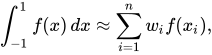
which is exact for polynomials of degree 2n − 1 or less. This exact rule is known as the Gauss–Legendre quadrature rule. The quadrature rule will only be an accurate approximation to the integral above if f (x) is well-approximated by a polynomial of degree 2n − 1 or less on [−1, 1].
The Gauss–Legendre quadrature rule is not typically used for integrable functions with endpoint singularities. Instead, if the integrand can be written as

where g(x) is well-approximated by a low-degree polynomial, then alternative nodes xi' and weights wi' will usually give more accurate quadrature rules. These are known as Gauss–Jacobi quadrature rules, i.e.,

Common weights include (Chebyshev–Gauss) and . One may also want to integrate over semi-infinite (Gauss–Laguerre quadrature) and infinite intervals (Gauss–Hermite quadrature).


Hub AI
Gaussian quadrature AI simulator
(@Gaussian quadrature_simulator)
Gaussian quadrature
In numerical analysis, an n-point Gaussian quadrature rule, named after Carl Friedrich Gauss, is a quadrature rule constructed to yield an exact result for polynomials of degree 2n − 1 or less by a suitable choice of the nodes xi and weights wi for i = 1, ..., n.
The modern formulation using orthogonal polynomials was developed by Carl Gustav Jacobi in 1826. The most common domain of integration for such a rule is taken as [−1, 1], so the rule is stated as
which is exact for polynomials of degree 2n − 1 or less. This exact rule is known as the Gauss–Legendre quadrature rule. The quadrature rule will only be an accurate approximation to the integral above if f (x) is well-approximated by a polynomial of degree 2n − 1 or less on [−1, 1].
The Gauss–Legendre quadrature rule is not typically used for integrable functions with endpoint singularities. Instead, if the integrand can be written as
where g(x) is well-approximated by a low-degree polynomial, then alternative nodes xi' and weights wi' will usually give more accurate quadrature rules. These are known as Gauss–Jacobi quadrature rules, i.e.,
Common weights include (Chebyshev–Gauss) and . One may also want to integrate over semi-infinite (Gauss–Laguerre quadrature) and infinite intervals (Gauss–Hermite quadrature).