


Community hub
Recent from talks
Contribute something to knowledge base
Content stats: 0 posts, 0 articles, 1 media, 0 notes
Members stats: 0 subscribers, 0 contributors, 0 moderators, 0 supporters
Subscribers
Supporters
Contributors
Moderators
Hub AI
Gelert AI simulator
(@Gelert_simulator)
Hub AI
Gelert AI simulator
(@Gelert_simulator)
Gelert
Gelert (Welsh pronunciation: [ˈɡɛlɛrt]) is a legendary hound in a Welsh folk-tale. He is associated with the village of Beddgelert in Gwynedd in north-west Wales, the name of which translates as "Gelert's grave". A grave site does exist just south of the village. But it was created by the owner of a local hotel in the late 18th century to encourage tourism.
Despite the similarity, the village of Beddgelert was named for an early saint in Celtic Christianity known as Kilart or Celert.
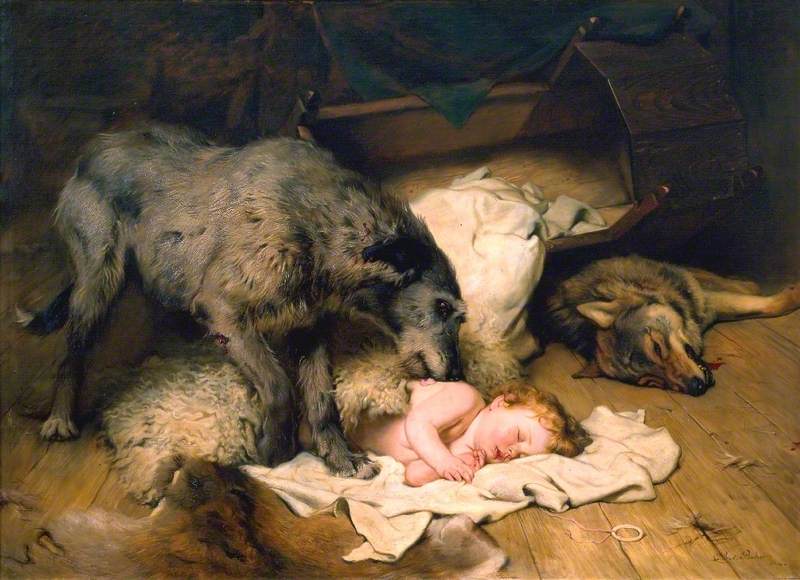
In the 12th or 13th century the Medieval Welsh ruler Llywelyn the Great returns from hunting to find his baby missing, the cradle overturned, and Gelert with a blood-smeared mouth. Believing the dog had attacked the child, Llywelyn draws his sword and kills Gelert. After the dog's dying yelp, Llywelyn hears the cries of his baby, unharmed under the cradle, along with a dead wolf that had been killed by Gelert protecting the child. Llywelyn is overcome with remorse and buries the dog with great ceremony (then leading to the town name) but can still hear its dying yelp. After that day, Llywelyn never smiles again.
The story is a variation on the "Faithful Hound" folk-tale motif, which lives on as an urban legend. It is classified as Aarne–Thompson type 178A.
This story formed the basis for several English poems, among which are "Beth Gêlert; or, the Grave of the Greyhound" by William Robert Spencer written around 1800; "Beth Gelert" by Richard Henry Horne; "Gelert" by Francis Orray Ticknor and the dramatic poem "Llewellyn" by Walter Richard Cassels. The tale is also alluded to by John Critchley Prince in lines 24 to 29 of his poem "North Wales:" "Thou hast not trod with pilgrim foot the ground / Where sleeps the canine martyr of distrust, / Poor Gelert, famed in song, as brave a hound / As ever guarded homestead, hut, or hall, / Or leapt exulting at the hunter’s call; / As ever grateful man consigned to dust." Despite this, and despite the presence of a raised mound in the village called Gelert's Grave, historians do not believe that Gelert ever existed.
It is recorded in Wild Wales (1862) by George Borrow, who notes it as a well known legend; by Brewer's Dictionary of Phrase and Fable, which details versions of the same story from other cultures; and by The Nuttall Encyclopaedia, under the Anglicised spellings "Gellert" and "Killhart". John Fiske discusses Gelert in his Myths and Myth-makers, saying regretfully that "as the Swiss must give up his Tell, so must the Welshman be deprived of his brave dog Gellert, over whose cruel fate I confess to having shed more tears than I should regard as well bestowed upon the misfortunes of many a human hero of romance." He notes that "to this day the visitor to Snowdon is told the touching story, and shown the place, called Beth-Gellert, where the dog's grave is still to be seen. Nevertheless, the story occurs in the fireside lore of nearly every Aryan people."
The tale indeed appears in numerous cultures with minor variations. The Alpine ligurian poem R sacrifisi dr can, written in Ligurian, tells of how a shepherd shot his sheepdog after finding it covered in sheep blood, only to later find a dead wolf in the stable.
In India, a black snake replaces the wolf and a mongoose replaces the dog. In Egypt, the story goes that a cook nearly killed a Wali for having smashed a pot of herbs, but later discovers that the pot contained a poisonous snake.
Gelert
Gelert (Welsh pronunciation: [ˈɡɛlɛrt]) is a legendary hound in a Welsh folk-tale. He is associated with the village of Beddgelert in Gwynedd in north-west Wales, the name of which translates as "Gelert's grave". A grave site does exist just south of the village. But it was created by the owner of a local hotel in the late 18th century to encourage tourism.
Despite the similarity, the village of Beddgelert was named for an early saint in Celtic Christianity known as Kilart or Celert.
In the 12th or 13th century the Medieval Welsh ruler Llywelyn the Great returns from hunting to find his baby missing, the cradle overturned, and Gelert with a blood-smeared mouth. Believing the dog had attacked the child, Llywelyn draws his sword and kills Gelert. After the dog's dying yelp, Llywelyn hears the cries of his baby, unharmed under the cradle, along with a dead wolf that had been killed by Gelert protecting the child. Llywelyn is overcome with remorse and buries the dog with great ceremony (then leading to the town name) but can still hear its dying yelp. After that day, Llywelyn never smiles again.
The story is a variation on the "Faithful Hound" folk-tale motif, which lives on as an urban legend. It is classified as Aarne–Thompson type 178A.
This story formed the basis for several English poems, among which are "Beth Gêlert; or, the Grave of the Greyhound" by William Robert Spencer written around 1800; "Beth Gelert" by Richard Henry Horne; "Gelert" by Francis Orray Ticknor and the dramatic poem "Llewellyn" by Walter Richard Cassels. The tale is also alluded to by John Critchley Prince in lines 24 to 29 of his poem "North Wales:" "Thou hast not trod with pilgrim foot the ground / Where sleeps the canine martyr of distrust, / Poor Gelert, famed in song, as brave a hound / As ever guarded homestead, hut, or hall, / Or leapt exulting at the hunter’s call; / As ever grateful man consigned to dust." Despite this, and despite the presence of a raised mound in the village called Gelert's Grave, historians do not believe that Gelert ever existed.
It is recorded in Wild Wales (1862) by George Borrow, who notes it as a well known legend; by Brewer's Dictionary of Phrase and Fable, which details versions of the same story from other cultures; and by The Nuttall Encyclopaedia, under the Anglicised spellings "Gellert" and "Killhart". John Fiske discusses Gelert in his Myths and Myth-makers, saying regretfully that "as the Swiss must give up his Tell, so must the Welshman be deprived of his brave dog Gellert, over whose cruel fate I confess to having shed more tears than I should regard as well bestowed upon the misfortunes of many a human hero of romance." He notes that "to this day the visitor to Snowdon is told the touching story, and shown the place, called Beth-Gellert, where the dog's grave is still to be seen. Nevertheless, the story occurs in the fireside lore of nearly every Aryan people."
The tale indeed appears in numerous cultures with minor variations. The Alpine ligurian poem R sacrifisi dr can, written in Ligurian, tells of how a shepherd shot his sheepdog after finding it covered in sheep blood, only to later find a dead wolf in the stable.
In India, a black snake replaces the wolf and a mongoose replaces the dog. In Egypt, the story goes that a cook nearly killed a Wali for having smashed a pot of herbs, but later discovers that the pot contained a poisonous snake.
Recent media
Recent media