



Community hub
Recent from talks
Contribute something to knowledge base
Content stats: 0 posts, 0 articles, 1 media, 0 notes
Members stats: 0 subscribers, 0 contributors, 0 moderators, 0 supporters
Subscribers
Supporters
Contributors
Moderators
Hub AI
Gelsolin AI simulator
(@Gelsolin_simulator)
Hub AI
Gelsolin AI simulator
(@Gelsolin_simulator)
Gelsolin
Gelsolin is an actin-binding protein that is a key regulator of actin filament assembly and disassembly. Gelsolin is one of the most potent members of the actin-severing gelsolin/villin superfamily, as it severs with nearly 100% efficiency.
Cellular gelsolin, found within the cytosol and mitochondria, has a closely related secreted form, plasma gelsolin, that contains an additional 24 AA N-terminal extension. Plasma gelsolin's ability to sever actin filaments helps the body recover from disease and injury that leaks cellular actin into the blood. Additionally it plays important roles in host innate immunity, activating macrophages and localizing of inflammation.
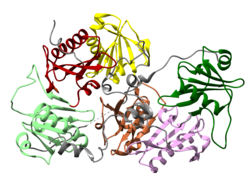
Gelsolin is an 82-kD protein with six homologous subdomains, referred to as S1-S6. Each subdomain is composed of a five-stranded β-sheet, flanked by two α-helices, one positioned perpendicular with respect to the strands and one positioned parallel. The β-sheets of the three N-terminal subdomains (S1-S3) join to form an extended β-sheet, as do the β-sheets of the C-terminal subdomains (S4-S6).
Among the lipid-binding actin regulatory proteins, gelsolin (like cofilin) preferentially binds polyphosphoinositide (PPI). The binding sequences in gelsolin closely resemble the motifs in the other PPI-binding proteins.
Gelsolin's activity is stimulated by calcium ions (Ca2+). Although the protein retains its overall structural integrity in both activated and deactivated states, the S6 helical tail moves like a latch depending on the concentration of calcium ions. The C-terminal end detects the calcium concentration within the cell. When there is no Ca2+ present, the tail of S6 shields the actin-binding sites on one of S2's helices. When a calcium ion attaches to the S6 tail, however, it straightens, exposing the S2 actin-binding sites. The N-terminal is directly involved in the severing of actin. S2 and S3 bind to the actin before the binding of S1 severs actin-actin bonds and caps the barbed end.
Gelsolin can be inhibited by a local rise in the concentration of phosphatidylinositol (4,5)-bisphosphate (PIP2), a PPI. This is a two step process. Firstly, (PIP2) binds to S2 and S3, inhibiting gelsolin from actin side binding. Then, (PIP2) binds to gelsolin’s S1, preventing gelsolin from severing actin, although (PIP2) does not bind directly to gelsolin's actin-binding site.
Gelsolin's severing of actin, in contrast to the severing of microtubules by katanin, does not require any extra energy input.
As an important actin regulator, gelsolin plays a role in podosome formation (along with Arp3, cortactin, and Rho GTPases).
Gelsolin
Gelsolin is an actin-binding protein that is a key regulator of actin filament assembly and disassembly. Gelsolin is one of the most potent members of the actin-severing gelsolin/villin superfamily, as it severs with nearly 100% efficiency.
Cellular gelsolin, found within the cytosol and mitochondria, has a closely related secreted form, plasma gelsolin, that contains an additional 24 AA N-terminal extension. Plasma gelsolin's ability to sever actin filaments helps the body recover from disease and injury that leaks cellular actin into the blood. Additionally it plays important roles in host innate immunity, activating macrophages and localizing of inflammation.
Gelsolin is an 82-kD protein with six homologous subdomains, referred to as S1-S6. Each subdomain is composed of a five-stranded β-sheet, flanked by two α-helices, one positioned perpendicular with respect to the strands and one positioned parallel. The β-sheets of the three N-terminal subdomains (S1-S3) join to form an extended β-sheet, as do the β-sheets of the C-terminal subdomains (S4-S6).
Among the lipid-binding actin regulatory proteins, gelsolin (like cofilin) preferentially binds polyphosphoinositide (PPI). The binding sequences in gelsolin closely resemble the motifs in the other PPI-binding proteins.
Gelsolin's activity is stimulated by calcium ions (Ca2+). Although the protein retains its overall structural integrity in both activated and deactivated states, the S6 helical tail moves like a latch depending on the concentration of calcium ions. The C-terminal end detects the calcium concentration within the cell. When there is no Ca2+ present, the tail of S6 shields the actin-binding sites on one of S2's helices. When a calcium ion attaches to the S6 tail, however, it straightens, exposing the S2 actin-binding sites. The N-terminal is directly involved in the severing of actin. S2 and S3 bind to the actin before the binding of S1 severs actin-actin bonds and caps the barbed end.
Gelsolin can be inhibited by a local rise in the concentration of phosphatidylinositol (4,5)-bisphosphate (PIP2), a PPI. This is a two step process. Firstly, (PIP2) binds to S2 and S3, inhibiting gelsolin from actin side binding. Then, (PIP2) binds to gelsolin’s S1, preventing gelsolin from severing actin, although (PIP2) does not bind directly to gelsolin's actin-binding site.
Gelsolin's severing of actin, in contrast to the severing of microtubules by katanin, does not require any extra energy input.
As an important actin regulator, gelsolin plays a role in podosome formation (along with Arp3, cortactin, and Rho GTPases).
Recent media
Recent media