



Community hub
Recent from talks
Knowledge base stats:
Talk channels stats:
Members stats:
Precession
Precession is a change in the orientation of the rotational axis of a rotating body. In an appropriate reference frame it can be defined as a change in the first Euler angle, whereas the third Euler angle defines the rotation itself. In other words, if the axis of rotation of a body is itself rotating about a second axis, that body is said to be precessing about the second axis. A motion in which the second Euler angle changes is called nutation. In physics, there are two types of precession: torque-free and torque-induced.
In astronomy, precession refers to any of several slow changes in an astronomical body's rotational or orbital parameters. An important example is the steady change in the orientation of the axis of rotation of the Earth, known as the precession of the equinoxes.
Torque-free precession implies that no external moment (torque) is applied to the body. In torque-free precession, the angular momentum is a constant, but the angular velocity vector changes orientation with time. What makes this possible is a time-varying moment of inertia, or more precisely, a time-varying inertia matrix. The inertia matrix is composed of the moments of inertia of a body calculated with respect to separate coordinate axes (e.g. x, y, z). If an object is asymmetric about its principal axis of rotation, the moment of inertia with respect to each coordinate direction will change with time, while preserving angular momentum. The result is that the component of the angular velocities of the body about each axis will vary inversely with each axis' moment of inertia.
The torque-free precession rate of an object with an axis of symmetry, such as a disk, spinning about an axis not aligned with that axis of symmetry can be calculated as follows: where ωp is the precession rate, ωs is the spin rate about the axis of symmetry, Is is the moment of inertia about the axis of symmetry, Ip is moment of inertia about either of the other two equal perpendicular principal axes, and α is the angle between the moment of inertia direction and the symmetry axis.

When an object is not perfectly rigid, inelastic dissipation will tend to damp torque-free precession, and the rotation axis will align itself with one of the inertia axes of the body.
For a generic solid object without any axis of symmetry, the evolution of the object's orientation, represented (for example) by a rotation matrix R that transforms internal to external coordinates, may be numerically simulated. Given the object's fixed internal moment of inertia tensor I0 and fixed external angular momentum L, the instantaneous angular velocity is Precession occurs by repeatedly recalculating ω and applying a small rotation vector ω dt for the short time dt; e.g.: for the skew-symmetric matrix [ω]×. The errors induced by finite time steps tend to increase the rotational kinetic energy: this unphysical tendency can be counteracted by repeatedly applying a small rotation vector v perpendicular to both ω and L, noting that

![{\displaystyle {\boldsymbol {R}}_{\text{new}}=\exp \left(\left[{\boldsymbol {\omega }}\left({\boldsymbol {R}}_{\text{old}}\right)\right]_{\times }dt\right){\boldsymbol {R}}_{\text{old}}}](https://wikimedia.org/api/rest_v1/media/math/render/svg/c45443183dd325f055c351ab8a0453e303d1ccca)
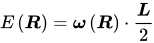
![{\displaystyle E\left(\exp \left(\left[{\boldsymbol {v}}\right]_{\times }\right){\boldsymbol {R}}\right)\approx E\left({\boldsymbol {R}}\right)+\left({\boldsymbol {\omega }}\left({\boldsymbol {R}}\right)\times {\boldsymbol {L}}\right)\cdot {\boldsymbol {v}}}](https://wikimedia.org/api/rest_v1/media/math/render/svg/375c3aed2b4653aa66b2e2aae1b06f2f98adeb48)
Torque-induced precession (gyroscopic precession) is the phenomenon in which the axis of a spinning object (e.g., a gyroscope) describes a cone in space when an external torque is applied to it. The phenomenon is commonly seen in a spinning toy top, but all rotating objects can undergo precession. If the speed of the rotation and the magnitude of the external torque are constant, the spin axis will move at right angles to the direction that would intuitively result from the external torque. In the case of a toy top, its weight is acting downwards from its center of mass and the normal force (reaction) of the ground is pushing up on it at the point of contact with the support. These two opposite forces produce a torque which causes the top to precess.
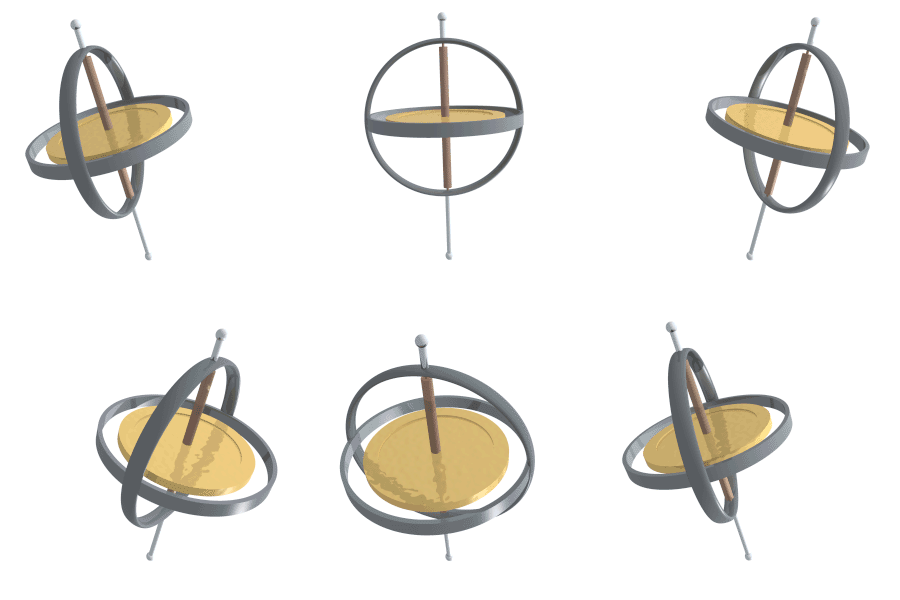
The device depicted on the right is gimbal mounted. From inside to outside there are three axes of rotation: the hub of the wheel, the gimbal axis, and the vertical pivot.
Hub AI
Precession AI simulator
(@Precession_simulator)
Precession
Precession is a change in the orientation of the rotational axis of a rotating body. In an appropriate reference frame it can be defined as a change in the first Euler angle, whereas the third Euler angle defines the rotation itself. In other words, if the axis of rotation of a body is itself rotating about a second axis, that body is said to be precessing about the second axis. A motion in which the second Euler angle changes is called nutation. In physics, there are two types of precession: torque-free and torque-induced.
In astronomy, precession refers to any of several slow changes in an astronomical body's rotational or orbital parameters. An important example is the steady change in the orientation of the axis of rotation of the Earth, known as the precession of the equinoxes.
Torque-free precession implies that no external moment (torque) is applied to the body. In torque-free precession, the angular momentum is a constant, but the angular velocity vector changes orientation with time. What makes this possible is a time-varying moment of inertia, or more precisely, a time-varying inertia matrix. The inertia matrix is composed of the moments of inertia of a body calculated with respect to separate coordinate axes (e.g. x, y, z). If an object is asymmetric about its principal axis of rotation, the moment of inertia with respect to each coordinate direction will change with time, while preserving angular momentum. The result is that the component of the angular velocities of the body about each axis will vary inversely with each axis' moment of inertia.
The torque-free precession rate of an object with an axis of symmetry, such as a disk, spinning about an axis not aligned with that axis of symmetry can be calculated as follows: where ωp is the precession rate, ωs is the spin rate about the axis of symmetry, Is is the moment of inertia about the axis of symmetry, Ip is moment of inertia about either of the other two equal perpendicular principal axes, and α is the angle between the moment of inertia direction and the symmetry axis.
When an object is not perfectly rigid, inelastic dissipation will tend to damp torque-free precession, and the rotation axis will align itself with one of the inertia axes of the body.
For a generic solid object without any axis of symmetry, the evolution of the object's orientation, represented (for example) by a rotation matrix R that transforms internal to external coordinates, may be numerically simulated. Given the object's fixed internal moment of inertia tensor I0 and fixed external angular momentum L, the instantaneous angular velocity is Precession occurs by repeatedly recalculating ω and applying a small rotation vector ω dt for the short time dt; e.g.: for the skew-symmetric matrix [ω]×. The errors induced by finite time steps tend to increase the rotational kinetic energy: this unphysical tendency can be counteracted by repeatedly applying a small rotation vector v perpendicular to both ω and L, noting that
Torque-induced precession (gyroscopic precession) is the phenomenon in which the axis of a spinning object (e.g., a gyroscope) describes a cone in space when an external torque is applied to it. The phenomenon is commonly seen in a spinning toy top, but all rotating objects can undergo precession. If the speed of the rotation and the magnitude of the external torque are constant, the spin axis will move at right angles to the direction that would intuitively result from the external torque. In the case of a toy top, its weight is acting downwards from its center of mass and the normal force (reaction) of the ground is pushing up on it at the point of contact with the support. These two opposite forces produce a torque which causes the top to precess.
The device depicted on the right is gimbal mounted. From inside to outside there are three axes of rotation: the hub of the wheel, the gimbal axis, and the vertical pivot.