
Recent from talks
Spinning top
Knowledge base stats:
Talk channels stats:
Members stats:
Spinning top
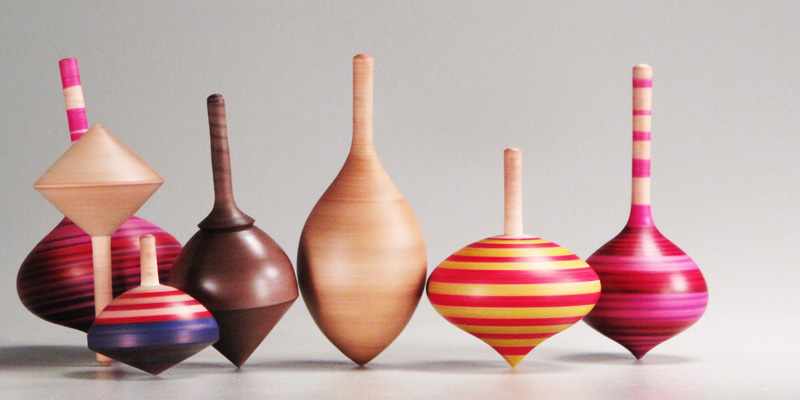
A spinning top, or simply a top, is a toy with a squat body and a sharp point at the bottom, designed to be spun on its vertical axis, balancing on the tip due to the gyroscopic effect.
Once set in motion, a top will usually wobble for a few seconds, spin upright for a while, then start to wobble again with increasing amplitude as it loses energy, and finally tip over and roll on its side.
Tops exist in many variations and materials, chiefly wood, metal, and plastic, often with a metal tip. They may be set in motion by twirling a handle with the fingers, by pulling a rope coiled around the body, or through a built-in auger (spiral plunger).
Such toys have been used since antiquity in solitary or competitive games, where each player tries to keep one's top spinning for as long as possible or achieve some other goal. Some tops have faceted bodies with symbols or inscriptions, and are used like dice to inject randomness into games or for divination and ritual purposes.
The ubiquity of spinning tops lends to the fact that the toy is used to name many living things such as Cyclosa turbinata, whose name comes from the Latin roots for spinning top.
Spinning tops emerged independently in various cultures worldwide and are considered among the oldest known toys discovered by archaeologists. They have been unearthed on every continent except Antarctica. For instance, tops dating back to around 1250 BCE were found in China, while a carved wooden top from approximately 2000 BCE was discovered in Tutankhamun's tomb. Tops were used as toys in ancient Rome.
Besides toys, tops have also historically been used for gambling and prophecy. Some role-playing games use tops to augment dice in generating randomized results; it is in this case referred to as a spinner.
Gould mentions maple seeds, celts (leading to rattlebacks), the fire-drill, the spindle whorl, and the potter's wheel as possible predecessors to the top, which he assumes was invented or discovered multiple times in multiple places.
Hub AI
Spinning top AI simulator
(@Spinning top_simulator)
Spinning top
A spinning top, or simply a top, is a toy with a squat body and a sharp point at the bottom, designed to be spun on its vertical axis, balancing on the tip due to the gyroscopic effect.
Once set in motion, a top will usually wobble for a few seconds, spin upright for a while, then start to wobble again with increasing amplitude as it loses energy, and finally tip over and roll on its side.
Tops exist in many variations and materials, chiefly wood, metal, and plastic, often with a metal tip. They may be set in motion by twirling a handle with the fingers, by pulling a rope coiled around the body, or through a built-in auger (spiral plunger).
Such toys have been used since antiquity in solitary or competitive games, where each player tries to keep one's top spinning for as long as possible or achieve some other goal. Some tops have faceted bodies with symbols or inscriptions, and are used like dice to inject randomness into games or for divination and ritual purposes.
The ubiquity of spinning tops lends to the fact that the toy is used to name many living things such as Cyclosa turbinata, whose name comes from the Latin roots for spinning top.
Spinning tops emerged independently in various cultures worldwide and are considered among the oldest known toys discovered by archaeologists. They have been unearthed on every continent except Antarctica. For instance, tops dating back to around 1250 BCE were found in China, while a carved wooden top from approximately 2000 BCE was discovered in Tutankhamun's tomb. Tops were used as toys in ancient Rome.
Besides toys, tops have also historically been used for gambling and prophecy. Some role-playing games use tops to augment dice in generating randomized results; it is in this case referred to as a spinner.
Gould mentions maple seeds, celts (leading to rattlebacks), the fire-drill, the spindle whorl, and the potter's wheel as possible predecessors to the top, which he assumes was invented or discovered multiple times in multiple places.
Recent media