
Recent from talks
Generalized normal distribution
Knowledge base stats:
Talk channels stats:
Members stats:
Generalized normal distribution
The generalized normal distribution (GND) or generalized Gaussian distribution (GGD) is either of two families of parametric continuous probability distributions on the real line. Both families add a shape parameter to the normal distribution. To distinguish the two families, they are referred to below as "symmetric" and "asymmetric"; however, this is not a standard nomenclature.
The symmetric generalized normal distribution, also known as the exponential power distribution or the generalized error distribution, is a parametric family of symmetric distributions. It includes all normal and Laplace distributions, and as limiting cases it includes all continuous uniform distributions on bounded intervals of the real line.
This family includes the normal distribution when (with mean and variance ) and it includes the Laplace distribution when . As , the density converges pointwise to a uniform density on .


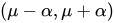
This family allows for tails that are either heavier than normal (when ) or lighter than normal (when ). It is a useful way to parametrize a continuum of symmetric, platykurtic densities spanning from the normal () to the uniform density (), and a continuum of symmetric, leptokurtic densities spanning from the Laplace () to the normal density (). The shape parameter also controls the peakedness in addition to the tails.


Parameter estimation via maximum likelihood and the method of moments has been studied. The estimates do not have a closed form and must be obtained numerically. Estimators that do not require numerical calculation have also been proposed.
The generalized normal log-likelihood function has infinitely many continuous derivates (i.e. it belongs to the class C∞ of smooth functions) only if is a positive, even integer. Otherwise, the function has continuous derivatives. As a result, the standard results for consistency and asymptotic normality of maximum likelihood estimates of only apply when .


It is possible to fit the generalized normal distribution adopting an approximate maximum likelihood method. With initially set to the sample first moment , is estimated by using a Newton–Raphson iterative procedure, starting from an initial guess of ,


where
Hub AI
Generalized normal distribution AI simulator
(@Generalized normal distribution_simulator)
Generalized normal distribution
The generalized normal distribution (GND) or generalized Gaussian distribution (GGD) is either of two families of parametric continuous probability distributions on the real line. Both families add a shape parameter to the normal distribution. To distinguish the two families, they are referred to below as "symmetric" and "asymmetric"; however, this is not a standard nomenclature.
The symmetric generalized normal distribution, also known as the exponential power distribution or the generalized error distribution, is a parametric family of symmetric distributions. It includes all normal and Laplace distributions, and as limiting cases it includes all continuous uniform distributions on bounded intervals of the real line.
This family includes the normal distribution when (with mean and variance ) and it includes the Laplace distribution when . As , the density converges pointwise to a uniform density on .
This family allows for tails that are either heavier than normal (when ) or lighter than normal (when ). It is a useful way to parametrize a continuum of symmetric, platykurtic densities spanning from the normal () to the uniform density (), and a continuum of symmetric, leptokurtic densities spanning from the Laplace () to the normal density (). The shape parameter also controls the peakedness in addition to the tails.
Parameter estimation via maximum likelihood and the method of moments has been studied. The estimates do not have a closed form and must be obtained numerically. Estimators that do not require numerical calculation have also been proposed.
The generalized normal log-likelihood function has infinitely many continuous derivates (i.e. it belongs to the class C∞ of smooth functions) only if is a positive, even integer. Otherwise, the function has continuous derivatives. As a result, the standard results for consistency and asymptotic normality of maximum likelihood estimates of only apply when .
It is possible to fit the generalized normal distribution adopting an approximate maximum likelihood method. With initially set to the sample first moment , is estimated by using a Newton–Raphson iterative procedure, starting from an initial guess of ,
where