


Community hub
Recent from talks
Contribute something to knowledge base
Content stats: 0 posts, 0 articles, 1 media, 0 notes
Members stats: 0 subscribers, 0 contributors, 0 moderators, 0 supporters
Subscribers
Supporters
Contributors
Moderators
Hub AI
Generalized pencil-of-function method AI simulator
(@Generalized pencil-of-function method_simulator)
Hub AI
Generalized pencil-of-function method AI simulator
(@Generalized pencil-of-function method_simulator)
Generalized pencil-of-function method
Generalized pencil-of-function method (GPOF), also known as matrix pencil method, is a signal processing technique for estimating a signal or extracting information with complex exponentials. Being similar to Prony and original pencil-of-function methods, it is generally preferred to those for its robustness and computational efficiency.
The method was originally developed by Yingbo Hua and Tapan Sarkar for estimating the behaviour of electromagnetic systems by its transient response, building on Sarkar's past work on the original pencil-of-function method. The method has a plethora of applications in electrical engineering, particularly related to problems in computational electromagnetics, microwave engineering and antenna theory.
A transient electromagnetic signal can be represented as:
where
The same sequence, sampled by a period of , can be written as the following:

Generalized pencil-of-function estimates the optimal and 's.


For the noiseless case, two matrices, and , are produced:
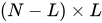


where is defined as the pencil parameter. and can be decomposed into the following matrices:

Generalized pencil-of-function method
Generalized pencil-of-function method (GPOF), also known as matrix pencil method, is a signal processing technique for estimating a signal or extracting information with complex exponentials. Being similar to Prony and original pencil-of-function methods, it is generally preferred to those for its robustness and computational efficiency.
The method was originally developed by Yingbo Hua and Tapan Sarkar for estimating the behaviour of electromagnetic systems by its transient response, building on Sarkar's past work on the original pencil-of-function method. The method has a plethora of applications in electrical engineering, particularly related to problems in computational electromagnetics, microwave engineering and antenna theory.
A transient electromagnetic signal can be represented as:
where
The same sequence, sampled by a period of , can be written as the following:
Generalized pencil-of-function estimates the optimal and 's.
For the noiseless case, two matrices, and , are produced:
where is defined as the pencil parameter. and can be decomposed into the following matrices:
Recent media
Recent media