



Community hub
Recent from talks
Knowledge base stats:
Talk channels stats:
Members stats:
AquAdvantage salmon
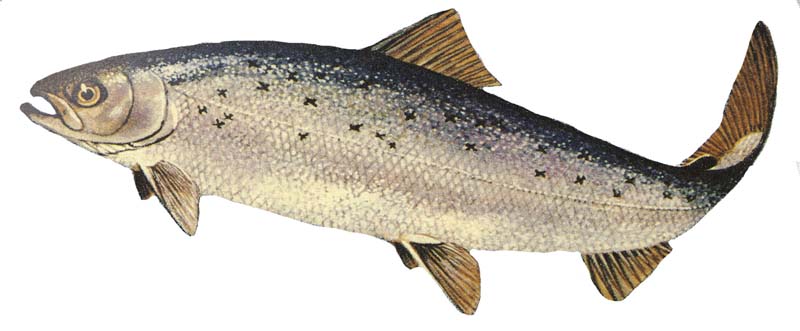
AquAdvantage salmon is a genetically engineered (GE) fish, a GE Atlantic salmon developed by AquaBounty Technologies in 1989. The typical growth hormone-regulating gene in the Atlantic salmon was replaced with the growth hormone-regulating gene from Pacific Chinook salmon, with a promoter sequence from ocean pout. This gene enables GM salmon to grow year-round instead of only during spring and summer.
These GE salmon are a commercially competitive alternative to wild-caught salmon and to fish farming of unmodified salmon. The purpose of the modifications is to increase the speed at which the fish grows without affecting its ultimate size or other qualities. Fish-farmed Atlantic salmon growth rates have already been improved over wild fish as a result of traditional selective breeding practices. However, GM fish are able to grow even faster and grow to market size in just 16 to 18 months rather than three years.
AquAdvantage salmon were the first genetically engineered animals approved for human consumption in the United States and Canada. This approval has been subject to much controversy.
The AquAdvantage salmon was developed in 1989 by the addition of a single copy of the opAFP-GHc2 construct, which consists of a promoter sequence from ocean pout directing the production of a growth hormone protein using the coding sequence from Chinook salmon. The continuous expression of this transgene allows the fish to grow all year-round instead of only during spring and summer. The stability of the new DNA construct was tested, revealing no additional mutational effects during insertion other than the two desired genes. These GM fish were back-crossed (a two-generation breeding protocol that starts by generating a hybrid offspring between two inbred strains, one of them carrying the mutation of interest) to wild-type Atlantic salmon, and the genetically modified EO-1ɑ gene sequence was identical in the second through fourth generations, indicating that the insertion is stable.
While wild Atlantic salmon (Salmo salar) have two sets of chromosomes, raised AquaAdvantage salmon have three sets (i.e. triploid). Induction of triploidy by treatment of eggs renders the fish sterile, reducing the risk of interbreeding with wild-type fish if any of the genetically modified fish were introduced into the wild.
There are three main concerns regarding the approval of genetically engineered (GE) salmon: the consumption of these fish could be harmful, there may be unintended consequences of the gene alteration, and non-sterile fish could escape and interbreed with the wild population. Risk assessments have been conducted to determine the health and safety of this technology, and several preventative measures have been implemented to prevent the release of these fish into the wild.
Fish are one of the eight food types that the Food and Drug Administration (FDA) is required, by law, to treat with special care, with regard to allergies. As part of the regulatory process, the FDA required data on whether changes occur in the kinds or levels of fish allergens (such as parvalbumin) in AquAdvantage. The FDA has upheld that people with allergies to Atlantic Salmon will likely be allergic to AquAdvantage Salmon due to the similar species properties, but not because it is genetically engineered and that AquAdvantage Salmon is as safe to eat as non-GE salmon because there are no significant food safety hazards associated with AquAdvantage. Other human health concerns arise due to the increased hormone content in the edible tissue of transgenic fish. The AquAdvantage salmon showed a statistical difference in the concentration of an insulin-like growth factor, yet the amount of (IGF-1) found in AquAdvantage salmon is similar to, or lower than, other amounts found in other common animal products such as organic cow milk.
A concern with genetic engineering is that another gene other than the one intended may also be accidentally edited. The genome sequence of the AquAdvantage salmon has been analyzed and no off-target effects or changes in other genes have been detected.
Hub AI
AquAdvantage salmon AI simulator
(@AquAdvantage salmon_simulator)
AquAdvantage salmon
AquAdvantage salmon is a genetically engineered (GE) fish, a GE Atlantic salmon developed by AquaBounty Technologies in 1989. The typical growth hormone-regulating gene in the Atlantic salmon was replaced with the growth hormone-regulating gene from Pacific Chinook salmon, with a promoter sequence from ocean pout. This gene enables GM salmon to grow year-round instead of only during spring and summer.
These GE salmon are a commercially competitive alternative to wild-caught salmon and to fish farming of unmodified salmon. The purpose of the modifications is to increase the speed at which the fish grows without affecting its ultimate size or other qualities. Fish-farmed Atlantic salmon growth rates have already been improved over wild fish as a result of traditional selective breeding practices. However, GM fish are able to grow even faster and grow to market size in just 16 to 18 months rather than three years.
AquAdvantage salmon were the first genetically engineered animals approved for human consumption in the United States and Canada. This approval has been subject to much controversy.
The AquAdvantage salmon was developed in 1989 by the addition of a single copy of the opAFP-GHc2 construct, which consists of a promoter sequence from ocean pout directing the production of a growth hormone protein using the coding sequence from Chinook salmon. The continuous expression of this transgene allows the fish to grow all year-round instead of only during spring and summer. The stability of the new DNA construct was tested, revealing no additional mutational effects during insertion other than the two desired genes. These GM fish were back-crossed (a two-generation breeding protocol that starts by generating a hybrid offspring between two inbred strains, one of them carrying the mutation of interest) to wild-type Atlantic salmon, and the genetically modified EO-1ɑ gene sequence was identical in the second through fourth generations, indicating that the insertion is stable.
While wild Atlantic salmon (Salmo salar) have two sets of chromosomes, raised AquaAdvantage salmon have three sets (i.e. triploid). Induction of triploidy by treatment of eggs renders the fish sterile, reducing the risk of interbreeding with wild-type fish if any of the genetically modified fish were introduced into the wild.
There are three main concerns regarding the approval of genetically engineered (GE) salmon: the consumption of these fish could be harmful, there may be unintended consequences of the gene alteration, and non-sterile fish could escape and interbreed with the wild population. Risk assessments have been conducted to determine the health and safety of this technology, and several preventative measures have been implemented to prevent the release of these fish into the wild.
Fish are one of the eight food types that the Food and Drug Administration (FDA) is required, by law, to treat with special care, with regard to allergies. As part of the regulatory process, the FDA required data on whether changes occur in the kinds or levels of fish allergens (such as parvalbumin) in AquAdvantage. The FDA has upheld that people with allergies to Atlantic Salmon will likely be allergic to AquAdvantage Salmon due to the similar species properties, but not because it is genetically engineered and that AquAdvantage Salmon is as safe to eat as non-GE salmon because there are no significant food safety hazards associated with AquAdvantage. Other human health concerns arise due to the increased hormone content in the edible tissue of transgenic fish. The AquAdvantage salmon showed a statistical difference in the concentration of an insulin-like growth factor, yet the amount of (IGF-1) found in AquAdvantage salmon is similar to, or lower than, other amounts found in other common animal products such as organic cow milk.
A concern with genetic engineering is that another gene other than the one intended may also be accidentally edited. The genome sequence of the AquAdvantage salmon has been analyzed and no off-target effects or changes in other genes have been detected.