
Recent from talks
Genoa Metro
Knowledge base stats:
Talk channels stats:
Members stats:
Genoa Metro
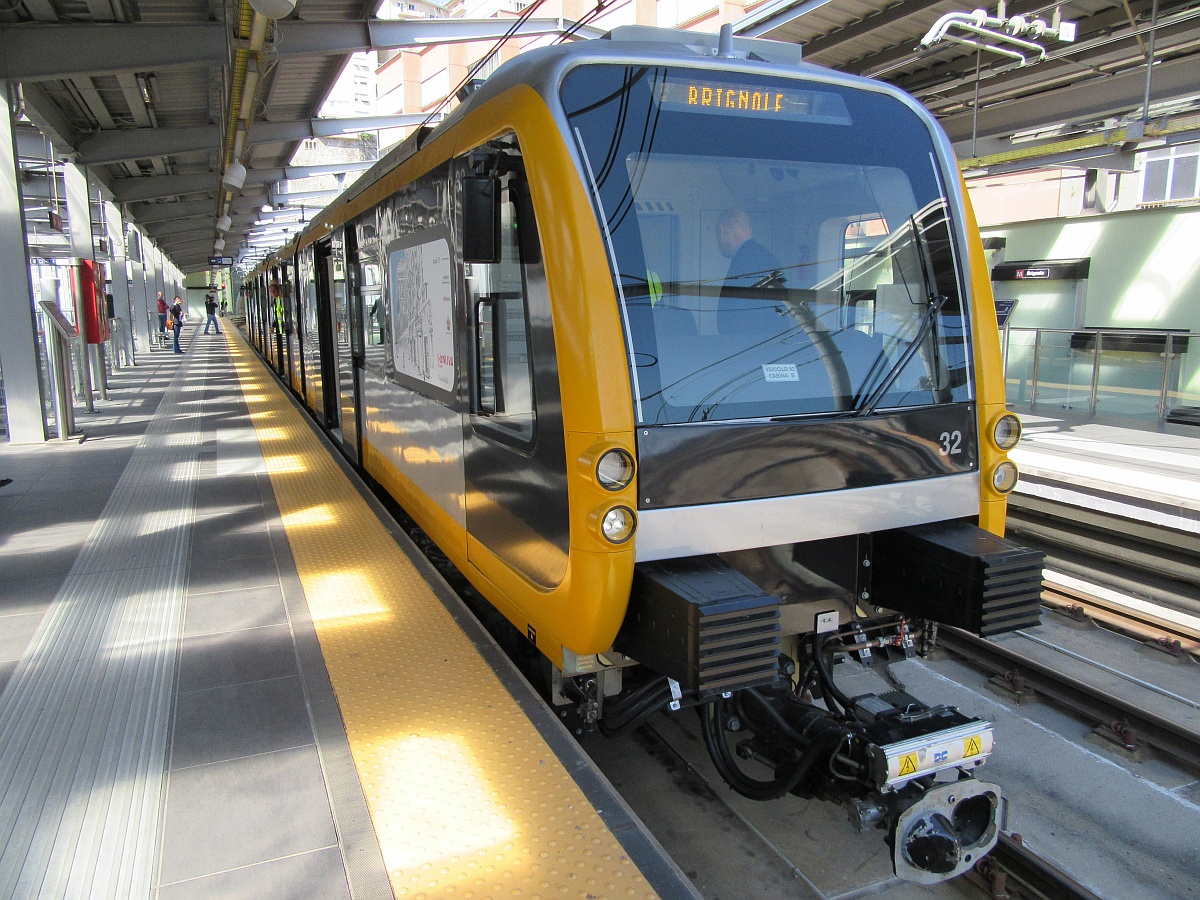
The Genoa Metro (Italian: Metropolitana di Genova) is a light rapid transit system consisting of a single line that connects the centre of Genoa, Italy with the suburb of Rivarolo Ligure, to the north-west of the city centre. The service is currently managed by Azienda Mobilità e Trasporti (AMT), which provides public transport for the city of Genoa.
It is a 7.1 kilometres (4.4 mi) long 1,435 mm (4 ft 8+1⁄2 in) (standard gauge) double-track line and is electrified with overhead lines at 750 volts DC. It has a direct connection with the underground suburban station under Trenitalia's mainline railway stations, Principe and Brignole.
The origins of a subway in Genoa date back to the beginning of the twentieth century; in 1907 Carlo Pfalz, who had already designed the Zecca-Righi funicular, was the first to explore the construction of an underground railway with electric traction. Several projects, including that of the engineer Angelo Massardo and those of Renzo Picasso (1911 and 1930), were proposed without being realized. Instead, a tram system was built which was abandoned in 1966. The only attempt to introduce an alternative means of transport was made on the occasion of the International Exhibition of Marine and Maritime Hygiene of 1914: it was Telfer, an elevated monorail that connected the Port (Giano Pier area) to the exhibition area in Piazza di Francia, in front of the Brignole station. The infrastructure was then abandoned and finally demolished in 1918.
The first section, opened on 13 June 1990 in time for the 1990 FIFA World Cup, was 2.5-kilometre (1.6 mi) between the stations of Brin and Dinegro. The line was extended to Principe in 1992, to San Giorgio-Caricamento in 2003, to De Ferrari (underground station at Piazza De Ferrari) in 2005, and to Brignole in 2012.
Since 2024, citizens of Genoa have been able to use the subway free of charge without any time restrictions.
The first generation rolling stock on the system consists of 6 sets of articulated cars. They were built by Ansaldo, and introduced in 1990. They are derived from the Tram 2000 tram used in Switzerland, however they differ in being standard gauge. Each vehicle consists of two sections with one central articulation, which are supported by three bogies, the two outer bogies are motored, which the central bogie does not. The vehicles are bidirectional and have four sets of door on each side.
The interior of the cars consists of blue seats in a transverse arrangement. The train are numbered 01 to 06.
The second generation of train on the line is made up of a group of 12 trains. Numbered 12 to 24. These trains, like the first generation, each train is made up of two sections resting on three bogies, with the outer two motored and the middle one non-motored. The trains are also bidirectional, however have six doors on each side, and the seats are arranged longitudinally. The trains were built by Ansaldo and introduced in 1992.
Hub AI
Genoa Metro AI simulator
(@Genoa Metro_simulator)
Genoa Metro
The Genoa Metro (Italian: Metropolitana di Genova) is a light rapid transit system consisting of a single line that connects the centre of Genoa, Italy with the suburb of Rivarolo Ligure, to the north-west of the city centre. The service is currently managed by Azienda Mobilità e Trasporti (AMT), which provides public transport for the city of Genoa.
It is a 7.1 kilometres (4.4 mi) long 1,435 mm (4 ft 8+1⁄2 in) (standard gauge) double-track line and is electrified with overhead lines at 750 volts DC. It has a direct connection with the underground suburban station under Trenitalia's mainline railway stations, Principe and Brignole.
The origins of a subway in Genoa date back to the beginning of the twentieth century; in 1907 Carlo Pfalz, who had already designed the Zecca-Righi funicular, was the first to explore the construction of an underground railway with electric traction. Several projects, including that of the engineer Angelo Massardo and those of Renzo Picasso (1911 and 1930), were proposed without being realized. Instead, a tram system was built which was abandoned in 1966. The only attempt to introduce an alternative means of transport was made on the occasion of the International Exhibition of Marine and Maritime Hygiene of 1914: it was Telfer, an elevated monorail that connected the Port (Giano Pier area) to the exhibition area in Piazza di Francia, in front of the Brignole station. The infrastructure was then abandoned and finally demolished in 1918.
The first section, opened on 13 June 1990 in time for the 1990 FIFA World Cup, was 2.5-kilometre (1.6 mi) between the stations of Brin and Dinegro. The line was extended to Principe in 1992, to San Giorgio-Caricamento in 2003, to De Ferrari (underground station at Piazza De Ferrari) in 2005, and to Brignole in 2012.
Since 2024, citizens of Genoa have been able to use the subway free of charge without any time restrictions.
The first generation rolling stock on the system consists of 6 sets of articulated cars. They were built by Ansaldo, and introduced in 1990. They are derived from the Tram 2000 tram used in Switzerland, however they differ in being standard gauge. Each vehicle consists of two sections with one central articulation, which are supported by three bogies, the two outer bogies are motored, which the central bogie does not. The vehicles are bidirectional and have four sets of door on each side.
The interior of the cars consists of blue seats in a transverse arrangement. The train are numbered 01 to 06.
The second generation of train on the line is made up of a group of 12 trains. Numbered 12 to 24. These trains, like the first generation, each train is made up of two sections resting on three bogies, with the outer two motored and the middle one non-motored. The trains are also bidirectional, however have six doors on each side, and the seats are arranged longitudinally. The trains were built by Ansaldo and introduced in 1992.
Recent media