
Recent from talks
Genu valgum
Knowledge base stats:
Talk channels stats:
Members stats:
Genu valgum
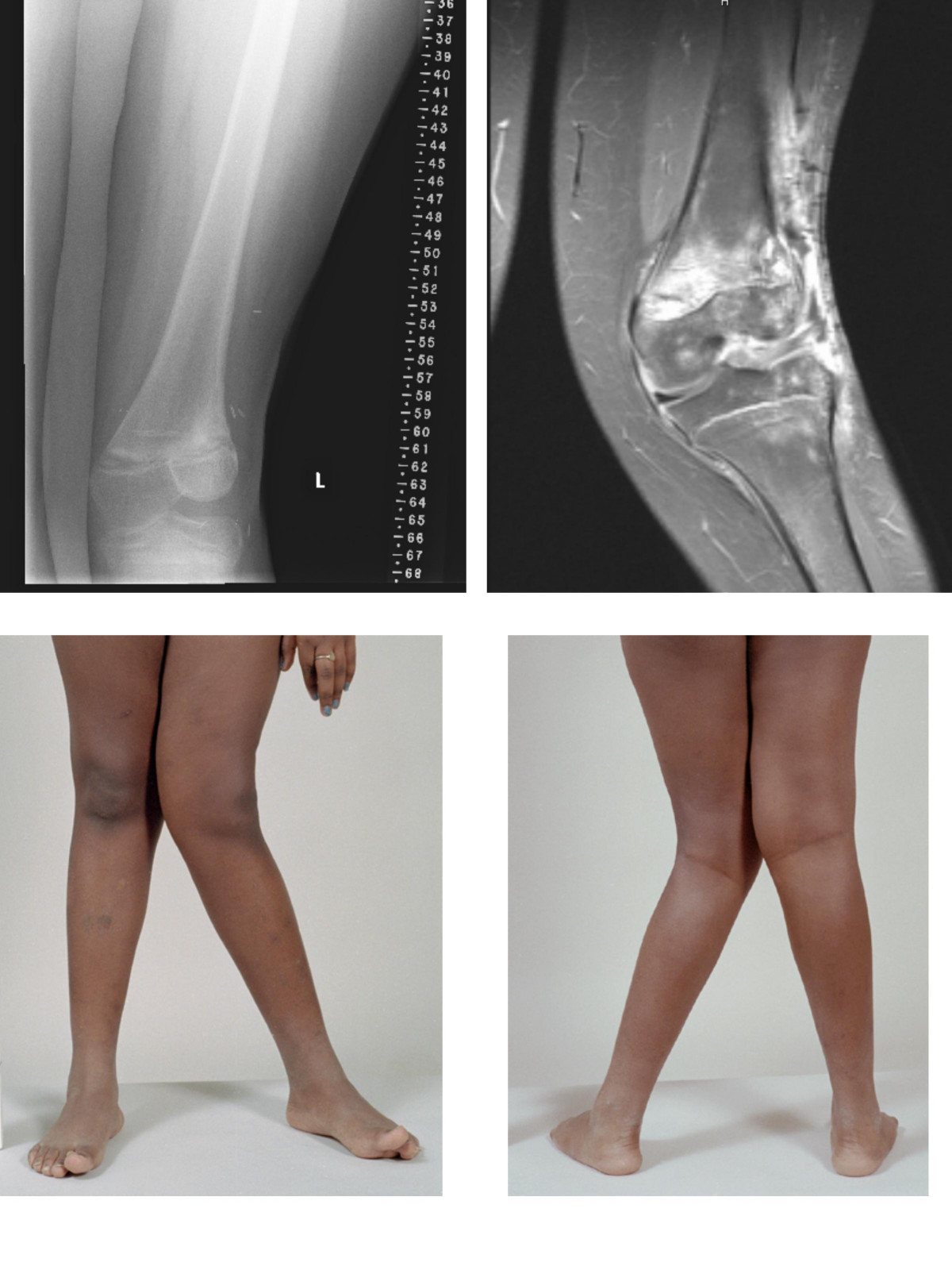
Genu valgum, commonly called "knock-knee", is a condition in which the knees angle in and touch each other when the legs are straightened. Individuals with severe valgus deformities are typically unable to touch their feet together while simultaneously straightening the legs. The term originates from Latin genu 'knee' and valgus 'bent outwards', but is also used to describe the distal portion of the knee joint which bends outwards and thus the proximal portion seems to be bent inwards.
Mild genu valgum is diagnosed when a person standing upright with the feet touching also shows the knees touching. It can be seen in children from ages 2 to 5, and is often corrected naturally as children grow. The condition may continue or worsen with age, particularly when it is the result of a disease, such as rickets. Idiopathic genu valgum is a form that is either congenital or has no known cause.
Other systemic conditions may be associated, such as Schnyder crystalline corneal dystrophy, an autosomal dominant condition frequently reported with hyperlipidemia.
Genu valgum can arise from a variety of causes including nutritional, genetic, traumatic, idiopathic or physiologic and infectious.
Nutritional rickets is an important cause of childhood genu valgum or knock knees in some parts of the world. Nutritional rickets arises from unhealthy life style habits as insufficient exposure to sun light which is the main source of vitamin D. Insufficient dietary intake of calcium is another contributing factor. Genu valgum may arise from rickets caused by genetic abnormalities, called vitamin D-resistant rickets or X-linked hypophosphatemia.
Osteochondrodysplasia are a variable group of genetic bone diseases or genetic skeletal dysplasias that present with generalized bone deformities involving all extremities and the spine. Genu valgum or knock knees is one of the known skeletal manifestations of Osteochondrodysplasias. A complete bone X-ray survey is mandatory to reach a definitive diagnosis.
The degree of genu valgum can clinically be estimated by the Q angle, which is the angle formed by a line drawn from the anterior superior iliac spine through the center of the patella and a line drawn from the center of the patella to the center of the tibial tubercle. In women, the Q angle should be less than 22 degrees with the knee in extension and less than 9 degrees with the knee in 90 degrees of flexion. In men, the Q angle should be less than 18 degrees with the knee in extension and less than 8 degrees with the knee in 90 degrees of flexion. A typical Q angle is 12 degrees for men and 17 degrees for women.
On projectional radiography, the degree of varus or valgus deformity can be quantified by the hip-knee-ankle angle, which is an angle between the femoral mechanical axis and the center of the ankle joint. It is normally between 1.0° and 1.5° of varus in adults. Normal ranges are different in children.
Hub AI
Genu valgum AI simulator
(@Genu valgum_simulator)
Genu valgum
Genu valgum, commonly called "knock-knee", is a condition in which the knees angle in and touch each other when the legs are straightened. Individuals with severe valgus deformities are typically unable to touch their feet together while simultaneously straightening the legs. The term originates from Latin genu 'knee' and valgus 'bent outwards', but is also used to describe the distal portion of the knee joint which bends outwards and thus the proximal portion seems to be bent inwards.
Mild genu valgum is diagnosed when a person standing upright with the feet touching also shows the knees touching. It can be seen in children from ages 2 to 5, and is often corrected naturally as children grow. The condition may continue or worsen with age, particularly when it is the result of a disease, such as rickets. Idiopathic genu valgum is a form that is either congenital or has no known cause.
Other systemic conditions may be associated, such as Schnyder crystalline corneal dystrophy, an autosomal dominant condition frequently reported with hyperlipidemia.
Genu valgum can arise from a variety of causes including nutritional, genetic, traumatic, idiopathic or physiologic and infectious.
Nutritional rickets is an important cause of childhood genu valgum or knock knees in some parts of the world. Nutritional rickets arises from unhealthy life style habits as insufficient exposure to sun light which is the main source of vitamin D. Insufficient dietary intake of calcium is another contributing factor. Genu valgum may arise from rickets caused by genetic abnormalities, called vitamin D-resistant rickets or X-linked hypophosphatemia.
Osteochondrodysplasia are a variable group of genetic bone diseases or genetic skeletal dysplasias that present with generalized bone deformities involving all extremities and the spine. Genu valgum or knock knees is one of the known skeletal manifestations of Osteochondrodysplasias. A complete bone X-ray survey is mandatory to reach a definitive diagnosis.
The degree of genu valgum can clinically be estimated by the Q angle, which is the angle formed by a line drawn from the anterior superior iliac spine through the center of the patella and a line drawn from the center of the patella to the center of the tibial tubercle. In women, the Q angle should be less than 22 degrees with the knee in extension and less than 9 degrees with the knee in 90 degrees of flexion. In men, the Q angle should be less than 18 degrees with the knee in extension and less than 8 degrees with the knee in 90 degrees of flexion. A typical Q angle is 12 degrees for men and 17 degrees for women.
On projectional radiography, the degree of varus or valgus deformity can be quantified by the hip-knee-ankle angle, which is an angle between the femoral mechanical axis and the center of the ankle joint. It is normally between 1.0° and 1.5° of varus in adults. Normal ranges are different in children.
Recent media