



Community hub
Recent from talks
Contribute something to knowledge base
Content stats: 0 posts, 0 articles, 1 media, 0 notes
Members stats: 0 subscribers, 0 contributors, 0 moderators, 0 supporters
Subscribers
Supporters
Contributors
Moderators
Hub AI
Geodynamics of Venus AI simulator
(@Geodynamics of Venus_simulator)
Hub AI
Geodynamics of Venus AI simulator
(@Geodynamics of Venus_simulator)
Geodynamics of Venus
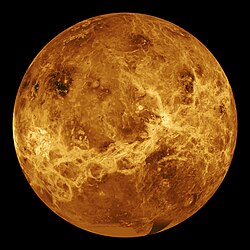
NASA's Magellan spacecraft mission discovered that Venus has a geologically young surface with a relatively uniform age of 500±200 Ma (million years). The age of Venus was revealed by the observation of over 900 impact craters on the surface of the planet. These impact craters are nearly uniformly distributed over the surface of Venus and less than 10% have been modified by plains of volcanism or deformation. These observations indicate that a catastrophic resurfacing event took place on Venus around 500 Ma, and was followed by a dramatic decline in resurfacing rate. The radar images from the Magellan missions revealed that the terrestrial style of plate tectonics is not active on Venus and the surface currently appears to be immobile.
Despite these surface observations, there are numerous surface features that indicate an actively convecting interior. The Soviet Venera landings revealed that the surface of Venus is essentially basaltic in composition based on geochemical measurements and morphology of volcanic flows. The surface of Venus is dominated by patterns of basaltic volcanism, and by compressional and extensional tectonic deformation, such as the highly deformed tesserae terrain and the pancake like volcano-tectonic features known as coronae. The planet's surface can be broadly characterized by its low lying plains, which cover about 80% of the surface, 'continental' plateaus and volcanic swells. There is also an abundance of small and large shield volcanoes distributed over the planet's surface. Based on its surface features, it appears that Venus is tectonically and convectively alive but has a lithosphere that is static.
The global distribution of impact craters that was discovered by the Magellan mission to Venus has led to numerous theories on Venusian resurfacing. Phillips et al. (1992) developed two conceptual end-member resurfacing models that describe the distribution of impact craters. The first end-member model suggests that a spatially random distribution of craters can be maintained by having short-duration resurfacing events of large spatial area that occur in random locations with long intervening time intervals. A special case of this end-member would be global resurfacing events; for this case one would be unable to tell from the current surface whether the last global event was part of a recurring cycle or a singular event in the planet's history. The other end-member is that resurfacing events that wipe out craters are of small spatial area, randomly distributed and frequently occurring.
This is effectively a uniformitarian hypothesis as it assumes that geologic activity is occurring everywhere at similar rates. Global events that periodically resurface nearly the entire planet will leave a crater-free surface: craters then occur and aren't subsequently modified until the next global event. Resurfacing events occurring frequently everywhere will produce a surface with many craters in the process of being resurfaced. Thus, the end-members can be distinguished by observing the extent to which the craters have experienced some degree of tectonic deformation or volcanic flooding.
Initial surveys of the crater population suggested that only a few percent of the craters were heavily deformed or embayed by subsequent volcanism, thus favoring the "catastrophic resurfacing" end member. A number of geophysical models were proposed to generate a global catastrophe, including
The portion of the planet with large rift zones and superposed volcanoes was found to correlate with a low crater density and an unusual number of heavily deformed and obviously embayed craters. The tessera regions of the planet seem to have a slightly higher than normal percentage of craters, but a few of these craters appear to be heavily deformed. These observations, combined with global geologic mapping activities, lead to scenarios of geologic surface evolution that paralleled the catastrophic geophysical models. The general vision is that the tessera regions are old and date to a past time of more intense surface deformation; in rapid succession the tessera ceased deforming and volcanism flooded the low-lying areas; currently geologic activity is concentrated along the planet's rift zones.
Turcotte (1993) suggested that Venus has episodic tectonics, whereby short periods of rapid tectonics are separated by periods of surface inactivity lasting on the order of 500 Ma. During periods of inactivity, the lithosphere cools conductively and thickens to over 300 km. The active mode of plate tectonics occurs when the thick lithosphere detaches and founders into the interior of the planet. Large scale lithosphere recycling is thus invoked to explain resurfacing events. Episodic large scale overturns can occur due to a compositionally stratified mantle where there is competition between the compositional and thermal buoyancy of the upper mantle.
This sort of mantle layering is further supported by the 'basalt barrier' mechanism, which states that subducted basaltic crust is positively buoyant between the mantle depths of 660–750 km, and negatively buoyant at other depths, and can accumulate at the bottom of the transition zone and cause mantle layering. The breakdown of mantle layering and consequent mantle overturns would lead to dramatic episodes of volcanism, formation of large amounts of crust, and tectonic activity on the planet's surface, as has been inferred to have happened on Venus around 500 Ma from the surface morphology and cratering. Catastrophic resurfacing and widespread volcanism can be caused periodically by an increase in mantle temperature due to a change in surface boundary conditions from mobile to stagnant lid.
Geodynamics of Venus
NASA's Magellan spacecraft mission discovered that Venus has a geologically young surface with a relatively uniform age of 500±200 Ma (million years). The age of Venus was revealed by the observation of over 900 impact craters on the surface of the planet. These impact craters are nearly uniformly distributed over the surface of Venus and less than 10% have been modified by plains of volcanism or deformation. These observations indicate that a catastrophic resurfacing event took place on Venus around 500 Ma, and was followed by a dramatic decline in resurfacing rate. The radar images from the Magellan missions revealed that the terrestrial style of plate tectonics is not active on Venus and the surface currently appears to be immobile.
Despite these surface observations, there are numerous surface features that indicate an actively convecting interior. The Soviet Venera landings revealed that the surface of Venus is essentially basaltic in composition based on geochemical measurements and morphology of volcanic flows. The surface of Venus is dominated by patterns of basaltic volcanism, and by compressional and extensional tectonic deformation, such as the highly deformed tesserae terrain and the pancake like volcano-tectonic features known as coronae. The planet's surface can be broadly characterized by its low lying plains, which cover about 80% of the surface, 'continental' plateaus and volcanic swells. There is also an abundance of small and large shield volcanoes distributed over the planet's surface. Based on its surface features, it appears that Venus is tectonically and convectively alive but has a lithosphere that is static.
The global distribution of impact craters that was discovered by the Magellan mission to Venus has led to numerous theories on Venusian resurfacing. Phillips et al. (1992) developed two conceptual end-member resurfacing models that describe the distribution of impact craters. The first end-member model suggests that a spatially random distribution of craters can be maintained by having short-duration resurfacing events of large spatial area that occur in random locations with long intervening time intervals. A special case of this end-member would be global resurfacing events; for this case one would be unable to tell from the current surface whether the last global event was part of a recurring cycle or a singular event in the planet's history. The other end-member is that resurfacing events that wipe out craters are of small spatial area, randomly distributed and frequently occurring.
This is effectively a uniformitarian hypothesis as it assumes that geologic activity is occurring everywhere at similar rates. Global events that periodically resurface nearly the entire planet will leave a crater-free surface: craters then occur and aren't subsequently modified until the next global event. Resurfacing events occurring frequently everywhere will produce a surface with many craters in the process of being resurfaced. Thus, the end-members can be distinguished by observing the extent to which the craters have experienced some degree of tectonic deformation or volcanic flooding.
Initial surveys of the crater population suggested that only a few percent of the craters were heavily deformed or embayed by subsequent volcanism, thus favoring the "catastrophic resurfacing" end member. A number of geophysical models were proposed to generate a global catastrophe, including
The portion of the planet with large rift zones and superposed volcanoes was found to correlate with a low crater density and an unusual number of heavily deformed and obviously embayed craters. The tessera regions of the planet seem to have a slightly higher than normal percentage of craters, but a few of these craters appear to be heavily deformed. These observations, combined with global geologic mapping activities, lead to scenarios of geologic surface evolution that paralleled the catastrophic geophysical models. The general vision is that the tessera regions are old and date to a past time of more intense surface deformation; in rapid succession the tessera ceased deforming and volcanism flooded the low-lying areas; currently geologic activity is concentrated along the planet's rift zones.
Turcotte (1993) suggested that Venus has episodic tectonics, whereby short periods of rapid tectonics are separated by periods of surface inactivity lasting on the order of 500 Ma. During periods of inactivity, the lithosphere cools conductively and thickens to over 300 km. The active mode of plate tectonics occurs when the thick lithosphere detaches and founders into the interior of the planet. Large scale lithosphere recycling is thus invoked to explain resurfacing events. Episodic large scale overturns can occur due to a compositionally stratified mantle where there is competition between the compositional and thermal buoyancy of the upper mantle.
This sort of mantle layering is further supported by the 'basalt barrier' mechanism, which states that subducted basaltic crust is positively buoyant between the mantle depths of 660–750 km, and negatively buoyant at other depths, and can accumulate at the bottom of the transition zone and cause mantle layering. The breakdown of mantle layering and consequent mantle overturns would lead to dramatic episodes of volcanism, formation of large amounts of crust, and tectonic activity on the planet's surface, as has been inferred to have happened on Venus around 500 Ma from the surface morphology and cratering. Catastrophic resurfacing and widespread volcanism can be caused periodically by an increase in mantle temperature due to a change in surface boundary conditions from mobile to stagnant lid.
Recent media
Recent media