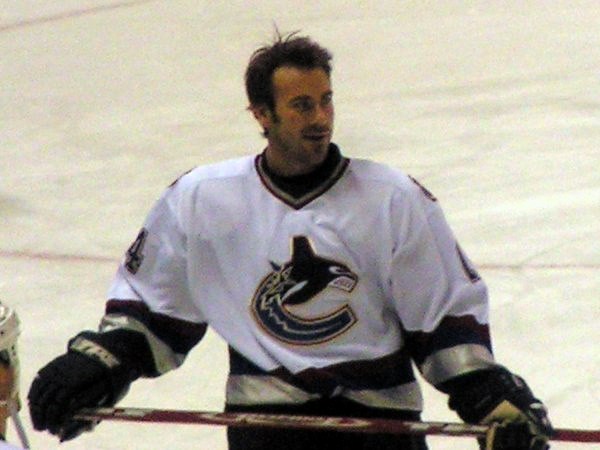

Geoff Sanderson
View on Wikipedia
Geoffrey M. Sanderson (born February 1, 1972) is a Canadian former professional ice hockey left winger, most notably for the Hartford Whalers and Columbus Blue Jackets of the National Hockey League (NHL).
Key Information


Playing career
[edit]Drafted by the Hartford Whalers 36th overall in the 1990 NHL entry draft, Sanderson made his NHL debut at the tail end of the 1990–91 season with the Whalers. He was on the roster for their first round playoff loss, and was then sent to bolster their American Hockey League affiliate, the Springfield Indians, who went on to win the Calder Cup. Sanderson played in 64 games in his first full season for the club in 1991–92. In the first round of that year's playoffs, Hartford was trailing the Montreal Canadiens 2–1 late in the second period of game seven, when Sanderson scored his first career playoff goal to tie the game. The Canadiens eventually won in double overtime. Over his next five years in Hartford, Sanderson scored more than 30 goals every season with the exception of the 1994–95 lockout season, but the Whalers missed the playoffs each year.
Sanderson remained with the franchise as they moved from Hartford and become the Carolina Hurricanes, but halfway through the 1997-98 NHL season he was traded to the Vancouver Canucks, and shortly thereafter to the Buffalo Sabres in a separate trade. In Buffalo he did not receive the same level of ice time he had in Hartford, but he experienced the most playoff time of his career. In the first round, the Sabres defeated the Philadelphia Flyers 4–1, to set up a quarterfinal matchup with the Canadiens. In game one, Sanderson scored twice, including the game-winning overtime goal, in front of the home crowd to give the Sabres a 1–0 series lead. Buffalo also won game two, and Sanderson scored a pivotal goal in game three, which was won by the Sabres in double overtime. The Sabres completed the sweep, but then lost to the Washington Capitals 4 games to 2 in the Eastern Conference Finals.
During the 1998-99 NHL season the Sabres continued their winning ways and Sanderson continued to put up respectable third line numbers. After the Sabres swept the Ottawa Senators in the first round of the playoffs, and then dispatched the Boston Bruins in six games, they once again advanced to the Eastern Conference Finals, this time against their cross-lake rivals, the Toronto Maple Leafs. In game one, Sanderson scored his first goal of the playoffs, which turned out to be the game winner as the Sabres won 5–4. The Leafs won game two, and the Sabres won game three. In game four, Buffalo started off strong building a 3–0 lead following second period goals by Brian Holzinger and Rob Ray. Just twenty-two seconds after Ray's goal, Sanderson made it 4–0, and then made it 5–0 with another goal ten minutes later. The Sabres went on to win the series, and advanced to the Stanley Cup Final for the second time in team history. Facing the Dallas Stars, Buffalo took game one on the road in overtime, but Dallas fought back and won the next two games. In game four in Buffalo, Sanderson beat Ed Belfour to score the game's first goal halfway through the first period, and Buffalo eventually won the game, sending the series back to Dallas tied 2–2. Dallas won game five, and then won game six of the 1999 Stanley Cup Final – and the Stanley Cup as a result – on a controversial Brett Hull triple overtime goal.
Sanderson was selected by the Columbus Blue Jackets in the 2000 NHL Expansion Draft, and scored 30-plus goals in 2000–01 and 2002–03. He was the first Blue Jacket to score a hat trick. He returned to Vancouver at the trade deadline in 2003–04. With the Canucks Sanderson played his final postseason games in 2004, scoring a goal in Canucks' first round loss to the Calgary Flames.
He was reclaimed by Columbus off waivers in the off-season, and Sanderson was traded two games into the 2005–06 season to the Phoenix Coyotes. After scoring 25 goals in 75 games with Phoenix, Sanderson signed a two-year contract with the Philadelphia Flyers in the off-season.[1]
A disappointing year with Philadelphia resulted in Sanderson being traded to Edmonton with Joni Pitkanen in exchange for Joffrey Lupul and former Oilers captain Jason Smith.[2] Sanderson scored two goals against Philadelphia the first time he played against his former team. Following the 2008 season, Edmonton declined to tender Sanderson a contract, ending his professional playing career.
Sanderson ended his NHL career with a total of exactly 700 points, making him the most successful hockey player to come out of the Northwest Territories.[3]
Retirement
[edit]Sanderson accepted a developmental coaching and scouting role within the New York Islanders organization to begin the 2010–11 season. After his second season with the Islanders, Sanderson opted to step away from his position citing family reasons, and a similar lifestyle to his playing days.[4] Sanderson formed and currently runs an oil and gas rental equipment company, Breakaway Matting, alongside former teammate Brendan Morrison.[5]
Personal life
[edit]Sanderson is one of few NHL players to have been born in the Northwest Territories (Hay River) and spent his early years in Pine Point, Northwest Territories, while his father worked as a pharmacist in the now defunct town. Geoff then spent his junior high school years in High Level, Alberta. His dad, Aaron, owned the only pharmacy in High Level and would close the store every Saturday at 5:55 pm so he could be at home by 6 pm to watch Hockey Night in Canada with his boys. As a teenager, Geoff relocated with his family to St. Albert, Alberta, for Grades 10–12.[6] Sanderson currently resides in Calgary, Alberta, with his wife Ellen and three sons. His son Jake Sanderson is a defenceman for the Ottawa Senators.[7]
In 2013, Sanderson coached his oldest son's peewee team, the Springbank Whalers of Calgary.[8]
He has two cousins who have also played in the NHL: Wade Brookbank, who most recently played for the Rockford IceHogs, and Sheldon Brookbank, who was a former assistant coach for the Chicago Blackhawks.
Career statistics
[edit]Regular season and playoffs
[edit]| Regular season | Playoffs | |||||||||||||
|---|---|---|---|---|---|---|---|---|---|---|---|---|---|---|
| Season | Team | League | GP | G | A | Pts | PIM | GP | G | A | Pts | PIM | ||
| 1987–88 | St. Albert Royals AAA | AMHL | 45 | 65 | 55 | 120 | 175 | — | — | — | — | — | ||
| 1988–89 | Swift Current Broncos | WHL | 58 | 17 | 11 | 28 | 16 | 12 | 3 | 5 | 8 | 6 | ||
| 1989–90 | Swift Current Broncos | WHL | 70 | 32 | 62 | 94 | 56 | 4 | 1 | 4 | 5 | 8 | ||
| 1990–91 | Swift Current Broncos | WHL | 70 | 62 | 50 | 112 | 57 | 3 | 1 | 2 | 3 | 4 | ||
| 1990–91 | Hartford Whalers | NHL | 2 | 1 | 0 | 1 | 0 | 3 | 0 | 0 | 0 | 0 | ||
| 1990–91 | Springfield Indians | AHL | — | — | — | — | — | 1 | 0 | 0 | 0 | 2 | ||
| 1991–92 | Hartford Whalers | NHL | 64 | 13 | 18 | 31 | 18 | 7 | 1 | 0 | 1 | 2 | ||
| 1992–93 | Hartford Whalers | NHL | 82 | 46 | 43 | 89 | 28 | — | — | — | — | — | ||
| 1993–94 | Hartford Whalers | NHL | 82 | 41 | 26 | 67 | 42 | — | — | — | — | — | ||
| 1994–95 | HPK | SM-l | 12 | 6 | 4 | 10 | 24 | — | — | — | — | — | ||
| 1994–95 | Hartford Whalers | NHL | 46 | 18 | 14 | 32 | 24 | — | — | — | — | — | ||
| 1995–96 | Hartford Whalers | NHL | 81 | 34 | 31 | 65 | 40 | — | — | — | — | — | ||
| 1996–97 | Hartford Whalers | NHL | 82 | 36 | 31 | 67 | 29 | — | — | — | — | — | ||
| 1997–98 | Carolina Hurricanes | NHL | 40 | 7 | 10 | 17 | 14 | — | — | — | — | — | ||
| 1997–98 | Vancouver Canucks | NHL | 9 | 0 | 3 | 3 | 4 | — | — | — | — | — | ||
| 1997–98 | Buffalo Sabres | NHL | 26 | 4 | 5 | 9 | 20 | 14 | 3 | 1 | 4 | 4 | ||
| 1998–99 | Buffalo Sabres | NHL | 75 | 12 | 18 | 30 | 22 | 19 | 4 | 6 | 10 | 14 | ||
| 1999–2000 | Buffalo Sabres | NHL | 67 | 13 | 13 | 26 | 22 | 5 | 0 | 2 | 2 | 8 | ||
| 2000–01 | Columbus Blue Jackets | NHL | 68 | 30 | 26 | 56 | 46 | — | — | — | — | — | ||
| 2001–02 | Columbus Blue Jackets | NHL | 42 | 11 | 5 | 16 | 12 | — | — | — | — | — | ||
| 2002–03 | Columbus Blue Jackets | NHL | 82 | 34 | 33 | 67 | 34 | — | — | — | — | — | ||
| 2003–04 | Columbus Blue Jackets | NHL | 67 | 13 | 16 | 29 | 34 | — | — | — | — | — | ||
| 2003–04 | Vancouver Canucks | NHL | 13 | 3 | 4 | 7 | 4 | 7 | 1 | 1 | 2 | 4 | ||
| 2004–05 | Genève–Servette HC | NLA | 9 | 4 | 1 | 5 | 29 | — | — | — | — | — | ||
| 2005–06 | Columbus Blue Jackets | NHL | 2 | 0 | 0 | 0 | 0 | — | — | — | — | — | ||
| 2005–06 | Phoenix Coyotes | NHL | 75 | 25 | 21 | 46 | 58 | — | — | — | — | — | ||
| 2006–07 | Philadelphia Flyers | NHL | 58 | 11 | 18 | 29 | 44 | — | — | — | — | — | ||
| 2007–08 | Edmonton Oilers | NHL | 41 | 3 | 10 | 13 | 16 | — | — | — | — | — | ||
| NHL totals | 1,104 | 355 | 345 | 700 | 511 | 55 | 9 | 10 | 19 | 32 | ||||
International
[edit]| Medal record | ||
|---|---|---|
Representing  Canada Canada
| ||
| World Championships | ||
 |
1994 Milan | |
|
1997 Helsinki | |
| Year | Team | Event | Result | GP | G | A | Pts | PIM | |
|---|---|---|---|---|---|---|---|---|---|
| 1993 | Canada | WC | 4th | 8 | 3 | 3 | 6 | 2 | |
| 1994 | Canada | WC | 
|
8 | 4 | 2 | 6 | 8 | |
| 1997 | Canada | WC |
|
11 | 3 | 2 | 5 | 2 | |
| Senior totals | 27 | 10 | 7 | 17 | 12 | ||||
Awards and honours
[edit]| Award | Year | |
|---|---|---|
| CHL | ||
| WHL Champions (Swift Current Broncos) | 1989 | |
| Memorial Cup | 1989 | |
| AHL | ||
| Calder Cup (Springfield Indians) | 1991 | |
| NHL | ||
| All-Star Game | 1994, 1997 | |
See also
[edit]References
[edit]- ^ "Flyers sign free agent left wing Geoff Sanderson". Philadelphia Flyers. July 19, 2006. Archived from the original on November 29, 2014. Retrieved September 12, 2008.
- ^ "Oilers acquire Pitkanen, Sanderson from Flyers for Lupul, Smith". National Hockey League. July 1, 2007. Archived from the original on December 22, 2015. Retrieved July 1, 2007.
- ^ "Geoff Sanderson Stats".
- ^ "Throwback Thursday: Catching Up with Geoff Sanderson". Columbus Blue Jackets. June 19, 2014. Archived from the original on December 22, 2015. Retrieved June 19, 2014.
- ^ "Geoff Sanderson about breakaway". breakawaymatting.com. June 20, 2014. Retrieved June 20, 2014.
- ^ "Hometown Sanderson". Sports Illustrated. October 27, 1999. Retrieved April 5, 2013.
{{cite magazine}}: CS1 maint: deprecated archival service (link) - ^ "Ottawa Senators sign defenceman Jake Sanderson to entry-level contract". March 27, 2022.
- ^ "Sanderson puts fun first". February 10, 2013. Archived from the original on October 10, 2016. Retrieved January 15, 2016.
External links
[edit]- Biographical information and career statistics from NHL.com, or Eliteprospects.com, or Eurohockey.com, or Hockey-Reference.com, or The Internet Hockey Database
Geoff Sanderson
View on GrokipediaEarly life and junior career
Early life
Geoffrey M. Sanderson was born on February 1, 1972, in Hay River, Northwest Territories, Canada, a remote community on the banks of Great Slave Lake.[6] As the second of four sons, he spent his earliest years in the area, including time in the nearby mining town of Pine Point, where his family settled after his birth.[6] These northern outposts provided a rugged, isolated environment that shaped his formative experiences.[7] The Sanderson family relocated several times during his childhood, reflecting his father's career as a pharmacist. At around age 10, they moved south to High Level, Alberta, where Geoff attended junior high school.[6] By age 15, the family had settled in St. Albert, an Edmonton suburb, allowing Geoff to attend high school there and access better educational and athletic opportunities.[6] These transitions from remote northern communities to more urban Alberta settings marked key phases in his upbringing.[7] Sanderson's interest in sports, particularly hockey, was influenced by his family environment in these northern locales. His father, Aaron Sanderson, originally from Kindersley, Saskatchewan, had played college hockey at Michigan Technological University, instilling an appreciation for the game from an early age.[6] Early exposure to hockey came through informal play in Hay River and Pine Point, where games often required long drives—sometimes nearly 600 kilometers around Great Slave Lake—to reach rinks in places like Yellowknife.[5] He frequently played alongside local Inuit and Indigenous children, fostering a deep connection to the sport amid the challenges of remote access.[7]Junior hockey achievements
Geoff Sanderson began his junior hockey career with the Swift Current Broncos of the Western Hockey League (WHL) during the 1988–89 season, where he appeared in 58 regular-season games, recording 17 goals and 11 assists for 28 points.[2] In the playoffs that year, he contributed 3 goals and 5 assists in 12 games as the Broncos advanced to the Memorial Cup, which they won in Saskatoon, Saskatchewan, defeating the host Saskatoon Blades 4–0 in the final on May 13, 1989; Sanderson played in two Memorial Cup games without recording a point.[2] In the 1989–90 season, Sanderson emerged as a key offensive contributor for the Broncos, tallying 32 goals and 62 assists for 94 points in 70 games. The team was eliminated in the first round of the playoffs.[8] His performance peaked in the 1990–91 season, when he led the WHL with 62 goals and amassed 112 points (62 goals, 50 assists) in 70 games, showcasing his speed and scoring prowess that drew NHL attention.[2][8] These accomplishments culminated in Sanderson being selected by the Hartford Whalers in the second round, 36th overall, of the 1990 NHL Entry Draft held on June 18 in Vancouver.[1] Following the draft, he returned to the Broncos for one more season but made a brief NHL debut with Hartford at the end of 1990–91, appearing in two games and scoring one goal.[3] His junior success, built on the resilience honed from his upbringing in remote northern Canada, positioned him as a promising prospect for professional hockey.[5]Professional playing career
Hartford Whalers and Carolina Hurricanes
Geoff Sanderson joined the Hartford Whalers full-time for the 1991–92 NHL season, playing in 64 games after appearing in just two contests the prior year following his junior success with the Swift Current Broncos.[1] Selected 36th overall in the 1990 NHL Entry Draft, he quickly adapted to professional hockey, contributing offensively as a left winger on a rebuilding Whalers team that reached the playoffs but fell in seven games to the Montreal Canadiens in the first round.[3] Sanderson's development peaked in the 1992–93 season, when he recorded a career-high 46 goals and 89 points in 82 games, leading the Whalers in scoring and establishing himself as one of the league's emerging snipers at age 20.[8] His breakout performance earned him a selection to the 1994 NHL All-Star Game in New York, where he represented the Eastern Conference alongside teammates like Pat Verbeek.[9] Over the mid-1990s, Sanderson consistently scored over 30 goals per season when not shortened by the 1994–95 lockout, forming a potent top line with center Andrew Cassels, with goaltender Kay Whitmore in net, though the team struggled defensively.[1] In the playoffs, Sanderson provided key contributions during the Whalers' limited 1990s postseason appearances, including his first playoff goal in the 1991–92 series against Montreal and a strong showing in 1995–96 with 7 points (1 goal, 6 assists) in 6 games against the Florida Panthers, helping extend the first-round series to six games before a 4-2 defeat.[3] As a core offensive player through the franchise's turbulent final years in Hartford, Sanderson remained loyal amid ownership changes and arena disputes, playing all 82 games in the 1996–97 season with 36 goals before the team's relocation.[1] The Whalers' move to North Carolina in 1997 transformed the franchise into the Carolina Hurricanes, with Sanderson's rights transferring as part of the relocation; he donned the new uniforms for the first 40 games of the 1997–98 season, scoring 7 goals before being traded to Vancouver in January 1998.[10] His tenure bridged the transition, providing continuity and scoring punch to a roster adapting to a new market and identity in Raleigh.[1]Vancouver Canucks and Buffalo Sabres
On January 3, 1998, Sanderson was traded from the Carolina Hurricanes to the Vancouver Canucks along with goaltender Sean Burke and defenseman Enrico Ciccone in exchange for goaltender Kirk McLean and forward Martin Gelinas.[3] He appeared in just nine games with Vancouver during the 1997–98 season, recording no goals and three assists, as the team missed the playoffs.[3] His brief stint in Vancouver highlighted his value as a proven scorer from prior success in Hartford, where he had established himself as a consistent 30-goal threat.[2] Less than a month later, on February 4, 1998, Sanderson was dealt again, this time from Vancouver to the Buffalo Sabres for forward Brad May and a third-round pick in the 1999 NHL Entry Draft.[3] Joining Buffalo midseason, he contributed four goals and five assists in 26 regular-season games, helping the Sabres secure a strong finish and a berth in the playoffs.[3] In the postseason, Sanderson played a key role during Buffalo's run to the 1999 Stanley Cup Finals, where they fell to the Dallas Stars in six games; he tallied four goals and six assists in 19 playoff contests, including crucial scoring in the Eastern Conference Finals against the Toronto Maple Leafs.[3] Sanderson's scoring consistency continued over his full seasons with Buffalo, as he posted 12 goals and 18 assists for 30 points in 75 games during the 1998–99 regular season, followed by 13 goals and 13 assists for 26 points in 67 games in 1999–2000.[3] He developed strong on-ice chemistry with linemates such as center Michael Peca and winger Michal Grosek, forming part of Buffalo's effective second line that balanced offensive production with defensive reliability under head coach Lindy Ruff.[11] This period marked a transitional phase in Sanderson's career, emphasizing his adaptability and contributions to a contending Sabres team that reached the conference finals again in 2000 before losing to the Philadelphia Flyers.Columbus Blue Jackets
Geoff Sanderson was selected by the Columbus Blue Jackets in the 2000 NHL Expansion Draft from the Buffalo Sabres, where he had established himself as a reliable scorer, joining the franchise as one of its inaugural foundational players.[12] In the team's debut 2000–01 season, Sanderson emerged as the leading scorer with 30 goals and 56 points in 68 games, providing offensive stability for the expansion squad that finished last in the Central Division.[13][12] A highlight of his early tenure came on February 10, 2001, when Sanderson recorded the first hat trick in Blue Jackets history, scoring all three goals in a 3–1 victory over the Nashville Predators at Nationwide Arena.[14] His scoring prowess, honed during his time with Buffalo, translated into strong leadership on the ice, helping guide a young roster through the challenges of building a new franchise.[12] As one of the team's veteran presences, Sanderson served as an alternate captain in the 2000–01, 2001–02, and 2002–03 seasons, offering guidance amid the Blue Jackets' initial struggles, including three straight seasons without playoffs and a combined 52–129–22–9 record over his first three years.[15][16] Sanderson maintained solid production in 2002–03 with 35 goals and 64 points, but his output declined in the 2003–04 season, recording 13 goals and 29 points in 67 games before the Blue Jackets traded him to the Vancouver Canucks on March 9, 2004, in exchange for a third-round draft pick.Phoenix Coyotes, Philadelphia Flyers, and Edmonton Oilers
In October 2005, early in the 2005–06 NHL season, Geoff Sanderson was traded from the Columbus Blue Jackets to the Phoenix Coyotes along with forward Tim Jackman in exchange for forward Jason Chimera, defenseman Cale Hulse, and center Mike Rupp.[17] With Phoenix, Sanderson revived his scoring touch after the 2004–05 lockout, registering 25 goals and 46 points in 75 games, providing offensive depth on a team that finished last in the Western Conference.[3] His performance highlighted his continued value as a veteran winger capable of contributing in a middle-six role, though the Coyotes missed the playoffs.[2] Following the season, Sanderson signed a two-year, $3.2 million contract as an unrestricted free agent with the Philadelphia Flyers in July 2006, joining a squad aiming to bolster its forward lines.[18] However, his 2006–07 stint was hampered by multiple injuries, including a groin strain in late November and an abdominal strain in early December, causing him to miss a combined 17 games.[10] Limited to 58 games, he managed 11 goals and 29 points, serving primarily as a depth forward on a last-place Flyers team that struggled offensively.[3] Sanderson's experience from leading Columbus's early offense influenced his veteran presence in Philadelphia, offering guidance amid the roster's challenges. On July 1, 2007, Sanderson was traded again, this time from Philadelphia to the Edmonton Oilers alongside defenseman Joni Pitkänen and a 2009 third-round draft pick in exchange for forward Joffrey Lupul and defenseman Jason Smith.[19] Returning to Western Canada, he played his final NHL season in 2007–08 with Edmonton, appearing in 41 games and recording 3 goals and 13 points as a bottom-six forward on a team that missed the playoffs.[3] At age 36, Sanderson's role had fully transitioned from top-line scorer to reliable journeyman depth player, reflecting the physical toll of a 17-year career across seven franchises.[2] The Oilers did not renew his contract that offseason, marking the end of his NHL playing days.[20]International career
World Championships
Sanderson made his international debut for Canada at the 1993 IIHF World Championship, where the team finished fourth. In 8 games, he recorded 3 goals and 3 assists for 6 points.[21] His breakthrough came the following year. Selected for the 1994 tournament in Milan and Bolzano, Italy, following a solid 1993–94 NHL season with the Hartford Whalers in which he recorded 41 goals and 67 points, Sanderson earned a spot on the roster as a versatile power forward known for his speed and net-front presence.[3] His All-Star appearance earlier that year further highlighted his form, aiding his inclusion among a group of NHL players available due to the tournament's scheduling conflict with the Stanley Cup playoffs—only those from eliminated or non-qualifying teams could participate, limiting Canada's options but allowing Sanderson, whose Whalers missed the postseason, to join.[1] Playing in all eight games, he contributed four goals and two assists for six points, tying for third in team scoring among forwards.[22] Canada defeated Sweden 6–0 in the semi-final en route to gold, ending a 33-year drought at the Worlds. Returning for the 1997 IIHF World Championship in Helsinki and Tampere, Finland, Sanderson was again selected based on his consistent NHL production, including a 34-goal season with the Carolina Hurricanes in 1996–97, building on his prior All-Star nod.[3] The playoff scheduling issue persisted, with Sanderson available as the Hurricanes again failed to qualify for the postseason, enabling his participation alongside other NHLers from similar situations. As a reliable power forward on the third line, he provided physicality and secondary scoring in 11 games, tallying three goals and two assists for five points while accumulating just two penalty minutes.[23] A standout moment came in Game 2 of the best-of-three final series against Sweden, where Sanderson scored the opening goal in Canada's 3–1 victory.[24] His contributions helped Canada defeat Sweden 2–1 in the series (3–2 loss in Game 1, 3–1 win in Game 2, 2–1 win in Game 3), marking the nation's first back-to-back World titles since 1959.Other international competitions
Sanderson's international career outside the World Championships was limited, with no recorded participation in major NHL-inclusive tournaments such as the Canada Cup series (1976–1991) or the inaugural 1996 World Cup of Hockey. As a young NHL rookie in the early 1990s, he focused primarily on establishing himself in the league amid a demanding schedule that restricted opportunities for additional international play, a common challenge for Canadian players prior to the NHL's broader Olympic commitments starting in 1998. Off-season exhibition games and preparatory tournaments for the World Championships provided occasional supplementary exposure, allowing Sanderson to maintain his representative duties without conflicting with club obligations.[2]Retirement and post-retirement activities
Retirement from playing
Geoff Sanderson retired from professional hockey in 2008 at age 36, after the Edmonton Oilers chose not to re-sign him following the 2007–08 season, during which back injuries limited him to 41 games and three goals.[25][26] Reflecting on his 17-season NHL career, Sanderson highlighted its longevity, having appeared in 1,104 regular-season games and accumulating 700 points, with 355 goals, across eight teams.[3][2] He expressed gratitude for the opportunities that allowed him to sustain a high level of play into his mid-30s, crediting his durability despite the sport's demands.[27] The physical toll of his career became particularly evident in his later years, with recurring back injuries in the 2007–08 season forcing him to miss 41 games and contributing to his decision to step away.[26] Sanderson later noted that these ailments, combined with the cumulative wear from nearly two decades of intense competition, made continuing untenable.[28] In the immediate aftermath, Sanderson took a year off from hockey-related activities to readjust to civilian life, prioritizing time with his family amid the transition from the NHL's rigorous schedule.[27] This period allowed him to focus on his three young sons and relocate to Calgary, Alberta, emphasizing the importance of family stability after years of frequent moves and absences.[27]Coaching and scouting roles
Following his retirement from professional hockey in 2008, Geoff Sanderson joined the New York Islanders organization as a player development coach ahead of the 2010–11 season.[5] In this role, he focused on enhancing the skills and preparation of emerging players within the Islanders' system, including conducting on-ice sessions with affiliates such as the Bridgeport Sound Tigers.[29] During the 2011–12 season, Sanderson transitioned into an amateur and professional scouting capacity while continuing his development work, contributing to the evaluation of prospects at various levels.[2] His firsthand NHL experience across multiple teams provided valuable insights into player assessment and growth strategies for the organization's programs.[30] Sanderson departed from the Islanders after the 2011–12 season to pursue other opportunities.[30] In August 2024, he joined the New Jersey Devils as a pro scout.[31]Business and other ventures
Following his retirement from professional hockey, Geoff Sanderson co-founded Breakaway Matting in 2012 alongside former NHL teammate Brendan Morrison and business partner Jay Ahenakew-Funk.[32][33] The company specializes in providing rental rig mats and access solutions primarily for the oil and gas industry, focusing on durable, high-quality matting to support heavy equipment and ensure safe operations in challenging terrains.[32][34] Based in Redwood Meadows, Alberta, near Calgary, Breakaway Matting has grown steadily by serving high-profile energy sector clients across Western Canada, emphasizing reliability and environmental compliance in its product offerings.[35][36] In addition to his business pursuits, Sanderson has contributed to community hockey initiatives in Calgary, including participating as a celebrity player in the 8th annual Shoot for a Cure charity hockey tournament in 2014, which raised over $285,000 for cancer research at the Tom Baker Cancer Centre.[37] As of 2025, there are no reported major philanthropy efforts or speaking engagements by Sanderson specifically tied to northern Canadian hockey development.Personal life
Family and residence
Geoff Sanderson has been married to Ellen Sanderson (née Clarke) since 1997, having met her in Alberta during his early career years.[6] Together, they have raised three sons—Ben, Jake, and Sawyer—in a family-oriented household.[38][39] Following his retirement from professional hockey in 2008, Sanderson and his family relocated from Whitefish, Montana, to Calgary, Alberta, prioritizing stability and proximity to extended family roots in the province.[39] The family maintains a cabin in Whitefish, returning there annually for summer vacations.[38] This move enabled Sanderson to embrace a stay-at-home dad role, focusing on daily family life in Calgary.[38] The Sandersons enjoy outdoor pursuits such as fishing on the Missouri River and mountain biking, activities that connect to Sanderson's northern Canadian heritage and the natural landscapes of Alberta and Montana.[38][39] The family maintains a low public profile, sharing little beyond occasional family photos in reputable sports profiles.[38]Hockey family connections
Geoff Sanderson's family has deep roots in professional hockey, with several relatives achieving success in the NHL. His son, Jake Sanderson, was selected fifth overall by the Ottawa Senators in the 2020 NHL Entry Draft and signed a three-year entry-level contract with the team on March 27, 2022.[40] By 2025, Jake had established himself as a key defenseman for the Senators, contributing significantly to the team's defensive core after signing an eight-year extension in 2023.[41] Sanderson's cousins, Wade Brookbank and Sheldon Brookbank, also pursued NHL careers. Wade, known for his role as an enforcer, appeared in 127 NHL games primarily between 2006 and 2008 with teams including the Carolina Hurricanes and Vancouver Canucks.[42] Sheldon played in 351 NHL games from 2006 to 2013, most notably with the Chicago Blackhawks, where he won the Stanley Cup in 2013.[43] The Sanderson family's longstanding hockey tradition has notably shaped Geoff's own path and provided a supportive environment for relatives like Jake, fostering a shared commitment to the sport without direct on-ice collaborations or shared teams among them.[44]Career statistics and awards
NHL and playoff statistics
Geoff Sanderson played 1,104 games in the National Hockey League (NHL) over 17 seasons, scoring 355 goals and recording 345 assists for a total of 700 points, along with 511 penalty minutes.[3] His career plus/minus rating stood at -100, reflecting the defensive challenges of his era and teams. Sanderson was known for his scoring prowess as a left winger, particularly during his early years with the Hartford Whalers, where he established himself as a consistent 30-plus goal threat. In the playoffs, Sanderson appeared in 55 games, contributing 9 goals and 10 assists for 19 points and 32 penalty minutes.[3] His postseason production was modest compared to his regular-season output, with his most notable performance coming during the 1998-99 playoffs with the Buffalo Sabres, where he tallied 10 points in 19 games en route to a Stanley Cup Final appearance. Sanderson's career featured two standout 40-plus goal seasons: 46 goals in 1992-93 and 41 in 1993-94, both with Hartford, marking his peak offensive output.[3] Following a strong 2002-03 season with the Columbus Blue Jackets (34 goals, 67 points), his production declined post-2003, averaging fewer than 20 goals per season in his final years, influenced by age, team changes, and reduced ice time, as he transitioned to a depth role across multiple franchises.[3]Regular Season Statistics
| Season | Team | GP | G | A | PTS | PIM | +/- |
|---|---|---|---|---|---|---|---|
| 1990-91 | HAR | 2 | 1 | 0 | 1 | 0 | -2 |
| 1991-92 | HAR | 64 | 13 | 18 | 31 | 18 | 5 |
| 1992-93 | HAR | 82 | 46 | 43 | 89 | 28 | -21 |
| 1993-94 | HAR | 82 | 41 | 26 | 67 | 42 | -13 |
| 1994-95 | HAR | 46 | 18 | 14 | 32 | 24 | -10 |
| 1995-96 | HAR | 81 | 34 | 31 | 65 | 40 | 0 |
| 1996-97 | HAR | 82 | 36 | 31 | 67 | 29 | -9 |
| 1997-98 | 3TM | 75 | 11 | 18 | 29 | 38 | 1 |
| 1998-99 | BUF | 75 | 12 | 18 | 30 | 22 | 8 |
| 1999-00 | BUF | 67 | 13 | 13 | 26 | 22 | 4 |
| 2000-01 | CBJ | 68 | 30 | 26 | 56 | 46 | 4 |
| 2001-02 | CBJ | 42 | 11 | 5 | 16 | 12 | -15 |
| 2002-03 | CBJ | 82 | 34 | 33 | 67 | 34 | -4 |
| 2003-04 | 2TM | 80 | 16 | 20 | 36 | 38 | -10 |
| 2005-06 | 2TM | 77 | 25 | 21 | 46 | 58 | -15 |
| 2006-07 | PHI | 58 | 11 | 18 | 29 | 44 | -16 |
| 2007-08 | EDM | 41 | 3 | 10 | 13 | 16 | -7 |
| Career | 1104 | 355 | 345 | 700 | 511 | -100 |
Playoff Statistics
| Season | Team | GP | G | A | PTS | PIM |
|---|---|---|---|---|---|---|
| 1990-91 | HAR | 3 | 0 | 0 | 0 | 0 |
| 1991-92 | HAR | 7 | 1 | 0 | 1 | 2 |
| 1997-98 | BUF | 14 | 3 | 1 | 4 | 4 |
| 1998-99 | BUF | 19 | 4 | 6 | 10 | 14 |
| 1999-00 | BUF | 5 | 0 | 2 | 2 | 8 |
| 2003-04 | VAN | 7 | 1 | 1 | 2 | 4 |
| Career | 55 | 9 | 10 | 19 | 32 |
International statistics
Geoff Sanderson represented Canada in three IIHF World Championships, accumulating 27 games played, 10 goals, 7 assists, and 17 points across the tournaments. Canada won gold medals in 1994 and 1997 during Sanderson's participation.[45] The following table summarizes his performance in senior international competition:| Year | Tournament | GP | G | A | P | PIM | Medal |
|---|---|---|---|---|---|---|---|
| 1993 | World Championship | 8 | 3 | 3 | 6 | 2 | |
| 1994 | World Championship | 8 | 4 | 2 | 6 | 8 | Gold |
| 1997 | World Championship | 11 | 3 | 2 | 5 | 2 | Gold |
| Total | 27 | 10 | 7 | 17 | 12 |