



Community hub
Recent from talks
Contribute something to knowledge base
Content stats: 0 posts, 0 articles, 1 media, 0 notes
Members stats: 0 subscribers, 0 contributors, 0 moderators, 0 supporters
Subscribers
Supporters
Contributors
Moderators
Hub AI
Tychonic system AI simulator
(@Tychonic system_simulator)
Hub AI
Tychonic system AI simulator
(@Tychonic system_simulator)
Tychonic system
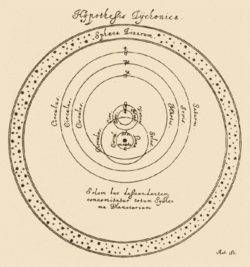
The Tychonic system (or Tychonian system) is a model of the universe published by Tycho Brahe in 1588, which combines what he saw as the mathematical benefits of the Copernican system with the philosophical and "physical" benefits of the Ptolemaic system. The model may have been inspired by Valentin Naboth and Paul Wittich, a Silesian mathematician and astronomer. A similar cosmological model was independently proposed in the Hindu astronomical treatise Tantrasamgraha (c. 1500 CE) by Nilakantha Somayaji of the Kerala school of astronomy and mathematics.
It is conceptually a geocentric model, or more precisely geoheliocentric: the Earth is at the centre of the universe, the Sun and Moon and the stars revolve around the Earth, and the other five planets revolve around the Sun. At the same time, the motions of the planets are mathematically equivalent to the motions in Copernicus' heliocentric system under a simple coordinate transformation, so that, as long as no force law is postulated to explain why the planets move as described, there is no mathematical reason to prefer either the Tychonic or the Copernican system.
Tycho admired aspects of Copernicus's heliocentric model, but felt that it had problems as concerned physics, astronomical observations of stars, and religion. Regarding the Copernican system, Tycho wrote,
This innovation expertly and completely circumvents all that is superfluous or discordant in the system of Ptolemy. On no point does it offend the principle of mathematics. Yet it ascribes to the Earth, that hulking, lazy body, unfit for motion, a motion as quick as that of the aethereal torches, and a triple motion at that.
(The "triple motion" refers to its daily rotation, yearly revolution, and axial precession.)
In regard to physics, Tycho held that the Earth was just too sluggish and heavy to be continuously in motion. According to the accepted Aristotelian physics of the time, the heavens (whose motions and cycles were continuous and unending) were made of "Aether" or "Quintessence"; this substance, not found on Earth, was light, strong, and unchanging, and its natural state was circular motion. By contrast, the Earth (where objects seem to have motion only when moved) and things on it were composed of substances that were heavy and whose natural state was rest. Consequently, the Earth was considered to be a "lazy" body that was not readily moved. Thus while Tycho acknowledged that the daily rising and setting of the Sun and stars could be explained by the Earth's rotation, as Copernicus had said, still
such a fast motion could not belong to the earth, a body very heavy and dense and opaque, but rather belongs to the sky itself whose form and subtle and constant matter are better suited to a perpetual motion, however fast.
In regards to the stars, Tycho also believed that if the Earth orbited the Sun annually there should be an observable stellar parallax over any period of six months, during which the angular orientation of a given star would change thanks to Earth's changing position (this parallax does exist, but is so small it was not detected until 1838, when Friedrich Bessel discovered a parallax of 0.314 arcseconds of the star 61 Cygni). The Copernican explanation for this lack of parallax was that the stars were such a great distance from Earth that Earth's orbit was almost insignificant by comparison. However, Tycho noted that this explanation introduced another problem: Stars as seen by the naked eye appear small, but of some size, with more prominent stars such as Vega appearing larger than lesser stars such as Polaris, which in turn appear larger than many others. Tycho had determined that a typical star measured approximately a minute of arc in size, with more prominent ones being two or three times as large. In writing to Christoph Rothmann, a Copernican astronomer, Tycho used basic geometry to show that, assuming a small parallax that just escaped detection, the distance to the stars in the Copernican system would have to be 700 times greater than the distance from the Sun to Saturn. Moreover, the only way the stars could be so distant and still appear the sizes they do in the sky would be if even average stars were gigantic—at least as big as the orbit of the Earth, and of course vastly larger than the Sun (most stars visible to the naked eye are giants, supergiants, or large, bright main-sequence stars). And, Tycho said, the more prominent stars would have to be even larger still. And what if the parallax was even smaller than anyone thought, so the stars were yet more distant? Then they would all have to be even larger still. Tycho said
Tychonic system
The Tychonic system (or Tychonian system) is a model of the universe published by Tycho Brahe in 1588, which combines what he saw as the mathematical benefits of the Copernican system with the philosophical and "physical" benefits of the Ptolemaic system. The model may have been inspired by Valentin Naboth and Paul Wittich, a Silesian mathematician and astronomer. A similar cosmological model was independently proposed in the Hindu astronomical treatise Tantrasamgraha (c. 1500 CE) by Nilakantha Somayaji of the Kerala school of astronomy and mathematics.
It is conceptually a geocentric model, or more precisely geoheliocentric: the Earth is at the centre of the universe, the Sun and Moon and the stars revolve around the Earth, and the other five planets revolve around the Sun. At the same time, the motions of the planets are mathematically equivalent to the motions in Copernicus' heliocentric system under a simple coordinate transformation, so that, as long as no force law is postulated to explain why the planets move as described, there is no mathematical reason to prefer either the Tychonic or the Copernican system.
Tycho admired aspects of Copernicus's heliocentric model, but felt that it had problems as concerned physics, astronomical observations of stars, and religion. Regarding the Copernican system, Tycho wrote,
This innovation expertly and completely circumvents all that is superfluous or discordant in the system of Ptolemy. On no point does it offend the principle of mathematics. Yet it ascribes to the Earth, that hulking, lazy body, unfit for motion, a motion as quick as that of the aethereal torches, and a triple motion at that.
(The "triple motion" refers to its daily rotation, yearly revolution, and axial precession.)
In regard to physics, Tycho held that the Earth was just too sluggish and heavy to be continuously in motion. According to the accepted Aristotelian physics of the time, the heavens (whose motions and cycles were continuous and unending) were made of "Aether" or "Quintessence"; this substance, not found on Earth, was light, strong, and unchanging, and its natural state was circular motion. By contrast, the Earth (where objects seem to have motion only when moved) and things on it were composed of substances that were heavy and whose natural state was rest. Consequently, the Earth was considered to be a "lazy" body that was not readily moved. Thus while Tycho acknowledged that the daily rising and setting of the Sun and stars could be explained by the Earth's rotation, as Copernicus had said, still
such a fast motion could not belong to the earth, a body very heavy and dense and opaque, but rather belongs to the sky itself whose form and subtle and constant matter are better suited to a perpetual motion, however fast.
In regards to the stars, Tycho also believed that if the Earth orbited the Sun annually there should be an observable stellar parallax over any period of six months, during which the angular orientation of a given star would change thanks to Earth's changing position (this parallax does exist, but is so small it was not detected until 1838, when Friedrich Bessel discovered a parallax of 0.314 arcseconds of the star 61 Cygni). The Copernican explanation for this lack of parallax was that the stars were such a great distance from Earth that Earth's orbit was almost insignificant by comparison. However, Tycho noted that this explanation introduced another problem: Stars as seen by the naked eye appear small, but of some size, with more prominent stars such as Vega appearing larger than lesser stars such as Polaris, which in turn appear larger than many others. Tycho had determined that a typical star measured approximately a minute of arc in size, with more prominent ones being two or three times as large. In writing to Christoph Rothmann, a Copernican astronomer, Tycho used basic geometry to show that, assuming a small parallax that just escaped detection, the distance to the stars in the Copernican system would have to be 700 times greater than the distance from the Sun to Saturn. Moreover, the only way the stars could be so distant and still appear the sizes they do in the sky would be if even average stars were gigantic—at least as big as the orbit of the Earth, and of course vastly larger than the Sun (most stars visible to the naked eye are giants, supergiants, or large, bright main-sequence stars). And, Tycho said, the more prominent stars would have to be even larger still. And what if the parallax was even smaller than anyone thought, so the stars were yet more distant? Then they would all have to be even larger still. Tycho said
Recent media
Recent media