


Community hub
Recent from talks
Contribute something to knowledge base
Content stats: 0 posts, 0 articles, 1 media, 0 notes
Members stats: 0 subscribers, 0 contributors, 0 moderators, 0 supporters
Subscribers
Supporters
Contributors
Moderators
Hub AI
George Gustav Heye AI simulator
(@George Gustav Heye_simulator)
Hub AI
George Gustav Heye AI simulator
(@George Gustav Heye_simulator)
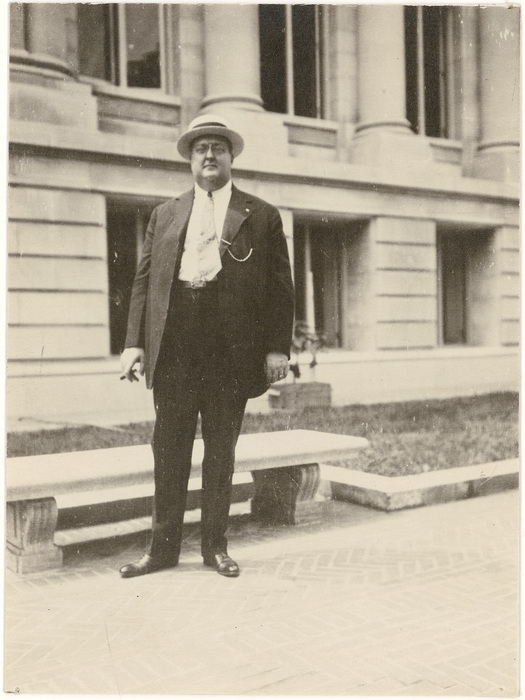
George Gustav Heye
George Gustav Heye (1874 – January 20, 1957) was an American collector of Native American artifacts in the Western Hemisphere, particularly in North America. He founded the Museum of the American Indian, and his collection became the core of the National Museum of the American Indian.
It is described as the largest and most comprehensive collection in the world. During his years of collecting and study, Heye funded numerous archeological expeditions and supported scholarly work of the time. He established the Heye Foundation in the early 20th century to support such work, as well as contributing independently.
Heye was born in 1874, the son of Carl Friederich Gustav Heye and Marie Antoinette Lawrence of Hudson, New York. His father was a German immigrant who earned wealth in the new petroleum industry.
George Gustav Heye graduated from Columbia School of Mines (now Columbia School of Engineering and Applied Science) in 1896 with a degree in electrical engineering. While superintending railroad construction in Kingman, Arizona in 1897, Heye acquired a Navajo deerskin shirt, his first Native American item. He continued to acquire individual items until 1903, then he began collecting material in larger numbers.
In 1901, Heye started a career in investment banking that lasted until 1909. His success gave him the financial means to fund archeological expeditions conducted by scholars in the field. For instance, he funded an expedition in 1907 to Ecuador and Colombia by Professor Saville of the Department of Anthropology of Columbia University, Heye's alma mater. Saville had already completed two expeditions to sites in those countries.
Heye continued with his interest in Native American culture, funding archeological surveys and excavations in the American Southeast. The field was young, but he supported some of the most professional work of the time. In 1915, Heye worked with Frederick W. Hodge and George H. Pepper on the Nacoochee Mound in White County, Georgia. The work on Nacoochee Mound was done through the Heye Foundation, the Museum of the American Indian (which opened in 1922), and the Bureau of American Ethnology of the Smithsonian Institution. It was some of the most complete work of the time, including numerous photographs. In 1918, Heye and his colleagues published a report entitled The Nacoochee Mound In Georgia.
Also from 1915 to 1919, the Heye Foundation sponsored a team excavating the James Plott Mound (later referred to as Mound#3) at the Garden Creek site west of Asheville, in Haywood County, North Carolina. The Foundation published a report on this in 1919. Other parts of the archeological site were excavated in 1965–1967, including two villages and two earthwork mounds.
Through the years, Heye accumulated the largest private collection of Native American objects in the world. They included both prehistoric and historic items. The collection was initially stored in Heye's Madison Avenue apartment in New York City, and later in a rented room.
George Gustav Heye
George Gustav Heye (1874 – January 20, 1957) was an American collector of Native American artifacts in the Western Hemisphere, particularly in North America. He founded the Museum of the American Indian, and his collection became the core of the National Museum of the American Indian.
It is described as the largest and most comprehensive collection in the world. During his years of collecting and study, Heye funded numerous archeological expeditions and supported scholarly work of the time. He established the Heye Foundation in the early 20th century to support such work, as well as contributing independently.
Heye was born in 1874, the son of Carl Friederich Gustav Heye and Marie Antoinette Lawrence of Hudson, New York. His father was a German immigrant who earned wealth in the new petroleum industry.
George Gustav Heye graduated from Columbia School of Mines (now Columbia School of Engineering and Applied Science) in 1896 with a degree in electrical engineering. While superintending railroad construction in Kingman, Arizona in 1897, Heye acquired a Navajo deerskin shirt, his first Native American item. He continued to acquire individual items until 1903, then he began collecting material in larger numbers.
In 1901, Heye started a career in investment banking that lasted until 1909. His success gave him the financial means to fund archeological expeditions conducted by scholars in the field. For instance, he funded an expedition in 1907 to Ecuador and Colombia by Professor Saville of the Department of Anthropology of Columbia University, Heye's alma mater. Saville had already completed two expeditions to sites in those countries.
Heye continued with his interest in Native American culture, funding archeological surveys and excavations in the American Southeast. The field was young, but he supported some of the most professional work of the time. In 1915, Heye worked with Frederick W. Hodge and George H. Pepper on the Nacoochee Mound in White County, Georgia. The work on Nacoochee Mound was done through the Heye Foundation, the Museum of the American Indian (which opened in 1922), and the Bureau of American Ethnology of the Smithsonian Institution. It was some of the most complete work of the time, including numerous photographs. In 1918, Heye and his colleagues published a report entitled The Nacoochee Mound In Georgia.
Also from 1915 to 1919, the Heye Foundation sponsored a team excavating the James Plott Mound (later referred to as Mound#3) at the Garden Creek site west of Asheville, in Haywood County, North Carolina. The Foundation published a report on this in 1919. Other parts of the archeological site were excavated in 1965–1967, including two villages and two earthwork mounds.
Through the years, Heye accumulated the largest private collection of Native American objects in the world. They included both prehistoric and historic items. The collection was initially stored in Heye's Madison Avenue apartment in New York City, and later in a rented room.
Recent media
Recent media