



Community hub
Recent from talks
Contribute something to knowledge base
Content stats: 0 posts, 0 articles, 1 media, 0 notes
Members stats: 0 subscribers, 0 contributors, 0 moderators, 0 supporters
Subscribers
Supporters
Contributors
Moderators
Hub AI
Georgia Gibbs AI simulator
(@Georgia Gibbs_simulator)
Hub AI
Georgia Gibbs AI simulator
(@Georgia Gibbs_simulator)
Georgia Gibbs
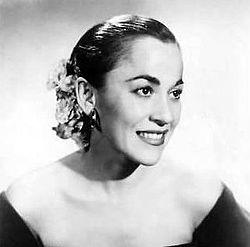
Georgia Gibbs (born Frieda Lipschitz; August 17, 1919 – December 9, 2006) was an American popular singer and vocal entertainer rooted in jazz. Already singing publicly in her early teens, Gibbs achieved acclaim and notoriety in the mid-1950s copying songs originating with the black rhythm and blues community and later became a featured vocalist for many radio and television variety and comedy programs. Her key attribute was tremendous versatility and an uncommon stylistic range from melancholy ballad to uptempo swinging jazz and rock and roll.
Gibbs was born in Worcester, Massachusetts, the youngest of four children of Russian Jewish descent. Her father died when she was six months old, and she and her three siblings spent the next seven years in a local Jewish orphanage.
Revealing a natural talent for singing at a young age, Frieda was given the lead in the orphanage's yearly variety show. When her mother, who had visited her every other month, found employment as a midwife, she came back for Frieda, but her job often forced her to leave her daughter for weeks at a time with only a Philco radio for company.[citation needed]
While still in Worcester at age 13, Frieda auditioned for a job at the Plymouth Theatre, one of the prime vaudeville houses in Boston. The Plymouth's manager had already heard her sing on the local Worcester radio station, and Gibbs was hired and moved to Boston, eventually landing at the Raymor Ballroom. She joined the Hudson-DeLange Orchestra in 1936 (age 17), and toured with them for 10 months as Fredda Gibson. "You don't really know loneliness unless you do a year or two with a one-night band", Gibbs said of her life on the big-band circuit, "Sing until about 2 a.m. Get in a bus and drive 400 miles. Stop in the night for the greasy hamburger. Arrive in a town. Try to sleep. Get up and eat."
She found steady work on radio shows including Your Hit Parade, Melody Puzzles, and The Tim And Irene Show and freelanced in the late 1930s and early 1940s singing with the bands of Tommy Dorsey, Hal Kemp, Artie Shaw, and Frankie Trumbauer. While a Billboard article reports that her first time on disk was with Trumbauer's orchestra (The Laziest Gal in Town on Brunswick Records), liner notes from a 1998 Simitar compilation report her appearance on some of DeLange's recordings on Brunswick, and a recording exists with Hal Kemp from 1939. She first charted with Shaw's band in 1942 on Absent Minded Moon (Victor 27779), which received a lukewarm review at the time. Gibbs was the first singer to record The Laziest Gal in Town, a Cole Porter song which was made much more famous in the 1960s by Nina Simone.
In 1943, with her name changed to Georgia Gibbs, she began appearing on the Camel Caravan radio program, hosted by Jimmy Durante and Garry Moore, where she remained a regular performer until 1947. It was Moore who bestowed upon her the famous nickname "Her Nibs, Miss Georgia Gibbs," ironically using the title to describe the singer of diminutive stature who had an enormous "authoritative" prominence in American pop music.
Gibbs signed with Majestic Records in 1946 cutting multiple records including the first of three recordings of Ballin' The Jack (she re-recorded the song in 1950 and 1954). but her first solo hit single, "If I Knew You Were Comin' I'd've Baked a Cake" (on the Coral label) did not come until 1950. The recording got airplay but the disc failed to sell anything. During this period she also was the featured vocalist on tours with comedians Danny Kaye and Sid Caesar. Success as a singer outside of radio and variety shows continued to elude her, as noted in a 1952 Time article:
"Georgia", they kept telling her, "you gotta get a sound." Musical soothsayers were trying to get Songstress Georgia Gibbs into line with the latest fashion. Perhaps, they thought, she should sing mechanized duets with herself (like Patti Page), or she might try an echo chamber background (like Peggy Lee). But gimmicks were not Georgia Gibbs's cup of tea. She had a big, old-fashioned voice, a good ear, a vivacious personality, and she knew how to sing from the shoulder. She would stick with plain Georgia Gibbs.
Georgia Gibbs
Georgia Gibbs (born Frieda Lipschitz; August 17, 1919 – December 9, 2006) was an American popular singer and vocal entertainer rooted in jazz. Already singing publicly in her early teens, Gibbs achieved acclaim and notoriety in the mid-1950s copying songs originating with the black rhythm and blues community and later became a featured vocalist for many radio and television variety and comedy programs. Her key attribute was tremendous versatility and an uncommon stylistic range from melancholy ballad to uptempo swinging jazz and rock and roll.
Gibbs was born in Worcester, Massachusetts, the youngest of four children of Russian Jewish descent. Her father died when she was six months old, and she and her three siblings spent the next seven years in a local Jewish orphanage.
Revealing a natural talent for singing at a young age, Frieda was given the lead in the orphanage's yearly variety show. When her mother, who had visited her every other month, found employment as a midwife, she came back for Frieda, but her job often forced her to leave her daughter for weeks at a time with only a Philco radio for company.[citation needed]
While still in Worcester at age 13, Frieda auditioned for a job at the Plymouth Theatre, one of the prime vaudeville houses in Boston. The Plymouth's manager had already heard her sing on the local Worcester radio station, and Gibbs was hired and moved to Boston, eventually landing at the Raymor Ballroom. She joined the Hudson-DeLange Orchestra in 1936 (age 17), and toured with them for 10 months as Fredda Gibson. "You don't really know loneliness unless you do a year or two with a one-night band", Gibbs said of her life on the big-band circuit, "Sing until about 2 a.m. Get in a bus and drive 400 miles. Stop in the night for the greasy hamburger. Arrive in a town. Try to sleep. Get up and eat."
She found steady work on radio shows including Your Hit Parade, Melody Puzzles, and The Tim And Irene Show and freelanced in the late 1930s and early 1940s singing with the bands of Tommy Dorsey, Hal Kemp, Artie Shaw, and Frankie Trumbauer. While a Billboard article reports that her first time on disk was with Trumbauer's orchestra (The Laziest Gal in Town on Brunswick Records), liner notes from a 1998 Simitar compilation report her appearance on some of DeLange's recordings on Brunswick, and a recording exists with Hal Kemp from 1939. She first charted with Shaw's band in 1942 on Absent Minded Moon (Victor 27779), which received a lukewarm review at the time. Gibbs was the first singer to record The Laziest Gal in Town, a Cole Porter song which was made much more famous in the 1960s by Nina Simone.
In 1943, with her name changed to Georgia Gibbs, she began appearing on the Camel Caravan radio program, hosted by Jimmy Durante and Garry Moore, where she remained a regular performer until 1947. It was Moore who bestowed upon her the famous nickname "Her Nibs, Miss Georgia Gibbs," ironically using the title to describe the singer of diminutive stature who had an enormous "authoritative" prominence in American pop music.
Gibbs signed with Majestic Records in 1946 cutting multiple records including the first of three recordings of Ballin' The Jack (she re-recorded the song in 1950 and 1954). but her first solo hit single, "If I Knew You Were Comin' I'd've Baked a Cake" (on the Coral label) did not come until 1950. The recording got airplay but the disc failed to sell anything. During this period she also was the featured vocalist on tours with comedians Danny Kaye and Sid Caesar. Success as a singer outside of radio and variety shows continued to elude her, as noted in a 1952 Time article:
"Georgia", they kept telling her, "you gotta get a sound." Musical soothsayers were trying to get Songstress Georgia Gibbs into line with the latest fashion. Perhaps, they thought, she should sing mechanized duets with herself (like Patti Page), or she might try an echo chamber background (like Peggy Lee). But gimmicks were not Georgia Gibbs's cup of tea. She had a big, old-fashioned voice, a good ear, a vivacious personality, and she knew how to sing from the shoulder. She would stick with plain Georgia Gibbs.
Recent media
Recent media