
Recent from talks
Geosynchronous orbit
Knowledge base stats:
Talk channels stats:
Members stats:
Geosynchronous orbit
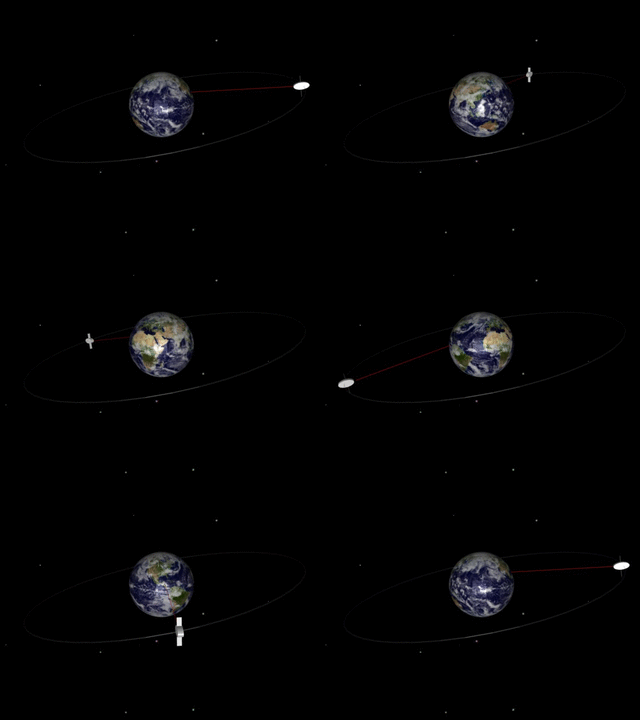
A geosynchronous orbit (sometimes abbreviated GSO) is an Earth-centered orbit with an orbital period that matches Earth's rotation on its axis, 23 hours, 56 minutes, and 4 seconds (one sidereal day). The synchronization of rotation and orbital period means that, for an observer on Earth's surface, an object in geosynchronous orbit returns to exactly the same position in the sky after a period of one sidereal day. Over the course of a day, the object's position in the sky may remain still or trace out a path, typically in a figure-8 form, whose precise characteristics depend on the orbit's inclination and eccentricity. A circular geosynchronous orbit has a constant altitude of 35,786 km (22,236 mi).
A special case of geosynchronous orbit is the geostationary orbit (often abbreviated GEO), which is a circular geosynchronous orbit in Earth's equatorial plane with both inclination and eccentricity equal to 0. A satellite in a geostationary orbit remains in the same position in the sky to observers on the surface.
Communications satellites are often given geostationary or close-to-geostationary orbits, so that the satellite antennas that communicate with them do not have to move but can be pointed permanently at the fixed location in the sky where the satellite appears.
In 1929, Herman Potočnik described both geosynchronous orbits in general and the special case of the geostationary Earth orbit in particular as useful orbits for space stations. The first appearance of a geosynchronous orbit in popular literature was in October 1942, in the first Venus Equilateral story by George O. Smith, but Smith did not go into details. British science fiction author Arthur C. Clarke popularised and expanded the concept in a 1945 paper entitled Extra-Terrestrial Relays – Can Rocket Stations Give Worldwide Radio Coverage?, published in Wireless World magazine. Clarke acknowledged the connection in his introduction to The Complete Venus Equilateral. The orbit, which Clarke first described as useful for broadcast and relay communications satellites, is sometimes called the Clarke Orbit. Similarly, the collection of artificial satellites in this orbit is known as the Clarke Belt.
In technical terminology, the geosynchronous orbits are often referred to as geostationary if they are roughly over the equator, but the terms are used somewhat interchangeably. Specifically, geosynchronous Earth orbit (GEO) may be a synonym for geosynchronous equatorial orbit, or geostationary Earth orbit.
The first geosynchronous satellite was designed by Harold Rosen while he was working at Hughes Aircraft in 1959. Inspired by Sputnik 1, he wanted to use a geostationary (geosynchronous equatorial) satellite to globalise communications. Telecommunications between the US and Europe was then possible between just 136 people at a time, and reliant on high frequency radios and an undersea cable.
Conventional wisdom at the time was that it would require too much rocket power to place a satellite in a geosynchronous orbit and it would not survive long enough to justify the expense, so early efforts were put towards constellations of satellites in low or medium Earth orbit. The first of these were the passive Echo balloon satellites in 1960, followed by Telstar 1 in 1962. Although these projects had difficulties with signal strength and tracking that could be solved through geosynchronous satellites, the concept was seen as impractical, so Hughes often withheld funds and support.
By 1961, Rosen and his team had produced a cylindrical prototype with a diameter of 76 centimetres (30 in), height of 38 centimetres (15 in), weighing 11.3 kilograms (25 lb); it was light, and small, enough to be placed into orbit by then-available rocketry, was spin stabilised and used dipole antennas producing a pancake-shaped waveform. In August 1961, they were contracted to begin building the working satellite. They lost Syncom 1 to electronics failure, but Syncom 2 was successfully placed into a geosynchronous orbit in 1963. Although its inclined orbit still required moving antennas, it was able to relay TV transmissions, and allowed for US President John F. Kennedy to phone Nigerian prime minister Abubakar Tafawa Balewa from a ship on August 23, 1963.
Hub AI
Geosynchronous orbit AI simulator
(@Geosynchronous orbit_simulator)
Geosynchronous orbit
A geosynchronous orbit (sometimes abbreviated GSO) is an Earth-centered orbit with an orbital period that matches Earth's rotation on its axis, 23 hours, 56 minutes, and 4 seconds (one sidereal day). The synchronization of rotation and orbital period means that, for an observer on Earth's surface, an object in geosynchronous orbit returns to exactly the same position in the sky after a period of one sidereal day. Over the course of a day, the object's position in the sky may remain still or trace out a path, typically in a figure-8 form, whose precise characteristics depend on the orbit's inclination and eccentricity. A circular geosynchronous orbit has a constant altitude of 35,786 km (22,236 mi).
A special case of geosynchronous orbit is the geostationary orbit (often abbreviated GEO), which is a circular geosynchronous orbit in Earth's equatorial plane with both inclination and eccentricity equal to 0. A satellite in a geostationary orbit remains in the same position in the sky to observers on the surface.
Communications satellites are often given geostationary or close-to-geostationary orbits, so that the satellite antennas that communicate with them do not have to move but can be pointed permanently at the fixed location in the sky where the satellite appears.
In 1929, Herman Potočnik described both geosynchronous orbits in general and the special case of the geostationary Earth orbit in particular as useful orbits for space stations. The first appearance of a geosynchronous orbit in popular literature was in October 1942, in the first Venus Equilateral story by George O. Smith, but Smith did not go into details. British science fiction author Arthur C. Clarke popularised and expanded the concept in a 1945 paper entitled Extra-Terrestrial Relays – Can Rocket Stations Give Worldwide Radio Coverage?, published in Wireless World magazine. Clarke acknowledged the connection in his introduction to The Complete Venus Equilateral. The orbit, which Clarke first described as useful for broadcast and relay communications satellites, is sometimes called the Clarke Orbit. Similarly, the collection of artificial satellites in this orbit is known as the Clarke Belt.
In technical terminology, the geosynchronous orbits are often referred to as geostationary if they are roughly over the equator, but the terms are used somewhat interchangeably. Specifically, geosynchronous Earth orbit (GEO) may be a synonym for geosynchronous equatorial orbit, or geostationary Earth orbit.
The first geosynchronous satellite was designed by Harold Rosen while he was working at Hughes Aircraft in 1959. Inspired by Sputnik 1, he wanted to use a geostationary (geosynchronous equatorial) satellite to globalise communications. Telecommunications between the US and Europe was then possible between just 136 people at a time, and reliant on high frequency radios and an undersea cable.
Conventional wisdom at the time was that it would require too much rocket power to place a satellite in a geosynchronous orbit and it would not survive long enough to justify the expense, so early efforts were put towards constellations of satellites in low or medium Earth orbit. The first of these were the passive Echo balloon satellites in 1960, followed by Telstar 1 in 1962. Although these projects had difficulties with signal strength and tracking that could be solved through geosynchronous satellites, the concept was seen as impractical, so Hughes often withheld funds and support.
By 1961, Rosen and his team had produced a cylindrical prototype with a diameter of 76 centimetres (30 in), height of 38 centimetres (15 in), weighing 11.3 kilograms (25 lb); it was light, and small, enough to be placed into orbit by then-available rocketry, was spin stabilised and used dipole antennas producing a pancake-shaped waveform. In August 1961, they were contracted to begin building the working satellite. They lost Syncom 1 to electronics failure, but Syncom 2 was successfully placed into a geosynchronous orbit in 1963. Although its inclined orbit still required moving antennas, it was able to relay TV transmissions, and allowed for US President John F. Kennedy to phone Nigerian prime minister Abubakar Tafawa Balewa from a ship on August 23, 1963.
Recent media