Recent from talks
Assassination
Domestic Policy
Foreign Policy
Space Exploration
Early Life and Education
Personal Life and Relationships
Military Service
Political Career
Main milestones
Nothing was collected or created yet.
John F. Kennedy
View on Wikipedia
Key Information
| ||
|---|---|---|
|
Personal 35th President of the United States Tenure Appointments Legacy |
||
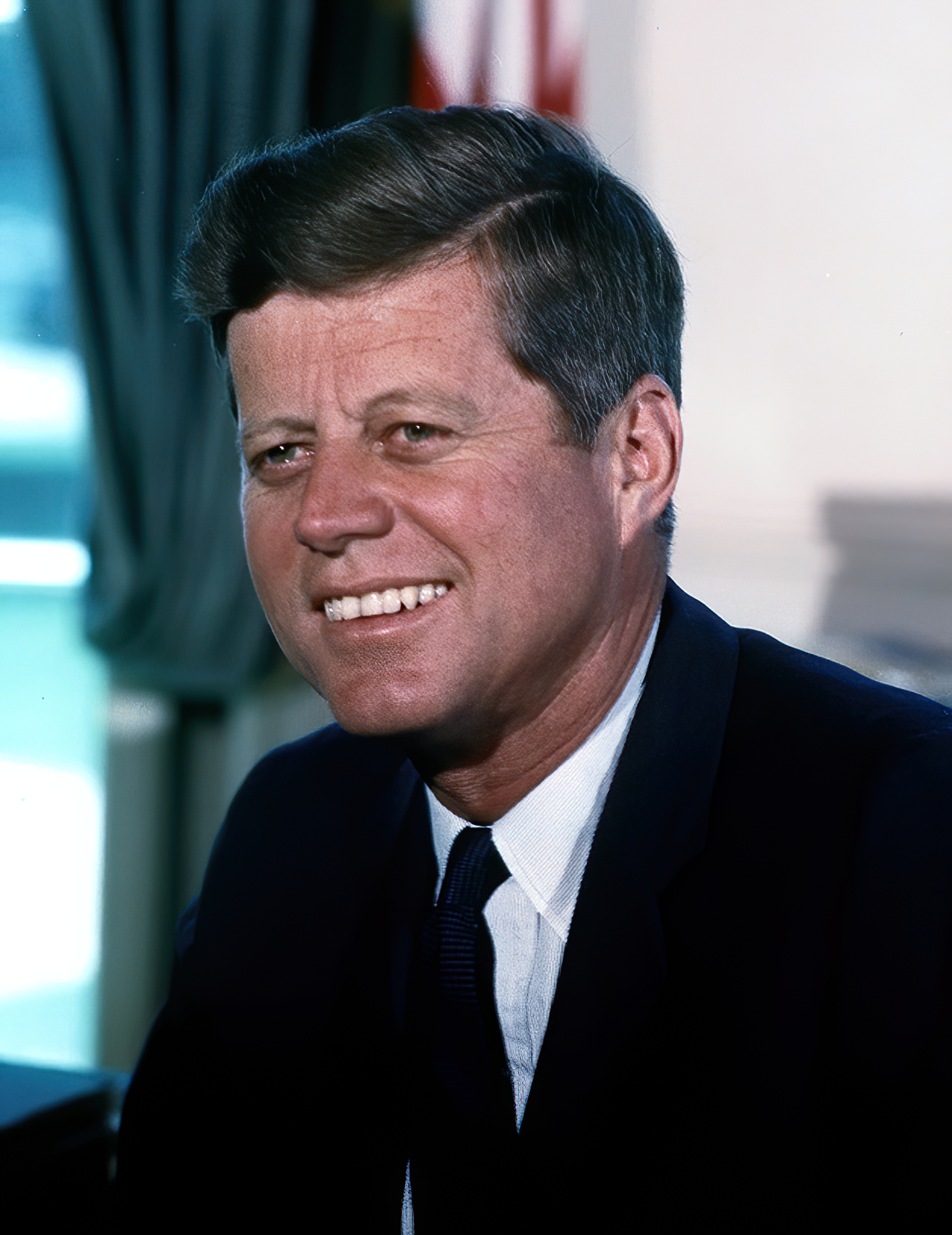
John Fitzgerald Kennedy (May 29, 1917 – November 22, 1963), also known as JFK, was the 35th president of the United States, serving from 1961 until his assassination in 1963. He was the youngest person elected president at 43 years.[a] Kennedy served at the height of the Cold War, and the majority of his foreign policy concerned relations with the Soviet Union and Cuba. A member of the Democratic Party, Kennedy represented Massachusetts in both houses of the United States Congress before his presidency.
Born into the prominent Kennedy family in Brookline, Massachusetts, Kennedy graduated from Harvard University in 1940, joining the U.S. Naval Reserve the following year. During World War II, he commanded PT boats in the Pacific theater. Kennedy's survival following the sinking of PT-109 and his rescue of his fellow sailors made him a war hero and earned the Navy and Marine Corps Medal, but left him with serious injuries. After a brief stint in journalism, Kennedy represented a working-class Boston district in the U.S. House of Representatives from 1947 to 1953. He was subsequently elected to the U.S. Senate, serving as the junior senator for Massachusetts from 1953 to 1960. While in the Senate, Kennedy published his book Profiles in Courage, which won a Pulitzer Prize. Kennedy ran in the 1960 presidential election. His campaign gained momentum after the first televised presidential debates in American history, and he was elected president, narrowly defeating Republican opponent Richard Nixon, the incumbent vice president.
Kennedy's presidency saw high tensions with communist states in the Cold War. He increased the number of American military advisers in South Vietnam, and the Strategic Hamlet Program began during his presidency. In 1961, he authorized attempts to overthrow the Cuban government of Fidel Castro in the failed Bay of Pigs Invasion and Operation Mongoose. In October 1962, U.S. spy planes discovered Soviet missile bases had been deployed in Cuba. The resulting period of tensions, termed the Cuban Missile Crisis, nearly resulted in nuclear war. In August 1961, after East German troops erected the Berlin Wall, Kennedy sent an army convoy to reassure West Berliners of U.S. support, and delivered one of his most famous speeches in West Berlin in June 1963. In 1963, Kennedy signed the first nuclear weapons treaty. He presided over the establishment of the Peace Corps, Alliance for Progress with Latin America, and the continuation of the Apollo program with the goal of landing a man on the Moon before 1970. He supported the civil rights movement but was only somewhat successful in passing his New Frontier domestic policies.
On November 22, 1963, Kennedy was assassinated in Dallas. His vice president, Lyndon B. Johnson, assumed the presidency. Lee Harvey Oswald was arrested for the assassination, but he was shot and killed by Jack Ruby two days later. The Federal Bureau of Investigation (FBI) and the Warren Commission both concluded Oswald had acted alone, but conspiracy theories about the assassination persist. After Kennedy's death, Congress enacted many of his proposals, including the Civil Rights Act of 1964 and the Revenue Act of 1964. Kennedy ranks highly in polls of U.S. presidents with historians and the general public. His personal life has been the focus of considerable sustained interest following public revelations in the 1970s of his chronic health ailments and extramarital affairs. Kennedy is the most recent U.S. president to have died in office.
Early life and education
[edit]John Fitzgerald Kennedy was born outside Boston in Brookline, Massachusetts, on May 29, 1917,[2] to Joseph P. Kennedy Sr., a businessman and politician, and Rose Kennedy (née Fitzgerald), a philanthropist and socialite.[3] His paternal grandfather, P. J. Kennedy, was an East Boston ward boss and Massachusetts state legislator.[4] Kennedy's maternal grandfather and namesake, John F. Fitzgerald, was a U.S. congressman and two-term mayor of Boston.[5] All four of his grandparents were children of Irish immigrants.[1] Kennedy had an older brother, Joseph Jr., and seven younger siblings: Rosemary, Kathleen, Eunice, Patricia, Robert, Jean, and Ted.[6]
Kennedy's father amassed a private fortune and established trust funds for his nine children, guaranteeing them lifelong financial independence.[7] His business kept him away from home for long stretches, but Joe Sr. was a formidable presence in his children's lives. He encouraged them to be ambitious, emphasized political discussions at the dinner table, and demanded a high level of academic achievement. John's first exposure to politics came in 1922, when he toured Boston wards with his grandfather Fitzgerald during his unsuccessful gubernatorial campaign.[8][9] In September 1927, due to an outbreak of polio in Massachusetts and Joe Sr.'s business interests in Wall Street and Hollywood, the family relocated from Boston to the Riverdale neighborhood of New York City.[10][11] Several years later, his brother Robert told Look magazine that his father left Boston because of job signs that read: "No Irish Need Apply."[12] The Kennedys spent summers and early autumns at their home in Hyannis Port, Massachusetts, a village on Cape Cod,[13] where they engaged in various outdoor activities.[14] Christmas and Easter holidays were spent at their winter retreat in Palm Beach, Florida.[15] In September 1930, Kennedy, 13 years old, was sent to the Canterbury School in New Milford, Connecticut, for 8th grade. In April 1931, he had an appendectomy, after which he withdrew from Canterbury and recuperated at home.[16]
In September 1931, Kennedy began attending Choate, a preparatory boarding school in Wallingford, Connecticut.[17] Rose had wanted John and Joe Jr. to attend a Catholic school, but Joe Sr. believed that if they were to compete in the political world, they needed to be among boys from prominent Protestant families.[18] John spent his first years at Choate in his older brother's shadow and compensated with rebellious behavior that attracted a clique. Their most notorious stunt was exploding a toilet seat with a firecracker. In the next chapel assembly, the headmaster, George St. John, brandished the toilet seat and spoke of "muckers" who would "spit in our sea," leading Kennedy to name his group "The Muckers Club." It included his roommate and lifelong friend Lem Billings.[19][20] Kennedy graduated from Choate in June 1935, finishing 64th of 112 students.[11] He had been the business manager of the school yearbook and was voted the "most likely to succeed."[19]


Kennedy intended to study under Harold Laski at the London School of Economics, as his older brother had done. However, ill health forced his return to the United States in October 1935, when he enrolled late at Princeton University, but had to withdraw after two months due to gastrointestinal illness.[21]
In September 1936, Kennedy enrolled at Harvard College.[22] He wrote occasionally for The Harvard Crimson, the campus newspaper, but had little involvement with campus politics, preferring to concentrate on athletics and his social life. Kennedy played football and was on the junior varsity squad during his sophomore year, but an injury forced him off the team, and left him with back problems that plagued him for the rest of his life. He earned membership in the Hasty Pudding Club and the Spee Club, one of Harvard's elite "final clubs".[23][24]
In July 1938, Kennedy sailed overseas with his older brother to work at the American embassy in London, where their father was serving as President Franklin D. Roosevelt's ambassador to the Court of St. James's.[25] The following year, Kennedy traveled throughout Europe, the Soviet Union, the Balkans, and the Middle East in preparation for his Harvard senior honors thesis.[26] He then went to Berlin, where a U.S. diplomatic representative gave him a secret message about war breaking out soon to pass on to his father, and to Czechoslovakia before returning to London on September 1, 1939—the day that Germany invaded Poland; the start of World War II.[27] Two days later, the family was in the House of Commons for speeches endorsing the United Kingdom's declaration of war on Germany. Kennedy was sent as his father's representative to assist with arrangements for American survivors of the torpedoing of SS Athenia before flying back to the United States on his first transatlantic flight.[28][29]
While an upperclassman at Harvard, Kennedy began to take his studies more seriously and developed an interest in political philosophy. He made the dean's list in his junior year.[30] In 1940, Kennedy completed his thesis, "Appeasement in Munich", about British negotiations during the Munich Agreement. The thesis was released on July 24, under the title Why England Slept.[31] The book was one of the first to offer information about the war and its origins, and quickly became a bestseller.[32] In addition to addressing Britain's unwillingness to strengthen its military in the lead-up to the war, the book called for an Anglo-American alliance against the rising totalitarian powers. Kennedy became increasingly supportive of U.S. intervention in World War II, and his father's isolationist beliefs resulted in the latter's dismissal as ambassador.[33]
In 1940, Kennedy graduated cum laude from Harvard with a Bachelor of Arts in government, concentrating on international affairs.[34] That fall, he enrolled at the Stanford Graduate School of Business and audited classes,[35] but he left after a semester to help his father complete his memoirs as an American ambassador. In early 1941, Kennedy toured South America.[36][37]
U.S. Naval Reserve (1941–1945)
[edit]Kennedy planned to attend Yale Law School, but canceled those plans when American entry into World War II seemed imminent.[38] In 1940, Kennedy attempted to enter the Army's Officer Candidate School. Despite months of training, he was medically disqualified due to chronic back problems. On September 24, 1941, with the help of Alan Goodrich Kirk—the director of the Office of Naval Intelligence (ONI) and former naval attaché to Joe Sr.—Kennedy joined the United States Naval Reserve. He was commissioned as an ensign on October 26, 1941,[39] and joined the ONI staff in Washington, D.C.[40][41][42]
In January 1942, Kennedy was assigned to the ONI field office at Headquarters, Sixth Naval District, in Charleston, South Carolina.[41] He hoped to command a PT (patrol torpedo) boat, but his health problems seemed almost certain to prevent active duty. Kennedy's father intervened by providing misleading medical records and convincing PT officers that his presence would bring publicity to the fleet.[43] Kennedy completed six months of training at the Naval Reserve Officer Training School in Chicago and at the Motor Torpedo Boat Squadrons Training Center in Melville, Rhode Island.[40][44] His first command was PT-101 from December 7, 1942, until February 23, 1943.[41] Unhappy with his assignment to the Panama Canal, far from the fighting, Kennedy appealed to Senator David Walsh of Massachusetts, who arranged for him to be reassigned to the South Pacific.[43]
Commanding PT-109 and PT-59
[edit]
In April 1943, Kennedy was assigned to Motor Torpedo Squadron TWO,[40] and on April 24 he took command of PT-109,[45] then based on Tulagi Island in the Solomons.[41] On the night of August 1–2, in support of the New Georgia campaign, PT-109 and fourteen other PTs were ordered to block or repel four Japanese destroyers and floatplanes carrying food, supplies, and 900 Japanese soldiers to the Vila Plantation garrison on the southern tip of the Solomon's Kolombangara Island. Intelligence had been sent to Kennedy's commander, Thomas G. Warfield, who, as a result, was expecting the arrival of the large Japanese naval force that would pass on the evening of August 1. Of the 24 torpedoes fired that night by eight of the American PTs, not one hit the Japanese convoy.[46] On that moonless night, Kennedy spotted a Japanese destroyer heading north on its return from the base of Kolombangara around 2:00 a.m., and attempted to turn to attack, when PT-109 was suddenly rammed at an angle and cut in half by the destroyer Amagiri, killing two PT-109 crew members.[47][48][41][b] Avoiding surrender, the remaining crew swam toward Plum Pudding Island, 3.5 miles (5.6 km) southwest of the remains of PT-109, on August 2.[41][50] Despite re-injuring his back in the collision, Kennedy towed a badly burned crewman named Patrick McMahon [51] to the island with a life jacket strap clenched between his teeth.[52] From there, Kennedy and his subordinate, Ensign George Ross, made forays through the coral islands, searching for help.[53] When they encountered an English-speaking native with a canoe, Kennedy carved his location on a coconut shell and requested a boat rescue. Seven days after the collision, with the coconut message delivered, the PT-109 crew was rescued.[54][55]
Almost immediately, the PT-109 rescue became a highly publicized event. The story was chronicled by John Hersey in The New Yorker in 1944; decades later, it was the basis of a successful film.[55] It followed Kennedy into politics and provided a strong foundation for his appeal as a leader.[56] Hersey portrayed Kennedy as a modest, self-deprecating hero.[57] For his courage and leadership, Kennedy was awarded the Navy and Marine Corps Medal, and the injuries he suffered during the incident qualified him for a Purple Heart.[56]
After a month's recovery, Kennedy returned to duty, commanding PT-59. On November 2, Kennedy's PT-59, along with two other PT boats, took part in the rescue of 40 to 50 Marines. The 59 acted as a shield from shore fire as they escaped on two rescue landing craft at the base of the Warrior River on Choiseul Island, taking ten Marines aboard and delivering them to safety.[58] Under doctor's orders, Kennedy was relieved of his command on November 18, and sent to the hospital on Tulagi.[59] By December 1943, with his health deteriorating, Kennedy left the Pacific front and arrived in San Francisco in early January 1944.[60] After receiving treatment for his back injury at the Chelsea Naval Hospital in Massachusetts from May to December 1944, he was released from active duty.[61][40] Beginning in January 1945, Kennedy spent three months recovering from his back injury at Castle Hot Springs, a resort and temporary military hospital in Arizona.[62][63] On March 1, 1945, Kennedy retired from the Navy Reserve on physical disability and was honorably discharged with the full rank of lieutenant.[64] When later asked how he became a war hero, Kennedy joked: "It was easy. They cut my PT boat in half."[65]
On August 12, 1944, Kennedy's older brother, Joe Jr., a Navy pilot, was killed during an air mission. His body was never recovered.[66][67] News of his death reached the family's home in Hyannis Port, Massachusetts, a day later. Kennedy felt that Joe Jr.'s reckless flight was partly an effort to outdo him.[68][69] To console himself, Kennedy set out to assemble a privately published book of remembrances of his brother, As We Remember Joe.[70]
Journalism (1945)
[edit]In April 1945, Kennedy's father, who was a friend of William Randolph Hearst, arranged a position for his son as a special correspondent for Hearst Newspapers; the assignment kept Kennedy's name in the public eye and "expose[d] him to journalism as a possible career".[71] He covered the United Nations Conference on International Organization in San Francisco, the British elections, and the Potsdam Conference in Germany.[72]
U.S. House of Representatives (1947–1953)
[edit]Kennedy's elder brother, Joe Jr., had been the family's political standard-bearer and was tapped by their father to seek the presidency. After Joe's death, the assignment fell to John as the second eldest.[73] Boston mayor Maurice J. Tobin discussed the possibility of John becoming his running mate in 1946 as a candidate for Massachusetts lieutenant governor, but Joe Sr. preferred a congressional campaign that could send John to Washington, where he could have national visibility.[74]

At the urging of Joe Sr., U.S. Representative James Michael Curley vacated his seat in the solidly Democratic 11th congressional district of Massachusetts to become mayor of Boston in 1946. Kennedy established legal residency at 122 Bowdoin Street across from the Massachusetts State House.[75] He won the Democratic primary with 42 percent of the vote, defeating nine other candidates.[76] According to Fredrik Logevall, Joe Sr.
spent hours on the phone with reporters and editors, seeking information, trading confidences, and cajoling them into publishing puff pieces on John, ones that invariably played up his war record in the Pacific. He oversaw a professional advertising campaign that ensured ads went up in just the right places. The campaign had a virtual monopoly on [Boston] subway space, and on window stickers ("Kennedy for Congress") for cars and homes, and was the force behind the mass mailing of Hersey's PT-109 article.[77]
Though Republicans took control of the House in the 1946 elections, Kennedy defeated his Republican opponent in the general election, taking 73 percent of the vote.[78]
As a congressman, Kennedy had a reputation for taking little interest in the management of his office or his constituents' concerns, with one of the highest absenteeism rates in the House, although much was explained by illness.[79] George Smathers, one of his few political friends at the time, claimed that he was more interested in being a writer than a politician, and at that time, he suffered from extreme shyness.[79] Kennedy found "most of his fellow congressmen boring, preoccupied as they all seemed to be with their narrow political concerns". The arcane House rules and customs, which slowed legislation, exasperated him.[80]
Kennedy served in the House for six years, joining the influential Education and Labor Committee and the Veterans' Affairs Committee.[81] He concentrated his attention on international affairs, supporting the Truman Doctrine as an appropriate response to the emerging Cold War.[82] He also supported public housing and opposed the Labor Management Relations Act of 1947, which restricted the power of labor unions.[83] Though not as vocally anti-communist as Joseph McCarthy, Kennedy supported the Internal Security Act of 1950, which required communists to register with the government, and he deplored the "loss of China".[84][85] Kennedy denounced Truman and the State Department during a speech in Salem, Massachusetts on January 30, 1949, for contributing to the "tragic story of China whose freedom we once fought to preserve. What our young men had saved [in World War II], our diplomats and our President have frittered away."[86][87] Having served as a Boy Scout during his childhood, Kennedy was active in the Boston Council from 1946 to 1955 as district vice chairman, member of the executive board, vice-president, and National Council Representative.[88][89]

To appeal to the large Italian-American voting bloc in Massachusetts, Kennedy delivered a speech in November 1947 supporting a $227 million aid package to Italy. He maintained that Italy was in danger from an "onslaught of the communist minority" and that the country was the "initial battleground in the communist drive to capture Western Europe."[90] To counter Soviet efforts to take control in Middle Eastern and Asian countries like Indochina, Kennedy wanted the United States to develop nonmilitary techniques of resistance that would not create suspicions of neoimperialism or add to the country's financial burden. The problem, as he saw it, was not simply to be anti-communist but to stand for something that these emerging nations would find appealing.[91]
Almost every weekend that Congress was in session, Kennedy would fly back to Massachusetts to give speeches to veteran, fraternal, and civic groups, while maintaining an index card file on individuals who might be helpful in a future statewide campaign.[92] Contemplating whether to run for Massachusetts governor or the U.S. Senate, Kennedy abandoned interest in the former, believing that the governor "sat in an office, handing out sewer contracts".[93]
U.S. Senate (1953–1960)
[edit]
As early as 1949, Kennedy began preparing to run for the Senate in 1952 against Republican three-term incumbent Henry Cabot Lodge Jr. with the campaign slogan "KENNEDY WILL DO MORE FOR MASSACHUSETTS".[94] Joe Sr. again financed his son's candidacy—persuading the Boston Post to switch its support to Kennedy by promising the publisher a $500,000 loan[95]—while John's younger brother Robert emerged as campaign manager.[96] Kennedy's mother and sisters were also highly effective canvassers, hosting a series of "teas" at hotels and parlors across Massachusetts to reach out to women voters.[97][98] In the presidential election, Republican Dwight D. Eisenhower carried Massachusetts by 208,000 votes, but Kennedy narrowly defeated Lodge by 70,000 votes for the Senate seat.[99] The following year, he married Jacqueline Bouvier.[100]
Kennedy underwent several spinal operations over the next two years. Often absent from the Senate, he was at times critically ill and received Catholic last rites. During his convalescence in 1956, he published Profiles in Courage, a book about U.S. senators who risked their careers for their personal beliefs, for which he won the Pulitzer Prize for Biography in 1957.[101] Rumors that this work was ghostwritten by his close adviser and speechwriter, Ted Sorensen, were confirmed in Sorensen's 2008 autobiography.[102]
At the start of his first term, Kennedy focused on fulfilling the promise of his campaign to do "more for Massachusetts" than his predecessor. Although Kennedy's and Lodge's legislative records were similarly liberal, Lodge voted for the Taft-Hartley Act of 1947 and Kennedy voted against it. On NBC's Meet the Press, Kennedy excoriated Lodge for not doing enough to prevent the increasing migration of manufacturing jobs from Massachusetts to the South, and blamed the right-to-work provision for giving the South an unfair advantage over Massachusetts in labor costs.[103] In May 1953, Kennedy introduced "The Economic Problems of New England",[104] a 36-point program[105] to help Massachusetts industries such as fishing, textile manufacturing, watchmaking, and shipbuilding, as well as the Boston seaport.[106] Kennedy's policy agenda included protective tariffs, preventing excessive speculation in raw wool, stronger efforts to research and market American fish products, an increase in the Fish and Wildlife Service budget (including funds for US FWS Albatross III), funds to rehabilitate the South Boston Army Base, shipbuilding contracts at the Fore River Shipyard in Quincy, Massachusetts, and the development of hydroelectric and nuclear power in New England—such as the Yankee Rowe Nuclear Power Station in Rowe, Massachusetts, which began construction in 1958.[107][108][109] Kennedy's suggestions for stimulating the region's economy appealed to both parties by offering benefits to business and labor, and promising to serve national defense. Congress would eventually enact most of the program.[106] A Massachusetts Audubon Society supporter, Kennedy wanted to make sure that the shorelines of Cape Cod remained unsullied by industrialization. On September 3, 1959, Kennedy co-sponsored the Cape Cod National Seashore bill with his Republican colleague Senator Leverett Saltonstall.[110][111]
As a senator, Kennedy quickly won a reputation for responsiveness to requests from constituents (i.e., co-sponsoring legislation to provide federal loans to help rebuild communities damaged by the 1953 Worcester tornado), except on certain occasions when the national interest was at stake.[112][113] In 1954, Kennedy voted in favor of the Saint Lawrence Seaway which would connect the Great Lakes to the Atlantic Ocean, despite opposition from Massachusetts politicians who argued that the project would hurt the Port of Boston economically.[114]
In 1954, when the Senate voted to condemn Joseph McCarthy for breaking Senate rules and abusing an Army general, Kennedy was the only Democrat not to cast a vote against him.[115] Kennedy drafted a speech supporting the censure. However, it was not delivered because Kennedy was hospitalized for back surgery in Boston.[116] Although Kennedy never indicated how he would have voted, the episode damaged his support among members of the liberal community in the 1956 and 1960 elections.[117]
In 1956, Kennedy gained control of the Massachusetts Democratic Party,[118] and delivered the state delegation to the party's presidential nominee, Adlai Stevenson II, at the Democratic National Convention in August.[119] Stevenson let the convention select the vice presidential nominee. Kennedy finished second in the balloting, losing to Senator Estes Kefauver of Tennessee, but receiving national exposure.[120]
In 1957, Kennedy joined the Senate's Select Committee on Labor Rackets (also known as the McClellan Committee) with his brother Robert, who was chief counsel, to investigate racketeering in labor-management relations.[121] The hearings attracted extensive radio and television coverage where the Kennedy brothers engaged in dramatic arguments with controversial labor leaders, including Jimmy Hoffa of the Teamsters Union. The following year, Kennedy introduced a bill to prevent the expenditure of union dues for improper purposes or private gain; to forbid loans from union funds for illicit transactions; and to compel audits of unions, which would ensure against false financial reports.[122] It was the first major labor relations bill to pass either house since the Taft–Hartley Act of 1947 and dealt largely with the control of union abuses exposed by the McClellan Committee, but did not incorporate tough Taft–Hartley amendments requested by President Eisenhower. It survived Senate floor attempts to include Taft-Hartley amendments and passed but was rejected by the House.[123] "Honest union members and the general public can only regard it as a tragedy that politics has prevented the recommendations of the McClellan committee from being carried out this year," Kennedy announced.[124]
That same year, Kennedy joined the Senate's Foreign Relations Committee.[125] There he supported Algeria's effort to gain independence from France and sponsored an amendment to the Mutual Defense Assistance Act that would provide aid to Soviet satellite nations. Kennedy in 1959 introduced a controversial bill to eliminate from the National Defense Education Act of 1958 a provision requiring loyalty oaths and affidavits from aid recipients.[126]
Kennedy cast a procedural vote against President Eisenhower's bill for the Civil Rights Act of 1957, and this was considered by some to be an appeasement of Southern Democratic opponents of the bill.[127] Kennedy did vote for Title III of the act, which would have given the Attorney General powers to enjoin, but Majority Leader Lyndon B. Johnson agreed to let the provision die as a compromise measure.[128] Kennedy also voted for the "Jury Trial Amendment." Many civil rights advocates criticized the vote as one that would weaken the Act.[129] A final compromise bill, which Kennedy supported, was passed in September 1957.[130] As a senator from Massachusetts, which lacked a sizable Black population, Kennedy was not particularly sensitive to the problems of African Americans. Robert Kennedy later reflected, "We weren't thinking of the Negroes of Mississippi or Alabama—what should be done for them. We were thinking of what needed to be done in Massachusetts."[131]

- 40–50% 50–60% 60–70% 70–80% 80–90% >90%
- 40–50% 50–60% 60–70% 70–80%
Most historians and political scientists who have written about Kennedy refer to his U.S. Senate years as an interlude.[134] According to historian Robert Dallek, Kennedy called being a senator "the most corrupting job in the world." He complained that they were all too quick to cut deals and please campaign contributors to ensure their political futures. Kennedy, with the luxury of a rich father who could finance his campaigns, could remain independent of any special interest, except for those in his home state of Massachusetts that could align against his reelection.[135] According to author Robert Caro, Majority Leader Lyndon Johnson viewed Kennedy as a "playboy", describing his performance in the Senate and the House as "pathetic" on another occasion, saying that he was "smart enough, but he doesn't like the grunt work".[136] Author John T. Shaw acknowledges that while his Senate career is not associated with acts of "historic statesmanship" or "novel political thought," Kennedy made modest contributions as a legislator, drafting more than 300 bills to benefit Massachusetts and the New England region, some of which became law.[137]
In 1958, Kennedy was re-elected to the Senate, defeating his Republican opponent, Boston lawyer Vincent J. Celeste, with 73.6 percent of the vote, the largest winning margin in the history of Massachusetts politics.[99] In the aftermath of his re-election, Kennedy began preparing to run for president by traveling throughout the U.S. to build his candidacy for 1960.[138][121]
1960 presidential election
[edit]
On January 2, 1960, Kennedy announced his candidacy for the Democratic presidential nomination.[139] Though some questioned Kennedy's age and experience, his charisma and eloquence earned him numerous supporters. Kennedy faced several potential challengers, including Senate Majority Leader Lyndon Johnson, Adlai Stevenson II, and Senator Hubert Humphrey.[140]
Kennedy traveled extensively to build his support. His campaign strategy was to win several primaries to demonstrate his electability to the party bosses, who controlled most of the delegates, and to prove to his detractors that a Catholic could win popular support.[141] Victories over Senator Humphrey in the Wisconsin and West Virginia primaries gave Kennedy momentum as he moved on to the 1960 Democratic National Convention in Los Angeles.[140][142]
When Kennedy entered the convention, he had the most delegates, but not enough to ensure that he would win the nomination.[143] Stevenson—the 1952 and 1956 presidential nominee—remained very popular, while Johnson also hoped to win the nomination with support from party leaders. Kennedy's candidacy also faced opposition from former President Harry S. Truman, who was concerned about Kennedy's lack of experience. Kennedy knew that a second ballot could give the nomination to Johnson or someone else, and his well-organized campaign was able to earn the support of just enough delegates to win the presidential nomination on the first ballot.[144]
Kennedy ignored the opposition of his brother Robert, who wanted him to choose labor leader Walter Reuther,[145] and other liberal supporters when he chose Johnson as his vice-presidential nominee. He believed that the Texas senator could help him win support from the South.[146][147] In accepting the presidential nomination, Kennedy gave his well-known "New Frontier" speech:
For the problems are not all solved and the battles are not all won—and we stand today on the edge of a New Frontier. ... But the New Frontier of which I speak is not a set of promises—it is a set of challenges. It sums up not what I intend to offer the American people, but what I intend to ask of them.[148]
At the start of the fall general election campaign, the Republican nominee and incumbent Vice President Richard Nixon held a six-point lead in the polls.[149] Major issues included how to get the economy moving again, Kennedy's Catholicism, the Cuban Revolution, and whether the space and missile programs of the Soviet Union had surpassed those of the U.S. To address fears that his Catholic faith would impact his decision-making, he told the Greater Houston Ministerial Association on September 12: "I am not the Catholic candidate for president. I am the Democratic Party candidate for president who also happens to be a Catholic. I do not speak for my Church on public matters—and the Church does not speak for me."[150] He promised to respect the separation of church and state, and not to allow Catholic officials to dictate public policy.[151][152]

The Kennedy and Nixon campaigns agreed to a series of televised debates.[153] An estimated 70 million Americans, about two-thirds of the electorate, watched the first debate on September 26.[154] Kennedy had met the day before with the producer to discuss the set design and camera placement. Nixon, recently released from the hospital after a painful knee injury, did not take advantage of this opportunity and, during the debate, looked at the reporters asking questions and not at the camera. Kennedy wore a blue suit and shirt to reduce glare and appeared sharply focused against the gray studio background. Nixon wore a light-colored suit that blended into the gray background; in combination with the harsh studio lighting that left Nixon perspiring, he offered a less-than-commanding presence. By contrast, Kennedy appeared relaxed, tanned, and telegenic, looking into the camera while answering questions.[155][153] It is often claimed that television viewers overwhelmingly believed Kennedy, appearing to be the more attractive of the two, had won, while radio listeners (a smaller audience) thought Nixon had defeated him.[154][156][157] However, only one poll split TV and radio voters like this and the methodology was poor.[158] Pollster Elmo Roper concluded that the debates raised interest, boosted turnout, and gave Kennedy an estimated two million additional votes, largely due to the first debate.[159] The debates are now considered a milestone in American political history—the point at which the medium of television began to play a dominant role.[101]

Kennedy's campaign gained momentum after the first debate, and he pulled slightly ahead of Nixon in most polls. On Election Day, Kennedy defeated Nixon in one of the closest presidential elections of the 20th century. In the national popular vote, by most accounts, Kennedy led Nixon by just two-tenths of one percent (49.7% to 49.5%), while in the Electoral College, he won 303 votes to Nixon's 219 (269 were needed to win).[160] Fourteen electors from Mississippi and Alabama refused to support Kennedy because he supported the civil rights movement; they voted for Senator Harry F. Byrd of Virginia, as did an elector from Oklahoma.[160] Forty-three years old, Kennedy was the youngest person ever elected to the presidency (though Theodore Roosevelt was a year younger when he succeeded to the presidency after the assassination of William McKinley in 1901).[161][162]
Presidency (1961–1963)
[edit]
Kennedy was sworn in as the 35th president at noon on January 20, 1961. In his inaugural address, he spoke of the need for all Americans to be active citizens: "Ask not what your country can do for you—ask what you can do for your country." He asked the nations of the world to join to fight what he called the "common enemies of man: tyranny, poverty, disease, and war itself."[163] He added:
"All this will not be finished in the first one hundred days. Nor will it be finished in the first one thousand days, nor in the life of this Administration, nor even perhaps in our lifetime on this planet. But let us begin." In closing, he expanded on his desire for greater internationalism: "Finally, whether you are citizens of America or citizens of the world, ask of us here the same high standards of strength and sacrifice which we ask of you."[163]
The address reflected Kennedy's confidence that his administration would chart a historically significant course in both domestic policy and foreign affairs. The contrast between this optimistic vision and the pressures of managing daily political realities would be one of the main tensions of the early years of his administration.[164]
Kennedy scrapped the decision-making structure of Eisenhower,[165] favoring an organizational model resembling a wheel, with all spokes leading to the president. He was willing to make the increased number of rapid decisions required in such an environment.[166] Though the cabinet remained important, Kennedy generally relied more on his staffers within the Executive Office.[167] Despite concerns over nepotism, Kennedy's father insisted that Robert Kennedy become U.S. Attorney General, and the younger Kennedy became the "assistant president" who advised on all major issues.[168]
Foreign policy
[edit]Cold War and flexible response
[edit]Kennedy's foreign policy was dominated by American confrontations with the Soviet Union, manifested by proxy contests in the global state of tension known as the Cold War. Like his predecessors, Kennedy adopted the policy of containment to stop the spread of communism.[169] Fearful of the possibility of nuclear war, Kennedy implemented a defense strategy known as flexible response. This strategy relied on multiple options for responding to the Soviet Union, discouraged massive retaliation, and encouraged mutual deterrence.[170][171] In contrast to Eisenhower's warning about the perils of the military-industrial complex, Kennedy focused on rearmament. From 1961 to 1964 the number of nuclear weapons increased by 50 percent, as did the number of B-52 bombers to deliver them.[172]
In January 1961, Soviet Premier Nikita Khrushchev declared his support for wars of national liberation. Kennedy interpreted this step as a direct threat to the "free world."[173][174]
Decolonization and the Congo Crisis
[edit]
Between 1960 and 1963, twenty-four countries gained independence as the process of decolonization continued. Kennedy set out to woo the leaders and people of the "Third World," expanding economic aid and appointing knowledgeable ambassadors.[175] His administration established the Food for Peace program and the Peace Corps to provide aid to developing countries. The Food for Peace program became a central element in American foreign policy, and eventually helped many countries to develop their economies and become commercial import customers.[176]
During the election campaign, Kennedy attacked the Eisenhower administration for losing ground on the African continent,[177] and stressed that the U.S. should be on the side of anti-colonialism and self-determination.[178] Kennedy considered the Congo Crisis to be among the most important foreign policy issues facing his presidency, and he supported a UN operation that prevented the secession of Katanga.[179] Moïse Tshombe, leader of Katanga, declared its independence from the Congo, and the Soviet Union responded by sending weapons and technicians to underwrite their struggle.[178] On October 2, 1962, Kennedy signed the United Nations bond issue bill to ensure U.S. assistance in financing UN peacekeeping operations in the Congo and elsewhere.[180]
Peace Corps
[edit]
In one of his first presidential acts, Kennedy signed Executive Order 10924 that officially started the Peace Corps. He named his brother-in-law, Sargent Shriver, as its first director.[181] Through this program, Americans volunteered to help developing countries in fields like education, farming, health care, and construction.[182] Kennedy believed that countries that received Peace Corps volunteers were less likely to succumb to a communist revolution.[183] Tanganyika (present-day Tanzania) and Ghana were the first countries to participate.[184] The organization grew to 5,000 members by March 1963 and 10,000 the year after.[185] Since 1961, over 200,000 Americans have joined the Peace Corps, representing 139 countries.[186][187]
Vienna Summit and the Berlin Wall
[edit]Kennedy anxiously anticipated a summit with Nikita Khrushchev. The proceedings for the summit got off to a problematic start when Kennedy reacted aggressively to a routine Khrushchev speech on Cold War confrontation in early 1961. The speech was intended for domestic audiences in the Soviet Union, but Kennedy interpreted it as a personal challenge. His mistake helped raise tensions going into the Vienna summit.[188] The summit would cover several topics, but both leaders knew that the most contentious issue would be Berlin, which had been divided in two with the start of the Cold War. The enclave of West Berlin lay within Soviet-allied East Germany, but was supported by the U.S. and other Western powers. The Soviets wanted to reunify Berlin under the control of East Germany, partly due to the large number of East Germans who had fled to West Berlin.[189]

On June 4, 1961, Kennedy met with Khrushchev in Vienna and left the meeting angry and disappointed that he had allowed the premier to bully him, despite the warnings he had received. Khrushchev, for his part, was impressed with the president's intelligence but thought him weak. Kennedy did succeed in conveying the bottom line to Khrushchev on the most sensitive issue before them, a proposed treaty between Moscow and East Berlin. He made it clear that any treaty interfering with U.S. access rights in West Berlin would be regarded as an act of war.[190] Shortly after Kennedy returned home, the Soviet Union announced its plan to sign a treaty with East Berlin, abrogating any third-party occupation rights in either sector of the city. Kennedy assumed that his only option was to prepare the country for nuclear war, which he thought had a one-in-five chance of occurring.[191]
In the weeks immediately following the summit, more than 20,000 people fled from East Berlin to the western sector, reacting to statements from the Soviet Union. Kennedy began intensive meetings on the Berlin issue, where Dean Acheson took the lead in recommending a military buildup alongside NATO allies.[192] In a July 1961 speech, Kennedy announced his decision to add $3.25 billion (equivalent to $34.2 billion in 2024) to the defense budget, along with over 200,000 additional troops, stating that an attack on West Berlin would be taken as an attack on the U.S. The speech received an 85% approval rating.[193]
A month later, both the Soviet Union and East Berlin began blocking any further passage of East Germans into West Berlin and erected barbed-wire fences, which were quickly upgraded to the Berlin Wall. Kennedy acquiesced to the wall, though he sent Vice President Johnson to West Berlin to reaffirm U.S. commitment to the enclave's defense. In the following months, in a sign of rising Cold War tensions, both the U.S. and the Soviet Union ended a moratorium on nuclear weapon testing.[194] A brief stand-off between U.S. and Soviet tanks occurred at Checkpoint Charlie in October following a dispute over free movement of Allied personnel. The crisis was defused largely through a backchannel communication the Kennedy administration had set up with Soviet spy Georgi Bolshakov.[195] In remarks to his aides on the Berlin Wall, Kennedy noted that "it's not a very nice solution, but a wall is a hell of a lot better than a war."[196]
Bay of Pigs Invasion
[edit]
The Eisenhower administration had created a plan to overthrow Fidel Castro's regime though an invasion of Cuba by a counter-revolutionary insurgency composed of U.S.-trained, anti-Castro Cuban exiles[197][198] led by CIA paramilitary officers.[199] Kennedy had campaigned on a hardline stance against Castro, and when presented with the plan that had been developed under the Eisenhower administration, he enthusiastically adopted it regardless of the risk of inflaming tensions with the Soviet Union.[200] Kennedy approved the final invasion plan on April 4, 1961.[201]
On April 15, 1961, eight CIA-supplied B-26 bombers left Nicaragua to bomb Cuban airfields. The bombers missed many of their targets, leaving most of Castro's air force intact.[202] On April 17, the 1,500 U.S.-trained Cuban exile invasion force, known as Brigade 2506, landed at beaches along the Bay of Pigs and immediately came under heavy fire.[203] The goal was to spark a widespread popular uprising against Castro, but no such uprising occurred.[204] No U.S. air support was provided.[205] The invading force was defeated within two days by the Cuban Revolutionary Armed Forces;[206] 114 were killed and Kennedy was forced to negotiate for the release of the 1,189 survivors.[207] After twenty months, Cuba released the captured exiles in exchange for a ransom of $53 million worth of food and medicine.[208] The incident made Castro wary of the U.S. and led him to believe that another invasion would take place.[209]
Biographer Richard Reeves said that Kennedy focused primarily on the political repercussions of the plan rather than military considerations. When it proved unsuccessful, he was convinced that the plan was a setup to make him look bad.[210] He took responsibility for the failure, saying, "We got a big kick in the leg and we deserved it. But maybe we'll learn something from it."[211] Kennedy's approval ratings climbed afterwards, helped in part by the vocal support given to him by Nixon and Eisenhower.[212] He appointed Robert Kennedy to help lead a committee to examine the causes of the failure.[213] The Kennedy administration banned all Cuban imports and convinced the Organization of American States (OAS) to expel Cuba.[214]
Operation Mongoose
[edit]In late 1961, the White House formed the Special Group (Augmented), headed by Robert Kennedy and including Edward Lansdale, Secretary Robert McNamara, and others. The group's objective—to overthrow Castro via espionage, sabotage, and other covert tactics—was never pursued.[215] In November 1961, he authorized Operation Mongoose.[216] In March 1962, Kennedy rejected Operation Northwoods, proposals for false flag attacks against American military and civilian targets,[217] and blaming them on the Cuban government to gain approval for a war against Cuba. However, the administration continued to plan for an invasion of Cuba in the summer of 1962.[216]
Cuban Missile Crisis
[edit]
In the aftermath of the Bay of Pigs invasion, Khrushchev increased economic and military assistance to Cuba.[218] The Soviet Union planned to allocate in Cuba 49 medium-range ballistic missiles, 32 intermediate-range ballistic missiles, 49 light Il-28 bombers and about 100 tactical nuclear weapons.[219] The Kennedy administration viewed the growing Cuba-Soviet alliance with alarm, fearing that it could eventually pose a threat to the U.S.[220] On October 14, 1962, CIA U-2 spy planes took photographs of the Soviets' construction of intermediate-range ballistic missile sites in Cuba. The photos were shown to Kennedy on October 16; a consensus was reached that the missiles were offensive in nature and posed an immediate nuclear threat.[221]
Kennedy faced a dilemma: if the U.S. attacked the sites, it might lead to nuclear war with the Soviet Union, but if the U.S. did nothing, it would be faced with the increased threat from close-range nuclear weapons (positioned approximately 90 mi (140 km) away from the Florida coast).[222] The U.S. would also appear to the world as less committed to the defense of the Western Hemisphere. On a personal level, Kennedy needed to show resolve in reaction to Khrushchev, especially after the Vienna summit.[223] To deal with the crisis, he formed an ad-hoc body of key advisers, later known as EXCOMM, that met secretly between October 16 and 28.[224]
More than a third of U.S. National Security Council (NSC) members favored an unannounced air assault on the missile sites, but some saw this as "Pearl Harbor in reverse."[225] There was some concern from the international community (asked in confidence) that the assault plan was an overreaction, given that Eisenhower had placed PGM-19 Jupiter missiles in Italy and Turkey in 1958. It also could not be assured that the assault would be 100% effective.[226] In concurrence with a majority vote of the NSC, Kennedy decided on a naval blockade (or "quarantine"). On October 22, after privately informing the cabinet and leading members of Congress about the situation, Kennedy announced the naval blockade on national television and warned that U.S. forces would seize "offensive weapons and associated materiel" that Soviet vessels might attempt to deliver to Cuba.[227]

The U.S. Navy would stop and inspect all Soviet ships arriving off Cuba, beginning October 24. Several Soviet ships approached the blockade line, but they stopped or reversed course.[228] The OAS gave unanimous support to the removal of the missiles. Kennedy exchanged two sets of letters with Khrushchev, to no avail.[229] UN Secretary General U Thant requested both parties to reverse their decisions and enter a cooling-off period. Khrushchev agreed, but Kennedy did not.[230] Kennedy managed to preserve restraint when a Soviet missile unauthorizedly downed a U.S. Lockheed U-2 reconnaissance aircraft over Cuba, killing pilot Rudolf Anderson.[231]
At the president's direction, Robert Kennedy privately informed Soviet Ambassador Anatoly Dobrynin that the U.S. would remove the Jupiter missiles from Turkey "within a short time after this crisis was over."[232] On October 28, Khrushchev agreed to dismantle the missile sites, subject to UN inspections.[233] The U.S. publicly promised never to invade Cuba and privately agreed to remove its Jupiter missiles from Italy and Turkey, which were by then obsolete and had been supplanted by submarines equipped with UGM-27 Polaris missiles.[234]
In the aftermath, a Moscow–Washington hotline was established to ensure clear communications between the leaders of the two countries.[235] This crisis brought the world closer to nuclear war than at any point before or after, but "the humanity" of Khrushchev and Kennedy prevailed.[236] The crisis improved the image of American willpower and the president's credibility. Kennedy's approval rating increased from 66% to 77% immediately thereafter.[237]
Latin America and communism
[edit]
Believing that "those who make peaceful revolution impossible, will make violent revolution inevitable,"[238][239] Kennedy sought to contain the perceived threat of communism in Latin America by establishing the Alliance for Progress, which sent aid to some countries and sought greater human rights standards in the region.[240] In response to Kennedy's plea, Congress voted for an initial grant of $500 million in May 1961.[241] The Alliance for Progress supported the construction of housing, schools, airports, hospitals, clinics and water-purification projects as well as the distribution of free textbooks to students.[242] However, the program did not meet many of its goals. Massive land reform was not achieved; populations more than kept pace with gains in health and welfare; and according to one study, only 2 percent of economic growth in 1960s Latin America directly benefited the poor.[243][244] U.S. presidents after Kennedy were less supportive of the program and by 1973, the permanent committee established to implement the Alliance was disbanded by the OAS.[242]
The Eisenhower administration, through the CIA, had begun formulating plans to assassinate Castro in Cuba and Rafael Trujillo in the Dominican Republic. When Kennedy took office, he privately instructed the CIA that any plan must include plausible deniability by the U.S. His public position was in opposition.[245] In June 1961, the Dominican Republic's leader was assassinated; in the days following, Undersecretary of State Chester Bowles led a cautious reaction by the nation. Robert Kennedy, who saw an opportunity for the U.S., called Bowles "a gutless bastard" to his face.[246]
Laos
[edit]After the election, Eisenhower emphasized to Kennedy that the communist threat in Southeast Asia required priority; Eisenhower considered Laos to be "the cork in the bottle" in regards to the regional threat.[247] In March 1961, Kennedy voiced a change in policy from supporting a "free" Laos to a "neutral" Laos, indicating privately that Vietnam should be deemed America's tripwire for communism's spread in the area.[247] Though he was unwilling to commit U.S. forces to a major military intervention in Laos, Kennedy did approve CIA activities designed to defeat Communist insurgents through bombing raids and the recruitment of the Hmong people.[248]
Vietnam
[edit]

During his presidency, Kennedy continued policies that provided political, economic, and military support to the South Vietnamese government.[249] Vietnam had been divided into a communist North Vietnam and a non-communist South Vietnam after the 1954 Geneva Conference, but Kennedy escalated American involvement in Vietnam in 1961 by financing the South Vietnam army, increasing the number of U.S. military advisors above the levels of the Eisenhower administration, and authorizing U.S. helicopter units to provide support to South Vietnamese forces.[250] On January 18, 1962, Kennedy formally authorized escalated involvement when he signed the National Security Action Memorandum (NSAM) – "Subversive Insurgency (War of Liberation)."[251] Operation Ranch Hand, a large-scale aerial defoliation effort using the herbicide Agent Orange, began on the roadsides of South Vietnam to combat guerrilla defendants.[252][253]
Though Kennedy provided support for South Vietnam throughout his tenure, Vietnam remained a secondary issue for the Kennedy administration until 1963.[254] On September 2, Kennedy declared in an interview with Walter Cronkite of CBS:
In the final analysis, it is their war. They are the ones who have to win it or lose it. We can help them, we can give them equipment, we can send our men out there as advisers, but they have to win it, the people of Vietnam, against the Communists... But I don't agree with those who say we should withdraw. That would be a great mistake... [The United States] made this effort to defend Europe. Now Europe is quite secure. We also have to participate—we may not like it—in the defense of Asia.[255][256]
Kennedy increasingly soured on the president of South Vietnam, Ngo Dinh Diem, whose violent crackdown on Buddhist practices galvanized opposition to his leadership. In August 1963, Henry Cabot Lodge Jr. replaced Frederick Nolting as the U.S. ambassador to South Vietnam. Days after his arrival in South Vietnam, Lodge reported that several South Vietnamese generals sought the assent of the U.S. government to their plan of removing Diem from power. The Kennedy administration was split regarding not just the removal of Diem, but also their assessment of the military situation and the proper U.S. role in the country. After the State Department sent a diplomatic cable to Lodge that ordered him to pressure Diem to remove military authority from his brother, Ngô Đình Nhu, or face potential withdrawal of U.S. support and removal from power,[257] Kennedy instructed Lodge to offer covert assistance to a coup d'état, excluding assassination.[258] On November 1, 1963, a junta of senior military officers executed the coup which led to the arrest and assassinations of Diem and Nhu on November 2.[259]
By November 1963, there were 16,000 American military personnel in South Vietnam, up from Eisenhower's 900 advisors;[260] more than one hundred Americans had been killed in action and no final policy decision was made.[261][262][263] In the aftermath of the aborted coup in September 1963, the Kennedy administration reevaluated its policies in South Vietnam. Kennedy rejected the full-scale deployment of ground soldiers but also the total withdrawal of U.S. forces.[264] Historians disagree on whether the U.S. military presence in Vietnam would have escalated had Kennedy survived and been re-elected in 1964.[265] Fueling the debate are statements made by Secretary of Defense McNamara in the 2003 documentary film The Fog of War that Kennedy was strongly considering pulling out of Vietnam after the 1964 election,[266] and comments made by Kennedy administration White House Counsel and speechwriter Ted Sorensen in a 2008 memoir suggesting that Kennedy was undecided about what policy direction to take.[267][263]
On October 11, 1963, Kennedy signed NSAM 263 ordering the withdrawal of 1,000 military personnel by the end of the year following the third recommendation of the McNamara–Taylor mission report, which concluded that the training program for the South Vietnamese military had sufficiently progressed to justify the withdrawal.[268][269][270] However, NSAM 263 also approved the first recommendation of the report to continue providing support to South Vietnam to prevent the spread of communism and until the Viet Cong was suppressed, while the third recommendation suggested that even if the majority of the U.S. military objective was completed by the end of 1965 that continued presence of U.S. training personnel in more limited numbers could be necessary if the insurgency was not suppressed.[271][272][270]
West Berlin speech
[edit]
In 1963, Germany was enduring a time of particular vulnerability due to Soviet aggression to the east as well as the impending retirement of West German Chancellor Adenauer.[273] At the same time, French President Charles de Gaulle was trying to build a Franco-West German counterweight to the American and Soviet spheres of influence.[274][275][276] To Kennedy's eyes, this Franco-German cooperation seemed directed against NATO's influence in Europe.[277]
To reinforce the U.S. alliance with West Germany, Kennedy travelled to West Germany and West Berlin in June 1963. On June 26, Kennedy toured West Berlin, culminating in a public speech at the city hall in front of hundreds of thousands of enthusiastic Berliners.[278] He reiterated the American commitment to Germany and criticized communism, and was met with an ecstatic response from the massive audience.[279] Kennedy used the construction of the Berlin Wall as an example of the failures of communism: "Freedom has many difficulties, and democracy is not perfect. But we have never had to put a wall up to keep our people in, to prevent them from leaving us." The speech is known for its famous phrase "Ich bin ein Berliner" ("I am a Berliner").[280]
Middle East
[edit]
Kennedy ended the arms embargo that the Truman and Eisenhower administrations had enforced on Israel in favor of increased security ties, becoming the founder of the U.S.-Israeli military alliance. Describing the protection of Israel as a moral and national commitment, he was the first to introduce the concept of a 'special relationship' between the U.S. and Israel.[281] In 1962, the Kennedy administration sold Israel a major weapon system, the Hawk antiaircraft missile. Historians differ as to whether Kennedy pursued security ties with Israel primarily to shore up support with Jewish-American voters or because he admired the Jewish state.[282]
In December 1961, Abd al-Karim Qasim's Iraqi government passed Public Law 80, which restricted the partially American-controlled Iraq Petroleum Company (IPC)'s concessionary holding to those areas in which oil was actually being produced (namely, the fields at Az Zubair and Kirkuk), effectively expropriating 99.5% of the IPC concession. British and U.S. officials demanded that the Kennedy administration place pressure on the Qasim regime.[283] In April 1962, the State Department issued new guidelines on Iraq that were intended to increase American influence. Meanwhile, Kennedy instructed the CIA—under the direction of Archibald Bulloch Roosevelt Jr.—to begin making preparations for a military coup against Qasim.[284]
The anti-imperialist and anti-communist Iraqi Ba'ath Party overthrew and executed Qasim in a violent coup on February 8, 1963. Despite persistent rumors that the CIA orchestrated the coup, declassified documents and the testimony of former CIA officers indicate that there was no direct American involvement.[285] The Kennedy administration was pleased with the outcome and ultimately approved a $55-million arms deal for Iraq.[286]
Ireland
[edit]
During his four-day visit to his ancestral home of Ireland beginning on June 26, 1963,[287] Kennedy accepted a grant of armorial bearings from the Chief Herald of Ireland, received honorary degrees from the National University of Ireland and Trinity College Dublin, attended a State Dinner in Dublin, and was conferred with the freedom of the towns and cities of Wexford, Cork, Dublin, Galway, and Limerick.[288][289] He visited the cottage at Dunganstown, near New Ross, County Wexford, where his ancestors had lived before emigrating to America.[290]
Kennedy was the first foreign leader to address the Houses of the Oireachtas, the Irish parliament.[289][291][292] Kennedy later told aides that the trip was the best four days of his life.[293]
American University speech
[edit]On June 10, 1963, Kennedy, at the high point of his rhetorical powers,[294] delivered the commencement address at American University. Also known as "A Strategy of Peace", not only did Kennedy outline a plan to curb nuclear arms, but he also "laid out a hopeful, yet realistic route for world peace at a time when the U.S. and Soviet Union faced the potential for an escalating nuclear arms race."[295] Kennedy also announced that the Soviets had expressed a desire to negotiate a nuclear test ban treaty, and that the U.S. had postponed planned atmospheric tests.[296]
Nuclear Test Ban Treaty
[edit]
Troubled by the long-term dangers of radioactive contamination and nuclear proliferation, Kennedy and Khrushchev agreed to negotiate a nuclear test ban treaty, originally conceived in Adlai Stevenson's 1956 presidential campaign.[297] In their Vienna summit meeting in June 1961, Khrushchev and Kennedy reached an informal understanding against nuclear testing, but the Soviet Union began testing nuclear weapons that September. In response, the United States conducted tests five days later.[298] Shortly afterwards, new U.S. satellites began delivering images that made it clear that the Soviets were substantially behind the U.S. in the arms race.[299] Nevertheless, the greater nuclear strength of the U.S. was of little value as long as the Soviet Union perceived itself to be at parity.[300]
In July 1963, Kennedy sent W. Averell Harriman to Moscow to negotiate a treaty with the Soviets.[301] The introductory sessions included Khrushchev, who later delegated Soviet representation to Andrei Gromyko. It quickly became clear that a comprehensive test ban would not be implemented, due largely to the reluctance of the Soviets to allow inspections to verify compliance.[302]
Ultimately, the United States, the United Kingdom, and the Soviet Union were the initial signatories to a limited treaty, which prohibited atomic testing on the ground, in the atmosphere, or underwater, but not underground. The U.S. Senate approved the treaty on September 23, 1963, and Kennedy signed it on October 7, 1963.[303] France was quick to declare that it was free to continue developing and testing its nuclear defenses.[304]
Domestic policy
[edit]New Frontier
[edit]
Kennedy called his domestic proposals the "New Frontier".[305] However, Kennedy's small margin of victory in the 1960 election, his lack of deep connections to influential members of Congress, and his administration's focus on foreign policy hindered the passage of New Frontier policies.[306]
In 1961, Kennedy prioritized passing five bills: federal assistance for education, medical insurance for the elderly, housing legislation, federal aid to struggling areas, and an increase in the federal minimum wage.[307] Kennedy's bill to increase the federal minimum wage to $1.25 an hour passed in early 1961, but an amendment inserted by conservative leader from Georgia, Carl Vinson, exempted laundry workers from the law.[308] Kennedy also won passage of the Area Redevelopment Act and the Housing Act of 1961. The Area Redevelopment Act, a $394 million program, provided federal funding to economically struggling regions (primarily in Appalachia), while the Housing Act of 1961 provided funds for urban renewal and public housing and authorized federal mortgage loans to those who did not qualify for public housing.[309] Kennedy proposed a bill providing for $2.3 billion in federal educational aid to the states, with more money going to states with lower per capita income. Though the Senate passed the education bill, it was defeated in the House by a coalition of Republicans, Southern Democrats, and Catholics.[310] Kennedy's health insurance bill, which would have paid for hospitalization and nursing costs for the elderly, failed to pass either house of Congress.[311] A bill that would have established the Department of Urban Affairs and Housing was also defeated.[312]
In 1962, Kennedy won approval of the Manpower Development and Training Act, a three-year program aimed at retraining workers displaced by new technology. Its impact on structural unemployment, however, was minimal.[309] At the urging of his sister Eunice, Kennedy made intellectual disabilities a priority for his administration. In 1963, Congress passed the Community Mental Health Act, which provided funding to local mental health community centers and research facilities.[313]
Trade policy included both domestic and foreign policy. The 1962 Trade Expansion Act was passed by Congress with wide majorities. It authorized the president to negotiate tariff reductions on a reciprocal basis of up to 50 percent with the European Common Market.[314] The legislation paved the way for the Kennedy Round of General Agreement on Tariffs and Trade negotiations, concluding on June 30, 1967, the last day before expiration of the Act.[315]
Taxes
[edit]Walter Heller, who served as the chairman of the CEA, advocated for a Keynesian-style tax cut designed to help spur economic growth, and Kennedy adopted this policy.[316] The idea was that a tax cut would stimulate consumer demand, which in turn would lead to higher economic growth, lower unemployment, and increased federal revenues.[317] To the disappointment of liberals like John Kenneth Galbraith, Kennedy's embrace of the tax cut shifted his administration's focus away from the proposed old-age health insurance program and other domestic expenditures.[318] In January 1963, Kennedy proposed a tax cut that would reduce the top marginal tax rate from 91 to 65 percent, and lower the corporate tax rate from 52 to 47 percent. The predictions according to the Keynesian model indicated the cuts would decrease income taxes by about $10 billion and corporate taxes by about $3.5 billion. The plan included reforms designed to reduce the impact of itemized deductions, as well as provisions to help the elderly and handicapped. Republicans and many Southern Democrats opposed the bill, calling for simultaneous reductions in expenditures, but debate continued throughout 1963.[319] Three months after Kennedy died, Johnson pushed the plan through Congress. The Revenue Act of 1964 lowered the top individual rate to 70 percent, and the top corporate rate to 48 percent.[320]
Economy
[edit]
Kennedy ended a period of tight fiscal policies, loosening monetary policy to keep interest rates down and to encourage growth of the economy.[321] He presided over the first government budget to top the $100 billion mark, in 1962, and his first budget in 1961 resulted in the nation's first non-war, non-recession deficit.[322] The economy, which had been through two recessions in three years and was in one when Kennedy took office, accelerated notably throughout his administration. Despite low inflation and interest rates, the GDP had grown by an average of only 2.2% per annum during the Eisenhower administration (scarcely more than population growth at the time), and it had declined by 1% during Eisenhower's last twelve months in office.[323]
The economy turned around and prospered during Kennedy's presidency. The GDP expanded by an average of 5.5% from early 1961 to late 1963,[323] while inflation remained steady at around 1% and unemployment eased.[324] Industrial production rose by 15% and motor vehicle sales increased by 40%.[325] This sustained rate of growth in GDP and industry continued until around 1969.[323]
Kennedy was proud that his Labor Department helped keep wages steady in the steel industry, but was outraged in April 1962 when Roger Blough, the president of U.S. Steel, quietly informed Kennedy that his company would raise prices.[326] In response, Attorney General Robert Kennedy began a price-fixing investigation against U.S. Steel, and President Kennedy convinced other steel companies to rescind their price increases until finally even U.S. Steel, isolated and in danger of being undersold, agreed to rescind its own price increase.[327] An editorial in The New York Times praised Kennedy's actions and stated that the steel industry's price increase "imperil[ed] the economic welfare of the country by inviting a tidal wave of inflation."[328] Nevertheless, the administration's Bureau of Budget reported the price increase would have caused a net gain for the GDP as well as a net budget surplus.[329] The stock market, which had steadily declined since Kennedy's election in 1960, dropped 10% shortly after the administration's action on the steel industry took place.[330]
Civil rights movement
[edit]
Kennedy verbally supported civil rights during his 1960 presidential campaign; he telephoned Coretta Scott King, wife of Martin Luther King Jr., who had been jailed while trying to integrate a department store lunch counter. Robert Kennedy called Georgia Governor Ernest Vandiver and obtained King's release from prison, which drew additional Black support to his brother's candidacy.[331] Recognizing that conservative Southern Democrats could block legislation, Kennedy did not introduce civil rights legislation on taking office.[332] He needed their support to pass his economic and foreign policy agendas, and to support his reelection in 1964.[333] Kennedy did appoint many Blacks to office, including civil rights attorney Thurgood Marshall to the U.S. Court of Appeals.[334] Abraham Bolden, the first black Secret Service agent, was appointed by Kennedy.[335]
Kennedy believed the grassroots movement for civil rights would anger many Southern Whites and make it more difficult to pass civil rights laws in Congress, and he distanced himself from it.[336] As articulated by Robert Kennedy, the administration's early priority was to "keep the president out of this civil rights mess."[337] Civil rights movement participants, mainly those on the front line in the South, viewed Kennedy as lukewarm,[334] especially concerning the Freedom Riders. In May 1961, the Congress of Racial Equality, led by James Farmer, organized integrated Freedom Rides to test a Supreme Court case ruling that declared segregation on interstate transportation illegal.[338] The Riders were repeatedly met with mob violence, including by federal and state law enforcement officers.[334] Kennedy assigned federal marshals to protect the Riders rather than using federal troops or uncooperative FBI agents.[334] Kennedy feared sending federal troops would stir up "hated memories of Reconstruction" among conservative Southern whites.[334] The Justice Department then petitioned the Interstate Commerce Commission (ICC) to adhere to federal law. By September 1961, the ICC ruled in favor of the petition.[339]
On March 6, 1961, Kennedy signed Executive Order 10925, which required government contractors to "take affirmative action to ensure that applicants are employed and that employees are treated during employment without regard to their race, creed, color, or national origin."[340] It established the President's Committee on Equal Employment Opportunity.[341]
In September 1962, James Meredith enrolled at the all-White University of Mississippi but was prevented from entering. In response, Attorney General Robert Kennedy sent 400 federal marshals.[342] The Ole Miss riot of 1962 left two dead and dozens injured, prompting Kennedy to send in 3,000 troops to quell the riot.[343] Meredith did finally enroll in class. Kennedy regretted not sending in troops earlier and he began to doubt whether the "evils of Reconstruction" he had been taught or believed were true.[334] On November 20, 1962, Kennedy signed Executive Order 11063, which prohibited racial discrimination in federally supported housing.[344]

On June 11, 1963, Kennedy intervened when Alabama Governor George Wallace blocked the doorway to the University of Alabama to stop two Black students, Vivian Malone and James Hood, from attending. Wallace moved aside only after being confronted by Deputy Attorney General Nicholas Katzenbach and the Alabama National Guard, which had just been federalized by order of the president. That evening Kennedy gave his famous Report to the American People on Civil Rights speech on national television and radio, launching his initiative for civil rights legislation—to provide equal access to public schools and other facilities, and greater protection of voting rights.[345]
His proposals became part of the Civil Rights Act of 1964. The day ended with the murder of an NAACP leader, Medgar Evers, in Mississippi.[346] As Kennedy had predicted, the day after his TV speech, and in reaction to it, House Majority leader Carl Albert called to advise him that his two-year signature effort in Congress to combat poverty in Appalachia had been defeated, primarily by the votes of Southern Democrats and Republicans.[347] When Arthur Schlesinger Jr. complimented Kennedy on his remarks, Kennedy bitterly replied, "Yes, and look at what happened to area development the very next day in the House." He then added, "But of course, I had to give that speech, and I'm glad that I did."[348] On June 16, The New York Times published an editorial which argued that while Kennedy had initially "moved too slowly and with little evidence of deep moral commitment" in regards to civil rights he "now demonstrate[d] a genuine sense of urgency about eradicating racial discrimination from our national life."[349]

A crowd of over 250,000, predominantly African Americans, gathered in Washington for the civil rights March on Washington for Jobs and Freedom on August 28, 1963. Kennedy initially opposed the march, fearing it would have a negative effect on the prospects for the civil rights bills pending in Congress. These fears were heightened just prior to the march when FBI Director J. Edgar Hoover presented Kennedy with reports that some of King's close advisers, specifically Jack O'Dell and Stanley Levison, were communists.[350] When King ignored the administration's warning, Robert Kennedy authorized the FBI to wiretap King and other leaders of the Southern Christian Leadership Conference.[351] Although Kennedy only gave written approval for limited wiretapping of King's phones "on a trial basis, for a month or so,"[352] Hoover extended the clearance so his men were "unshackled" to look for evidence in any areas of King's life they deemed worthy.[353]
The Department of Justice was assigned to coordinate the federal government's involvement in the March on Washington on August 28; several hundred thousand dollars were channeled to the six sponsors of the March.[354] To ensure a peaceful demonstration, the organizers and the president personally edited speeches that were inflammatory and collaborated on all aspects related to times and venues. Thousands of troops were placed on standby. Kennedy watched King's speech on TV and was very impressed. The March was considered a "triumph of managed protest," and not one arrest relating to the demonstration occurred. Afterwards, the March leaders accepted an invitation to the White House to meet with Kennedy, and photos were taken. Kennedy felt that the March was a victory for him as well and bolstered the chances for his civil rights bill.[354]
Three weeks later, on Sunday, September 15, a bomb exploded at the 16th Street Baptist Church in Birmingham; by the end of the day, four Black children had died in the explosion, and two others were shot to death in the aftermath.[355] Due to this resurgent violence, the civil rights legislation underwent some drastic amendments that critically endangered any prospects for passage of the bill, to the outrage of Kennedy. He called the congressional leaders to the White House, and by the following day, the original bill, without the additions, had enough votes to get it out of the House committee.[356] Gaining Republican support, Senator Everett Dirksen promised the legislation would be brought to a vote preventing a Senate filibuster.[357] On July 2, 1964, the guarantees Kennedy proposed in his June 1963 speech became federal law, when President Johnson signed the Civil Rights Act.[357]
Status of women
[edit]
During the 1960 presidential campaign, Kennedy endorsed the concept of equal pay for equal work.[358] In December 1961, Kennedy signed an executive order creating the Presidential Commission on the Status of Women to advise him on issues concerning the status of women.[359] Former First Lady Eleanor Roosevelt led the commission. The commission's final report was issued in October 1963; it documented the legal and cultural discrimination women in America faced and made several policy recommendations to bring about change.[360] On June 10, 1963, Kennedy signed the Equal Pay Act of 1963, which amended the Fair Labor Standards Act and abolished wage disparity based on sex.[361]
Crime
[edit]Under the leadership of the attorney general, the Kennedy administration shifted the focus of the Justice Department, the FBI, and the IRS to organized crime. Kennedy won congressional approval for five bills (i.e., Federal Wire Act of 1961) designed to crack down on interstate racketeering, gambling, and the transportation of firearms.[362][363]
On March 22, 1962, Kennedy signed into law a bill abolishing the mandatory death penalty for first degree murder in the District of Columbia, the only remaining jurisdiction in the United States with such a penalty.[364] The death penalty has not been applied in D.C. since 1957 and has now been abolished.[365]
Agriculture
[edit]Kennedy had relatively little interest in agricultural issues, but he sought to remedy the issue of overproduction, boost the income of farmers, and lower federal expenditures on agriculture. Under the direction of Secretary of Agriculture Orville Freeman, the administration sought to limit the production of farmers, but these proposals were generally defeated in Congress. To increase demand for domestic agricultural products and help the impoverished, Kennedy launched a pilot Food Stamp program and expanded the federal school lunch program.[366]
Native American relations
[edit]Construction of the Kinzua Dam flooded 10,000 acres (4,000 hectares) of Seneca nation land that they had occupied under the Treaty of 1794, and forced 600 Seneca to relocate to Salamanca, New York. Kennedy was asked by the American Civil Liberties Union to halt the project, but he declined, citing a critical need for flood control. He expressed concern about the plight of the Seneca and directed government agencies to assist in obtaining more land, damages, and assistance to mitigate their displacement.[367][368]
Space policy
[edit]
In the aftermath of the Soviet launch of Sputnik 1, the first artificial Earth satellite, NASA proposed a crewed lunar landing by the early 1970s.[369] Funding for the program, known as the Apollo program, was far from certain as Eisenhower held an ambivalent attitude.[370] Early in his presidency, Kennedy was poised to dismantle the crewed space program, but he postponed any decision out of deference to Vice President Johnson, who had been a strong supporter of the program in the Senate.[371] With Jerome Wiesner, Johnson was given a major role in overseeing the administration's space policy, and at Johnson's recommendation, Kennedy appointed James E. Webb to head NASA.[372]
In Kennedy's State of the Union address in 1961, he suggested international cooperation in space. Khrushchev declined, as the Soviets did not wish to reveal the status of their rocketry and space capabilities.[373] In April 1961, Soviet cosmonaut Yuri Gagarin became the first person to fly in space, reinforcing American fears about being left behind by the Soviet Union.[374] Less than a month later, Alan Shepard became the first American to travel into space, strengthening Kennedy's confidence in NASA.[375] The following year, John Glenn, aboard the Mercury craft Friendship 7, became the first American to orbit the Earth.[376]
In the aftermath of Gagarin's flight, as well as the failed Bay of Pigs invasion, Kennedy felt pressured to respond to the perceived erosion of American prestige. He asked Johnson to explore the feasibility of beating the Soviets to the Moon. Though he was concerned about the program's costs, Kennedy agreed to Johnson's recommendation that the U.S. commit to a crewed lunar landing as the major objective of the space program. In a May 25 speech to Congress, Kennedy declared,[375]
... I believe that this nation should commit itself to achieving the goal, before this decade is out, of landing a man on the Moon and returning him safely to the Earth. No single space project in this period will be more impressive to mankind, or more important for the long-range exploration of space; and none will be so difficult or expensive to accomplish.[377] Full text

Though Gallup polling showed that many in the public were skeptical of the necessity of the Apollo program,[378] members of Congress were strongly supportive in 1961 and approved a major increase in NASA's funding. Webb began reorganizing NASA, increasing its staffing level, and building two new centers: a Launch Operations Center for the large Moon rocket northwest of Cape Canaveral Air Force Station, and a Manned Spacecraft Center in Houston. Kennedy took the latter occasion as an opportunity to deliver another speech promoting the space effort on September 12, 1962, in which he said:
No nation which expects to be the leader of other nations can expect to stay behind in this race for space. ... We choose to go to the Moon in this decade and do the other things, not because they are easy, but because they are hard.[379] Full text
On November 21, 1962, in a cabinet meeting with Webb and other officials, Kennedy explained that the Moon shot was important for reasons of international prestige, and that the expense was justified.[380] On July 20, 1969, almost six years after Kennedy's death, Apollo 11 landed the first crewed spacecraft on the Moon.[381]
Judicial appointments
[edit]In 1962, Kennedy appointed justices Byron White and Arthur Goldberg to the Supreme Court.[382] Additionally, Kennedy appointed 21 judges to the United States Courts of Appeals, and 102 judges to the United States district courts.[383]
Assassination
[edit]Kennedy was assassinated in Dallas at 12:30 p.m. Central Standard Time on November 22, 1963.[384] He was in Texas on a political trip to smooth over frictions in the Democratic Party between liberals Ralph Yarborough and Don Yarborough (no relation) and conservative John Connally.[385] While traveling in a presidential motorcade through Dealey Plaza, he was shot once in the back, the bullet exiting via his throat, and once in the head.[386][387]

Kennedy was taken to Parkland Hospital, where he was pronounced dead 30 minutes later, at 1:00 p.m.[388] He was 46 years old. Lee Harvey Oswald was arrested for the murder of police officer J. D. Tippit and was subsequently charged with Kennedy's assassination.[389] Oswald denied shooting anyone, claiming he was a patsy.[390][391] On November 24, before he could be prosecuted, he was shot and killed by Jack Ruby.[388] Ruby was arrested and convicted for the murder of Oswald. Ruby successfully appealed his conviction but died of cancer on January 3, 1967, while the date for his new trial was being set.[392]
President Johnson quickly issued an executive order to create the Warren Commission—chaired by Chief Justice Earl Warren—to investigate the assassination. The commission concluded that Oswald acted alone in killing Kennedy and that Oswald was not part of any conspiracy.[393][394] These conclusions are disputed by many.[395] A Gallup Poll in November 2013 showed 61% believed in a conspiracy, and only 30% thought that Oswald did it alone.[396] In 1979, the U.S. House Select Committee on Assassinations concluded, with one third of the committee dissenting, "that Kennedy was probably assassinated as a result of a conspiracy." The committee was unable to identify the other gunmen or the extent of the conspiracy. This conclusion was based largely on audio recordings of the shooting.[397] Subsequently, investigative reports from the FBI and a specially appointed National Academy of Sciences Committee determined that "reliable acoustic data do not support a conclusion that there was a second gunman."[398] The Justice Department later concluded "that no persuasive evidence can be identified to support the theory of a conspiracy".[399]
Funeral
[edit]
Kennedy's body was brought back to Washington. On November 23, six military pallbearers carried the flag-draped coffin into the East Room of the White House, where he lay in repose for 24 hours.[400][401] The coffin was then transported on a horse-drawn caisson to the Capitol to lie in state. Throughout the day and night, hundreds of thousands of people lined up to view the guarded casket,[402][403] with a quarter million passing through the rotunda during the 18 hours of lying in state.[402]
Kennedy's funeral service was held on November 25, at Cathedral of St. Matthew the Apostle in Washington, D.C.[404] The Requiem Mass was led by Cardinal Richard Cushing, then the Archbishop of Boston.[404] It was attended by approximately 1,200 guests, including representatives from over 90 countries.[405][406] After the service, Kennedy was buried at Arlington National Cemetery in Arlington County, Virginia.[407]
Personal life, family, and reputation
[edit]
The Kennedy family is one of the most established political families in the United States, having produced a president, three senators, three ambassadors, and numerous other representatives and public officials. While a congressman, Kennedy embarked on a seven-week trip to India, Japan, Vietnam, and Israel in 1951, at which point he became close with his then 25-year-old brother Robert, as well as his 27-year-old sister Patricia. Because they were several years apart in age, the brothers had previously seen little of each other. This 25,000-mile (40,000 km) journey was the first extended time they had spent together and resulted in their becoming best friends.[408] Robert would eventually serve as his brother's attorney general and closest presidential advisor;[408] he would later run for president in 1968 before his assassination, while another Kennedy brother, Ted, ran for president in 1980.[409]
Wife and children
[edit]Kennedy met his wife, Jacqueline Lee "Jackie" Bouvier, when he was a congressman. Charles L. Bartlett, a journalist, introduced the pair at a dinner party.[410] They were married on September 12, 1953, at St. Mary's Church in Newport, Rhode Island.[411][412] The newlyweds honeymooned in Mexico before settling in their new home, Hickory Hill, in McLean, Virginia.[413] In 1956, they sold their Hickory Hill estate to Kennedy's brother Robert, and bought a townhouse in Georgetown.[414][415] The Kennedys also resided at an apartment in Boston, their legal residence during John's congressional career,[416][417] and a summer home in Cape Cod, Massachusetts.[418]
After a miscarriage in 1955 and a stillbirth in 1956 (their daughter Arabella), their daughter Caroline was born in 1957. John Jr., nicknamed "John-John" by the press as a child, was born in late November 1960, 17 days after his father was elected. John Jr. died in 1999 when the small plane he was piloting crashed.[419] In August 1963, Jackie gave birth to a son, Patrick; however, he died after two days due to complications from birth.[420]
Popular image
[edit]
Kennedy and his wife were younger than the presidents and first ladies who preceded them, and both were popular in the media culture in ways more common to pop singers and movie stars than politicians, influencing fashion trends and becoming the subjects of photo spreads in popular magazines. Although Eisenhower had allowed presidential press conferences to be filmed for television, Kennedy was the first president to ask for them to be broadcast live and made good use of the medium.[421] In 1961, the Radio-Television News Directors Association presented Kennedy with its highest honor, the Paul White Award, in recognition of his open relationship with the media.[422]
The Kennedys invited a range of artists, writers, and intellectuals to White House dinners, raising the profile of the arts in America. On the White House lawn, they established a swimming pool and tree house, while Caroline attended a preschool with 10 other children inside the home.[423][424]
Vaughn Meader's First Family comedy album, which parodied the president, the first lady, their family, and the administration, sold about four million copies.[425]
Health
[edit]Kennedy was plagued by childhood diseases, including whooping cough, chickenpox, measles, and ear infections. These ailments compelled him to spend a considerable amount of time convalescing. Three months prior to his third birthday, in 1920, Kennedy came down with scarlet fever, a highly contagious and life-threatening disease, and was admitted to Boston City Hospital.[426][14]

During his years at Choate, Kennedy was beset by health problems that culminated with his emergency hospitalization in 1934 at Yale New Haven Hospital, where doctors suspected leukemia.[427] While ill, he became a passionate reader and also a fatalist.[428] In June 1934, he was admitted to the Mayo Clinic in Minnesota; the ultimate diagnosis was colitis.[427] After withdrawing from Princeton University, Kennedy was hospitalized for observation at Peter Bent Brigham Hospital in Boston. He then spent the spring of 1936 working as a ranch hand outside Benson, Arizona under Jack Speiden.[429]
Years after Kennedy's death, it was revealed that in September 1947—at age 30 and during his first term in Congress—he was diagnosed by Sir Daniel Davis at The London Clinic with Addison's disease. Davis estimated that Kennedy would not live for another year, while Kennedy hoped he could live for ten.[430] In 1966, White House physician Janet Travell disclosed that Kennedy also had hypothyroidism. The presence of two endocrine diseases raises the possibility that Kennedy had autoimmune polyendocrine syndrome type 2.[431]
Kennedy suffered from chronic severe back pain, for which he underwent surgery. His condition may have had diplomatic repercussions, as he was reportedly taking a combination of medications to manage the pain during the 1961 Vienna Summit. The combination included hormones, animal organ cells, steroids, vitamins, enzymes, and amphetamines, and possible side effects included hyperactivity, hypertension, impaired judgment, nervousness, and mood swings.[432] Kennedy at one time was regularly seen by three doctors, one of whom, Max Jacobson, at first was unknown to the other two, as his mode of treatment was controversial[433] and used for the most severe bouts of back pain.[434]
Into late 1961, disagreements existed among Kennedy's doctors concerning the balance of medication and exercise. Kennedy preferred the former because he was short on time and desired immediate relief.[300] The president's primary White House physician, George G. Burkley, set up gym equipment in the White House basement, where Kennedy performed stretching exercises three times a week.[435] Details of these and other medical issues were not publicly disclosed during Kennedy's lifetime.[436] Burkley realized that treatments by Jacobson and Travell, including excessive use of steroids and amphetamines, were medically inappropriate, and took action to remove Kennedy from their care.[437]
| External videos | |
|---|---|
In 2002, Robert Dallek wrote an extensive history of Kennedy's health based on a collection of Kennedy–associated papers from 1955 to 1963, including X-rays and prescription records from Travell. According to Travell's records, during his presidency, Kennedy suffered from high fevers; stomach, colon, and prostate issues; abscesses; high cholesterol; and adrenal problems. Travell kept a "Medicine Administration Record", cataloging Kennedy's medications:
injected and ingested corticosteroids for his adrenal insufficiency; procaine shots and ultrasound treatments and hot packs for his back; Lomotil, Metamucil, paregoric, phenobarbital, testosterone, and trasentine to control his diarrhea, abdominal discomfort, and weight loss; penicillin and other antibiotics for his urinary-tract infections and an abscess; and Tuinal to help him sleep.[427]
Affairs and friendships
[edit]
Kennedy was single in the 1940s and had relationships with Danish journalist Inga Arvad[438] and actress Gene Tierney.[439] During his time as a senator, he had an affair with Gunilla von Post who later wrote that the future president tried to end his marriage to be with her before he and his wife had any children.[440] Kennedy was also reported to have had affairs with Marilyn Monroe,[441] Judith Campbell,[442] Mary Pinchot Meyer,[443] Marlene Dietrich,[29] White House intern Mimi Alford,[444] and his wife's press secretary, Pamela Turnure.[445] Several conspiracy theories have surrounded Monroe's death, alleging that Kennedy may have been involved.[446]
The full extent of Kennedy's relationship with Monroe—who in 1962 famously sang "Happy Birthday, Mr. President" at Kennedy's birthday celebration at Madison Square Garden—is not known, though it has been reported that they spent a weekend together in March 1962 while he was staying at Bing Crosby's house.[447] Furthermore, people at the White House switchboard noted that Monroe had called Kennedy during 1962.[448] J. Edgar Hoover, the FBI director, received reports about Kennedy's indiscretions.[449] These included an alleged tryst with a suspected East German spy, Ellen Rometsch. According to historian Michael Beschloss, in July 1963, Hoover reportedly informed Robert Kennedy about the affair with a woman "suspected as a Soviet intelligence agent, someone linked to East German intelligence." Robert reportedly took the matter seriously enough to raise it with leading Democratic and Republican figures in Congress.[450][451] However, the FBI never turned up "any solid evidence" that Rometsch was a spy or that she had a relationship with President Kennedy.[452] Former Secret Service agent Larry Newman recalled "morale problems" that the president's indiscretions engendered within the Secret Service.[453]
Kennedy inspired affection and loyalty from the members of his team and his supporters.[454] According to Reeves, this included "the logistics of Kennedy's liaisons ... [which] required secrecy and devotion rare in the annals of the energetic service demanded by successful politicians."[455] Kennedy believed that his friendly relationship with members of the press would help protect him from public revelations about his sex life.[456]
Sports
[edit]
Kennedy was a fan of Major League Baseball's Boston Red Sox and the National Basketball Association's Boston Celtics.[457][458] Growing up on Cape Cod, Kennedy and his siblings developed a lifelong passion for sailing.[459] He also took up golf; playing regularly at the Hyannisport Club in Massachusetts and the Palm Beach Country Club in Florida.[457][460]
Religion
[edit]Kennedy was the first Catholic elected to the presidency.[461] During his childhood, he attended St. Aidan's Church in Brookline, Massachusetts, where he was baptized on June 19, 1917.[462] From 1946 until he died in 1963, he served on the advisory board of the Roman Catholic Emmanuel College.[463]
Historical evaluations and legacy
[edit]
Presidency
[edit]Historians and political scientists tend to rank Kennedy as an above-average president, and he is usually the highest-ranking president who served less than one full term.[464] A 2010 survey by the Gallup Organization, when Americans were asked their opinions of modern presidents, Kennedy was found to be the most-popular, with an 85 percent retrospective approval rating.[465] A 2014 survey from The Washington Post of 162 members of the American Political Science Association's Presidents and Executive Politics section ranked Kennedy 14th highest overall among the 43 persons who have been president, including then-president Barack Obama. The survey found Kennedy to be the most overrated U.S. president.[466] A 2017 C-SPAN survey has Kennedy ranked among the top ten presidents.[467] A 2023 Gallup survey showed Kennedy with a retrospective approval rating of 90 percent, the highest of all U.S. presidents in recent history.[468] Assessments of his policies are mixed.[469][470] Many of Kennedy's legislative proposals were passed after his death, during the Johnson administration, and Kennedy's death gave those proposals a powerful moral component.[471]
Kennedy came in third (behind Martin Luther King Jr. and Mother Teresa) in Gallup's List of Widely Admired People of the 20th century.[472][473] In 1961, he was awarded the Laetare Medal by the University of Notre Dame, considered the most prestigious award for American Catholics.[474] He was posthumously awarded the Pacem in Terris Award (Latin: Peace on Earth) and the Presidential Medal of Freedom.[475]
Camelot
[edit]
The term "Camelot" is often used to describe his presidency, reflecting both the mythic grandeur accorded Kennedy in death and powerful nostalgia for that era of American history.[476] According to Richard Dean Burns and Joseph M. Siracusa, the most popular theme surrounding Kennedy's legacy is its replay of the legend of King Arthur and Camelot from Arthurian Literature.[477] In an interview following Kennedy's death, his widow Jacqueline mentioned his affection for the Broadway musical Camelot and quoted its closing lines: "Don't let it be forgot, that once there was a spot, for one brief, shining moment that was known as Camelot."[478][479] Critics, especially historians, have dismissed the Camelot myth as a distortion of Kennedy's actions, beliefs, and policies. However, in the public memory, the years of Kennedy's presidency are still seen as a brief, brilliant, and shining moment.[480][481]
Memorials and eponyms
[edit]Examples of the extensive list include:
- John F. Kennedy Space Center (formerly NASA Launch Operations Center), Merritt Island, Florida – renamed on November 29, 1963
- John F. Kennedy International Airport (formerly Idlewild Airport), Queens, New York City – renamed on December 24, 1963
- USS John F. Kennedy (CV-67) – U.S. Navy aircraft carrier ordered in April 1964, launched in May 1967, and decommissioned in August 2007;
- Kennedy half dollar – first minted in 1964
- John F. Kennedy School of Government, part of Harvard University – renamed in 1966
- John F. Kennedy Federal Building, Government Center section of Boston, – opened in 1966
- John Fitzgerald Kennedy Memorial, Dallas – opened in 1970
- John F. Kennedy Center for the Performing Arts, Washington, D.C. – named in 1964; opened in 1971
- John F. Kennedy Presidential Library and Museum, Dorchester section of Boston, adjacent to the University of Massachusetts Boston – opened in 1979
- Statue of John F. Kennedy by Isabel McIlvain, on the grounds of the Massachusetts State House, Boston – dedicated on May 29, 1990
Works
[edit]Books
[edit]- Kennedy, John F. (1940). Why England Slept. W. Funk. ISBN 978-1-44-084990-9.
{{cite book}}: ISBN / Date incompatibility (help) - Kennedy, John F. (1956). Profiles in Courage. Harper & Brothers. ISBN 978-0-06-095544-1.
{{cite book}}: ISBN / Date incompatibility (help) - Kennedy, John F. (1958). A Nation of Immigrants. Anti-Defamation League. ISBN 978-0-06-144754-9.
{{cite book}}: ISBN / Date incompatibility (help)
Select speeches
[edit]See also
[edit]- Cultural depictions of John F. Kennedy
- Electoral history of John F. Kennedy – List of elections featuring John F. Kennedy as a candidate
- History of the United States (1945–1964)
- Kennedy Doctrine – U.S. foreign policy doctrine
- Lincoln–Kennedy coincidences urban legend – Urban legend about two U.S. presidents
- List of heads of state and government who were assassinated or executed
- List of presidents of the United States
- List of presidents of the United States by previous experience
- List of United States presidential assassination attempts and plots
- Presidential transition of John F. Kennedy – Transfer of presidential power from Dwight D. Eisenhower to John F. Kennedy
- Presidents of the United States on U.S. postage stamps
- "Senator, you're no Jack Kennedy" – Vice Presidential debate retort by Senator Lloyd Bentsen, 1988
Notes
[edit]- ^ Theodore Roosevelt was nine months younger than Kennedy when he became president after the assassination of William McKinley, but he was not elected until he was 46.
- ^ After the war, Kennedy contacted the captain of the Amagiri, Kohei Hanami, and formed a friendship with him. Hanami later supported Kennedy's election campaign.[49]
References
[edit]Citations
[edit]- ^ a b "John F. Kennedy Miscellaneous Information". John F. Kennedy Presidential Library & Museum. Archived from the original on August 31, 2009. Retrieved February 22, 2012.
- ^ "A History of 83 Beals Street, Brookline, Massachusetts: Birthplace of John Fitzgerald Kennedy". National Park Service. Archived from the original on January 29, 2024. Retrieved January 29, 2024.
- ^ Dallek 2003, p. 20.
- ^ "Patrick Joseph Kennedy Personal Papers". John F. Kennedy Presidential Library & Museum. Archived from the original on January 29, 2024. Retrieved January 29, 2024.
- ^ Dallek 2003, pp. 8–13.
- ^ Meagher, Michael (2011). John F. Kennedy: A Biography. Greenwood. p. 8.
- ^ "John F. Kennedy". Encyclopedia Britannica. November 22, 2023. Archived from the original on January 18, 2017. Retrieved January 16, 2017.
- ^ MacGregor Burns, James (1960). John Kennedy: A Political Profile. pp. 22–23.
- ^ Logevall, Fredrik (2020). JFK Coming of Age in the American Century, 1917–1956. Random House. pp. 50–51. ISBN 978-0-8129-9713-2.
- ^ Logevall, Fredrik (2020). JFK Coming of Age in the American Century, 1917–1956. Random House. p. 57. ISBN 978-0-8129-9713-2.
- ^ a b "John F. Kennedy: Early Years". Archived from the original on April 29, 2017. Retrieved April 17, 2017.
- ^ Thomas 2000, p. 33.
- ^ Kennedy, Edward M. (2009). True Compass: A Memoir (1st ed.). Twelve. p. 37. ISBN 978-0-446-53925-8.
- ^ a b "Life of John F. Kennedy". John F. Kennedy Presidential Library and Museum. Archived from the original on February 6, 2019. Retrieved February 7, 2019.
This article incorporates text from this source, which is in the public domain.
- ^ O'Brien 2005, p. 31.
- ^ Dallek 2003, p. 34.
- ^ Dallek 2003, p. 33.
- ^ Logevall, Fredrik (2020). JFK – Volume One. Penguin. p. 81. ISBN 978-0-241-97201-4.
- ^ a b Kenney 2000, p. 11.
- ^ Logevall, Fredrik (2020). JFK – Volume One. Penguin. p. 112. ISBN 978-0-241-97201-4.
- ^ "John F. Kennedy's Princeton University undergraduate alumni file". Mudd Manuscript Library Blog. November 22, 2013. Archived from the original on August 1, 2016. Retrieved December 21, 2015.
- ^ Logevall, Fredrik (2020). JFK – Volume One. Penguin. p. 131. ISBN 978-0-241-97201-4.
- ^ Brinkley 2012, p. 14.
- ^ Wills, Chuck (2009). Jack Kennedy: The Illustrated Life of a President. Chronicle Books LLC. p. 25.
- ^ Dallek 2003, p. 54.
- ^ O'Brien 2005, p. 93.
- ^ Logevall, Fredrik (2020). JFK – Volume One. Penguin. p. 220. ISBN 978-0-241-97201-4.
- ^ Logevall, Fredrik (2020). JFK – Volume One. Penguin. pp. 225–226. ISBN 978-0-241-97201-4.
- ^ a b Dallek 2003, p. 58.
- ^ "Obama joins list of seven presidents with Harvard degrees". Harvard Gazette. Harvard University. November 6, 2008. Archived from the original on August 1, 2016. Retrieved February 24, 2012.
- ^ Dallek 2003, pp. 61–66.
- ^ Logevall, Fredrik (2020). JFK – Volume One. Penguin. pp. 269–270. ISBN 978-0-241-97201-4.
- ^ Brinkley 2012, pp. 15–17.
- ^ Brinkley 2012, pp. 183.
- ^ Kenney 2000, p. 18.
- ^ Dallek 2003, p. 68.
- ^ Kenney 2000, p. 21.
- ^ O'Brien 2005, pp. 114, 117–118.
- ^ "John F. Kennedy, Jr". Veteran Tributes. Archived from the original on August 1, 2016. Retrieved August 1, 2016.
- ^ a b c d "President John Fitzgerald Kennedy (1917–1963)". Michael W. Pocock and MaritimeQuest.com. Archived from the original on August 1, 2016. Retrieved August 1, 2016.
- ^ Ballard 2002, pp. 12, 36.
- ^ a b Brinkley 2012, pp. 18.
- ^ Donovan 2001, pp. 19, 20.
- ^ "USS PT 109". Michael W. Pocock and MaritimeQuest.com. Archived from the original on August 1, 2016. Retrieved August 1, 2016.
- ^ Donovan 2001, pp. 99, 100.
- ^ "USS PT-109 Final Crew List". Michael W. Pocock and MaritimeQuest.com. Archived from the original on August 1, 2016. Retrieved August 1, 2016.
- ^ Donovan 2001, pp. 106.
- ^ "「きのうの敵は今日の友」― ケネディ大統領と日本人艦長の友情秘話". American View (in Japanese). Embassy of the United States of America in Japan. April 5, 2015. Archived from the original on July 26, 2020. Retrieved July 26, 2020.
- ^ Donovan 2001, pp. 106–107, 119.
- ^ "John F. Kennedy and PT-109 | JFK Library". www.jfklibrary.org. April 23, 2025. Archived from the original on March 28, 2025. Retrieved August 22, 2025.
- ^ Donovan 2001, pp. 106–107, 124.
- ^ Doyle 2015, pp. 66–106, 134–139.
- ^ Doyle 2015, pp. 143–148.
- ^ a b Brinkley 2012, pp. 19.
- ^ a b "John F. Kennedy and PT 109". John F. Kennedy Presidential Library and Museum. Archived from the original on August 1, 2016. Retrieved July 9, 2023.
- ^ Hersey, John (June 17, 1944). "Survival". The New Yorker. pp. 31–44.
- ^ Donovan 2001, pp. 172–184, 189.
- ^ Doyle 2015, pp. 193.
- ^ Brinkley 2012, pp. 20.
- ^ "Record of John F. Kennedy's Naval Service". Naval History & Heritage Command. June 18, 2002. Archived from the original on May 27, 2012. Retrieved July 9, 2023.
- ^ O'Brien 2005, pp. 179, 180.
- ^ "Peoria Open Space Master Plan: Chapter 4 – Historic and Cultural Resources" (PDF). Archived from the original (PDF) on February 1, 2014. Retrieved January 22, 2014.
- ^ "JFK: A Timeline of His Life 1917–1963". St. Petersburg Times. Archived from the original on August 1, 2016. Retrieved August 1, 2016.
- ^ Dallek 2003, p. 98.
- ^ Dallek 2003, p. 106–107.
- ^ "Joseph P. Kennedy Jr". John F. Kennedy Presidential Library & Museum. June 6, 2019. Archived from the original on December 13, 2023. Retrieved December 13, 2023.
- ^ O'Brien 2005, pp. 175.
- ^ Brinkley 2012, pp. 21.
- ^ Logevall, Fredrik (2020). JFK – Volume One. Penguin. pp. 379–380. ISBN 978-0-241-97201-4.
- ^ O'Brien 2005, p. 180.
- ^ Dallek 2003, p. 104.
- ^ Dallek 2003, p. 118.
- ^ Dallek 2003, p. 122.
- ^ Sorensen, Ted (1965). Kennedy. Harper & Row. p. 21. ISBN 978-1-56852-035-3.
- ^ Massachusetts Secretary of Commonwealth: Election Statistics 1946.
- ^ Logevall, Fredrik (2020). JFK: Coming of Age in the American Century, 1917–1956. Random House. p. 424.
- ^ Brinkley 2012, pp. 24–26.
- ^ a b Caro, Robert (2012). "2. The Rich Man's Son". The Passage of Power: The Years of Lyndon Johnson. Knopf Doubleday Publishing Group.
- ^ Dallek 2003, p. 136–137.
- ^ Brinkley 2012, p. 26.
- ^ Brinkley 2012, p. 27.
- ^ Meagher, Michael (2011). John F. Kennedy: A Biography. Greenwood. p. 32.
- ^ Brinkley 2012, p. 29.
- ^ Meagher, Michael (2011). John F. Kennedy: A Biography. Greenwood. p. 33.
- ^ Dallek 2003, p. 160.
- ^ "Remarks Of Representative John F. Kennedy At The Philip J. Durkin Testimonial Dinner, Salem, Massachusetts, January 30, 1949". John F. Kennedy Presidential Library & Museum. Archived from the original on June 1, 2023. Retrieved June 1, 2023.
- ^ "Fast Facts about John F. Kennedy". John F. Kennedy Presidential Library and Museum. Archived from the original on July 30, 2023. Retrieved February 7, 2019.
- ^ Skip (January 2, 1961). "JFK John F. Kennedy boy scouts". Daily JFK. Archived from the original on April 14, 2018. Retrieved April 14, 2018.
- ^ "Remarks Of Representative John F. Kennedy In The House Of Representatives, Washington, D.C., November 20, 1947". John F. Kennedy Presidential Library & Museum. Archived from the original on June 3, 2023. Retrieved June 3, 2023.
- ^ Dallek 2003, p. 159–165.
- ^ Meagher, Michael (2011). John F. Kennedy: A Biography. Greenwood. p. 35.
- ^ Dallek 2003, p. 168.
- ^ O'Brien 2005, p. 254.
- ^ Giglio 2006, p. 9.
- ^ Brinkley 2012, pp. 29–31.
- ^ Shaw, John T. (October 15, 2013). JFK in the Senate. St. Martin's Press. p. 41. ISBN 978-0-230-34183-8.
- ^ Kennedy, Robert F. Jr. (2018). American Values: Lessons I Learned from My Family. Harper. p. 142. ISBN 978-0-06-084834-7.
- ^ a b "John F. Kennedy". Encyclopædia Britannica. Archived from the original on January 18, 2017. Retrieved January 16, 2017.
- ^ Kenney 2000, p. 29.
- ^ a b Edward Smith, Jean (March 1967). "Kennedy and Defense The formative years". Air University Review. Archived from the original on December 12, 2008. Retrieved September 18, 2007.
- ^ Tofel, Richard J. (May 9, 2008). "In His Own Words". The Wall Street Journal. Archived from the original on February 23, 2015. Retrieved March 28, 2010.
- ^ Savage, Sean J. (2004). JFK, LBJ, and the Democratic Party. State University of New York Press. p. 11.
- ^ "Economic Problems Of New England, May 1953: 18–20". John F. Kennedy Presidential Library & Museum. Archived from the original on June 18, 2023. Retrieved June 18, 2023.
- ^ Bryant 2006b, p. 45.
- ^ a b Dallek 2003, pp. 181–182.
- ^ Savage, Sean J. (2015). The Senator from New England: The Rise of JFK. State University of New York Press. p. 22.
- ^ MacGregor Burns, James (1960). John Kennedy: A Political Profile. pp. 120–121.
- ^ "The U.S. Senator John F. Kennedy Story". John F. Kennedy Presidential Library and Museum. Archived from the original on August 2, 2016. Retrieved August 25, 2015.
- ^ "Rachel Carson and JFK, an Environmental Tag Team". Audubon. May 8, 2012. Archived from the original on January 7, 2024. Retrieved March 31, 2024.
- ^ Savage, Sean J. (2015). The Senator from New England: The Rise of JFK. State University of New York Press. p. 71.
- ^ "John F. Kennedy". Encyclopedia Britannica. Archived from the original on June 5, 2023. Retrieved June 5, 2023.
- ^ Savage, Sean J. (2015). The Senator from New England: The Rise of JFK. State University of New York Press. pp. 48, 54–55.
- ^ Dallek 2003, pp. 182–183.
- ^ Dallek 2003, p. 189.
- ^ Dallek, Robert (1991). Lone Star Rising: Lyndon Johnson and His Times, 1908–1960. Oxford University Press. p. 458.
- ^ O'Brien 2005, pp. 274–279, 394–399.
- ^ Dallek 2003, p. 201.
- ^ Brinkley 2012, pp. 34–35.
- ^ Shaw, John T. "JFK in the Senate: Pathway to the Presidency". Macmillan. Retrieved August 3, 2016.[permanent dead link]
- ^ a b ""JFK's Early Campaign"1957 | The Pop History Dig". pophistorydig.com. Archived from the original on December 28, 2022. Retrieved December 28, 2022.
- ^ Dallek 2003, p. 219.
- ^ "John F. Kennedy's Pre-Presidential Voting Record & Stands on Issues (p. 2 of 9)". John F. Kennedy Presidential Library and Museum. November 8, 2022. Archived from the original on January 18, 2024. Retrieved March 31, 2024.
- ^ Dallek 2003, p. 220.
- ^ Shaw, John T. (2013). JFK in the Senate. St. Martin's Press. p. 183. ISBN 978-0-230-34183-8.
- ^ "John F. Kennedy's Pre-Presidential Voting Record & Stands on Issues (p. 1 of 9)". John F. Kennedy Presidential Library and Museum. November 8, 2022. Archived from the original on December 5, 2023. Retrieved March 31, 2024.
- ^ O'Brien 2005, p. 370.
- ^ O'Brien 2005, pp. 370, 371.
- ^ O'Brien 2005, p. 372.
- ^ O'Brien 2005, p. 374.
- ^ Bryant 2006b, pp. 23–24.
- ^ "John F. Kennedy – Presidential candidate and president". Encyclopedia Britannica. July 4, 2023. Archived from the original on January 18, 2017. Retrieved January 16, 2017.
- ^ Brinkley 2012, p. 37.
- ^ Shaw, John T. (2013). JFK in the Senate. St. Martin's Press. p. 191. ISBN 978-0-230-34183-8.
- ^ Dallek, Robert (2020). How Did We Get Here?: From Theodore Roosevelt to Donald Trump. Harper. pp. 112–113.
- ^ Caro, Robert (2012). The Passage of Power: The Years of Lyndon Johnson. Knopf Doubleday Publishing Group. p. 33.
- ^ Shaw, John T. (2013). JFK in the Senate. St. Martin's Press. p. 193. ISBN 978-0-230-34183-8.
- ^ Brinkley 2012, pp. 35–36.
- ^ "Sen. John Kennedy Formally Enters Presidential Race". Progress-Bulletin. January 2, 1960. p. 1. Archived from the original on March 2, 2020 – via Newspapers.com.
- ^ a b Brinkley 2012, pp. 38–45.
- ^ Hilty, James (2000). Robert Kennedy: Brother Protector. Temple University Press. pp. 135–136.
- ^ "The 1960 Democratic Presidential Race". PBS American Experience.
- ^ "The 1960 Democratic Presidential Race". PBS American Experience. Archived from the original on October 17, 2023. Retrieved November 21, 2023.
- ^ Brinkley 2012, pp. 45–47.
- ^ Cosgrave, Ben (May 24, 2014). "Head to Head: JFK and RFK, Los Angeles, July 1960". Time Magazine. Archived from the original on November 14, 2014. Retrieved March 19, 2018.
- ^ Brinkley 2012, p. 47.
- ^ "John F. Kennedy: Campaigns and Elections". Miller Center. October 4, 2016. Retrieved August 17, 2024.
- ^ Kennedy, John F. (July 15, 1960). "Address of Senator John F. Kennedy Accepting the Democratic Party Nomination for the Presidency of the United States". John F. Kennedy Presidential Library. Archived from the original on September 19, 2016. Retrieved August 2, 2016.
- ^ Brinkley 2012, p. 49.
- ^ "From the Editor Emeritus: When John F. Kennedy won the presidential election of 1960 (October 6, 2017)". www.archindy.org.
- ^ Casey, Shaun A. (2009). The Making of a Catholic President: Kennedy vs. Nixon 1960. New York City: Oxford University Press.
- ^ Lacroix, Patrick (2021). John F. Kennedy and the Politics of Faith. Lawrence: University Press of Kansas. pp. 21–44.
- ^ a b "Campaign of 1960". John F. Kennedy Presidential Library & Museum. March 2, 2022. Archived from the original on October 17, 2023. Retrieved October 15, 2023.
- ^ a b "THE KENNEDY-NIXON PRESIDENTIAL DEBATES, 1960 – The Museum of Broadcast Communications". The Museum of Broadcast Communications (MBC). Archived from the original on August 21, 2010. Retrieved October 8, 2010.
- ^ Selverstone, Marc J. (October 4, 2016). "The Campaign and Election of 1960". University of Virginia: Miller Center. Archived from the original on April 29, 2017. Retrieved October 29, 2023.
- ^ "Nixon". American Experience. Season 3. Episode 2. October 15, 1990. PBS. WGBH. Archived from the original on June 15, 2022. Retrieved June 15, 2022.
- ^ "JFK (Part 1)". American Experience. Season 25. Episode 7. November 11, 2013. PBS. WGBH. Archived from the original on September 25, 2019. Retrieved September 24, 2019.
- ^ Bruschke, John; Laura, Divine (March 2017). "Debunking Nixon's radio victory in the 1960 election: Re-analyzing the historical record and considering currently unexamined polling data". The Social Science Journal. 54 (1): 67–75. doi:10.1016/j.soscij.2016.09.007. ISSN 0362-3319. S2CID 151390817. Archived from the original on October 22, 2022. Retrieved October 22, 2022.
- ^ White, Theodore H. (1961). The Making of the President, 1960. p. 294.
- ^ a b Dudley & Shiraev 2008, p. 83.
- ^ Hoberek, Andrew, ed. (2015). The Cambridge Companion to John F. Kennedy. Cambridge Companions to American Studies. New York: Cambridge University Press. p. 1. ISBN 978-1-107-66316-9.
- ^ Reeves 1993, p. 21.
- ^ a b Kennedy, John F. (January 20, 1961). "Inaugural Address". John F. Kennedy Presidential Library. Archived from the original on January 11, 2012. Retrieved February 22, 2012.
- ^ Kempe 2011, p. 52.
- ^ Reeves 1993, p. 22.
- ^ Reeves 1993, pp. 23, 25.
- ^ Giglio 2006, pp. 31–32, 35.
- ^ "Bobby Kennedy: Is He the 'Assistant President'?". U.S. News & World Report. February 19, 1962. Archived from the original on September 15, 2016. Retrieved January 25, 2024.
- ^ Herring 2008, pp. 704–705.
- ^ Brinkley 2012, pp. 76–77.
- ^ "1961–1968: The Presidencies of John F. Kennedy and Lyndon B. Johnson". U.S. Department of State. Archived from the original on February 16, 2024. Retrieved November 19, 2023.
- ^ Stephen G Rabe, "John F. Kennedy" in Timothy J Lynch, ed., "The Oxford Encyclopedia of American Military and Diplomatic History" (2013) 1:610–615.
- ^ Larres, Klaus; Ann Lane (2001). The Cold War: the essential readings. Wiley-Blackwell. p. 103. ISBN 978-0-631-20706-1.
- ^ Schlight, John. "A War Too Long: The USAF in Southeast Asia 1961–1975" (PDF). U.S. Department of Defense. Archived from the original (PDF) on January 27, 2024. Retrieved January 27, 2024.
- ^ Herring 2008, pp. 711–712.
- ^ Robert G. Lewis, "What Food Crisis?: Global Hunger and Farmers' Woes." World Policy Journal 25.1 (2008): 29–35. online Archived January 9, 2020, at the Wayback Machine
- ^ Michael O'Brien, John F. Kennedy: A biography (2005) pp. 867–68.
- ^ a b "John F. Kennedy and African Independence". John F. Kennedy Presidential Library & Museum. March 6, 2019. Archived from the original on November 12, 2023. Retrieved November 19, 2023.
This article incorporates text from this source, which is in the public domain.
- ^ Giglio 2006, pp. 239–242.
- ^ "Remarks on signing U.N. Loan Bill, 2 October 1962". John F. Kennedy Presidential Library & Museum. Archived from the original on November 19, 2023. Retrieved November 19, 2023.
- ^ Dallek 2003, pp. 338–339.
- ^ "The Peace Corps: Traveling The World To Live, Work, And Learn". John F. Kennedy Presidential Library & Museum. Archived from the original on January 31, 2024. Retrieved January 31, 2024.
- ^ "Kennedy's Global Challenges". U.S. History: From Pre-Columbian to the New Millennium. Archived from the original on November 19, 2023. Retrieved November 19, 2023.
- ^ "Peace Corps". John F. Kennedy Presidential Library & Museum. Archived from the original on December 2, 2023. Retrieved January 27, 2024.
- ^ Schlesinger 2002, pp. 606–607.
- ^ Meisler, Stanley (2011). When the World Calls: The Inside Story of the Peace Corps and Its First Fifty Years. Beacon Press. ISBN 978-0-8070-5049-1.
- ^ "Peace Corps, Fast Facts". Archived from the original on August 2, 2016. Retrieved August 2, 2016.
- ^ Kempe 2011, pp. 76–78.
- ^ Brinkley 2012, pp. 74, 77–78.
- ^ Reeves 1993, pp. 161–171.
- ^ Reeves 1993, p. 175.
- ^ Reeves 1993, p. 185.
- ^ Reeves 1993, p. 201.
- ^ Giglio 2006, pp. 85–86.
- ^ Kempe 2011, pp. 478–479.
- ^ Updegrove, Mark K. (2022). Incomparable Grace: JFK in the Presidency. Penguin Publishing Group. p. 118.
- ^ Schlesinger 2002, pp. 233, 238.
- ^ Gleijeses 1995.
- ^ Reeves 1993, pp. 69–73.
- ^ "50 Years Later: Learning From The Bay Of Pigs". NPR. April 17, 2011. Archived from the original on November 1, 2019. Retrieved September 1, 2016.
- ^ Quesada, Alejandro de (2009). The Bay of Pigs: Cuba 1961. Elite series #166. Illustrated by Stephen Walsh. Osprey Publishing. p. 17.
- ^ "The Bay of Pigs". John F. Kennedy Presidential Library & Museum. Archived from the original on February 23, 2021. Retrieved November 19, 2023.
This article incorporates text from this source, which is in the public domain.
- ^ Reeves 1993, pp. 71, 673.
- ^ Brinkley 2012, pp. 68–69.
- ^ Voss, Michael (April 14, 2011). "Bay of Pigs: The 'perfect failure' of Cuba invasion". BBC News. Archived from the original on December 18, 2023. Retrieved November 26, 2023.
- ^ "The Bay of Pigs Invasion and its Aftermath, April 1961 – October 1962". U.S. Department of State. Archived from the original on August 23, 2016. Retrieved November 26, 2023.
- ^ "In Echo Park Many Local Cubans Celebrate Death Of Former President Fidel Castro". CBS News. November 26, 2016. Archived from the original on November 26, 2023. Retrieved November 26, 2023.
- ^ Schlesinger 2002, pp. 268–294, 838–839.
- ^ Jean Edward Smith, "Bay of Pigs: The Unanswered Questions", The Nation, April 13, 1964.
- ^ Reeves 1993, pp. 95–97.
- ^ Schlesinger 2002, pp. 290, 295.
- ^ Dallek 2003, pp. 370–371.
- ^ Hayes, Matthew A. (2019). "Robert Kennedy and the Cuban Missile Crisis: A Reassertion of Robert Kennedy's Role as the President's 'Indispensable Partner' in the Successful Resolution of the Crisis" (PDF). History. 104 (361): 473–503. doi:10.1111/1468-229X.12815. ISSN 1468-229X. S2CID 164907501. Archived (PDF) from the original on December 27, 2021. Retrieved March 31, 2024.
- ^ Herring 2008, pp. 707–708.
- ^ Reeves 1993, p. 264.
- ^ a b "U.S. planned massive Cuba invasion force, the kidnapping of Cuban officials". USA Today. October 30, 2017. Archived from the original on April 12, 2019. Retrieved April 15, 2019.
- ^ "1962 US Joint Chiefs Of Staff Operation Northwoods Unclassified Document Bolsheviks NWO". Internet Archive. 1962.
- ^ Giglio 2006, pp. 203–205.
- ^ Giglio, James; Stephen G. Rabe (2003). Debating the Kennedy presidency. Rowman & Littlefield. p. 39. ISBN 978-0-7425-0834-7.
- ^ Brinkley 2012, pp. 113–114.
- ^ Reeves 1993, p. 345.
- ^ "President John F. Kennedy – Cuban Missile Crisis, 1962". National Archives. Archived from the original on September 28, 2023. Retrieved January 30, 2024.
- ^ Reeves 1993, p. 245.
- ^ Giglio 2006, pp. 207–208.
- ^ Reeves 1993, p. 387.
- ^ Reeves 1993, p. 388.
- ^ Reeves 1993, p. 389.
- ^ Giglio 2006, p. 220.
- ^ Reeves 1993, p. 390.
- ^ Reeves 1993, p. 403.
- ^ "The World on the Brink: John F. Kennedy and the Cuban Missile Crisis". John F. Kennedy Presidential Library & Museum. Archived from the original on November 24, 2023. Retrieved November 26, 2023.
- ^ Giglio 2006, pp. 225–226.
- ^ Reeves 1993, p. 426.
- ^ Kenney 2000, pp. 184–186.
- ^ Herring 2008, p. 723.
- ^ Kenney 2000, p. 189.
- ^ Reeves 1993, p. 425.
- ^ JFK's "Address on the First Anniversary of the Alliance for Progress", White House reception for diplomatic corps of the Latin American republics, March 13, 1962. Public Papers of the Presidents – John F. Kennedy (1962), p. 223.
- ^ Kennedy, John F. (John Fitzgerald) (2005). John F. Kennedy: 1962 : containing the public messages, speeches, and statements of the president, January 20 to December 31, 1962. Archived from the original on March 31, 2024. Retrieved December 29, 2018.
- ^ Schlesinger 2002, pp. 788–789.
- ^ Glass, Andrew (March 13, 2019). "JFK proposes an Alliance for Progress for Latin America, March 13, 1961". Politico. Archived from the original on November 26, 2023. Retrieved November 26, 2023.
- ^ a b "Alliance for Progress". John F. Kennedy Presidential Library & Museum. December 15, 2021. Archived from the original on November 12, 2023. Retrieved November 19, 2023.
This article incorporates text from this source, which is in the public domain.
- ^ "Alliance for Progress". Encyclopædia Britannica. Archived from the original on November 18, 2023. Retrieved November 19, 2023.
- ^ "Alliance for Progress and Peace Corps, 1961–1969". United States Department of State. Archived from the original on November 18, 2023. Retrieved November 19, 2023.
- ^ Reeves 1993, pp. 140–142.
- ^ Reeves 1993, p. 152.
- ^ a b Reeves 1993, p. 75.
- ^ Patterson 1996, p. 498.
- ^ Dunnigan & Nofi 1999, p. 257.
- ^ Giglio 2006, pp. 256–261.
- ^ Reeves 1993, p. 281.
- ^ Reeves 1993, p. 259.
- ^ Dunst, Charles (July 20, 2019). "The U.S.'s Toxic Agent Orange Legacy". The Atlantic. Archived from the original on October 14, 2019. Retrieved May 13, 2023.
- ^ Giglio 2006, pp. 256–257.
- ^ "50. Interview With the President". U.S. Department of State. Archived from the original on November 12, 2023. Retrieved November 12, 2023.
- ^ "Interview with Walter Cronkite, Inaugurating a CBS TV News Program, 2 September 1963". John F. Kennedy Presidential Library and Museum. Retrieved May 7, 2024.
- ^ Reeves 1993, pp. 562–563.
- ^ Reeves 1993, p. 617.
- ^ Giglio 2006, pp. 262–268.
- ^ "Vietnam War". Swarthmore College Peace Collection. Archived from the original on August 3, 2016.
- ^ "Vietnam War U.S. Military Fatal Casualty Statistics". National Archives. August 15, 2016. Archived from the original on May 26, 2020. Retrieved January 30, 2024.
- ^ "Track the rapid escalation of the Vietnam War under Pres. John F. Kennedy's administration". Encyclopedia Britannica. Archived from the original on January 30, 2024. Retrieved January 30, 2024.
- ^ a b Matthews 2011, pp. 393–394.
- ^ Giglio 2006, pp. 265–266.
- ^ Ellis, Joseph J. (2000). "Making Vietnam History". Reviews in American History. 28 (4): 625–629. doi:10.1353/rah.2000.0068. S2CID 144881388.
- ^ Talbot, David (June 21, 2007). "Warrior For Peace". Time Magazine. Archived from the original on June 28, 2007. Retrieved March 1, 2012.
- ^ Sorensen, Ted (2008). Counselor: A Life at the Edge of History. New York: HarperCollins. p. 359. ISBN 978-0060798710.
- ^ Bundy, McGeorge (October 11, 1963). "National Security Action Memorandum # 263". JFK Lancer. Archived from the original on August 3, 2016. Retrieved February 19, 2012.
- ^ Dallek 2003, p. 680.
- ^ a b McNamara–Taylor Report on Vietnam (PDF). cia.gov (Report). Retrieved May 6, 2024.
- ^ Logevall, Frederick (1998), "Vietnam and the Question of What Might Have Been," in Mark J. White, ed. Kennedy: The New Frontier Revisited, New York: New York University Press, pp. 25, 27, 34–53
- ^ National Security Action Memoranda [NSAM]: NSAM 263, South Vietnam (Report). John F. Kennedy Presidential Library and Museum. Retrieved May 6, 2024.
- ^ Reeves 1993, p. 534.
- ^ Gehler, Michael; Kaiser, Professor of European Studies Wolfram; Kaiser, Wolfram (2004). Christian Democracy in Europe Since 19455. Routledge. ISBN 978-1-135-75385-6. Archived from the original on July 24, 2023. Retrieved July 24, 2023.
- ^ Geis, Anna; Müller, Harald; Schörnig, Niklas (2013). The Militant Face of Democracy. Cambridge University Press. ISBN 978-1-107-03740-3. Archived from the original on July 24, 2023. Retrieved July 24, 2023.
- ^ Kulski, W. W (1966). De Gaulle and the World. Syracuse University Press. p. 29.
de gaulle and germany european counterweight.
- ^ Ninkovich, Frank (1994). Modernity and Power. University of Chicago Press. ISBN 978-0-226-58650-2. Archived from the original on July 24, 2023. Retrieved July 24, 2023.
- ^ Daum 2008, pp. 125–163.
- ^ Dallek 2003, p. 624.
- ^ Daum 2008, pp. 147–156.
- ^ Shannon, Vaughn P. (2003). Balancing Act: US Foreign Policy and the Arab-Israeli Conflict. Aldershot: Ashgate Publishing. p. 55. ISBN 0754635910.
- ^ Zachary K. Goldman, "Ties that bind: John F. Kennedy and the foundations of the American–Israeli alliance: The Cold War and Israel." Cold War History 9.1 (2009): 23–58, quoting Ben-Zvi on p 25.
- ^ Little, Douglas. American Orientalism: The United States and the Middle East Since 1945. The University of North Carolina Press. p. 62.
- ^ Gibson 2015, pp. 43–45.
- ^ Gibson 2015, pp. 45, 57–58.
- ^ Gibson 2015, pp. 60–61, 80.
- ^ "President John F. Kennedy on His Historic Trip to Ireland". Shapell Manuscript Collection. Shapell Manuscript Foundation. Archived from the original on May 17, 2020. Retrieved November 13, 2013.
- ^ Sorensen 1966, p. 656.
- ^ a b "Timeline". JFKhomecoming. 2013. Archived from the original on November 11, 2023. Retrieved March 31, 2024.
- ^ "1963: Warm welcome for JFK in Ireland". BBC News. June 27, 1963. Archived from the original on August 3, 2016. Retrieved February 23, 2012.
- ^ "Address Before the Irish Parliament in Dublin, June 28, 1963 (Text and audio)". John F. Kennedy Presidential Library and Museum. June 28, 1963. Archived from the original on August 28, 2018. Retrieved July 3, 2013.
- ^ "President Kennedy in Ireland (Text and video)". RTÉ Archives. Archived from the original on September 20, 2023. Retrieved July 3, 2013.
- ^ Ryan, Ray (June 21, 2013). "The best four days of JFK's life". Irish Examiner. Cork. ISSN 1393-9564. Archived from the original on January 27, 2022. Retrieved February 6, 2022.
- ^ Mufson, Steve (August 4, 2015). "Obama will echo Kennedy's American University nuclear speech from 1963". The Washington Post. Archived from the original on August 5, 2015. Retrieved August 6, 2015.
- ^ Wang, Joy Y. (August 4, 2015). "Obama to follow in John F. Kennedy's historic footsteps". MSNBC. Archived from the original on August 3, 2016. Retrieved August 6, 2015.
- ^ Reeves 1993, p. 514.
- ^ Reeves 1993, p. 552.
- ^ Reeves 1993, p. 227.
- ^ Reeves 1993, p. 229.
- ^ a b Reeves 1993, p. 243.
- ^ Reeves 1993, p. 542.
- ^ Reeves 1993, p. 548.
- ^ "Nuclear Test Ban Treaty". John F. Kennedy Presidential Library & Museum. Archived from the original on July 19, 2019. Retrieved November 19, 2023.
This article incorporates text from this source, which is in the public domain.
- ^ Reeves 1993, p. 550.
- ^ Brinkley 2012, pp. 63–65.
- ^ Giglio 2006, pp. 40–41, 100.
- ^ Giglio 2006, p. 99.
- ^ Giglio 2006, pp. 102–103.
- ^ a b Giglio 2006, pp. 105–106.
- ^ Giglio 2006, pp. 103–104.
- ^ Giglio 2006, pp. 104–105.
- ^ Giglio 2006, pp. 106–107.
- ^ "John F. Kennedy and People with Intellectual Disabilities". John F. Kennedy Presidential Library & Museum. December 15, 2021. Archived from the original on January 21, 2022. Retrieved November 19, 2023.
This article incorporates text from this source, which is in the public domain.
- ^ Giglio 2006, pp. 107–109.
- ^ Rehm, John B. (April 1968). "Developments in the law and institutions of international economic relations: the Kennedy Round of Trade Negotiations". The American Journal of International Law. 62 (2). American Society of International Law: 403–434. doi:10.2307/2196880. JSTOR 2196880.
- ^ Patterson 1996, pp. 464–465.
- ^ Giglio 2006, p. 125.
- ^ Giglio 2006, pp. 136–137.
- ^ Giglio 2006, pp. 139–141.
- ^ Ippolito, Dennis (2004). Why Budgets Matter: Budget Policy and American Politics. Penn State Press. pp. 173–175. ISBN 0-271-02260-4.
- ^ Frum 2000, p. 293.
- ^ Frum 2000, p. 324.
- ^ a b c "BEA: Quarterly GDP figures by sector, 1953–1964". United States Department of Commerce, Bureau of Economic Analysis. Archived from the original on March 6, 2012. Retrieved February 23, 2012.
- ^ "Consumer and Gross Domestic Price Indices: 1913 to 2002" (PDF). U.S. Census Bureau. 2003. Archived from the original (PDF) on May 11, 2005. Retrieved February 23, 2012.
- ^ "Statistical Abstract of the United States, 1964" (PDF). U.S. Department of Commerce. July 1964. Archived (PDF) from the original on May 17, 2020. Retrieved March 28, 2010.
- ^ Parmet 1983, p. 238.
- ^ Giglio 2006, pp. 130–134.
- ^ "Inflation in Steel". The New York Times. April 12, 1962. Archived from the original on March 31, 2024. Retrieved February 24, 2012.
- ^ Reeves 1993, p. 300.
- ^ Reeves 1993, pp. 318–320.
- ^ Dallek 2003, pp. 292–293.
- ^ Brauer 2002, p. 487.
- ^ "The Kennedys and the Civil Rights Movement". National Park Service. Archived from the original on June 24, 2023. Retrieved November 19, 2023.
- ^ a b c d e f Brauer 2002, p. 490.
- ^ "Abraham Bolden: Ex-Secret Service agent pardoned by Biden". BBC. April 26, 2022.
- ^ Bryant 2006a, pp. 60, 66.
- ^ Reeves 1993, p. 126.
- ^ "The Modern Civil Rights Movement and The Kennedy Administration". John F. Kennedy Presidential Library & Museum. Archived from the original on December 14, 2018. Retrieved November 19, 2023.
This article incorporates text from this source, which is in the public domain.
- ^ Hilty, James (2000). Robert Kennedy: Brother Protector. Temple University Press. p. 329.
- ^ wikisource – Executive Order No. 10925
- ^ Patterson 1996, pp. 473–475.
- ^ "U.S. Marshals Mark 50th Anniversary of the Integration of 'Ole Miss'". www.usmarshals.gov. Archived from the original on May 23, 2020. Retrieved April 25, 2020.
- ^ Bryant 2006a, p. 71.
- ^ Dallek 2003, p. 580.
- ^ Reeves 1993, pp. 521–523.
- ^ Schlesinger 2002, p. 966.
- ^ Reeves 1993, p. 524.
- ^ Cohen 2016, p. 357.
- ^ Goduti 2012, p. 206.
- ^ Garrow, David J. "The FBI and Martin Luther King". The Atlantic. Archived from the original on April 25, 2017. Retrieved April 25, 2017.
- ^ "Federal Bureau of Investigation (FBI)". Stanford University. May 2, 2017. Archived from the original on April 15, 2020. Retrieved December 3, 2019.
- ^ Herst 2007, p. 372.
- ^ Herst 2007, pp. 372–374.
- ^ a b Reeves 1993, pp. 580–584.
- ^ Reeves 1993, pp. 599–600.
- ^ Reeves 1993, pp. 628–631.
- ^ a b Brauer 2002, p. 492.
- ^ Giglio 2006, p. 142.
- ^ Kennedy, John F. (December 14, 1961). "Executive Order 10980 – Establishing the President's Commission on the Status of Women". Online by Gerhard Peters and John T. Woolley, The American Presidency Project. Archived from the original on May 11, 2011. Retrieved January 25, 2011.
- ^ Reeves 1993, p. 433.
- ^ "The Equal Pay Act Turns 40". Archive.eeoc.gov. Archived from the original on June 26, 2012.
- ^ Schwartz, David (September 2010). "Not Undertaking the Almost-Impossible Task: The 1961 Wire Act's Development, Initial Applications, and Ultimate Purpose". Gaming Law Review and Economics. 14 (7): 533–540. doi:10.1089/glre.2010.14708. Archived from the original on October 1, 2023. Retrieved November 19, 2023.
- ^ Rothchild, John A. (2016). Research Handbook on Electronic Commerce Law. Edward Elgar Publishing Ltd. p. 453. ISBN 9781783479924. Archived from the original on November 18, 2023. Retrieved November 19, 2023.
- ^ "Legislative Summary: District of Columbia". John F. Kennedy Presidential Library. Archived from the original on May 29, 2015. Retrieved June 8, 2015.
- ^ "Norton Letter to U.S. Attorney Says Death Penalty Trial That Begins Today Part of Troubling and Futile Pattern". Office of Congresswoman Eleanor Holmes Norton. January 8, 2007. Archived from the original on March 3, 2012. Retrieved February 23, 2012.
- ^ Giglio 2006, pp. 109–118.
- ^ Bilharz 2002, p. 55.
- ^ Kennedy, John F. (August 11, 1961). "320 – Letter to the President of the Seneca Nation of Indians Concerning the Kinzua Dam on the Allegheny River". The American Presidency Project. Archived from the original on January 12, 2012. Retrieved February 25, 2012.
- ^ Giglio 2006, pp. 150–151.
- ^ Murray, Charles; Cox, Catherine Bly (1989). Apollo: The Race to the Moon. Simon & Schuster. p. 60. ISBN 0671611011.
- ^ Reeves 1993, p. 138.
- ^ Giglio 2006, pp. 151–152.
- ^ Dallek 2003, p. 502.
- ^ Dallek 2003, p. 393.
- ^ a b Giglio 2006, pp. 152–153.
- ^ "Space Program". John F. Kennedy Presidential Library & Museum. Archived from the original on November 21, 2023. Retrieved November 21, 2023.
- ^ Kennedy, John F. (1961). "Apollo Expeditions to the Moon: Chapter 2". history.nasa.gov. Archived from the original on July 14, 2019. Retrieved February 26, 2012.
- ^ Young, Hugo; Silcock, Bryan; Dunn, Peter M. (1969). Journey to Tranquility. London: Jonathon Cape. pp. 109–112
- ^ Kennedy, John F. (September 12, 1962). "President John F. Kennedy: The Space Effort". Rice University. Archived from the original on July 8, 2006.
- ^ Selverstone, Marc (2011). "JFK and the Space Race". White House Tapes–Presidential Recordings Program, Miller Center of Public Affairs, University of Virginia. Archived from the original on March 5, 2012. Retrieved February 26, 2012.
- ^ Giglio 2006, pp. 153–155.
- ^ "Supreme Court Nominations (1789–Present)". Washington, D.C.: United States Senate. Archived from the original on October 7, 2019. Retrieved February 16, 2022.
- ^ "Kennedy Nominees Still Serving Country" (PDF). Federal Bar Association. Archived (PDF) from the original on December 13, 2023. Retrieved December 13, 2023.
- ^ Wicker, Tom (November 23, 1963). "Kennedy Is Killed By Sniper As He Rides In Car In Dallas; Johnson Sworn In On Plane". The New York Times.
- ^ "Why was U.S. Pres. John F. Kennedy in Texas on November 22, 1963?". Encyclopedia Britannica. Retrieved August 17, 2024.
- ^ "Doctors attending to Kennedy reported". November 1963. Archived from the original on May 28, 2018. Retrieved May 15, 2018.
- ^ Dallek 2003, p. 694.
- ^ a b "November 22, 1963: Death of the President". John F. Kennedy Presidential Library and Museum. Archived from the original on February 28, 2012. Retrieved July 25, 2021.
- ^ "Lee Harvey Oswald". Encyclopedia Britannica. July 29, 2024.
- ^ Lee Oswald claiming innocence (film) Archived March 26, 2014, at the Wayback Machine, YouTube
- ^ Warren Commission Hearings, vol. 20, p. 366, Kantor Exhibit No. 3 – Handwritten notes made by Seth Kantor concerning events surrounding the assassination Archived March 28, 2019, at the Wayback Machine
- ^ "Jack Ruby". Encyclopedia Britannica.
- ^ Brauer 2002, p. 497.
- ^ Dallek 2003, p. 698.
- ^ Gus Russo and Stephen Molton Archived November 19, 2018, at the Wayback Machine "Did Castro OK the Kennedy Assassination?," American Heritage, Winter 2009.
- ^ "Majority in U.S. Still Believe JFK Killed in a Conspiracy: Mafia, federal government top list of potential conspirators". Gallup, Inc. November 15, 2013. Archived from the original on August 1, 2016.
- ^ "Report of the Select Committee on Assassinations of the U.S. House of Representatives" Archived April 3, 2020, at the Wayback Machine. U.S. House of Representatives. Retrieved November 11, 2013.
- ^ Council, National Research (1982). Report of the Committee on Ballistic Acoustics. Bibcode:1982nap..book10264N. doi:10.17226/10264. ISBN 978-0-309-25372-7. Archived from the original on March 14, 2022. Retrieved January 11, 2022.
- ^ "PDF Justice Department of JFK-King Reinvestigation" (PDF). The Harold Weisberg Archive. p. 5. Archived (PDF) from the original on November 9, 2021. Retrieved January 17, 2022.
- ^ Associated Press 1963, pp. 36–37, 56–57, 68
- ^ The New York Times 2003, pp. 197–201
- ^ a b White 1965, p. 16
- ^ NBC News 1966, pp. 106–107, 110, 114–115, 119–123, 133–134
- ^ a b White 1965, p. 17
- ^ Associated Press 1963, p. 93
- ^ NBC News 1966, p. 126
- ^ White 1965, p. 18
- ^ a b Reeves 1993, p. 29.
- ^ "The Kennedys in Politics". PBS American Experience. Retrieved October 7, 2024.
- ^ Cover story, Time magazine, January 20, 1961
- ^ "Wedding of Jacqueline Bouvier and John F. Kennedy". John F. Kennedy Presidential Library and Museum. Retrieved February 6, 2016.
- ^ Specious allegations in 1997 by UK journalist Terry O'Hanlon Golden, Andrew (July 27, 1997). "JFK The Bigamist. ... . The Truth At Last; Kennedy was already married when he got wed to Jackie. ... ". Sunday Mirror. Archived from the original on September 6, 2023. Retrieved October 31, 2010. and by author Seymour Hersh Reingold, Joyce (March 26, 2008). "JFK 'Secret Marriage' A Story With Legs". Palm Beach Daily News. Archived from the original on May 10, 2011. Retrieved October 31, 2010. that Kennedy had married previously have been soundly disproven. Reeves states that Ben Bradlee, then at Newsweek, inspected FBI files on it, and confirmed the falsehood. Reeves 1993, p. 348; for further refutation, see O'Brien 2005, p. 706.
- ^ Smith, Sally Bedell (2004). Grace and Power: The Private World of the Kennedy White House. Random House. ISBN 978-0-375-50449-5.
- ^ O'Brien, p. 291.
- ^ Brinkley 2012, p. 36.
- ^ Logevall, Fredrik (2020). JFK: Coming of Age in the American Century, 1917–1956. Random House. pp. 443–444.
- ^ Shaw, John T. (2013). JFK in the Senate. St. Martin's Press. p. 15. ISBN 978-0-230-34183-8.
- ^ O'Brien, p. 292.
- ^ "Kennedy Plane Found to Be Fully Functional". The Washington Post. July 31, 1999. Archived from the original on May 25, 2010. Retrieved January 2, 2010.
- ^ Blair, William M. (August 10, 1963). "Kennedys Mourn Death of Infant – Kennedys Mourning Baby Son; Funeral Today Will Be Private". The New York Times. p. 1. Archived from the original on October 20, 2023. Retrieved December 13, 2023.
- ^ Rouse, Robert (March 15, 2006). "Happy Anniversary to the first scheduled presidential press conference—93 years young!". American Chronicle. Archived from the original on September 13, 2008.
- ^ "RTDNA's Kennedy connections". Radio Television Digital News Association, November 26, 2013. Archived from the original on August 19, 2017. Retrieved May 27, 2014.
- ^ "Life of Jacqueline B. Kennedy". John F. Kennedy Presidential Library & Museum. December 15, 2021. Archived from the original on December 18, 2023. Retrieved December 13, 2023.
- ^ "The White House Restoration". John F. Kennedy Presidential Library & Museum. December 15, 2021. Archived from the original on December 13, 2023. Retrieved December 13, 2023.
- ^ ""The First Family" (1962)" (PDF). Library of Congress. Archived (PDF) from the original on January 17, 2024. Retrieved December 20, 2023.
- ^ Dallek 2003, p. 32.
- ^ a b c Dallek, Robert (December 2002). "The Medical Ordeals of JFK". The Atlantic. Archived from the original on August 1, 2016. Retrieved March 29, 2015.
- ^ Matthews 2011, p. 15.
- ^ Dallek 2003, p. 42.
- ^ "JFK (Part 1)". American Experience. Season 25. Episode 7. November 11, 2013. PBS. WGBH. Archived from the original on September 25, 2019. Retrieved September 24, 2019.
- ^ Mandel, Lee R. (2009). "Endocrine and Autoimmune Aspects of the Health History of John F. Kennedy". Annals of Internal Medicine. 151 (5): 350–354. doi:10.7326/0003-4819-151-5-200909010-00011. PMID 19721023.
- ^ Kempe 2011, p. 213.
- ^ New York Sun September 20, 2005: "Dr. Feelgood" Archived April 10, 2019, at the Wayback Machine Retrieved July 11, 2011
- ^ Reeves 1993, pp. 42, 158–159.
- ^ Reeves 1993, p. 244.
- ^ Online NewsHour with Senior Correspondent Ray Suarez and physician Jeffrey Kelman, "Pres. Kennedy's Health Secrets", The NewsHour with Jim Lehrer transcript, November 18, 2002
- ^ Ghaemi M.D., M.P.H., Nassir (September 14, 2011). "What Jackie Kennedy Didn't Say—and Didn't Know". Psychology Today. Archived from the original on March 31, 2024. Retrieved August 22, 2016.
- ^ Dallek 2003, pp. 83–85.
- ^ Osborne 2006, p. 195.
- ^ Kole, William J. (May 5, 2021). "JFK love letters to Swedish mistress to be sold at auction". The Atlanta Journal-Constitution. Archived from the original on May 7, 2021. Retrieved May 8, 2021.
- ^ Reeves 1993, pp. 315–316.
- ^ Reeves 1993, p. 289.
- ^ Dallek 2003, p. 475.
- ^ Garrow, David J. (May 28, 2003). "Substance Over Sex In Kennedy Biography". The New York Times. Archived from the original on January 3, 2013. Retrieved January 20, 2013.
- ^ Dallek 2003, pp. 475, 476.
- ^ Kimble, Lindsay (March 18, 2024). "Meet JFK's Alleged Mistresses – and How Some Met Mysterious Ends". People. Retrieved August 26, 2024.
- ^ Leaming 2006, pp. 379–380.
- ^ Dallek 2003, p. 581.
- ^ Dallek 2003, p. 376.
- ^ Booknotes interview with historian Michael Beschloss on The Crisis Years: Kennedy and Khrushchev Archived November 2, 2021, at the Wayback Machine (C-SPAN: June 21, 1991)
- ^ Taylor Branch, "Kennedys and Hoover: How Their Battles Affected King Archived November 2, 2021, at the Wayback Machine" Los Angeles Times (December 18, 1988)
- ^ Thomas 2000, pp. 255–256.
- ^ Larry Sabato, "John F. Kennedy's Final Days Reveal A Man Who Craved Excitement Archived November 2, 2021, at the Wayback Machine" Forbes (October 16, 2013)
- ^ Barnes 2007, p. 116.
- ^ Reeves 1993, p. 291.
- ^ Dallek 2003, p. 478.
- ^ a b "Shaping Up America: JFK, Sports and the Call to Physical Fitness". John F. Kennedy Presidential Library & Museum. Archived from the original on February 13, 2024. Retrieved March 19, 2024.
- ^ Prince, DeAntae (January 20, 2017). "Satch Sanders Q&A: The NBA And the White House". Sports Illustrated. Archived from the original on March 19, 2024. Retrieved March 19, 2024.
- ^ "Summertime Sailing". John F. Kennedy Presidential Library & Museum. February 28, 2022. Archived from the original on March 19, 2024. Retrieved March 19, 2024.
- ^ Buccellato, Robert (2021). Images of America: Presidential Vacations in Florida. Arcadia Publishing. p. 98.
- ^ "Life of John F. Kennedy". John F. Kennedy Presidential Library & Museum. April 26, 2023. Archived from the original on March 21, 2024. Retrieved March 21, 2024.
- ^ "Saint Aidan's Church". National Park Service. Archived from the original on March 21, 2024. Retrieved March 20, 2024.
- ^ "Emmanuel Remembers John F. Kennedy". Emmanuel College Boston. Retrieved May 5, 2025.
- ^ Giglio 2006, pp. 308–309.
- ^ Saad, Lydia (December 6, 2010). Kennedy Still Highest-Rated Modern President, Nixon Lowest. Gallup Organization. Retrieved December 4, 2024.
- ^ Rottinghaus, Brandon; Vaughn, Justin (February 16, 2015). "New ranking of U.S. presidents puts Lincoln at No. 1, Obama at 18; Kennedy judged most overrated". The Washington Post. Archived from the original on December 19, 2019. Retrieved April 28, 2017.
- ^ "Presidential Historians Survey 2017". C-SPAN. 2017. Archived from the original on April 27, 2017. Retrieved April 28, 2017.
- ^ Jones, Jeffrey M. (July 17, 2023). "Retrospective Approval of JFK Rises to 90%; Trump at 46%". Gallup, Inc. Archived from the original on January 7, 2024. Retrieved January 7, 2024.
- ^ "John F. Kennedy: Impact and Legacy". Miller Center of Public Affairs, University of Virginia. October 4, 2016. Archived from the original on March 18, 2017. Retrieved April 28, 2017.
- ^ Brinkley, Alan. "The Legacy of John F. Kennedy". The Atlantic. Archived from the original on August 29, 2016. Retrieved September 1, 2016.
- ^ Gillman, Todd J. (November 16, 2013). "JFK's legacy: Kennedy fell short of greatness, yet inspired a generation". Dallas Morning News. Retrieved April 28, 2017.[permanent dead link]
- ^ The Gallup Poll 1999. Wilmington, DE: Scholarly Resources Inc. 1999. pp. 248–249.
- ^ "Greatest of the Century". Gallup/CNN/USA Today Poll. December 20–21, 1999. Archived from the original on January 5, 2007. Retrieved January 5, 2007.
- ^ "Recipients". The Laetare Medal. University of Notre Dame. Archived from the original on February 4, 2021. Retrieved July 31, 2020.
- ^ Wetterau, Bruce (1996). The Presidential Medal of Freedom : winners and their achievements. Washington, D.C.: Congressional Quarterly Inc. p. 58. ISBN 1-56802-128-3. Retrieved September 9, 2019.
- ^ Linda Czuba Brigance, "For One Brief Shining Moment: Choosing to Remember Camelot." Studies in Popular Culture 25.3 (2003): 1–12 online Archived September 6, 2023, at the Wayback Machine
- ^ Richard Dean Burns and Joseph M. Siracusa, Historical Dictionary of the Kennedy-Johnson Era (Rowman & Littlefield, 2015) pp. 75–76.
- ^ The Personal Papers of Theodore H. White (1915–1986): Series 11. Camelot Documents, John F. Kennedy Presidential Library & Museum quotation:
The 1963 LIFE article represented the first use of the term "Camelot" in print and is attributed with having played a major role in establishing and fixing this image of the Kennedy Administration and period in the popular mind.
- ^ An Epilogue, in LIFE, December 6, 1963, pp. 158–159
- ^ Richard Dean Burns and Joseph M. Siracusa, Historical Dictionary of the Kennedy–Johnson Era (Rowman & Littlefield, 2015) pp. 75–76.
- ^ Jon Goodman, et al., The Kennedy Mystique: Creating Camelot (National Geographic Books, 2006).
Works cited
[edit]- Ballard, Robert D. (2002). Collision With History: The Search for John F. Kennedy's PT 109. Washington, D.C.: National Geographic. ISBN 978-0-7922-6876-5.
- Barnes, John (2007). John F. Kennedy on Leadership. New York: AMACOM. ISBN 978-0-8144-7455-6.
- Bilharz, Joy Ann (2002) [1998]. The Allegany Senecas and Kinzua Dam: Forced Relocation Through Two Generations. Lincoln: University of Nebraska Press. ISBN 978-0-8032-1282-4.
- Blight, James G.; Lang, Janet M. (2005). The Fog of War: Eleven Lessons from the Life of Robert S. McNamara. Lanham, MD: Rowman & Littlefield. ISBN 978-0-7425-4221-1.
- Brauer, Carl M. (2002). "John F. Kennedy". In Graff, Henry (ed.). The Presidents: A Reference History (2nd ed.). Macmillan Library Reference USA. pp. 481–498. ISBN 0-684-80551-0.
- Brinkley, Alan (2012). John F. Kennedy. New York: Times Books. ISBN 978-0-8050-8349-1.
- Bryant, Nick (Autumn 2006a). "Black Man Who Was Crazy Enough to Apply to Ole Miss". The Journal of Blacks in Higher Education (53): 31, 60–71. JSTOR 25073538. Archived from the original on February 10, 2023. Retrieved March 31, 2024.
- Bryant, Nick (2006b). The Bystander: John F. Kennedy and the Struggle for Black Equality. Basic Books.
- Cohen, Andrew (2016) [2014]. Two Days in June: John F. Kennedy and the 48 Hours That Changed History (illustrated, reprint ed.). Toronto: McClelland & Stewart. ISBN 978-0-7710-2389-7. Archived from the original on March 31, 2024. Retrieved July 24, 2023.
- Dallek, Robert (2003). An Unfinished Life: John F. Kennedy, 1917–1963. Boston: Little, Brown and Co. ISBN 978-0-316-17238-7.
- Daum, Andreas (2008). Kennedy in Berlin. New York: Cambridge University Press. ISBN 978-0-521-85824-3.
- Donovan, Robert J. (2001) [1961]. PT-109: John F. Kennedy in WW II (40th Anniversary ed.). New York: McGraw Hill. ISBN 978-0-07-137643-3.
- Doyle, William (2015). PT-109: An American Epic of War, Survival, and the Destiny of John F. Kennedy. New York: Harper-Collins. ISBN 978-0-06-234658-2.
- Dudley, Robert L.; Shiraev, Eric (2008). Counting Every Vote: The Most Contentious Elections in American History. Dulles, VA: Potomac Books. ISBN 978-1-59797-224-6.
- Dunnigan, James; Nofi, Albert (1999). Dirty Little Secrets of the Vietnam War. New York: St. Martin's. ISBN 978-0-312-19857-2.
- Thomas, Evan (2000). Robert Kennedy: His Life. New York, NY: Simon and Schuster. ISBN 978-0-684-83480-1.
- Frum, David (2000). How We Got Here: The '70s. New York: Basic Books. ISBN 978-0-465-04196-1.
- Gibson, Bryan R. (2015). Sold Out? US Foreign Policy, Iraq, the Kurds, and the Cold War. New York: Palgrave Macmillan. ISBN 978-1-137-48711-7.
- Giglio, James N. (2006). The Presidency of John F. Kennedy (2nd ed.). University Press of Kansas.
- Gleijeses, Piero (February 1995). "Ships in the Night: The CIA, the White House and the Bay of Pigs". Journal of Latin American Studies. 27 (1): 1–42. doi:10.1017/S0022216X00010154. ISSN 0022-216X. S2CID 146390097.
- Goduti, Philip A. Jr. (2012). Robert F. Kennedy and the Shaping of Civil Rights, 1960–1964. Jefferson, NC: McFarland. ISBN 978-0-7864-4943-9.
- Herring, George C. (2008). From Colony to Superpower; U.S. Foreign Relations Since 1776. Oxford University Press. ISBN 978-0-19-507822-0.
- Herst, Burton (2007). Bobby and J. Edgar: The Historic Face-Off Between the Kennedys and J. Edgar Hoover That Transformed America. New York: Basic Books. ISBN 978-0-7867-1982-2.
- Kempe, Frederick (2011). Berlin 1961. New York: G.P. Putnam's Sons. ISBN 978-0-399-15729-5.
- Kenney, Charles (2000). John F. Kennedy: The Presidential Portfolio. New York: PublicAffairs. ISBN 978-1-891620-36-2.
- Leaming, Barbara (2006). Jack Kennedy: The Education of a Statesman. New York: W. W. Norton. ISBN 978-0-393051-61-2.
- Matthews, Chris (2011). Jack Kennedy: Elusive Hero. New York: Simon & Schuster. ISBN 978-1-4516-3508-9.
- O'Brien, Michael (2005). John F. Kennedy: A Biography. New York: Thomas Dunne. ISBN 978-0-312-28129-8.
- Osborne, Robert (2006). Leading Ladies: The 50 Most Unforgettable Actresses of the Studio Era. San Francisco: Chronicle Books. ISBN 978-0-8118-5248-7.
- Parmet, Herbert S. (1983). JFK: The Presidency of John F. Kennedy. New York: Dial Press. ISBN 978-0-140-07054-5.
- Patterson, James (1996). Grand Expectations: The United States 19451974. Oxford University Press. ISBN 978-0195117974.
- Reeves, Richard (1993). President Kennedy: Profile of Power. New York: Simon & Schuster. ISBN 978-0-671-64879-4.
- Schlesinger, Arthur M. Jr. (2002) [1965]. A Thousand Days: John F. Kennedy in the White House. Boston: Houghton Mifflin. ISBN 978-0-618-21927-8.
- Sorensen, Theodore (1966) [1965]. Kennedy (paperback). New York: Bantam. OCLC 2746832.
- Walton, Hanes Jr.; Smith, Robert C. (2000). American Politics and the African American Quest for Universal Freedom. New York: Addison, Wesley, Longman. ISBN 978-0-321-07038-8.
- The Torch is Passed: The Associated Press Story of the Death of a President. New York: Associated Press. 1963. ISBN 978-0861015689.
{{cite book}}: ISBN / Date incompatibility (help) - NBC News (1966). There Was a President. New York: Random House.
- White, Theodore Harold (1965). The Making of the President, 1964. New York: Atheneum.
- The New York Times (2003). Semple, Robert B. Jr. (ed.). Four days in November. New York: St. Martin's Press.
Further reading
[edit]External links
[edit]- John F. Kennedy Presidential Library and Museum
- John Fitzgerald Kennedy National Historic Site
- Appearances on C-SPAN
- John F. Kennedy: A Resource Guide – the Library of Congress
- Extensive Essays on JFK with shorter essays on his cabinet and First Lady – Miller Center of Public Affairs
- Kennedy Administration from Office of the Historian, United States Government Printing Office
- Works by or about John F. Kennedy at the Internet Archive
- Works by John F. Kennedy at LibriVox (public domain audiobooks)

- Works by John F. Kennedy at Project Gutenberg
- Kennedy Convocation Collection at the Amherst College Archives & Special Collections, documenting one of his last visits before his assassination
- United States Congress. "John F. Kennedy (id: K000107)". Biographical Directory of the United States Congress.
John F. Kennedy
View on GrokipediaEarly Life and Family
Childhood and Upbringing in Massachusetts
John F. Kennedy was born on May 29, 1917, in the master bedroom of his parents' home at 83 Beals Street in Brookline, Massachusetts, a suburb of Boston.[1] He was the second child and first son born to Joseph P. Kennedy Sr., a banker and investor of Irish Catholic descent, and Rose Elizabeth Fitzgerald Kennedy, daughter of Boston mayor John Francis "Honey Fitz" Fitzgerald.[6] The Kennedy family, originating from Irish immigrants who arrived in Massachusetts in the mid-19th century, resided in this modest three-story colonial revival house, constructed in 1909, which served as their first marital home after Joseph and Rose wed in 1914.[7] The early years of Kennedy's childhood unfolded in Brookline amid a growing family; by 1920, with four children—including elder brother Joseph P. Kennedy Jr. (born 1915) and younger sister Rosemary Kennedy (born 1918)—the household outgrew the space, prompting a relocation.[8] [9] Joseph Kennedy Sr.'s rising business success, stemming from banking and real estate ventures in Boston, afforded the family domestic staff and a comfortable but not ostentatious lifestyle reflective of upper-middle-class aspirations in an Irish-American enclave. Brookline's proximity to Boston exposed young Kennedy to the city's political and cultural milieu, influences that aligned with his maternal grandfather's machine-style mayoralty from 1906 to 1908 and 1910 to 1914.[10] Kennedy's initial formal education began in Brookline at the public Edward Devotion School, where he attended from kindergarten through early elementary grades, instilling early discipline amid a Catholic family ethos emphasizing achievement and public service.[11] The family's time in Massachusetts during these formative years, though brief until the 1920 move to Riverdale, New York, rooted Kennedy in New England traditions of self-reliance and community involvement, shaped by parental expectations for excellence in a competitive sibling dynamic that would later define the Kennedy clan's public persona.[2]Education and Intellectual Development
Kennedy attended the Edward Devotion School in Brookline, Massachusetts, from kindergarten through third grade, followed by the Riverdale Country School in the Bronx, New York, for two years after his family temporarily relocated.[12] In 1933, he enrolled at the Dexter School, a preparatory academy in Brookline and Milton, Massachusetts, where he participated in sports and extracurriculars despite emerging health issues including colitis and frequent illnesses.[13] He transferred to Choate Rosemary Hall, an elite boarding school in Wallingford, Connecticut, in 1935, graduating in June 1936; there, Kennedy excelled in English and history but ranked 20th in a class of 51, reflecting inconsistent academic effort amid social activities and health setbacks.[14] His prep school years fostered independence but highlighted a pattern of underachievement relative to his family's expectations, as his father, Joseph P. Kennedy Sr., pushed rigorous standards while Kennedy chafed under authority.[13] In September 1936, Kennedy enrolled as a freshman at Princeton University but withdrew after two months due to a severe bout of gastrointestinal illness, recuperating in Arizona before transferring to Harvard University as a sophomore in February 1937.[15] At Harvard, he majored in government and international relations, maintaining average grades overall—bolstered by strong performances in history and government courses—while engaging in student government, the Harvard Crimson newspaper, and swimming.[2] A pivotal summer trip to Europe in 1937 exposed him to the aftermath of the Munich Agreement, shaping his views on appeasement; he drew on family connections, including his father's role as U.S. Ambassador to the United Kingdom, to access insights into British policy failures.[15] These experiences informed his senior thesis, completed in 1940, which analyzed Britain's pre-World War II inaction against Nazi aggression, arguing that democratic inertia and lack of resolve enabled Hitler's rise—a critique rooted in empirical review of parliamentary debates and military unpreparedness rather than ideological bias.[16] Kennedy graduated from Harvard cum laude with a Bachelor of Arts degree in government on June 20, 1940, after expanding his thesis into the book Why England Slept, published that July with editorial assistance from friends and family promotion.[17] The work, selling 80,000 copies in its first year, demonstrated his emerging analytical style: favoring pragmatic realism over isolationism, emphasizing timely military preparedness, and citing Winston Churchill's warnings as prescient—earning Churchill's praise despite initial contrasts with his father's appeasement-tolerant stance.[17] Post-graduation, he briefly attended Stanford University for graduate business studies in 1940-1941 but left without a degree upon U.S. entry into World War II, reflecting a shift from academia to action amid health-persistent but intellectually formative years marked by voracious reading of history and current events, though oral histories note his study habits as diligent yet not scholarly rigorous compared to peers.[18] This period cultivated a worldview prioritizing causal decisiveness in foreign policy, evident in his critique of systemic democratic delays over abstract moralism.[16]Military Service
World War II Enlistment and PT Boat Duty
Despite chronic back pain from a 1937 college football injury and subsequent spinal surgeries in 1938 and 1944, John F. Kennedy sought active military service amid rising U.S. involvement in World War II.[19] On September 24, 1941, he enlisted in the U.S. Naval Reserve, leveraging connections through family friend Captain Alan G. Kirk, then Director of Naval Intelligence, who facilitated his entry despite initial medical deferrals.[20] Kennedy was commissioned as an ensign on October 26, 1941, shortly before the Japanese attack on Pearl Harbor, and initially assigned to the Office of Naval Intelligence in Washington, D.C., where he analyzed foreign publications and maritime data.[19][21] Kennedy's health issues confined him to shore duty initially; on January 15, 1942, he transferred to the Sixth Naval District in Charleston, South Carolina, for administrative roles and physical conditioning.[19] Dissatisfied with desk work and inspired by his brother Joseph P. Kennedy Jr.'s combat flying assignments, Kennedy repeatedly requested sea duty, undergoing further evaluation for fitness.[2] Promoted to lieutenant junior grade on October 10, 1942, he attended the Naval Reserve Officers Training School at Northwestern University from July 27 to September 27, 1942, followed by specialized motor torpedo boat (PT boat) training at the MT Boat Squadron Training Center in Melville, Rhode Island, which he completed on December 2, 1942.[19] This eight-week course emphasized high-speed maneuvers, gunnery, and torpedo operations on the 78-foot Higgins and 80-foot Elco PT boats, designed for rapid interdiction of enemy shipping in littoral waters.[22] Upon completion, Kennedy assumed command of PT-101, a 78-foot Higgins-class boat, with Motor Torpedo Boat Squadron Four, conducting shakedown operations along the U.S. East Coast.[19] In January 1943, Squadron Four transferred to Motor Torpedo Boat Squadron Fourteen for Panama Canal Zone patrols, where Kennedy's vessel supported anti-submarine efforts amid concerns over Axis threats to the canal.[19] Persisting in his bid for Pacific combat, Kennedy requested and received reassignment on February 23, 1943, to Motor Torpedo Boat Squadron Two in the Solomon Islands theater, arriving at Tulagi on April 14, 1943, after transport aboard USS Rochambeau.[19] This posting immersed him in the grueling island-hopping campaign, where PT boats operated under constant threat from Japanese air and naval forces, often in poorly supported forward bases with unreliable torpedoes and engines prone to mechanical failure.[23]PT-109 Command, Sinking, and Heroic Rescue
Lieutenant (junior grade) John F. Kennedy assumed command of the 80-foot Elco motor torpedo boat PT-109 in the Solomon Islands in April 1943, shortly after arriving in the Pacific theater.[22] The vessel, based initially at Tulagi and later at Rendova Island following its capture by Allied forces in July 1943, was part of efforts to interdict Japanese barge traffic and supply lines in the New Georgia campaign.[24] Under Kennedy's leadership, PT-109 conducted patrols but recorded no confirmed torpedo hits prior to its loss.[22] On the night of August 1–2, 1943, PT-109 departed Rendova for a patrol in Blackett Strait, operating without radar and running silent to evade Japanese detection amid a group of other PT boats.[25] Around 2:20 a.m., while idling at low speed, the boat was rammed amidships by the Japanese destroyer Amagiri, traveling at approximately 40 knots; the collision sheared PT-109 in two, igniting a fire in the forward section from spilled aviation fuel.[26] Two crew members, Motor Machinist's Mate 1st Class John E. Maguire and Seaman 2nd Class Harris E. Wood, perished in the explosion and sinking.[27] The 11 survivors, including Kennedy, clung to the intact stern section as it drifted; fearing further explosions, Kennedy ordered the men to abandon the wreckage and swim approximately 3.5 miles to Plum Pudding Island (later renamed Kennedy Island).[26] Kennedy personally towed the severely burned Motor Machinist's Mate 2nd Class Patrick H. McMahon using the strap of McMahon's life jacket clenched in his teeth, while other crew members used life vests, 27x110 aircraft life rafts, or timber from the boat to aid their swim through shark-infested waters and currents.[28] The group reached the uninhabited island by mid-morning on August 2, where they subsisted on coconuts amid limited fresh water.[26] Over the next days, Kennedy made multiple swims to nearby islands in search of Allied forces or canoes, covering distances up to four miles despite chronic back pain exacerbated by the incident.[29] On August 4, he led the crew to Olasana Island, about 0.5 miles away, for better access to coconuts and potential rescue routes closer to Ferguson Passage.[28] Returning alone to Plum Pudding on August 6 to investigate reported smoke signals, Kennedy encountered two Solomon Islanders, Biuku Gasa and Eroni Kumana, who were scouting for the Allies; he carved a distress message into a coconut husk—"NAURO ISL COMMANDER NATIVE KNOWS POS'N"—which the natives delivered to a nearby PT base via dugout canoe.[26] The crew was rescued on August 8, 1943, by PT-157 after six days of survival, with Kennedy credited for maintaining morale and orchestrating the signals that facilitated contact.[25]Injuries, Recovery, and Awards
During the collision of PT-109 with the Japanese destroyer Amagiri on August 2, 1943, Kennedy was thrown violently within the cockpit, exacerbating his pre-existing chronic back condition from a 1940 airplane crash and college football injuries.[26] Over the subsequent days of survival, Kennedy sustained additional strains while swimming multiple miles through shark-infested waters and sharp coral reefs to tow the severely burned crewman Patrick McMahon to safety, as well as cuts, bruises, and sunburn from prolonged exposure on the islands of Olasana and Naru.[28] [26] These injuries, particularly the aggravated spinal issues, caused persistent pain that limited his mobility and required ongoing medical intervention.[26] Following the crew's rescue by PT-157 and PT-171 on August 8, 1943, after six days adrift, Kennedy underwent initial treatment for his wounds and exhaustion at a naval base in the Solomon Islands.[26] He returned to duty briefly but was soon hospitalized for months at Chelsea Naval Hospital in Massachusetts due to debilitating back pain, which included muscle spasms and vertebral damage necessitating braces, physical therapy, and experimental treatments like heat therapy and prolotherapy injections.[26] The incident's physical toll contributed to lifelong complications, including two spinal fusion surgeries in 1944 and 1954, though full recovery was never achieved, with pain managed through medications and support devices throughout his political career.[26] For his leadership in ensuring the survival of 11 crew members despite the loss of two, Kennedy was awarded the Navy and Marine Corps Medal on June 11, 1944, the Navy's highest non-combat heroism decoration, cited for "extremely gallant conduct" in repeatedly risking his life to rescue and sustain the survivors.[30] He also received the Purple Heart for the injuries sustained in the sinking, making him the only U.S. president to earn both medals from World War II service.[31] These honors were presented at naval ceremonies, with the Navy and Marine Corps Medal specifically recognizing his swims to deliver a distress message carved on a coconut shell to allied forces on August 7, 1943.[26]Political Ascendancy
1946 House Campaign and Congressional Service
Following his medical discharge from the U.S. Navy in March 1945, John F. Kennedy entered politics, announcing his candidacy for the Democratic nomination in Massachusetts's 11th congressional district on April 25, 1946.[32] The district, centered in Boston's working-class neighborhoods including South Boston, Dorchester, and East Boston, had been represented by his maternal grandfather, John F. "Honey Fitz" Fitzgerald, from 1912 to 1917.[32] Kennedy's campaign leveraged his status as a decorated World War II veteran, particularly the PT-109 incident, to appeal to voters amid postwar economic concerns and a Republican surge nationally.[32] His father, Joseph P. Kennedy Sr., provided substantial financial support, funding extensive advertising, including radio spots and streetcar ads, while a team of organizers conducted door-to-door canvassing in ethnic communities.[1] In the Democratic primary on June 18, 1946, Kennedy faced seven opponents, including state representatives and local figures, and secured the nomination with a plurality of approximately 42% of the vote, reflecting fragmented opposition rather than overwhelming support.[33] The general election on November 5 pitted him against Republican W. W. McDonough, a state legislator; Kennedy prevailed narrowly with 52.1% of the vote (about 72,633 votes to McDonough's 66,550), bucking the national Republican tide that flipped control of the House.[32] His victory owed much to Democratic machine endorsements, his war hero narrative, and targeted outreach to Irish Catholic and Italian voters, though turnout was low in the district's immigrant-heavy areas.[34] Seated in the 80th Congress on January 3, 1947, Kennedy served three terms until 1953, assigned initially to the Committee on Education and Labor.[35] As a freshman in the Republican-controlled House, he focused on district-specific issues like postwar housing shortages and labor protections, introducing legislation in 1949 to authorize up to $1 billion annually in federal loans for slum clearance and low-rent public housing.[36] He opposed the Taft-Hartley Act of 1947, criticizing it for inserting government as a "prejudiced participant" in labor-management disputes and weakening unions' bargaining power, though he voted present on final passage amid health-related absences.[37] [32] Kennedy supported internationalist foreign policy measures, backing the Marshall Plan for European reconstruction and Truman's Point Four program for technical aid to developing nations, viewing them as bulwarks against Soviet expansion.[36] Chronic back pain limited his attendance, leading to criticism for low voting participation in early years—missing over 50% of roll calls in 1947—but he improved attendance later and secured re-election in 1948 (unopposed after primary) and 1950 (unopposed).[32] His congressional tenure emphasized pragmatic constituency service over ideological crusades, building a record of moderate liberalism on domestic issues while aligning with anti-communist consensus abroad, setting the stage for his 1952 Senate bid.[36]1952 Senate Victory and Legislative Record
John F. Kennedy secured the Democratic nomination for the U.S. Senate from Massachusetts at the state party convention in 1952, following his service in the House of Representatives.[38] The campaign against incumbent Republican Henry Cabot Lodge Jr. emphasized Kennedy's war hero status, youth, and family resources, including organized "campaign teas" modeled on traditional political gatherings to mobilize voters.[39] Despite chronic health issues limiting his personal appearances, Kennedy's father, Joseph P. Kennedy Sr., directed a comprehensive grassroots effort involving door-to-door canvassing and substantial financial support.[40] On November 4, 1952, Kennedy defeated Lodge in a narrow upset, even as Republican Dwight D. Eisenhower carried Massachusetts in the presidential race by a wide margin.[41] This victory marked Kennedy's elevation to the Senate at age 35, the minimum required by the Constitution, amid a national Republican landslide that gained them control of both chambers of Congress.[42] Kennedy served in the Senate from January 3, 1953, to December 1960, primarily assigned to the Labor and Public Welfare Committee, where he chaired subcommittees on railroad retirement (1955–1956) and labor (1957–1960).[36] He also joined the Government Operations Committee (1953–1956), the Select Committee on Improper Activities in Labor or Management Field (McClellan Committee, 1957–1960), and the Foreign Relations Committee (1957–1960), chairing its African Affairs Subcommittee. Additional roles included chairing the Special Committee to Select Five Outstanding Senators in 1957, which informed his book Profiles in Courage.[36] His legislative efforts focused on labor reform, foreign aid, and education policy; he co-sponsored the Kennedy-Ervin bill in the late 1950s, which passed the Senate in the 1959–1960 session with provisions strengthening labor protections amid investigations into union corruption via the McClellan Committee.[32] Kennedy sponsored S. 1697 (1959) to permit U.S. aid to nations under Soviet influence, which passed the Senate on September 12, 1959, and introduced S. 819 (1959) to eliminate loyalty oaths from the National Defense Education Act, though it faced recommittal.[36] He advocated for Algeria's independence from France in a July 2, 1957, proposal and supported amendments to shift mutual security aid toward economic development over military spending.[36] Kennedy's attendance was irregular due to recurring back pain requiring surgeries, including one in December 1954 that caused him to miss the Senate censure vote against Joseph McCarthy; overall, his participation in roll-call votes averaged below typical levels for senators during this period, prioritizing recovery and writing over floor presence.[36]Profiles in Courage and 1956 Vice Presidential Bid
In early 1956, Kennedy published Profiles in Courage, a book examining instances of political bravery among eight United States Senators who prioritized conscience over party loyalty or public opinion.[43] The work, dedicated to his wife Jacqueline, detailed figures such as John Quincy Adams, Daniel Webster, and Robert A. Taft, portraying their stands on issues like the Missouri Compromise and civil rights.[43] Published on January 2, 1956, by Harper & Brothers, it aimed to qualify for that year's Pulitzer consideration, though the award was granted in 1957 for biography or autobiography.[44] While credited solely to Kennedy, substantial research and drafting were contributed by his Senate aide Theodore Sorensen, sparking later debates over authorship, with critics noting Kennedy's heavy promotion of the book despite limited personal writing involvement.[45][46] The book's release elevated Kennedy's national profile, positioning him as a thoughtful intellectual amid his Senate tenure. It sold modestly at first but gained traction, ultimately earning the Pulitzer on May 7, 1957, an outcome Kennedy reportedly valued highly, once quipping a preference for the prize over the presidency.[44][46] This acclaim contributed to speculation about his vice-presidential prospects later that year. At the 1956 Democratic National Convention in Chicago from August 13 to 17, Kennedy, then 39, nominated [Adlai Stevenson](/page/Adlai Stevenson) for president on August 16, delivering a speech that highlighted Stevenson's integrity and experience.[47] After Stevenson's nomination, he unprecedentedly opened the vice-presidential selection to a convention ballot rather than choosing a running mate himself.[47] Kennedy entered the contest as a leading contender, supported by northern delegates and party liberals, but faced opposition from southern Democrats wary of his Catholicism and youth.[48] In the floor vote on August 17, Kennedy garnered 618 votes, trailing Estes Kefauver's 755.5, with Kefauver securing the nomination on the first ballot after other candidates like Hubert Humphrey and Lyndon Johnson withdrew or split votes.[48] Kennedy conceded gracefully in a televised address, praising Kefauver and endorsing the Stevenson-Kefauver ticket, an event that showcased his poise and boosted his stature for future national campaigns despite the loss.[47] The defeat, attributed partly to religious prejudice and regional divides, nonetheless marked Kennedy's emergence as a viable party figure beyond Massachusetts.[48]1960 Presidential Campaign
Securing the Democratic Nomination
Kennedy formally announced his candidacy for the Democratic presidential nomination on January 2, 1960, from the Senate Caucus Room in Washington, D.C., emphasizing the need for vigorous leadership amid Cold War challenges and domestic economic pressures.[49] His entry faced skepticism due to his relative youth at age 42, limited legislative achievements, and status as a Catholic in a party wary of anti-Catholic prejudice among Protestant voters.[50] The nomination process relied heavily on state primaries for momentum and delegate endorsements from party leaders, as only about half of convention delegates were chosen through primaries.[51] Kennedy won the New Hampshire primary on March 8, 1960, capturing 35,000 votes to Paul Butler's 8,000 as a favorite-son stand-in, followed by a victory in the Wisconsin primary on April 5, 1960, where he defeated Hubert Humphrey by 56% to 39% despite Humphrey's stronger labor support in the state.[52] The pivotal West Virginia primary on May 10, 1960, tested Kennedy's viability in a predominantly Protestant, economically depressed state; he secured 60.3% of the vote to Humphrey's 39.7%, overcoming religious doubts through personal campaigning, celebrity endorsements, and allegations of vote-buying by coal interests favoring Humphrey—claims later investigated but not conclusively proven to alter the outcome.[53][54] Humphrey conceded immediately after, withdrawing from the race and endorsing Kennedy, which cleared the path for unchallenged wins in subsequent primaries in Nebraska, Maryland, Indiana, and Oregon.[55] By the Democratic National Convention, held July 11–15, 1960, in Los Angeles, Kennedy had amassed sufficient delegate commitments—estimated at over 600 of the 761 needed for nomination—through primary successes demonstrating electability and alliances with urban party bosses, despite competition from Lyndon B. Johnson, Adlai Stevenson, and Stuart Symington.[56] On July 13, 1960, Kennedy received the nomination on the first ballot with 806 votes, far surpassing Johnson's 409, in a roll-call that reflected his pre-convention lead and the primaries' role in shifting power from smoke-filled rooms to voter input.[57] This outcome marked a turning point in Democratic politics, elevating primaries' influence while Kennedy addressed lingering religious concerns in his acceptance speech, affirming separation of church and state.[58]Debates, Strategy, and Anti-Communist Stance
The 1960 presidential campaign featured four televised debates between Senator John F. Kennedy and Vice President Richard Nixon, the first such general election debates in U.S. history, broadcast on September 26, October 7, October 13, and October 21. The initial debate, held in Chicago and moderated by Howard K. Smith, focused on domestic issues but set a precedent for television's influence, reaching an estimated 70 million viewers.[59] Nixon, recovering from illness, appeared pale and refused makeup, contrasting with Kennedy's tanned, composed demeanor; post-debate polls indicated Kennedy won among television audiences by margins up to 4-to-1, while radio listeners favored Nixon.[60] Subsequent debates addressed foreign policy, with the October 7 exchange emphasizing Cold War tensions, where Kennedy criticized Republican handling of Cuba and accused the administration of complacency toward communist advances.[61] Kennedy's campaign strategy leveraged emerging media, emphasizing his youth and vigor through extensive television appearances and a vigorous travel schedule covering over 170,000 miles.[62] To counter concerns over his Catholicism, Kennedy addressed religious prejudice directly in a September 12 speech to Protestant ministers in Houston, affirming separation of church and state.[63] Selecting Lyndon B. Johnson as running mate balanced the ticket regionally and ideologically, appealing to Southern Democrats wary of Kennedy's liberalism.[52] The strategy also incorporated aggressive advertising and grassroots mobilization, with Kennedy framing the election as a choice between vigor and stagnation under Eisenhower.[50] Central to Kennedy's platform was a firm anti-communist stance, positioning him as more resolute than Nixon in confronting Soviet expansionism.[64] He repeatedly invoked a purported "missile gap," claiming Soviet superiority in intercontinental ballistic missiles—estimated by some intelligence assessments at up to 100 or more by 1963—necessitating increased defense spending and military readiness.[65] This rhetoric, echoed in speeches like his October 1960 address in Portland, Oregon, argued that U.S. allies doubted American deterrence amid widening disparities, though post-election analysis revealed no such gap existed, with U.S. capabilities superior.[66] [67] Kennedy advocated robust support for anti-communist allies, including defense of Formosa and opposition to communist aggression in Laos and Africa, while pledging to roll back Castro's regime in Cuba through covert and overt measures.[68] In the debates, he pressed Nixon on failures to prevent communist gains, asserting that Democratic leadership would restore U.S. prestige eroded under eight years of Republican rule.[61] This hawkish posture, drawing on his Senate record and Profiles in Courage, resonated amid heightened Cold War anxieties following the U-2 incident and Khrushchev's shoe-banging at the UN.[52]Election Outcome, Popular Vote, and Electoral Disputes
John F. Kennedy defeated Richard Nixon in the 1960 presidential election held on November 8, 1960, securing 303 electoral votes to Nixon's 219, with the total electoral votes cast at 537 and the required majority of 269.[69] The results were not finalized until late on November 9, after prolonged counting in key states, marking one of the closest contests in U.S. history.[70] In the popular vote, Kennedy received 34,220,984 votes, comprising 49.72% of the total, while Nixon garnered 34,108,157 votes at 49.55%, a margin of just 112,827 votes or 0.17 percentage points—the narrowest since Benjamin Harrison's 1888 win.[71] Unpledged electors from Southern states, protesting civil rights issues, awarded 15 electoral votes to Harry F. Byrd, further fragmenting the vote but not altering the outcome.[72] Kennedy's victory hinged on slim margins in populous states like Illinois and Texas, where he prevailed by 8,858 and 46,257 votes, respectively, totaling over 50 electoral votes critical to surpassing the threshold.[73] Electoral disputes centered on allegations of voter fraud and irregularities in Illinois and Texas, where Democratic machines under Mayor Richard J. Daley in Chicago and Lyndon B. Johnson's influence in Texas were accused of ballot stuffing, voting by deceased individuals, and other manipulations.[74] Republican investigations uncovered evidence of discrepancies, such as precincts reporting more votes than registered voters in Chicago and suspicious late-night vote hauls in Texas, prompting claims that overturning these states could have swung the election to Nixon.[75] Nixon, advised by Eisenhower to probe the issues privately, considered legal challenges but ultimately conceded on November 9 without contesting the results publicly, citing the need to preserve national unity and avoid prolonging uncertainty amid Cold War tensions.[76] The Republican National Committee pursued recounts and lawsuits in Illinois, which failed due to procedural hurdles and lack of conclusive proof under prevailing standards, abandoning formal fraud claims more than a month later despite persistent doubts among Nixon's allies.[74][77]Presidential Administration
Inauguration, Cabinet Selection, and Initial Priorities
John F. Kennedy was sworn in as the 35th President of the United States on January 20, 1961, by Chief Justice Earl Warren, during a ceremony on the Capitol steps attended by nearly one million spectators despite subfreezing temperatures around 22°F.[78][79] The event included invocations, the national anthem performed by Marian Anderson, and Kennedy's inaugural address, which emphasized national resolve against global tyranny, stating, "Let every nation know, whether it wishes us well or ill, that we shall pay any price, bear any burden, meet any hardship, support any friend, oppose any foe to assure the survival and the success of liberty."[80] The speech concluded with the famous exhortation, "ask not what your country can do for you—ask what you can do for your country," framing a call for civic duty amid Cold War tensions. The following day, January 21, 1961, Kennedy's cabinet was sworn in by Chief Justice Warren, featuring a mix of established Democrats, Republicans, and business executives to signal competence and bipartisanship.[81] Key appointments included Dean Rusk as Secretary of State for diplomatic continuity, C. Douglas Dillon as Secretary of the Treasury despite his Republican background, Robert S. McNamara as Secretary of Defense to apply managerial rigor from his Ford Motor Company experience, and Kennedy's brother Robert F. Kennedy as Attorney General, a nepotistic choice justified by the president as essential for trust in handling sensitive legal and political matters.[81][82] Other notable selections were Stewart Udall as Secretary of the Interior, Arthur Goldberg as Secretary of Labor, and Abraham Ribicoff as Secretary of Health, Education, and Welfare, reflecting priorities in resource management, labor relations, and social services.[82]| Position | Appointee | Start Date |
|---|---|---|
| Secretary of State | Dean Rusk | January 21, 1961 |
| Secretary of the Treasury | C. Douglas Dillon | January 21, 1961 |
| Secretary of Defense | Robert S. McNamara | January 21, 1961 |
| Attorney General | Robert F. Kennedy | January 21, 1961 |
| Secretary of the Interior | Stewart Udall | January 21, 1961 |
| Secretary of Labor | Arthur Goldberg | January 21, 1961 |
| Secretary of HEW | Abraham Ribicoff | January 21, 1961 |
Management Style, Advisors, and Decision-Making Processes
Kennedy maintained an informal management style in the White House, favoring ad-hoc meetings and personal consultations over rigid bureaucratic structures, which allowed for flexibility but sometimes led to overlapping responsibilities and inefficiencies.[84][85] He held frequent but irregular cabinet meetings, treating them more as information sessions than decision forums, and often marginalized formal bodies like the National Security Council (NSC) in favor of smaller, trusted groups to streamline advice and maintain control.[86][87] This approach, described by contemporaries as "guerrilla government," prioritized loyalty and direct access to the president, enabling rapid responses but risking insularity.[88] His inner circle of advisors included family member and Attorney General Robert F. Kennedy, who acted as a primary political counselor and intervened in domestic and foreign policy matters beyond justice issues; National Security Advisor McGeorge Bundy, who coordinated security policy and chaired informal interagency groups; Special Counsel Theodore Sorensen, who shaped legislative strategy and speeches; and aides like Lawrence O'Brien for congressional relations.[81][89][90] Cabinet secretaries such as Secretary of Defense Robert McNamara and Secretary of State Dean Rusk provided expertise but operated within a system where Kennedy solicited their input selectively, often through written memos or one-on-one sessions rather than collective deliberation.[91][92] Appointments emphasized competence and ideological alignment with Kennedy's pragmatic liberalism, though critics noted favoritism toward Harvard-educated elites.[93] Kennedy's decision-making processes evolved from early reliance on consensus-seeking, which contributed to the April 1961 Bay of Pigs failure due to unchallenged assumptions among advisors, toward deliberate encouragement of dissent and multiple perspectives to mitigate groupthink.[85][94] In the October 1962 Cuban Missile Crisis, he established the Executive Committee of the NSC (ExComm) on October 22, 1961, via National Security Action Memorandum 196, comprising about a dozen senior officials to debate blockade versus airstrike options through taped sessions that preserved divergent views for later review.[95][86] This method involved circulating position papers, playing devil's advocate, and delaying final calls until evidence clarified risks, reflecting a causal emphasis on probabilistic outcomes over ideological purity; Kennedy reportedly reviewed ExComm recordings privately to refine judgments.[85][96] Overall, his processes prioritized presidential synthesis of conflicting inputs, with final authority resting on his assessment of strategic imperatives, as evidenced by over 200 NSC meetings held but often abbreviated or redirected to informal channels.[97][98]Foreign Policy
Cold War Doctrine: Containment and Flexible Response
Kennedy maintained the U.S. policy of containment, originally articulated in the Truman Doctrine and pursued through subsequent administrations, which aimed to prevent the further expansion of Soviet and communist influence without provoking all-out war.[99] In his January 20, 1961, inaugural address, Kennedy reaffirmed this commitment by pledging that the United States would "pay any price, bear any burden, meet any hardship, support any friend, oppose any foe to assure the survival and the success of liberty," signaling a robust defense of free nations against communist aggression.[80] This stance reflected Kennedy's pre-presidential views, as expressed in his 1952 Senate campaign, where he emphasized the need to contain communism's "powerful, unrelenting" advance.[100] To address perceived vulnerabilities in Dwight D. Eisenhower's "New Look" strategy of massive nuclear retaliation—which risked escalation without intermediate options—Kennedy and his advisors shifted toward a doctrine of flexible response.[101] Articulated primarily by Secretary of Defense Robert McNamara, this approach sought to equip the United States with graduated military capabilities, including conventional, counterinsurgency, and limited nuclear forces, enabling proportional responses to aggression at various levels rather than relying solely on strategic nuclear strikes.[102] McNamara described it as providing "a controlled, flexible response, a response tailored to the specific level of political or military aggression."[103] Implementation of flexible response involved reallocating defense priorities toward conventional forces and counterinsurgency capabilities. The 1961 defense budget increased by approximately 15 percent over the prior year, funding expansions in non-nuclear assets such as Army combat units and special operations.[104] This included a buildup of U.S. ground troops in Europe to deter Warsaw Pact conventional threats and the creation of elite units like the Army Special Forces (Green Berets) for unconventional warfare, with troop levels rising from about 870,000 active-duty Army personnel in 1961 to over 900,000 by 1963.[105] These measures aimed to enhance deterrence across theaters, from limited proxy conflicts to potential NATO-Warsaw Pact clashes, while preserving nuclear superiority as a backstop.[101]Bay of Pigs Invasion: Origins, Execution, and Blame
The Bay of Pigs Invasion originated as a CIA-orchestrated paramilitary operation to overthrow Fidel Castro's regime, initially conceived under President Dwight D. Eisenhower in March 1960 following Castro's consolidation of power after the 1959 Cuban Revolution.[106] The plan involved training approximately 1,400 Cuban exiles, organized as Brigade 2506, in Guatemala for an amphibious landing to spark a popular uprising against Castro's communist government.[107] After John F. Kennedy's election, he received briefings on the inherited operation in November 1960 and, despite reservations about its feasibility, approved its continuation in January 1961 while insisting on modifications to minimize overt U.S. involvement, such as disguising pre-invasion airstrikes as defections by Cuban pilots.[108] On April 4, 1961, Kennedy convened advisors at the State Department and, after polling their views, authorized proceeding with the invasion under the condition that U.S. military forces would not intervene directly.[106] Execution commenced on April 15, 1961, with limited airstrikes on Cuban airfields using B-26 bombers painted to resemble Cuban aircraft, aimed at destroying Castro's air force but failing to neutralize it due to incomplete sorties and Castro's prior alert from intelligence leaks.[109] The main assault followed on April 17, when Brigade 2506 landed at Playa Girón and Playa Larga on the Bay of Pigs' southwestern coast, supported by supply ships and initial paratroop drops, but encountered swift resistance from Cuban militia and regular forces totaling over 20,000 troops under Castro's direct command.[110] By April 18, the invaders secured a shallow beachhead but suffered from ammunition shortages, destroyed ships due to lack of follow-up air cover, and Castro's effective use of T-34 tanks and artillery; a second wave of airstrikes was canceled by Kennedy on April 16 to preserve plausible deniability, leaving the brigade without adequate close air support.[111] The operation collapsed by April 19, with 114 exiles killed, over 1,100 captured, and the survivors surrendering after failed extraction attempts, marking a rapid defeat within 72 hours.[112] Blame for the failure centered on a confluence of flawed planning, intelligence misjudgments, and operational decisions, with Kennedy publicly accepting responsibility in a April 21, 1961, address to the American Society of Newspaper Editors, stating "victory has 100 fathers and defeat is an orphan."[111] CIA Director Allen Dulles and Deputy Director for Plans Richard Bissell bore significant accountability for overoptimistic assessments that underestimated Cuban popular support for Castro and overestimated the uprising potential, as revealed in declassified Inspector General's reports highlighting the agency's failure to adapt the plan's assumptions to reality.[113] Kennedy's last-minute cancellation of essential airstrikes, driven by fears of escalating U.S. commitment and Soviet retaliation, proved decisive, as documented in declassified cables showing the brigade's pleas for support were denied to avoid direct intervention.[114] While some analysts, including military historians, attribute partial origins to Eisenhower's framework, Kennedy's inexperience and reliance on CIA assurances—despite private doubts expressed to aides—exacerbated the risks, leading to Dulles' resignation in September 1961 and a subsequent Taylor Commission review that criticized inter-agency coordination but spared Kennedy direct censure.[110][115]Cuban Missile Crisis: Brinkmanship, Blockade, and Secret Dealings
On October 14, 1962, U.S. U-2 reconnaissance aircraft photographed Soviet medium-range ballistic missile sites under construction in Cuba, prompting President Kennedy to form the Executive Committee of the National Security Council (ExComm) on October 16 to deliberate responses.[116] ExComm considered options including airstrikes, full invasion, or diplomatic isolation, but Kennedy rejected immediate military action to avoid escalating to nuclear war, favoring instead a naval "quarantine" to interdict further offensive weapons shipments while buying time for negotiation.[117] This choice reflected brinkmanship, as U.S. forces raised readiness to DEFCON 2—the highest ever—placing Strategic Air Command bombers on alert with nuclear payloads and positioning invasion forces in Florida, signaling to Soviet Premier Nikita Khrushchev the risk of confrontation if missiles were not removed.[116] Kennedy announced the quarantine in a televised address on October 22, 1962, declaring that the United States would not permit offensive weapons in Cuba and demanding their dismantlement and removal under UN supervision.[117] The next day, he signed Proclamation 3504, establishing a quarantine line approximately 500 miles from Cuba effective at 10:00 a.m. on October 24, authorizing U.S. Navy vessels to inspect and turn back suspect ships while exempting non-military cargo.[118] As Soviet vessels approached the line on October 24, they reversed course, averting immediate clash and demonstrating the blockade's coercive effect, though submarine incidents and a U-2 shootdown on October 27 heightened tensions toward potential war.[116][117] Parallel secret diplomacy unfolded, with Attorney General Robert Kennedy meeting Soviet Ambassador Anatoly Dobrynin on October 27 to convey that, in exchange for Soviet missile withdrawal from Cuba, the U.S. would pledge not to invade the island and would quietly remove Jupiter intermediate-range missiles from Turkey within four to five months—a concession not publicly disclosed to avoid perceptions of bargaining away allied security.[119][120] Khrushchev accepted these terms on October 28, ordering missile disassembly, which UN inspectors later verified, while the U.S. fulfilled the Turkey withdrawal by April 1963 without fanfare.[117] This backchannel deal, corroborated by declassified Soviet cables and U.S. records, resolved the crisis without overt linkage, preserving Kennedy's public stance of unilateral demand while addressing Soviet concerns over NATO missiles near their borders.[120][116]Vietnam Policy: Advisor Increases, NSAM 111, and Commitment Deepening
Upon taking office in January 1961, President Kennedy inherited approximately 700 U.S. military advisors in South Vietnam from the Eisenhower administration, focused on supporting President Ngo Dinh Diem against Viet Cong insurgents.[121] In May 1961, Kennedy approved the deployment of 400 U.S. Army Special Forces personnel, known as Green Berets, to train South Vietnamese forces in counterinsurgency tactics, marking an early expansion of advisory roles.[122] This was followed by additional increments, bringing the advisor count to around 3,400 by mid-1962.[123] The pivotal Taylor mission in October-November 1961, dispatched to assess the deteriorating situation, recommended bolstering U.S. presence with more advisors and limited combat units for base defense, but Kennedy rejected large-scale troop deployments in favor of advisory augmentation.[89] On November 22, 1961, Kennedy issued National Security Action Memorandum (NSAM) 111, titled "First Phase of Vietnam Program," which directed increased U.S. military and economic aid while requiring the South Vietnamese government to enact reforms, mobilize resources, and assume primary responsibility for counterinsurgency efforts.[124] NSAM 111 specified U.S. provision of personnel for helicopter airlift, reconnaissance, training, intelligence, and waterway patrols, alongside joint surveys to identify counterinsurgency needs, but conditioned further support on Vietnamese legislative and administrative actions to decentralize governance and restructure their military.[125] This framework deepened U.S. commitment without crossing into direct combat, as advisor numbers continued rising: from 746 in January 1962 to over 16,000 by late 1963, including logistics and aviation support units.[121][126] In February 1962, Kennedy established the Military Assistance Command, Vietnam (MACV) under General Paul Harkins to oversee advisory operations, reflecting a shift toward more structured involvement amid escalating Viet Cong attacks.[127] These steps emphasized training South Vietnamese forces to fight their own war, yet empirically expanded U.S. logistical footprint and exposure to hostilities, with advisors increasingly accompanying ARVN units in combat advisory capacities.[122] Kennedy's public statements, such as his December 14, 1961, announcement of heightened aid, underscored resolve to prevent communist domination, aligning with containment doctrine while avoiding open-ended guarantees.[128]Nuclear Arms Control: Test Ban Treaty Negotiations and Limitations
Kennedy initiated renewed efforts toward a nuclear test ban following the Cuban Missile Crisis of October 1962, which had heightened tensions but also opened a diplomatic window with the Soviet Union under Nikita Khrushchev.[129] In his June 10, 1963, commencement address at American University, Kennedy emphasized the mutual interest in avoiding nuclear war and called for negotiations on a test ban treaty, framing it as a practical step to reduce the risks of an escalating arms race while preserving national security. This speech shifted public and allied opinion toward accommodation, countering domestic skepticism from military advisors and Republicans who argued that verification challenges would allow Soviet cheating.[130] Formal talks among the United States, Soviet Union, and United Kingdom began in Moscow on July 15, 1963, building on prior stalled discussions from the late 1950s and early 1960s that had foundered over on-site inspection disputes.[130] After 12 days of intensive negotiations, the parties agreed on July 25, 1963, to prohibit nuclear explosions in the atmosphere, outer space, and underwater, while permitting underground tests not vented to the environment.[130] [129] The treaty text was finalized to include provisions for peaceful nuclear explosions under safeguards and cooperation on verification methods, though it lacked the comprehensive scope Kennedy had initially favored.[129] Signed in Moscow on August 5, 1963, by U.S. representative Averell Harriman, Soviet Foreign Minister Andrei Gromyko, and British representative Lord Hailsham, the agreement reflected Kennedy's directive to prioritize a verifiable limited ban over deadlock.[129] The U.S. Senate ratified it on August 24, 1963, by a vote of 80-19, after Kennedy's personal lobbying and assurances that it would not constrain U.S. nuclear superiority or self-defense rights under the UN Charter.[130] Kennedy signed the instrument of ratification on October 7, 1963, and it entered into force on October 10, 1963, after Soviet and British ratifications.[131] [132] The treaty's limitations stemmed from compromises necessitated by technical and political hurdles, excluding underground explosions—which accounted for the majority of subsequent tests by both superpowers—and failing to achieve a comprehensive ban that Kennedy had pursued earlier in his term.[133] Between 1963 and the 1996 Comprehensive Test Ban Treaty proposal, the U.S. conducted 928 underground tests, and the Soviet Union over 500, enabling continued refinement of nuclear arsenals without atmospheric fallout.[133] Non-signature by France and China allowed their atmospheric testing to persist—France until 1974 and China until 1980—undermining global restraint and highlighting the treaty's incomplete coverage amid proliferation concerns Kennedy had voiced, predicting up to 25 nuclear states without controls.[134] Verification relied on national technical means rather than intrusive inspections, which Soviet objections had blocked, leaving potential for covert violations though seismic monitoring improved detection over time.[129] Critics, including Joint Chiefs of Staff Chairman Maxwell Taylor, contended it conceded U.S. testing advantages without reciprocal Soviet disarmament, yet Kennedy maintained in a July 26, 1963, address that the partial ban averted worse escalation while aligning with flexible response doctrine.[135] Over 100 nations eventually acceded, but the exclusions perpetuated the qualitative arms race, as both sides advanced multiple independently targetable reentry vehicles and other technologies through permitted testing.[132]Other Global Engagements: Berlin, Laos, and Anti-Colonial Stances
Kennedy addressed the Berlin Crisis following Soviet Premier Nikita Khrushchev's ultimatum in November 1958, which demanded Western withdrawal from West Berlin, but tensions escalated after Kennedy's inauguration with Khrushchev's renewed demands in June 1961.[136] In response to the Soviet construction of the Berlin Wall on August 13, 1961, which sealed off East Berlin to prevent defections, Kennedy chose not to challenge the barrier militarily to avoid escalation to nuclear war, instead reinforcing U.S. commitments through increased military readiness, including the mobilization of 148,000 reservists on August 30, 1961.[137] [138] He dispatched Vice President Lyndon B. Johnson and General Lucius D. Clay to Berlin in August 1961 to demonstrate resolve, and in a televised address on July 25, 1961, outlined a strategy of firm deterrence without provocation, emphasizing that the U.S. would not abandon its allies.[139] [140] On June 26, 1963, Kennedy delivered his "Ich bin ein Berliner" speech in West Berlin, affirming solidarity with the divided city's residents and rejecting communist division of Europe as illegitimate, which bolstered Western morale amid ongoing tensions.[136] This rhetorical commitment aligned with his broader Cold War doctrine of containment, though declassified documents indicate Kennedy viewed direct confrontation over the Wall as risking uncontrollable escalation, prioritizing negotiation and military buildup over immediate rollback.[141] In Laos, Kennedy inherited a civil war involving neutralist, royalist, and communist Pathet Lao forces, with Soviet and North Vietnamese support for the latter complicating U.S. involvement under the 1954 Geneva Accords.[142] On March 23, 1961, he publicly endorsed a neutral and independent Laos free from external influence, urging cessation of hostilities and negotiations, while covertly increasing U.S. military aid to royalist forces to counter communist advances.[143] Facing escalation risks, including potential U.S. troop commitments, Kennedy pursued diplomacy, dispatching W. Averell Harriman to negotiate, leading to the International Conference on Laos in Geneva.[142] The 1962 Geneva Accords, signed on July 23, established Laos's neutrality, requiring withdrawal of foreign forces and integration of Pathet Lao into a coalition government under Prince Souvanna Phouma, with international supervision by the International Control Commission.[144] Kennedy accepted this as a pragmatic "good, bad deal" to avert wider Indochina conflict, though implementation faltered post-agreement due to Pathet Lao violations and limited enforcement, reflecting his preference for diplomatic containment over military intervention in peripheral theaters.[145] Kennedy's anti-colonial stance emphasized support for self-determination in Africa and Asia, rooted in his 1957 Senate speech decrying imperialism as a threat to freedom and urging U.S. opposition to lingering European dominions.[146] [147] As president, he extended recognition to newly independent states, such as Congo in 1960, and increased aid to counter Soviet influence, establishing an African task force to promote economic development and nationalism while navigating alliances with colonial powers like France.[148] [149] His administration backed decolonization rhetorically—opposing apartheid and funding projects like Ghana's Volta River Dam—but pragmatically withheld full pressure on allies, as in Algeria, prioritizing Cold War stability over unqualified anti-colonialism.[150] [151] This approach aimed to win emerging nations to the Western bloc, though critics noted inconsistencies, such as continued U.S. tolerance of Portuguese holdings in Africa.[152]Domestic Policy
Economic Agenda: Tax Reduction Act Proposal and Fiscal Restraint
Kennedy proposed a major tax reduction and reform package in late 1962 to stimulate economic growth amid sluggish recovery from the 1960-1961 recession, high unemployment hovering around 5.5-6%, and underutilized industrial capacity.[153] In a December 14, 1962, address to the Economic Club of New York, he argued that high marginal tax rates discouraged investment and work incentives, advocating cuts to boost aggregate demand and long-term revenue through expanded economic activity.[154] The plan targeted a $13.6 billion revenue reduction, including $11 billion in individual income tax cuts and $2.6 billion for corporations, alongside reforms to eliminate certain deductions and loopholes like the oil depletion allowance.[155] Specific rate reductions outlined in Kennedy's January 1963 message to Congress included lowering the individual income tax range from 20-91% to 14-65%, with the standard deduction doubled to reduce effective rates for lower earners, and the corporate rate from 52% to 47%.[153] He justified these as essential to prevent economic stagnation, drawing on empirical observations of post-World War II growth under lower relative taxes and rejecting balanced-budget orthodoxy in favor of growth-oriented fiscal policy.[156] Critics, including congressional conservatives, opposed the cuts due to projected deficits exceeding $10 billion annually, arguing they undermined fiscal discipline amid rising federal expenditures on defense and social programs.[157] On fiscal restraint, Kennedy emphasized expenditure control in his budget messages, projecting a modest surplus for fiscal year 1963 of $0.4 billion before tax cuts, achieved through efficiencies like reduced farm supports and military procurement scrutiny, while receipts were estimated at $93 billion against $92.6 billion in outlays.[158] He advocated closing tax loopholes to offset some revenue losses and pursued a philosophy of "pay-as-you-go" for new spending, but accepted temporary deficits as a tool for expansion, contending that growth-induced revenue gains—potentially 3-4% annual GDP increase—would restore balance without inflation.[159] This approach marked a shift from rigid annual balancing toward countercyclical policy, informed by Keynesian analysis but rooted in observed causal links between tax burdens and private sector vitality.[160] The proposal faced resistance in Congress, stalling until after Kennedy's assassination; President Johnson secured passage of the Revenue Act of 1964 on February 26, 1964, enacting moderated cuts with the top individual rate at 70% rather than 65% and corporate at 48%, yielding $11.5 billion in relief and correlating with subsequent GDP acceleration to 5.8% in 1964.[161] Kennedy's prior 1962 investment tax credit, allowing 7% credit on qualified machinery purchases, complemented the agenda by incentivizing capital formation without broad rate slashes.[162] Overall, the policy reflected a calculated trade-off: short-term fiscal loosening for enduring prosperity, substantiated by pre-cut data showing investment stagnation under high rates.[153]Civil Rights Approach: Federal Intervention Delays and Political Calculations
Kennedy's administration initially adopted a restrained approach to civil rights enforcement, prioritizing executive actions over comprehensive legislation to avoid alienating Southern Democrats whose congressional support was essential for passing his economic and foreign policy priorities.[83] The president calculated that aggressive federal intervention risked fracturing the Democratic Party coalition, which included segregationist lawmakers who controlled key committees, potentially derailing initiatives like tax cuts and trade expansion.[163] This caution stemmed from the 1960 election dynamics, where Kennedy secured narrow victories in Southern states by appealing to white voters wary of rapid desegregation, while relying on Attorney General Robert Kennedy to handle crises through negotiation rather than confrontation.[164] Delays in federal intervention were evident during the Freedom Rides of May 1961, when interracial activists challenged segregated interstate transportation; the administration hesitated publicly, with Robert Kennedy urging a "cooling-off" period to prevent escalation, only dispatching 400 federal marshals to Montgomery, Alabama, after violent attacks on riders.[163] This response, while ultimately enforcing a May 1961 Interstate Commerce Commission ruling against segregation in terminals, reflected a preference for minimal involvement to preserve political capital for the 1962 midterm elections.[165] Similarly, in early 1962, the Justice Department pursued legal avenues to admit James Meredith to the University of Mississippi but delayed deploying troops despite Governor Ross Barnett's defiance, leading to prolonged standoffs that postponed Meredith's enrollment until September.[166] These hesitations were driven by electoral math: Kennedy anticipated needing Southern Democratic votes for his 1964 reelection bid and viewed civil rights as a potential liability in Dixiecrat strongholds, where polls showed white opposition to federal overreach.[83] Internal administration memos revealed concerns that bold action could provoke backlash akin to Eisenhower's Little Rock intervention, complicating alliances with figures like House Rules Committee Chairman Howard Smith.[167] Federal restraint extended to voting rights enforcement, where the administration filed few suits under the 1957 Civil Rights Act, filing only 29 desegregation cases in public accommodations by mid-1963 despite widespread violations.[168] Escalating crises compelled shifts; the September 30, 1962, Ole Miss riot, which killed two and injured over 160 marshals, prompted Kennedy to federalize the Mississippi National Guard and deploy 30,000 troops to secure Meredith's admission, marking a rare direct military intervention but one framed as upholding court orders rather than proactive reform.[169] The Birmingham campaign's violence in May 1963, including police attacks on children, further eroded delays, leading Kennedy to propose a civil rights bill on June 11 via a national address, though this followed months of resistance and was positioned as a response to moral urgency rather than premeditated strategy.[170] Even then, the bill's scope—banning discrimination in public accommodations and employment—was tempered to navigate Senate filibusters, underscoring ongoing political trade-offs.[171]Space Exploration: Moon Goal Announcement and NASA Funding
In response to Soviet milestones, including the launch of Sputnik 1 on October 4, 1957, and cosmonaut Yuri Gagarin's orbital flight on April 12, 1961, which highlighted U.S. lags in manned spaceflight despite Alan Shepard's suborbital mission on May 5, 1961, Kennedy prioritized a decisive American advancement.[172] [173] On May 25, 1961, during a special joint session of Congress addressing "Urgent National Needs," Kennedy declared: "I believe that this nation should commit itself to achieving the goal, before this decade is out, of landing a man on the moon and returning him safely to the earth."[174] [175] The announcement stemmed from internal deliberations, including Vice President Johnson's assessment that catching the Soviets required a bold lunar target, as lesser goals like orbital labs offered insufficient competitive edge.[176] Kennedy's pledge emphasized national prestige and technological superiority in the Cold War context over immediate scientific returns, acknowledging the program's estimated $7-9 billion cost over five years and risks to U.S. prestige if unmet.[175] [177] To support it, he requested supplemental funding in the speech, including $531 million immediately for fiscal year 1962 to expand launch facilities, propulsion development, and manned programs like Mercury.[178] [179] Congress approved these and subsequent boosts, raising NASA's appropriations from $744 million in FY1961 to $1.269 billion in FY1962 (a 71% increase) and $3.674 billion in FY1963.[180] [181] Kennedy's FY1964 request totaled $5.712 billion, with Congress authorizing $5.351 billion, elevating NASA's federal budget share from under 1% to approximately 2.5%.[182] [183] These allocations funded infrastructure like the Saturn rocket and Cape Canaveral expansions, though Kennedy expressed private reservations about costs and feasibility, later proposing in 1963 a joint U.S.-Soviet lunar mission to mitigate expenses amid shifting geopolitical dynamics.[177] He reiterated the lunar commitment publicly at Rice University on September 12, 1962, framing it as essential for maintaining U.S. resolve despite the "billions of dollars every year" required.[184] The funding enabled Apollo's groundwork, but execution extended beyond Kennedy's November 1963 assassination, culminating in Apollo 11's success on July 20, 1969.[185]Social and Labor Initiatives: Minimum Wage Expansion and Trade Expansion Act
President Kennedy proposed raising the federal minimum wage from $1.00 to $1.25 per hour as part of his New Frontier economic agenda, arguing it would support low-wage workers amid rising productivity without significant inflationary pressure.[186] The Fair Labor Standards Amendments of 1961, signed into law on May 5, 1961, implemented this increase in stages: to $1.15 per hour effective four months after enactment and to $1.25 two years thereafter, while extending coverage to approximately 3.6 million additional workers previously exempt, such as certain retail, restaurant, and agricultural employees.[187] [188] This expansion aimed to protect vulnerable laborers from exploitation and align wages with economic growth, though congressional debates highlighted concerns over business burdens in low-margin industries.[189] The legislation faced initial resistance in Congress, with the House passing a narrower version before a conference committee reconciled differences to match Kennedy's proposal, reflecting compromises to secure bipartisan support amid a divided legislature.[189] Upon signing, Kennedy emphasized the bill's role in advancing fair labor standards established since the 1930s, noting it would benefit over 50 million workers overall by reinforcing overtime protections and child labor restrictions.[188] Empirical data post-enactment showed minimal immediate job losses in covered sectors, though longer-term studies attributed modest employment reductions among youth and low-skill workers to the wage floor's rigidity.[187] In parallel, Kennedy pursued trade liberalization to stimulate exports and economic expansion, culminating in the Trade Expansion Act of 1962, signed on October 11, 1962.[190] The act granted the president authority for five years—until July 1, 1967—to negotiate reciprocal tariff reductions of up to 50 percent on most goods and eliminate duties entirely on tropical products and certain raw materials where U.S. production was negligible, facilitating broader multilateral talks under the General Agreement on Tariffs and Trade (GATT).[191] This measure addressed balance-of-payments deficits and aimed to counter European economic integration by promoting U.S. competitiveness, with provisions for adjustment assistance to displaced workers via loans and retraining.[190] Kennedy framed the act as essential for national security and welfare, rejecting protectionism in favor of dynamic trade to foster growth rates exceeding 1961's stagnation.[190] It enabled the Kennedy Round negotiations (1964–1967), which ultimately cut industrial tariffs by an average of 35 percent across 62 countries, boosting U.S. exports by over $2 billion annually by decade's end, though import competition strained specific domestic industries like textiles and agriculture.[191] These initiatives reflected Kennedy's pragmatic labor focus: bolstering worker incomes domestically while leveraging global markets for broader prosperity, amid a Congress wary of rapid reforms.[192]Appointments and Judicial Influence
Supreme Court and Federal Bench Nominations
Kennedy nominated Byron R. White to the Supreme Court on April 3, 1962, to succeed retiring Associate Justice Charles Evans Whittaker.[193] White, who had served as Deputy Attorney General under Kennedy, received Senate confirmation by voice vote on April 11, 1962, and was sworn in on April 16.[193][194] Known for his athletic background as a Rhodes Scholar and NFL player, White brought a reputation for rigorous legal analysis, often aligning with more restrained interpretations of federal power during his tenure.[195] On August 31, 1962, Kennedy nominated Arthur J. Goldberg to replace Associate Justice Felix Frankfurter, who retired amid health concerns and ideological shifts on the Court.[193] Goldberg, previously Kennedy's Secretary of Labor and a prominent labor lawyer who had negotiated the merger of the AFL and CIO, was confirmed by the Senate on September 25, 1962, also by voice vote, and took his seat on October 1.[193][196] His appointment reflected Kennedy's emphasis on expertise in labor and administrative law, though Goldberg's brief tenure ended in 1965 when he resigned to become U.S. Ambassador to the United Nations.[197]| Nominee | Position Replaced | Nomination Date | Confirmation Date |
|---|---|---|---|
| Byron R. White | Charles E. Whittaker | April 3, 1962 | April 11, 1962 |
| Arthur J. Goldberg | Felix Frankfurter | August 31, 1962 | September 25, 1962 |


