
Recent from talks
German idealism
Knowledge base stats:
Talk channels stats:
Members stats:
German idealism
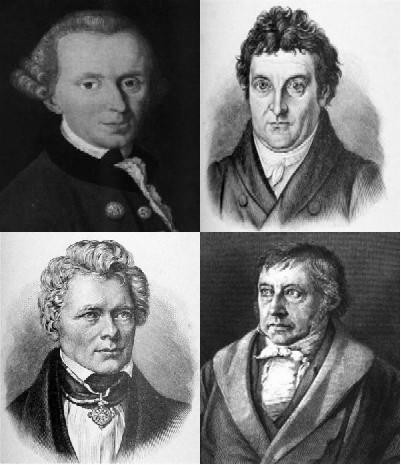
German idealism (German: Deutscher Idealismus) was a philosophical movement that emerged in Germany in the late 18th and early 19th centuries. It developed out of the work of Immanuel Kant in the 1780s and 1790s, and was closely linked with both Romanticism and the revolutionary politics of the Enlightenment. The most prominent German idealists were Kant, Johann Gottlieb Fichte, Friedrich Wilhelm Joseph Schelling, and Georg Wilhelm Friedrich Hegel, who is considered the most influential figure of the movement. Other thinkers, such as Friedrich Heinrich Jacobi, Karl Leonhard Reinhold, Friedrich Schlegel, and Novalis, also made major contributions. The period of German idealism is one of the most intellectually fertile in modern philosophy, and its prominence has been compared to the golden age of philosophy in ancient Athens.
The movement is best understood as a manifestation of the modern demand for rationality and freedom. It originated in Kant's attempt to reconcile the empiricism of thinkers like David Hume with the rationalism of Gottfried Wilhelm Leibniz and Baruch Spinoza. Hume's skepticism had challenged the core tenets of the Enlightenment, arguing that reason was subordinate to custom and habit and that free will was an "unattainable fantasy". All forms of German idealism sought to resolve the crisis of the Enlightenment by attempting to "save criticism from skepticism, and naturalism from materialism". Kant's transcendental idealism sought to rescue philosophy by asserting that the mind is not a passive recipient of sensory information, but actively structures our experience of the world through an act of "spontaneity". Kant's work, however, limited knowledge to appearances (phenomena) and left the nature of things as they are in themselves (noumena) unknowable.
Fichte, Schelling, and Hegel attempted to overcome this dualism while defending Kant's central insight that the thinking subject is a necessary condition for all experience. They responded to renewed skeptical challenges by pursuing a more rigorously systematic philosophy than Kant. Fichte's "subjective idealism" centered on the absolute "I" or self-consciousness as the ground of all experience. Schelling's "objective idealism" and later "identity philosophy" replaced Fichte's absolute subject with a monistic "Absolute" as the ground of both nature and mind. Hegel's absolute idealism rejected the foundationalism of his predecessors, arguing that philosophy must be a presuppositionless system that traces the self-development of "the concept" to reveal the rational structure of actuality itself.
German idealism is distinguished by its exploration of the relationship between reason and reality, the nature of freedom, and the contours of modernity. The movement effectively ended with Hegel's death in 1831, but its influence was profound and enduring. Its legacy shaped the development of post-Hegelian philosophy, including the work of Søren Kierkegaard, Karl Marx, and the neo-Kantians. In the 20th century, idealism profoundly influenced continental philosophy, and it has become an increasingly significant influence in contemporary analytic philosophy.
The intellectual problem that gave rise to German idealism was the modern split between mind and world, or subject and object, that had structured philosophy since the 17th century. This problem was rooted in a longer historical process of secularization that had displaced religious authority and transformed the classical Greek understanding of being (logos) into the modern concept of a reality accessible to human consciousness.
The broader cultural context was shaped by the Enlightenment, with its emphasis on reason as the basis for legitimate authority and its promise of replacing premodern acceptance of unjustified authority with a modern commitment to rational justification and freedom. In late 18th-century Germany, however, this Enlightenment promise existed within a complex and contradictory social landscape. Politically, "Germany" did not exist as a unified nation-state but was a fragmented collection of principalities under the loose authority of the expiring Holy Roman Empire. This fragmentation, combined with rapid population growth and the pressures of early industrialization, produced significant social tension. A growing, educated middle class found its opportunities for employment and social advancement stifled by a patronage-based society that remained largely aristocratic.
This situation led to a pervasive "dual consciousness" among the educated classes. They felt alienated from the conformist, traditional social order, which seemed to prescribe their life-paths for them, while simultaneously feeling compelled by an inner, "natural" sense of authenticity and a desire to lead their "own" lives. This sense of alienation was amplified by new cultural movements. A burgeoning reading public, fueled by the rise of journals and novels, embraced a new ideal of self-cultivation (Bildung). The emotionalist currents of Pietism and the Sturm und Drang literary movement, exemplified by the thought of Jean-Jacques Rousseau and Johann Wolfgang von Goethe's enormously popular novel The Sorrows of Young Werther (1774), gave voice to the widespread dissatisfaction with the perceived cold rationalism of the Enlightenment and the longing for a more authentic, self-directed existence. The political atmosphere of the late 18th century, shaped by the French Revolution, fueled a sense among the idealists that they were participating in an "intellectual revolution" with decisive consequences for all of humanity. The immediate philosophical impetus, however, came from the skeptical and determinist challenges posed by the Scottish philosopher David Hume.
The Enlightenment project rested on the idea that human beings could be self-determining or free by exercising their own rationality, rather than deferring to external authorities. Hume's philosophy, however, threatened this project by questioning the very capacity of reason to ground belief and action. Hume was a committed empiricist, holding that all ideas must derive from sensory experience, which he called "impressions". He argued that knowledge is limited to either "relations of ideas" (logical truths known a priori, such as "all bachelors are unmarried") or "matters of fact" (truths known a posteriori through experience).
Hub AI
German idealism AI simulator
(@German idealism_simulator)
German idealism
German idealism (German: Deutscher Idealismus) was a philosophical movement that emerged in Germany in the late 18th and early 19th centuries. It developed out of the work of Immanuel Kant in the 1780s and 1790s, and was closely linked with both Romanticism and the revolutionary politics of the Enlightenment. The most prominent German idealists were Kant, Johann Gottlieb Fichte, Friedrich Wilhelm Joseph Schelling, and Georg Wilhelm Friedrich Hegel, who is considered the most influential figure of the movement. Other thinkers, such as Friedrich Heinrich Jacobi, Karl Leonhard Reinhold, Friedrich Schlegel, and Novalis, also made major contributions. The period of German idealism is one of the most intellectually fertile in modern philosophy, and its prominence has been compared to the golden age of philosophy in ancient Athens.
The movement is best understood as a manifestation of the modern demand for rationality and freedom. It originated in Kant's attempt to reconcile the empiricism of thinkers like David Hume with the rationalism of Gottfried Wilhelm Leibniz and Baruch Spinoza. Hume's skepticism had challenged the core tenets of the Enlightenment, arguing that reason was subordinate to custom and habit and that free will was an "unattainable fantasy". All forms of German idealism sought to resolve the crisis of the Enlightenment by attempting to "save criticism from skepticism, and naturalism from materialism". Kant's transcendental idealism sought to rescue philosophy by asserting that the mind is not a passive recipient of sensory information, but actively structures our experience of the world through an act of "spontaneity". Kant's work, however, limited knowledge to appearances (phenomena) and left the nature of things as they are in themselves (noumena) unknowable.
Fichte, Schelling, and Hegel attempted to overcome this dualism while defending Kant's central insight that the thinking subject is a necessary condition for all experience. They responded to renewed skeptical challenges by pursuing a more rigorously systematic philosophy than Kant. Fichte's "subjective idealism" centered on the absolute "I" or self-consciousness as the ground of all experience. Schelling's "objective idealism" and later "identity philosophy" replaced Fichte's absolute subject with a monistic "Absolute" as the ground of both nature and mind. Hegel's absolute idealism rejected the foundationalism of his predecessors, arguing that philosophy must be a presuppositionless system that traces the self-development of "the concept" to reveal the rational structure of actuality itself.
German idealism is distinguished by its exploration of the relationship between reason and reality, the nature of freedom, and the contours of modernity. The movement effectively ended with Hegel's death in 1831, but its influence was profound and enduring. Its legacy shaped the development of post-Hegelian philosophy, including the work of Søren Kierkegaard, Karl Marx, and the neo-Kantians. In the 20th century, idealism profoundly influenced continental philosophy, and it has become an increasingly significant influence in contemporary analytic philosophy.
The intellectual problem that gave rise to German idealism was the modern split between mind and world, or subject and object, that had structured philosophy since the 17th century. This problem was rooted in a longer historical process of secularization that had displaced religious authority and transformed the classical Greek understanding of being (logos) into the modern concept of a reality accessible to human consciousness.
The broader cultural context was shaped by the Enlightenment, with its emphasis on reason as the basis for legitimate authority and its promise of replacing premodern acceptance of unjustified authority with a modern commitment to rational justification and freedom. In late 18th-century Germany, however, this Enlightenment promise existed within a complex and contradictory social landscape. Politically, "Germany" did not exist as a unified nation-state but was a fragmented collection of principalities under the loose authority of the expiring Holy Roman Empire. This fragmentation, combined with rapid population growth and the pressures of early industrialization, produced significant social tension. A growing, educated middle class found its opportunities for employment and social advancement stifled by a patronage-based society that remained largely aristocratic.
This situation led to a pervasive "dual consciousness" among the educated classes. They felt alienated from the conformist, traditional social order, which seemed to prescribe their life-paths for them, while simultaneously feeling compelled by an inner, "natural" sense of authenticity and a desire to lead their "own" lives. This sense of alienation was amplified by new cultural movements. A burgeoning reading public, fueled by the rise of journals and novels, embraced a new ideal of self-cultivation (Bildung). The emotionalist currents of Pietism and the Sturm und Drang literary movement, exemplified by the thought of Jean-Jacques Rousseau and Johann Wolfgang von Goethe's enormously popular novel The Sorrows of Young Werther (1774), gave voice to the widespread dissatisfaction with the perceived cold rationalism of the Enlightenment and the longing for a more authentic, self-directed existence. The political atmosphere of the late 18th century, shaped by the French Revolution, fueled a sense among the idealists that they were participating in an "intellectual revolution" with decisive consequences for all of humanity. The immediate philosophical impetus, however, came from the skeptical and determinist challenges posed by the Scottish philosopher David Hume.
The Enlightenment project rested on the idea that human beings could be self-determining or free by exercising their own rationality, rather than deferring to external authorities. Hume's philosophy, however, threatened this project by questioning the very capacity of reason to ground belief and action. Hume was a committed empiricist, holding that all ideas must derive from sensory experience, which he called "impressions". He argued that knowledge is limited to either "relations of ideas" (logical truths known a priori, such as "all bachelors are unmarried") or "matters of fact" (truths known a posteriori through experience).
Recent media