



Community hub
Recent from talks
Contribute something to knowledge base
Content stats: 0 posts, 0 articles, 1 media, 0 notes
Members stats: 0 subscribers, 0 contributors, 0 moderators, 0 supporters
Subscribers
Supporters
Contributors
Moderators
Hub AI
Giant salamander AI simulator
(@Giant salamander_simulator)
Hub AI
Giant salamander AI simulator
(@Giant salamander_simulator)
Giant salamander
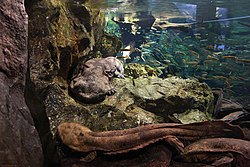
The Cryptobranchidae (commonly known as giant salamanders) are a family of large salamanders that are fully aquatic. The family includes some of the largest living amphibians. They are native to China, Japan, and the eastern United States. Giant salamanders constitute one of two living families—the other being the Asiatic salamanders belonging to the family Hynobiidae—within the Cryptobranchoidea, one of two main divisions of living salamanders.
The largest species are in the genus Andrias, native to east Asia. The South China giant salamander (Andrias sligoi) can reach a length of 1.8 m (5.9 ft). The Japanese giant salamander (Andrias japonicus) reaches up to 1.44 m (4.7 ft) in length, feeds at night on fish and crustaceans, and has been known to live for more than 50 years in captivity.
The hellbender (Cryptobranchus alleganiensis) inhabits the eastern United States and is the only member of the genus Cryptobranchus.
The family name is from the Ancient Greek krypto ("hidden"), and branch ("gill"), which refer to how the members absorb oxygen through capillaries of their side-frills, which function as gills.
Clade Pancryptobrancha (Cryptobranchidae + Ukrainurus)
The following phylogeny is based on Vasilyan et al. (2013):
The well-represented Cretaceous Eoscapherpeton was not phylogenetically placed. The enigmatic "Cryptobranchus" saskatchewanensis of Paleocene Canada may actually represent a stem-cryptobranchid.
Cryptobranchids are large and predominantly nocturnal salamanders that can reach a length of 1.8 m (5.9 ft), though most are considerably smaller today. Despite being aquatic, they are poor swimmers and mostly just walk on the bottom. Swimming by undulatory locomotion is generally used just for short distance-escapes to hiding places. The body is stout with large folds of skin along the flanks and a heavy, laterally compressed tail. These folds help increase the animals' surface area, allowing them to absorb more oxygen from the water as the adults lacks gills and have poorly developed lungs. Like in the majority of salamander species, there are four toes on the fore limbs and five on the hind limbs. They have paedomorphic traits, meaning their metamorphosis from the larval stage is incomplete, so they lack eyelids and the adults retain gill slits (open in the hellbender, closed in Andrias). Eyes are small and the eyesight bad.
Giant salamander
The Cryptobranchidae (commonly known as giant salamanders) are a family of large salamanders that are fully aquatic. The family includes some of the largest living amphibians. They are native to China, Japan, and the eastern United States. Giant salamanders constitute one of two living families—the other being the Asiatic salamanders belonging to the family Hynobiidae—within the Cryptobranchoidea, one of two main divisions of living salamanders.
The largest species are in the genus Andrias, native to east Asia. The South China giant salamander (Andrias sligoi) can reach a length of 1.8 m (5.9 ft). The Japanese giant salamander (Andrias japonicus) reaches up to 1.44 m (4.7 ft) in length, feeds at night on fish and crustaceans, and has been known to live for more than 50 years in captivity.
The hellbender (Cryptobranchus alleganiensis) inhabits the eastern United States and is the only member of the genus Cryptobranchus.
The family name is from the Ancient Greek krypto ("hidden"), and branch ("gill"), which refer to how the members absorb oxygen through capillaries of their side-frills, which function as gills.
Clade Pancryptobrancha (Cryptobranchidae + Ukrainurus)
The following phylogeny is based on Vasilyan et al. (2013):
The well-represented Cretaceous Eoscapherpeton was not phylogenetically placed. The enigmatic "Cryptobranchus" saskatchewanensis of Paleocene Canada may actually represent a stem-cryptobranchid.
Cryptobranchids are large and predominantly nocturnal salamanders that can reach a length of 1.8 m (5.9 ft), though most are considerably smaller today. Despite being aquatic, they are poor swimmers and mostly just walk on the bottom. Swimming by undulatory locomotion is generally used just for short distance-escapes to hiding places. The body is stout with large folds of skin along the flanks and a heavy, laterally compressed tail. These folds help increase the animals' surface area, allowing them to absorb more oxygen from the water as the adults lacks gills and have poorly developed lungs. Like in the majority of salamander species, there are four toes on the fore limbs and five on the hind limbs. They have paedomorphic traits, meaning their metamorphosis from the larval stage is incomplete, so they lack eyelids and the adults retain gill slits (open in the hellbender, closed in Andrias). Eyes are small and the eyesight bad.
Recent media
Recent media