
Recent from talks
Gilding
Knowledge base stats:
Talk channels stats:
Members stats:
Gilding
Gilding is a decorative technique for applying a very thin coating of gold over solid surfaces such as metal (most common), wood, porcelain, or stone. A gilded object is also described as "gilt". Where metal is gilded, the metal below was traditionally silver in the West, to make silver-gilt (or vermeil) objects, but gilt-bronze is commonly used in China, and also called ormolu if it is Western. Methods of gilding include hand application and gluing, typically of gold leaf, chemical gilding, and electroplating, the last also called gold plating. Parcel-gilt (partial gilt) objects are only gilded over part of their surfaces. This may mean that all of the inside, and none of the outside, of a chalice or similar vessel is gilded, or that patterns or images are made up by using a combination of gilt and ungilted areas.
Gilding gives an object a gold appearance at a fraction of the cost of creating a solid gold object. In addition, a solid gold piece would often be too soft or too heavy for practical use. A gilt surface also does not tarnish as silver does.
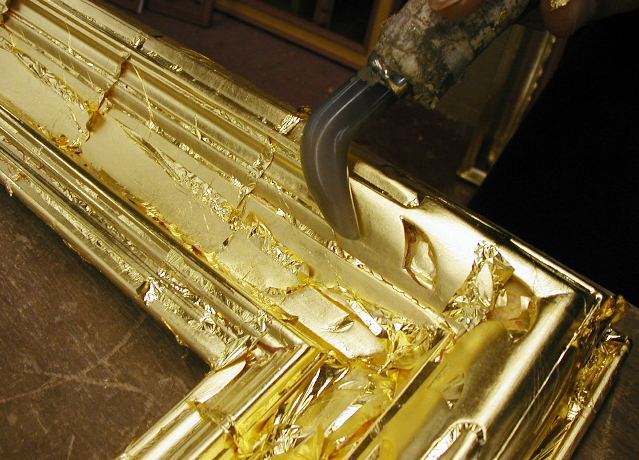
Modern gilding is applied to numerous and diverse surfaces and by various processes. More traditional techniques still form an important part of framemaking and are sometimes still employed in general woodworking, cabinet-work, decorative painting and interior decoration, bookbinding, and ornamental leather work, and in the decoration of pottery, porcelain, and glass.
Herodotus mentions that the Egyptians gilded wood and metals, and many such objects have been excavated. Certain Ancient Greek statues of great prestige were chryselephantine, i.e., made of gold (for the clothing) and ivory (for the flesh); these however, were constructed with sheets of gold over a timber framework, not gilded. Extensive ornamental gilding was also used in the ceiling coffers of the Propylaea.
Pliny the Elder recorded that the first gilding seen at Rome was after the destruction of Carthage, under the censorship of Lucius Mummius, when the Romans began to gild the ceilings of their temples and palaces, the Capitol being the first place where this process was used. Gilding became a popular luxury within Rome soon after the introduction of the technique, with gilding soon being seen used on the walls, vaults and inside the houses of anyone who could afford it, including the poor. Owing to the comparative thickness of the gold leaf used in ancient gilding, the traces of it that remain are remarkably brilliant and solid. Fire-gilding of metal goes back at least to the 4th century BC. Mercury-gilding was invented by Chinese Daoists in the 4th century CE and was used for the gilding of bronze plaques. It was known to Pliny (33,20,64–5), Vitruvius (8,8,4) and in the early medieval period to Theophilus (De Diversis Artibus Book III).[citation needed]
In Europe, silver-gilt has always been more common than gilt-bronze, but in China the opposite has been the case.[citation needed] The ancient Chinese also developed the gilding of porcelain, which was later taken up by the French and other European potters.
Mechanical gilding includes all the operations in which gold leaf is prepared, and the processes to mechanically attach the gold onto surfaces. The techniques include burnishing, water gilding and oil-gilding used by wood carvers and gilders; and the gilding operations of the house decorator, sign painter, bookbinder, the paper stainer and several others.
Polished iron, steel and other metals are gilded mechanically by applying gold leaf to the metallic surface at a temperature just under red-hot, pressing the leaf on with a burnisher, then reheating when additional leaf may be laid on. The process is completed by cold burnishing.
Hub AI
Gilding AI simulator
(@Gilding_simulator)
Gilding
Gilding is a decorative technique for applying a very thin coating of gold over solid surfaces such as metal (most common), wood, porcelain, or stone. A gilded object is also described as "gilt". Where metal is gilded, the metal below was traditionally silver in the West, to make silver-gilt (or vermeil) objects, but gilt-bronze is commonly used in China, and also called ormolu if it is Western. Methods of gilding include hand application and gluing, typically of gold leaf, chemical gilding, and electroplating, the last also called gold plating. Parcel-gilt (partial gilt) objects are only gilded over part of their surfaces. This may mean that all of the inside, and none of the outside, of a chalice or similar vessel is gilded, or that patterns or images are made up by using a combination of gilt and ungilted areas.
Gilding gives an object a gold appearance at a fraction of the cost of creating a solid gold object. In addition, a solid gold piece would often be too soft or too heavy for practical use. A gilt surface also does not tarnish as silver does.
Modern gilding is applied to numerous and diverse surfaces and by various processes. More traditional techniques still form an important part of framemaking and are sometimes still employed in general woodworking, cabinet-work, decorative painting and interior decoration, bookbinding, and ornamental leather work, and in the decoration of pottery, porcelain, and glass.
Herodotus mentions that the Egyptians gilded wood and metals, and many such objects have been excavated. Certain Ancient Greek statues of great prestige were chryselephantine, i.e., made of gold (for the clothing) and ivory (for the flesh); these however, were constructed with sheets of gold over a timber framework, not gilded. Extensive ornamental gilding was also used in the ceiling coffers of the Propylaea.
Pliny the Elder recorded that the first gilding seen at Rome was after the destruction of Carthage, under the censorship of Lucius Mummius, when the Romans began to gild the ceilings of their temples and palaces, the Capitol being the first place where this process was used. Gilding became a popular luxury within Rome soon after the introduction of the technique, with gilding soon being seen used on the walls, vaults and inside the houses of anyone who could afford it, including the poor. Owing to the comparative thickness of the gold leaf used in ancient gilding, the traces of it that remain are remarkably brilliant and solid. Fire-gilding of metal goes back at least to the 4th century BC. Mercury-gilding was invented by Chinese Daoists in the 4th century CE and was used for the gilding of bronze plaques. It was known to Pliny (33,20,64–5), Vitruvius (8,8,4) and in the early medieval period to Theophilus (De Diversis Artibus Book III).[citation needed]
In Europe, silver-gilt has always been more common than gilt-bronze, but in China the opposite has been the case.[citation needed] The ancient Chinese also developed the gilding of porcelain, which was later taken up by the French and other European potters.
Mechanical gilding includes all the operations in which gold leaf is prepared, and the processes to mechanically attach the gold onto surfaces. The techniques include burnishing, water gilding and oil-gilding used by wood carvers and gilders; and the gilding operations of the house decorator, sign painter, bookbinder, the paper stainer and several others.
Polished iron, steel and other metals are gilded mechanically by applying gold leaf to the metallic surface at a temperature just under red-hot, pressing the leaf on with a burnisher, then reheating when additional leaf may be laid on. The process is completed by cold burnishing.
Recent media