
Recent from talks
Chalice
Knowledge base stats:
Talk channels stats:
Members stats:
Chalice
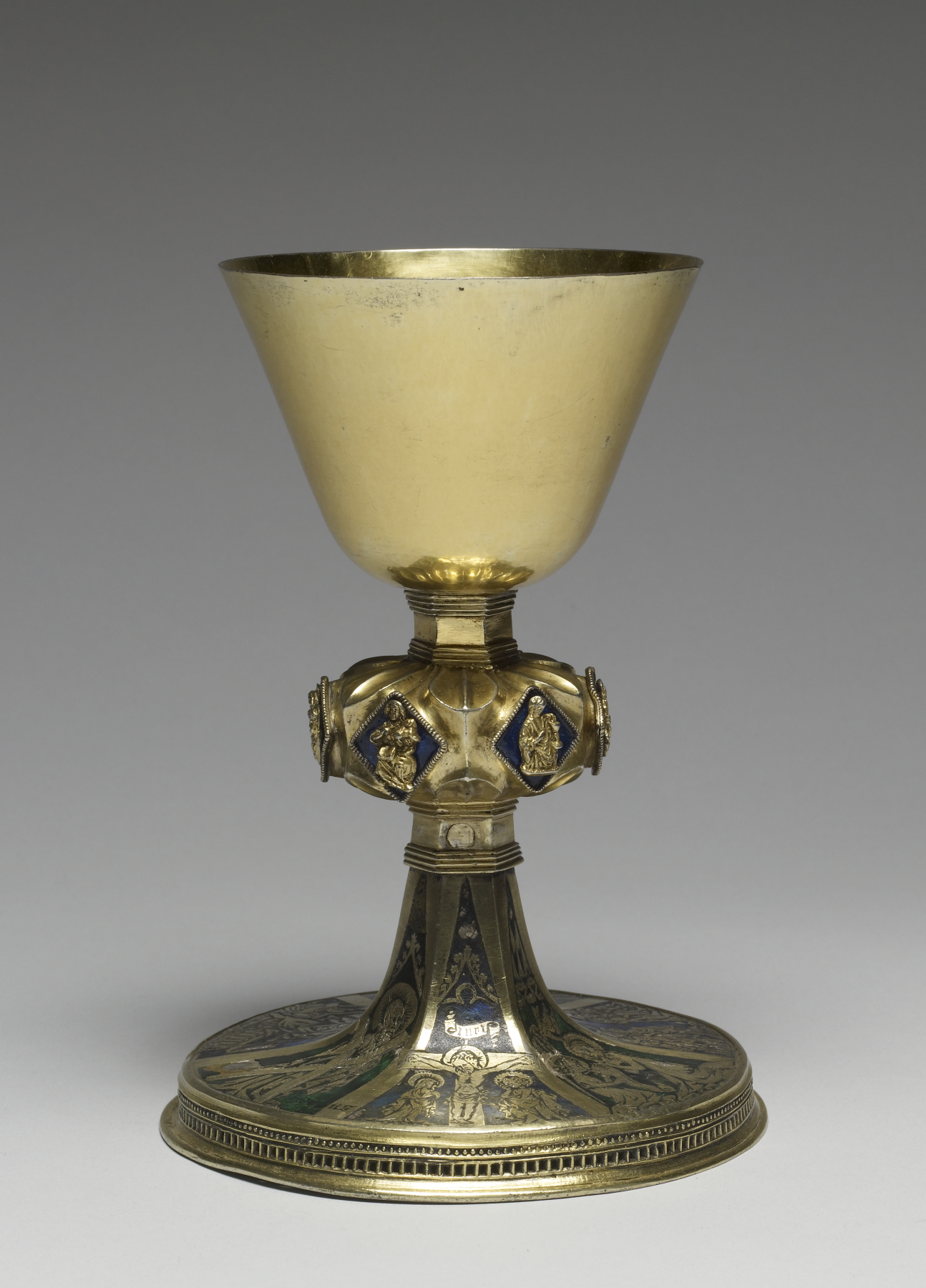
A chalice (from Latin calix 'cup', taken from the Ancient Greek κύλιξ (kylix) 'cup') is a drinking cup raised on a stem with a foot or base. Although it is a technical archaeological term, in modern parlance the word is now used almost exclusively for the cups used in Christian liturgy as part of a service of the Eucharist, such as a Catholic mass. These are normally made of metal, but neither the shape nor the material is a requirement. Most have no handles, and in recent centuries the cup at the top has usually been a simple flared shape.
Historically, the same shape was used for elite secular vessels, and many individual examples have served both secular and liturgical uses over their history, for example the Lacock Cup and Royal Gold Cup, both late medieval cups. Cups owned by churches were much more likely to survive, as secular drinkware in precious metal was usually melted down when it fell out of fashion.
The same general cup shape is also called a goblet (from Old French gobellet, diminutive of gobel 'cup'), normally in secular contexts. This remains current as a term for wineglasses and other stemware, most of which have a goblet shape, with Paris goblet as a trade term for basic rounded wineglasses. The modern French term gobelet has developed differently, and is used for different shapes such as the Gobelet André Falquet and Roman Lyon Cup, both stemless.
The ancient Roman calix was a cup or drinking vessel, probably rather vaguely defined as to its exact shape. But most consisted of a bowl on a stem over a foot or base; handles were probably optional. The Greek kylix, at least as defined by modern authorities, was a far wider and more shallow bowl on some sort of stem, with two horizontal handles. It is the most common wine cup seen in paintings of symposium drinking parties. Gradually the term became more or less restricted to cups for liturgical use.
In Roman Catholicism, Eastern Orthodox Church, Oriental Orthodoxy, Anglicanism, Lutheranism and some other Christian denominations, a chalice is a standing cup used to hold sacramental wine during the Eucharist (also called the Lord's Supper or Holy Communion). Chalices are often made of precious metal, and they are sometimes richly enamelled and jewelled. Generally they have no handles.
Chalices have been used since the early Church. Because of Jesus' command to his disciples to "Do this in remembrance of me." (Luke 22:19), and Paul's account of the Eucharistic rite in 1 Corinthians 11:24–25, the celebration of the Eucharist became central to Christian liturgy. Naturally, the vessels used in this important act of worship were highly decorated and treated with great respect. A number of early examples of chalices have a large bowl and two vertical handles, reflecting classical cup shapes such as the kantharos and skyphos. Over time, the size of the bowl diminished and the base became larger for better stability. Eventually, official church regulations dictated the construction, blessing, and treatment of chalices. Some religious traditions still require that the chalice, at least on the inside of the cup, be gold-plated.
In Western Christianity, chalices will often have a knop, pommel or node where the stem meets the cup to make the elevation easier. In Roman Catholicism, chalices of recent centuries tend to have quite narrow cups. Roman Catholic priests will often receive chalices from members of their families when first ordained.
In Eastern Christianity (Oriental Orthodox, Eastern Orthodox and Eastern Catholic churches), chalices will often have icons enameled or engraved on them, as well as a cross. In Orthodoxy and Eastern Catholicism, all communicants receive both the Body of Christ and the Blood of Christ. To accomplish this, a portion of the Lamb (host) is placed in the chalice, and then the faithful receive Communion on a spoon. For this reason, eastern chalices tend to have larger, rounded cups. In the Russian Orthodox Church, the faithful will often kiss the "foot" (base) of the chalice after receiving Holy Communion. In other traditions, they will kiss the cup. Although Orthodox monks are not permitted to hold personal possessions, the canons permit a hieromonk (i.e., a monk who has been ordained to the priesthood) to keep a chalice and other vessels necessary to celebrate the Divine Liturgy.
Hub AI
Chalice AI simulator
(@Chalice_simulator)
Chalice
A chalice (from Latin calix 'cup', taken from the Ancient Greek κύλιξ (kylix) 'cup') is a drinking cup raised on a stem with a foot or base. Although it is a technical archaeological term, in modern parlance the word is now used almost exclusively for the cups used in Christian liturgy as part of a service of the Eucharist, such as a Catholic mass. These are normally made of metal, but neither the shape nor the material is a requirement. Most have no handles, and in recent centuries the cup at the top has usually been a simple flared shape.
Historically, the same shape was used for elite secular vessels, and many individual examples have served both secular and liturgical uses over their history, for example the Lacock Cup and Royal Gold Cup, both late medieval cups. Cups owned by churches were much more likely to survive, as secular drinkware in precious metal was usually melted down when it fell out of fashion.
The same general cup shape is also called a goblet (from Old French gobellet, diminutive of gobel 'cup'), normally in secular contexts. This remains current as a term for wineglasses and other stemware, most of which have a goblet shape, with Paris goblet as a trade term for basic rounded wineglasses. The modern French term gobelet has developed differently, and is used for different shapes such as the Gobelet André Falquet and Roman Lyon Cup, both stemless.
The ancient Roman calix was a cup or drinking vessel, probably rather vaguely defined as to its exact shape. But most consisted of a bowl on a stem over a foot or base; handles were probably optional. The Greek kylix, at least as defined by modern authorities, was a far wider and more shallow bowl on some sort of stem, with two horizontal handles. It is the most common wine cup seen in paintings of symposium drinking parties. Gradually the term became more or less restricted to cups for liturgical use.
In Roman Catholicism, Eastern Orthodox Church, Oriental Orthodoxy, Anglicanism, Lutheranism and some other Christian denominations, a chalice is a standing cup used to hold sacramental wine during the Eucharist (also called the Lord's Supper or Holy Communion). Chalices are often made of precious metal, and they are sometimes richly enamelled and jewelled. Generally they have no handles.
Chalices have been used since the early Church. Because of Jesus' command to his disciples to "Do this in remembrance of me." (Luke 22:19), and Paul's account of the Eucharistic rite in 1 Corinthians 11:24–25, the celebration of the Eucharist became central to Christian liturgy. Naturally, the vessels used in this important act of worship were highly decorated and treated with great respect. A number of early examples of chalices have a large bowl and two vertical handles, reflecting classical cup shapes such as the kantharos and skyphos. Over time, the size of the bowl diminished and the base became larger for better stability. Eventually, official church regulations dictated the construction, blessing, and treatment of chalices. Some religious traditions still require that the chalice, at least on the inside of the cup, be gold-plated.
In Western Christianity, chalices will often have a knop, pommel or node where the stem meets the cup to make the elevation easier. In Roman Catholicism, chalices of recent centuries tend to have quite narrow cups. Roman Catholic priests will often receive chalices from members of their families when first ordained.
In Eastern Christianity (Oriental Orthodox, Eastern Orthodox and Eastern Catholic churches), chalices will often have icons enameled or engraved on them, as well as a cross. In Orthodoxy and Eastern Catholicism, all communicants receive both the Body of Christ and the Blood of Christ. To accomplish this, a portion of the Lamb (host) is placed in the chalice, and then the faithful receive Communion on a spoon. For this reason, eastern chalices tend to have larger, rounded cups. In the Russian Orthodox Church, the faithful will often kiss the "foot" (base) of the chalice after receiving Holy Communion. In other traditions, they will kiss the cup. Although Orthodox monks are not permitted to hold personal possessions, the canons permit a hieromonk (i.e., a monk who has been ordained to the priesthood) to keep a chalice and other vessels necessary to celebrate the Divine Liturgy.
Recent media