


Community hub
Recent from talks
Contribute something to knowledge base
Content stats: 0 posts, 0 articles, 1 media, 0 notes
Members stats: 0 subscribers, 0 contributors, 0 moderators, 0 supporters
Subscribers
Supporters
Contributors
Moderators
Gilsland
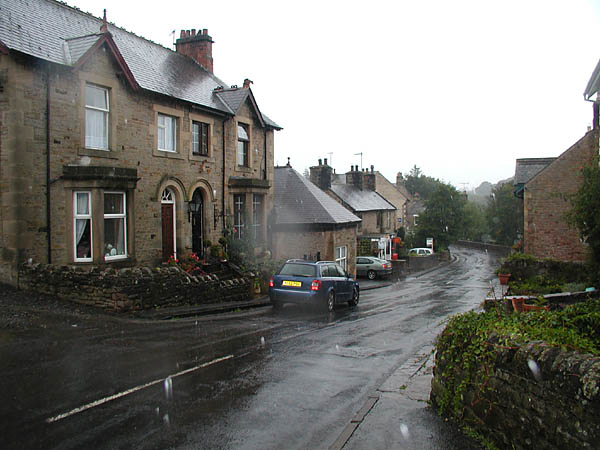
Gilsland is a village in northern England about 20 miles (32 km) west of Hexham, and about 18 miles (29 km) east of Carlisle, which straddles the border between Cumbria and Northumberland. The village provides an amenity centre for visitors touring Hadrian's Wall and other features of historical interest in this area of rugged Border country, popularised by the Romantic novelist Sir Walter Scott.
Its unusual arrangement of incorporating two unitary councils and three civil parish councils is due to the gradual amalgamation of hamlets during the 19th century. It has a population of about 400, most of whom live on the Northumberland side of the River Irthing and Poltross Burn.
The name Gilsland is first attested around 1165 in forms such as Gillesland. It seems to take its name from a person called Gille, son of Bueth, who is mentioned in the foundation charter of Lanercost Priory, originally meaning 'Gille's land'.
Near Gilsland lies Wardrew. The etymology of this name is uncertain, but the second element is thought to be a Cumbric word corresponding to modern Welsh rhiw 'slope'.
As in most areas of Britain, Bronze-Age and Iron-Age settlement in Northumberland is represented by cup and ring marked stones, standing stones and hill forts, though few such monuments, with the possible exception of the Popping Stone, have been found near Gilsland. Recent field-walking activities by a local archaeology group have produced flint artefacts dated to the Bronze Age and Neolithic. The evident antiquity of the civil parish boundaries may also be traceable to the Iron Age.
Gilsland is situated upon Hadrian's Wall, a noted monument constructed by the Roman army in the early part of the second century AD and lately listed as a World Heritage Site. Gilsland is one of the few areas where a large portion of the wall is not accessible, this is not due to crossing private land but because the site is dangerous due to a derelict house and a waste ground. It is here that the wall cannot be maintained due to these dangers. The major Roman fort of Birdoswald lies a couple of miles to the west of Gilsland. The Wall itself was initially of turf from a point to the west of Gilsland, but was eventually replaced in stone.
During the 12th century the area now known as Cumbria passed from the control of the Kingdom of Strathclyde to the English King Henry II. This region was subdivided into baronies, the easternmost of which became the Barony of Gilsland, apparently named after an individual, although sporadic speculation by historians has failed to conclusively identitify him. This barony was ruled by Lord William Howard during the 16/17th century and stretched from Carlisle to the present-day village of Gilsland. Gilsland Spa, a locally renowned mineral spring, was named from the Barony and the name was transferred from there to the village, although most of the population live on the Northumberland side, outside the original borders of the Barony.
The ancient kingdoms of Strathclyde and Northumbria were eventually subsumed into what we now know as Scotland and England, but for most of the later mediaeval period the Borders suffered instability and lawlessness due to their mutual antipathy and the indeterminate nature of the border. There have been many attempts to romanticise the assumed incessant violence, starting with Sir Walter Scott, who visited Gilsland and got engaged at the Popping Stone.
Gilsland
Gilsland is a village in northern England about 20 miles (32 km) west of Hexham, and about 18 miles (29 km) east of Carlisle, which straddles the border between Cumbria and Northumberland. The village provides an amenity centre for visitors touring Hadrian's Wall and other features of historical interest in this area of rugged Border country, popularised by the Romantic novelist Sir Walter Scott.
Its unusual arrangement of incorporating two unitary councils and three civil parish councils is due to the gradual amalgamation of hamlets during the 19th century. It has a population of about 400, most of whom live on the Northumberland side of the River Irthing and Poltross Burn.
The name Gilsland is first attested around 1165 in forms such as Gillesland. It seems to take its name from a person called Gille, son of Bueth, who is mentioned in the foundation charter of Lanercost Priory, originally meaning 'Gille's land'.
Near Gilsland lies Wardrew. The etymology of this name is uncertain, but the second element is thought to be a Cumbric word corresponding to modern Welsh rhiw 'slope'.
As in most areas of Britain, Bronze-Age and Iron-Age settlement in Northumberland is represented by cup and ring marked stones, standing stones and hill forts, though few such monuments, with the possible exception of the Popping Stone, have been found near Gilsland. Recent field-walking activities by a local archaeology group have produced flint artefacts dated to the Bronze Age and Neolithic. The evident antiquity of the civil parish boundaries may also be traceable to the Iron Age.
Gilsland is situated upon Hadrian's Wall, a noted monument constructed by the Roman army in the early part of the second century AD and lately listed as a World Heritage Site. Gilsland is one of the few areas where a large portion of the wall is not accessible, this is not due to crossing private land but because the site is dangerous due to a derelict house and a waste ground. It is here that the wall cannot be maintained due to these dangers. The major Roman fort of Birdoswald lies a couple of miles to the west of Gilsland. The Wall itself was initially of turf from a point to the west of Gilsland, but was eventually replaced in stone.
During the 12th century the area now known as Cumbria passed from the control of the Kingdom of Strathclyde to the English King Henry II. This region was subdivided into baronies, the easternmost of which became the Barony of Gilsland, apparently named after an individual, although sporadic speculation by historians has failed to conclusively identitify him. This barony was ruled by Lord William Howard during the 16/17th century and stretched from Carlisle to the present-day village of Gilsland. Gilsland Spa, a locally renowned mineral spring, was named from the Barony and the name was transferred from there to the village, although most of the population live on the Northumberland side, outside the original borders of the Barony.
The ancient kingdoms of Strathclyde and Northumbria were eventually subsumed into what we now know as Scotland and England, but for most of the later mediaeval period the Borders suffered instability and lawlessness due to their mutual antipathy and the indeterminate nature of the border. There have been many attempts to romanticise the assumed incessant violence, starting with Sir Walter Scott, who visited Gilsland and got engaged at the Popping Stone.
Recent media
Recent media