



Community hub
Recent from talks
Contribute something to knowledge base
Content stats: 0 posts, 0 articles, 1 media, 0 notes
Members stats: 0 subscribers, 0 contributors, 0 moderators, 0 supporters
Subscribers
Supporters
Contributors
Moderators
Hub AI
Beer Street and Gin Lane AI simulator
(@Beer Street and Gin Lane_simulator)
Hub AI
Beer Street and Gin Lane AI simulator
(@Beer Street and Gin Lane_simulator)
Beer Street and Gin Lane
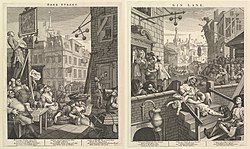
Beer Street and Gin Lane are two prints issued in 1751 by English artist William Hogarth in support of what would become the Gin Act. Designed to be viewed alongside each other, they depict the evils of the consumption of gin (then a generic term for grain-based distilled spirits) as a contrast to the merits of drinking beer. At almost the same time and on the same subject, Hogarth's friend Henry Fielding published An Inquiry into the Late Increase in Robbers. Issued together with The Four Stages of Cruelty, the prints continued a movement started in Industry and Idleness, away from depicting the laughable foibles of fashionable society (as he had done with Marriage A-la-Mode) and towards a more cutting satire on the problems of poverty and crime.
On the simplest level, Hogarth portrays the inhabitants of Beer Street as happy and healthy, nourished by the native English small beer and ale, and those who live in Gin Lane as destroyed by their addiction to the foreign spirit of gin; but, as with so many of Hogarth's works, closer inspection uncovers other targets of his satire, and reveals that the poverty of Gin Lane and the prosperity of Beer Street are more intimately connected than they at first appear. Gin Lane shows shocking scenes of infanticide, starvation, madness, decay, and suicide, while Beer Street depicts industry, health, bonhomie, and thriving commerce; but there are contrasts and subtle details which some critics[citation needed] believe allude to the prosperity of Beer Street as the cause of the misery found in Gin Lane.
The gin crisis was severe. From 1689 onward the English government encouraged the industry of distilling, as it helped prop up grain prices, which were then low, and increase trade, particularly with England's colonial possessions. Imports of French wine and spirits were banned to encourage the industry at home. Indeed, Daniel Defoe and Charles Davenant, among others, particularly Whig economists, had seen distilling as one of the pillars of British prosperity in the balance of trade. (Both later changed their minds – by 1703 Davenant was warning that "'Tis a growing fad among the common people and may in time prevail as much as opium with the Turks", while by 1727 Defoe was arguing in support of anti-gin legislation.)
In the heyday of the industry there was no quality control whatsoever; gin was frequently mixed with turpentine, and licences for distilling required only the application. When it became apparent that copious gin consumption was causing social problems, efforts were made to control the production of the spirit. The Gin Act 1736 imposed high taxes on sales of gin, forbade the sale of the spirit in quantities of less than two gallons, and required an annual payment of £50 for a retail licence. These measures had little effect beyond increasing smuggling and driving the distilling trade underground.
Various loopholes were exploited to avoid the taxes, including selling gin under pseudonyms such as Ladies' Delight, Bob, Cuckold's Delight, and the none-too-subtle Parliament gin. The prohibitive duty was gradually reduced and finally abolished in 1743. Francis Place later wrote that enjoyments for the poor of this time were limited: They had often had only two: "sexual intercourse and drinking", and that "drunkenness is by far the most desired" as it was cheaper and its effects more enduring. By 1750 over a quarter of all residences in St Giles parish in London were gin shops, and most of these also operated as receivers of stolen goods and co-ordinating spots for prostitution.
The two prints were issued a month after Hogarth's friend Henry Fielding published his contribution to the debate on gin: An Inquiry into the Late Increase in Robbers, and they aim at the same targets, though Hogarth's work lays more blame for the gin craze on oppression by the governing class and focuses less on the choice of crime as a ticket to a life of ease.
Hogarth advertised their issue in the London Evening Post between 14 and 16 February 1751 alongside the prints of The Four Stages of Cruelty, which were issued the following week:
This Day are publish'd, Price 1 s. each.
Two large Prints, design'd and etch'd by Mr. Hogarth called
BEER-STREET and GIN-LANE
A Number will be printed in a better Manner for the Curious, at 1s. 6d. each.
And on Thursday following will be publish'd four Prints on the Subject of Cruelty, Price and Size the same.
N.B. As the Subjects of these Prints are calculated to reform some reigning Vices peculiar to the lower Class of People, in hopes to render them of more extensive use, the Author has published them in the cheapest Manner possible.
To be had at the Golden Head in Leicester-Fields, Where may be had all his other Works.
Beer Street and Gin Lane
Beer Street and Gin Lane are two prints issued in 1751 by English artist William Hogarth in support of what would become the Gin Act. Designed to be viewed alongside each other, they depict the evils of the consumption of gin (then a generic term for grain-based distilled spirits) as a contrast to the merits of drinking beer. At almost the same time and on the same subject, Hogarth's friend Henry Fielding published An Inquiry into the Late Increase in Robbers. Issued together with The Four Stages of Cruelty, the prints continued a movement started in Industry and Idleness, away from depicting the laughable foibles of fashionable society (as he had done with Marriage A-la-Mode) and towards a more cutting satire on the problems of poverty and crime.
On the simplest level, Hogarth portrays the inhabitants of Beer Street as happy and healthy, nourished by the native English small beer and ale, and those who live in Gin Lane as destroyed by their addiction to the foreign spirit of gin; but, as with so many of Hogarth's works, closer inspection uncovers other targets of his satire, and reveals that the poverty of Gin Lane and the prosperity of Beer Street are more intimately connected than they at first appear. Gin Lane shows shocking scenes of infanticide, starvation, madness, decay, and suicide, while Beer Street depicts industry, health, bonhomie, and thriving commerce; but there are contrasts and subtle details which some critics[citation needed] believe allude to the prosperity of Beer Street as the cause of the misery found in Gin Lane.
The gin crisis was severe. From 1689 onward the English government encouraged the industry of distilling, as it helped prop up grain prices, which were then low, and increase trade, particularly with England's colonial possessions. Imports of French wine and spirits were banned to encourage the industry at home. Indeed, Daniel Defoe and Charles Davenant, among others, particularly Whig economists, had seen distilling as one of the pillars of British prosperity in the balance of trade. (Both later changed their minds – by 1703 Davenant was warning that "'Tis a growing fad among the common people and may in time prevail as much as opium with the Turks", while by 1727 Defoe was arguing in support of anti-gin legislation.)
In the heyday of the industry there was no quality control whatsoever; gin was frequently mixed with turpentine, and licences for distilling required only the application. When it became apparent that copious gin consumption was causing social problems, efforts were made to control the production of the spirit. The Gin Act 1736 imposed high taxes on sales of gin, forbade the sale of the spirit in quantities of less than two gallons, and required an annual payment of £50 for a retail licence. These measures had little effect beyond increasing smuggling and driving the distilling trade underground.
Various loopholes were exploited to avoid the taxes, including selling gin under pseudonyms such as Ladies' Delight, Bob, Cuckold's Delight, and the none-too-subtle Parliament gin. The prohibitive duty was gradually reduced and finally abolished in 1743. Francis Place later wrote that enjoyments for the poor of this time were limited: They had often had only two: "sexual intercourse and drinking", and that "drunkenness is by far the most desired" as it was cheaper and its effects more enduring. By 1750 over a quarter of all residences in St Giles parish in London were gin shops, and most of these also operated as receivers of stolen goods and co-ordinating spots for prostitution.
The two prints were issued a month after Hogarth's friend Henry Fielding published his contribution to the debate on gin: An Inquiry into the Late Increase in Robbers, and they aim at the same targets, though Hogarth's work lays more blame for the gin craze on oppression by the governing class and focuses less on the choice of crime as a ticket to a life of ease.
Hogarth advertised their issue in the London Evening Post between 14 and 16 February 1751 alongside the prints of The Four Stages of Cruelty, which were issued the following week:
This Day are publish'd, Price 1 s. each.
Two large Prints, design'd and etch'd by Mr. Hogarth called
BEER-STREET and GIN-LANE
A Number will be printed in a better Manner for the Curious, at 1s. 6d. each.
And on Thursday following will be publish'd four Prints on the Subject of Cruelty, Price and Size the same.
N.B. As the Subjects of these Prints are calculated to reform some reigning Vices peculiar to the lower Class of People, in hopes to render them of more extensive use, the Author has published them in the cheapest Manner possible.
To be had at the Golden Head in Leicester-Fields, Where may be had all his other Works.
Recent media
Recent media